Nothing matches these filters —
clear the search or widen the filters.
Summaries Ellen gave as host
· 662 summaries
Recaps of other experts' statements, not Ellen's own clinical position.
Summaries Ellen gave as host · Abdominal Wall Defects
20 summaries
Open the Abdominal Wall Defects collection →
Intestinal rehabilitation: What is intestinal rehab? - Episode 1
 ▶
Ep 22 · 6:30
▶
Ep 22 · 6:30
host summary
Ellen Encisco summarizing the discussion: Mucosal defects in enteropathies lead to hypersecretion and profuse fluid losses, preventing nutrient absorption.
↗
▶
Ep 22 · 7:22
host summary
Ellen Encisco summarizing the discussion: Gastroschisis can involve all three categories: short bowel from nonviable tissue, inflammation affecting absorption, and motility issues.
↗
Quick Literature Updates Episode 6
 ▶
Ep 29 · 0:20
▶
Ep 29 · 0:20
host summary
Ellen Encisco summarizing a resource: Gunshot wound victims were more likely to require immediate surgery and had increased mortality compared to MVC victims.
↗
▶
Ep 29 · 0:20
host summary
Ellen Encisco summarizing a resource: Teodoro et al. studied pediatric trauma patients presenting to a level one trauma center with gunshot wounds or MVCs between 2009 and 2019.
↗
▶
Ep 29 · 0:20
host summary
Ellen Encisco summarizing a resource: Teodoro et al. examined California Department of Public Health data on pediatric gunshot wounds and MVCs from 2006 to 2015.
↗
▶
Ep 29 · 0:20
host summary
Ellen Encisco summarizing a resource: In California statewide data, the case fatality rate for gunshot wound victims was higher than that for motor vehicle collisions.
↗
▶
Ep 29 · 0:20
host summary
Ellen Encisco summarizing a resource: Gunshot wound victims were 7.8 times more likely to die than MVC victims.
↗
Quick Literature Updates Episode 11
 ▶
Ep 31 · 0:46
▶
Ep 31 · 0:46
host summary
Ellen Encisco summarizing a resource: Stevens et al. examined CDC Wonder database data between 1999 and 2020 for pediatric firearm and automobile fatalities.
↗
▶
Ep 31 · 0:46
host summary
Ellen Encisco summarizing a resource: As other recent studies had shown, in the last few years, the fatality rate for firearms has surpassed the fatality rate for automobiles in children.
↗
▶
Ep 31 · 0:46
host summary
Ellen Encisco summarizing a resource: Stronger gun laws were associated with decreased fatality rates, with a 55% lower firearm fatality rate for states with the strongest gun laws compared to those with the weakest gun laws.
↗
▶
Ep 31 · 0:46
host summary
Ellen Encisco summarizing a resource: In recent years, the fatality rate for firearms has surpassed the fatality rate for automobiles in children.
↗
▶
Ep 31 · 0:46
host summary
Ellen Encisco summarizing a resource: Stevens et al. used the Gifford's Law Center annual gun law scorecard between 2014 and 2020 to assess state gun law scores.
↗
▶
Ep 31 · 0:46
host summary
Ellen Encisco summarizing a resource: There was a 55% lower firearm fatality rate for the states with the strongest gun laws compared to those with the weakest gun laws.
↗
Quick Literature Updates Episode 16
 ▶
Ep 40 · 1:00
▶
Ep 40 · 1:00
host summary
Ellen Encisco summarizes what Dr. Alex Halpern said: Connecticut Children's Medical Center implemented an algorithm for managing esophageal button batteries in 2019 that includes activating the critical airway response team.
↗
▶
Ep 40 · 1:12
host summary
Ellen Encisco summarizes what Dr. Alex Halpern said: The Brent et al. study compared patients presenting with esophageal button batteries before algorithm implementation (2015-2019) to those after implementation (2019-2022).
↗
▶
Ep 40 · 1:25
host summary
Ellen Encisco summarizes what Dr. Alex Halpern said: There was a significant reduction in time from chest X-ray to OR for button battery removal after implementing the new algorithm at Connecticut Children's.
↗
▶
Ep 40 · 1:34
host summary
Ellen Encisco summarizes what Dr. Alex Halpern said: Based on this data, it looks like the implementation of this algorithm helped the kids get the care they needed faster.
↗
▶
Ep 40 · 1:40
host summary
Ellen Encisco summarizes what Dr. Alex Halpern said: What does your institution do for oesophageal button batteries?
↗
Update Course Rewind: Omphalocele & Gastroschisis 2020
 ▶
Ep 49 · 10:26
▶
Ep 49 · 10:26
host summary
Ellen Encisco summarizing the discussion: Component separation technique involves separating tissue at the external oblique about a centimeter beyond the rectus sheath on both sides, dissecting between external and internal oblique, and optionally making an incision on the anterior rectus sheath for another centimeter of space
↗
▶
Ep 49 · 10:26
host summary
Ellen Encisco summarizing the discussion: A Texas report described component separation use in nine children aged seven days to 10 years, mostly for omphaloceles and giant defects, achieving fascial closure in the vast majority with some mesh use for bridging
↗
Summaries Ellen gave as host · Abdominal Wall Defects: Omphalocele & Gastroschisis
2 summaries
Open the Abdominal Wall Defects: Omphalocele & Gastroschisis collection →
Update Course Rewind: Omphalocele & Gastroschisis 2020
▶
Ep 4 · 10:26
host summary
Ellen Encisco summarizing the discussion: A Texas report described component separation use in nine children aged seven days to 10 years, mostly for omphaloceles and giant defects, achieving fascial closure in the vast majority with some mesh use for bridging
↗
▶
Ep 4 · 10:26
host summary
Ellen Encisco summarizing the discussion: Component separation technique involves separating tissue at the external oblique about a centimeter beyond the rectus sheath on both sides, dissecting between external and internal oblique, and optionally making an incision on the anterior rectus sheath for another centimeter of space
↗
Summaries Ellen gave as host · Anorectal Malformation
12 summaries
Open the Anorectal Malformation collection →
Update Course Rewind: Pediatric Colorectal Consortium 2021
 ▶
Ep 45 · 1:31
▶
Ep 45 · 1:31
host summary
Ellen Encisco summarizing the discussion: There is literature suggesting a component of psychosocial, psychological dissociation in children on later testing related to anal dilations.
↗
▶
Ep 45 · 2:55
host summary
Ellen Encisco summarizing the discussion: The number of strictures, number needing anoplasties, and number of redo operations were the same between dilation and no-dilation groups.
↗
▶
Ep 45 · 3:04
host summary
Ellen Encisco summarizing the discussion: The number of patients who had rectal prolapse is consistent with the literature.
↗
▶
Ep 45 · 5:20
host summary
Ellen Encisco summarizing the discussion: A study of 30-day outcomes for ARM with perineal or rectovaginal fistulas divided patients into early repair (before 6 days old) and late repair (6-8 weeks), with 66 early and 231 late repairs among 291 patients.
↗
Quick Literature Updates Episode 14
 ▶
Ep 53 · 1:03
▶
Ep 53 · 1:03
host summary
Ellen Encisco summarizes what Dr. Alex Halpern said: The study by Ahmad et al. examined 384 females with anorectal malformations using the Pediatric Colorectal and Pelvic Learning Consortium database.
↗
▶
Ep 53 · 1:22
host summary
Ellen Encisco summarizes what Dr. Alex Halpern said: About 46% of females with anorectal malformations had VACTERL association, defined as having the anorectal malformation plus two of: vertebral, cardiac, tracheoesophageal, renal, or limb anomaly.
↗
▶
Ep 53 · 1:22
host summary
Ellen Encisco summarizes what Dr. Alex Halpern said: About 27% of patients with anorectal malformations had a gynecologic anomaly.
↗
▶
Ep 53 · 1:39
host summary
Ellen Encisco summarizes what Dr. Alex Halpern said: Having VACTERL association was associated with more gynecologic anomalies compared to patients without VACTERL association.
↗
▶
Ep 53 · 1:49
host summary
Ellen Encisco summarizes what Dr. Alex Halpern said: The association between VACTERL and gynecologic anomalies was especially true when renal anomalies were found.
↗
▶
Ep 53 · 1:49
host summary
Ellen Encisco summarizes what Dr. Alex Halpern said: The association between VACTERL and gynecologic anomalies was especially true when patients had recto vestibular or rectal perineal fistulas.
↗
▶
Ep 53 · 1:57
host summary
Ellen Encisco summarizes what Dr. Alex Halpern said: So for females with inner rectum malformations and veal association, especially renal anomalies, we should look carefully for gynecologic anomalies.
↗
▶
Ep 53 · 1:57
host summary
Ellen Encisco summarizes what Dr. Alex Halpern said: For females with anorectal malformations and VACTERL association, especially renal anomalies, clinicians should look carefully for gynecologic anomalies.
↗
Summaries Ellen gave as host · Appendicitis
6 summaries
Open the Appendicitis collection →
Quick Literature Updates Episode 11
▶
Ep 11 · 0:46
host summary
Ellen Encisco summarizing a resource: Stevens et al. used the Gifford's Law Center annual gun law scorecard between 2014 and 2020 to assess state gun law scores.
↗
▶
Ep 11 · 0:46
host summary
Ellen Encisco summarizing a resource: As other recent studies had shown, in the last few years, the fatality rate for firearms has surpassed the fatality rate for automobiles in children.
↗
▶
Ep 11 · 0:46
host summary
Ellen Encisco summarizing a resource: There was a 55% lower firearm fatality rate for the states with the strongest gun laws compared to those with the weakest gun laws.
↗
▶
Ep 11 · 0:46
host summary
Ellen Encisco summarizing a resource: Stronger gun laws were associated with decreased fatality rates, with a 55% lower firearm fatality rate for states with the strongest gun laws compared to those with the weakest gun laws.
↗
▶
Ep 11 · 0:46
host summary
Ellen Encisco summarizing a resource: In recent years, the fatality rate for firearms has surpassed the fatality rate for automobiles in children.
↗
▶
Ep 11 · 0:46
host summary
Ellen Encisco summarizing a resource: Stevens et al. examined CDC Wonder database data between 1999 and 2020 for pediatric firearm and automobile fatalities.
↗
Summaries Ellen gave as host · Appendicitis
6 summaries
Open the Appendicitis collection →
Quick Literature Updates Episode 11
▶
Ep 19 · 0:46
host summary
Ellen Encisco summarizing a resource: Stevens et al. examined CDC Wonder database data between 1999 and 2020 for pediatric firearm and automobile fatalities.
↗
▶
Ep 19 · 0:46
host summary
Ellen Encisco summarizing a resource: There was a 55% lower firearm fatality rate for the states with the strongest gun laws compared to those with the weakest gun laws.
↗
▶
Ep 19 · 0:46
host summary
Ellen Encisco summarizing a resource: As other recent studies had shown, in the last few years, the fatality rate for firearms has surpassed the fatality rate for automobiles in children.
↗
▶
Ep 19 · 0:46
host summary
Ellen Encisco summarizing a resource: Stronger gun laws were associated with decreased fatality rates, with a 55% lower firearm fatality rate for states with the strongest gun laws compared to those with the weakest gun laws.
↗
▶
Ep 19 · 0:46
host summary
Ellen Encisco summarizing a resource: In recent years, the fatality rate for firearms has surpassed the fatality rate for automobiles in children.
↗
▶
Ep 19 · 0:46
host summary
Ellen Encisco summarizing a resource: Stevens et al. used the Gifford's Law Center annual gun law scorecard between 2014 and 2020 to assess state gun law scores.
↗
Summaries Ellen gave as host · Button Battery Ingestion
4 summaries
Open the Button Battery Ingestion collection →
Journal of pediatric surgery Article Review: April 2023, IPEG issue
 ▶
Ep 4 · 3:59
▶
Ep 4 · 3:59
host summary
Ellen Encisco summarizing the discussion: The Titanic Index provides an objective way to determine bar number rather than guessing based on eyeballing or age.
↗
▶
Ep 4 · 5:36
host summary
Ellen Encisco summarizing the discussion: Severe outcomes in button battery ingestion were defined as deep mucosal erosion, perforation, mediastinitis, vascular or airway injury or fistula, or esophageal stricture development.
↗
▶
Ep 4 · 6:05
host summary
Ellen Encisco summarizing the discussion: The Boston Children's study included 143 patients under 21 years old from 2008 to 2021, with 24 having severe outcomes.
↗
▶
Ep 4 · 6:20
host summary
Ellen Encisco summarizing the discussion: Three predictive factors for severe button battery outcomes are: battery in esophagus at presentation, battery size ≥2cm, and presence of any symptoms.
↗
Summaries Ellen gave as host · Choledochal Cyst
8 summaries
Open the Choledochal Cyst collection →
Outcomes of laparoscopic versus open resection of pediatric choledochal cyst
 ▶
Ep 3 · 0:13
▶
Ep 3 · 0:13
host summary
Ellen Encisco summarizing a resource: The study used the nationwide readmissions database and identified 577 children who underwent choledochal cyst resection between 2016 and 2018.
↗
▶
Ep 3 · 0:24
host summary
Ellen Encisco summarizing a resource: Patients who underwent open resection were more likely to have a Roux-en-Y hepaticojejunostomy.
↗
▶
Ep 3 · 0:24
host summary
Ellen Encisco summarizing a resource: Patients who underwent laparoscopic resection were more likely to have a hepaticoduodenostomy.
↗
▶
Ep 3 · 0:24
host summary
Ellen Encisco summarizing a resource: The majority of patients underwent open resection.
↗
▶
Ep 3 · 0:39
host summary
Ellen Encisco summarizing a resource: Patients who underwent open resection had higher total costs.
↗
▶
Ep 3 · 0:39
host summary
Ellen Encisco summarizing a resource: Patients who underwent open resection were more likely to have a longer length of hospital stay.
↗
▶
Ep 3 · 0:39
host summary
Ellen Encisco summarizing a resource: Patients who underwent open resection were more likely to have more complications.
↗
▶
Ep 3 · 0:47
host summary
Ellen Encisco summarizing a resource: How do you resect colodocal cysts in pediatric patients?
↗
Summaries Ellen gave as host · Choledochal Cyst
8 summaries
Open the Choledochal Cyst collection →
Outcomes of laparoscopic versus open resection of pediatric choledochal cyst
▶
Ep 4 · 0:13
host summary
Ellen Encisco summarizing a resource: The study used the nationwide readmissions database and identified 577 children who underwent choledochal cyst resection between 2016 and 2018.
↗
▶
Ep 4 · 0:24
host summary
Ellen Encisco summarizing a resource: Patients who underwent laparoscopic resection were more likely to have a hepaticoduodenostomy.
↗
▶
Ep 4 · 0:24
host summary
Ellen Encisco summarizing a resource: The majority of patients underwent open resection.
↗
▶
Ep 4 · 0:24
host summary
Ellen Encisco summarizing a resource: Patients who underwent open resection were more likely to have a Roux-en-Y hepaticojejunostomy.
↗
▶
Ep 4 · 0:39
host summary
Ellen Encisco summarizing a resource: Patients who underwent open resection had higher total costs.
↗
▶
Ep 4 · 0:39
host summary
Ellen Encisco summarizing a resource: Patients who underwent open resection were more likely to have more complications.
↗
▶
Ep 4 · 0:39
host summary
Ellen Encisco summarizing a resource: Patients who underwent open resection were more likely to have a longer length of hospital stay.
↗
▶
Ep 4 · 0:47
host summary
Ellen Encisco summarizing a resource: How do you resect colodocal cysts in pediatric patients?
↗
Summaries Ellen gave as host · Choledochal Cyst / Biliary
19 summaries
Open the Choledochal Cyst / Biliary collection →
Outcomes of laparoscopic versus open resection of pediatric choledochal cyst
▶
Ep 3 · 0:13
host summary
Ellen Encisco summarizing a resource: The study used the nationwide readmissions database and identified 577 children who underwent choledochal cyst resection between 2016 and 2018.
↗
▶
Ep 3 · 0:24
host summary
Ellen Encisco summarizing a resource: Patients who underwent laparoscopic resection were more likely to have a hepaticoduodenostomy.
↗
▶
Ep 3 · 0:24
host summary
Ellen Encisco summarizing a resource: The majority of patients underwent open resection.
↗
▶
Ep 3 · 0:24
host summary
Ellen Encisco summarizing a resource: Patients who underwent open resection were more likely to have a Roux-en-Y hepaticojejunostomy.
↗
▶
Ep 3 · 0:39
host summary
Ellen Encisco summarizing a resource: Patients who underwent open resection were more likely to have more complications.
↗
▶
Ep 3 · 0:39
host summary
Ellen Encisco summarizing a resource: Patients who underwent open resection had higher total costs.
↗
▶
Ep 3 · 0:39
host summary
Ellen Encisco summarizing a resource: Patients who underwent open resection were more likely to have a longer length of hospital stay.
↗
▶
Ep 3 · 0:47
host summary
Ellen Encisco summarizing a resource: How do you resect colodocal cysts in pediatric patients?
↗
Journal of pediatric surgery Article Review: April 2023, IPEG issue
▶
Ep 4 · 3:59
host summary
Ellen Encisco summarizing the discussion: The Titanic Index provides an objective way to determine bar number rather than guessing based on eyeballing or age.
↗
▶
Ep 4 · 5:36
host summary
Ellen Encisco summarizing the discussion: Severe outcomes in button battery ingestion were defined as deep mucosal erosion, perforation, mediastinitis, vascular or airway injury or fistula, or esophageal stricture development.
↗
▶
Ep 4 · 6:05
host summary
Ellen Encisco summarizing the discussion: The Boston Children's study included 143 patients under 21 years old from 2008 to 2021, with 24 having severe outcomes.
↗
▶
Ep 4 · 6:20
host summary
Ellen Encisco summarizing the discussion: Three predictive factors for severe button battery outcomes are: battery in esophagus at presentation, battery size ≥2cm, and presence of any symptoms.
↗
Quick Literature Updates Episode 15
 ▶
Ep 5 · 2:11
▶
Ep 5 · 2:11
host summary
Ellen Encisco summarizing a resource: The choledochal cyst study used the nationwide readmissions database and identified 577 children who underwent choledochal cyst resection between 2016 and 2018.
↗
▶
Ep 5 · 2:21
host summary
Ellen Encisco summarizing a resource: Patients who underwent open choledochal cyst resection were more likely to have a Roux-en-Y hepaticojejunostomy.
↗
▶
Ep 5 · 2:21
host summary
Ellen Encisco summarizing a resource: Patients who underwent laparoscopic choledochal cyst resection were more likely to have a hepaticoduodenostomy.
↗
▶
Ep 5 · 2:21
host summary
Ellen Encisco summarizing a resource: The majority of pediatric choledochal cyst patients underwent open resection.
↗
▶
Ep 5 · 2:36
host summary
Ellen Encisco summarizing a resource: Patients who underwent open choledochal cyst resection had higher total costs than those who underwent laparoscopic resection.
↗
▶
Ep 5 · 2:36
host summary
Ellen Encisco summarizing a resource: Patients who underwent open choledochal cyst resection had more complications than those who underwent laparoscopic resection.
↗
▶
Ep 5 · 2:36
host summary
Ellen Encisco summarizing a resource: Patients who underwent open choledochal cyst resection were more likely to have a longer length of hospital stay.
↗
Summaries Ellen gave as host · Cholestasis
3 summaries
Open the Cholestasis collection →
Intestinal Rehabilitation, Episode 6: Cholestasis
 ▶
Ep 5 · 6:04
▶
Ep 5 · 6:04
host summary
Ellen Encisco summarizing the discussion: SMOF lipid emulsion is composed of soybean oil, medium chain triglycerides, olive oil, and fish oil.
↗
▶
Ep 5 · 6:41
host summary
Ellen Encisco summarizing the discussion: Patients on SMOF lipid emulsions can still develop cholestasis due to other factors beyond lipid composition.
↗
▶
Ep 5 · 11:36
host summary
Ellen Encisco summarizing the discussion: A lake drain helps identify proximal bowel and leaves the bowel at appropriate size to make future anastomosis easier without large size mismatch.
↗
Summaries Ellen gave as host · Cholestasis
3 summaries
Open the Cholestasis collection →
Intestinal Rehabilitation, Episode 6: Cholestasis
▶
Ep 4 · 6:04
host summary
Ellen Encisco summarizing the discussion: SMOF lipid emulsion is composed of soybean oil, medium chain triglycerides, olive oil, and fish oil.
↗
▶
Ep 4 · 6:41
host summary
Ellen Encisco summarizing the discussion: Patients on SMOF lipid emulsions can still develop cholestasis due to other factors beyond lipid composition.
↗
▶
Ep 4 · 11:36
host summary
Ellen Encisco summarizing the discussion: A lake drain helps identify proximal bowel and leaves the bowel at appropriate size to make future anastomosis easier without large size mismatch.
↗
Summaries Ellen gave as host · Colorectal / ARM & Hirschsprung
41 summaries
Open the Colorectal / ARM & Hirschsprung collection →
Journal of Pediatric Surgery Article Review: October 2021
 ▶
Ep 110 · 12:12
▶
Ep 110 · 12:12
host summary
Ellen Encisco summarizing the discussion: After one year in the bowel management program, 30% of patients still struggled with fecal incontinence despite intensive resources.
↗
▶
Ep 110 · 14:46
host summary
Ellen Encisco summarizing the discussion: The Italian anorectal malformation study was a retrospective review of 350 patients between 1999 and 2019, representing one of the largest series.
↗
▶
Ep 110 · 15:29
host summary
Ellen Encisco summarizing the discussion: The Italian study demonstrated a close relationship between spinal cord abnormalities and spinal bone anomalies in anorectal malformation patients.
↗
▶
Ep 110 · 15:44
host summary
Ellen Encisco summarizing the discussion: Despite correlation between spinal bone and cord abnormalities, many patients without sacral or vertebral anomalies still had spinal cord abnormalities, making MRI necessary for screening.
↗
▶
Ep 110 · 16:01
host summary
Ellen Encisco summarizing the discussion: In typical US practice for anorectal malformations, ultrasound shortly after birth is usually sufficient to look for spinal cord abnormalities, whereas the Italian practice finds MRI necessary.
↗
Intestinal rehabilitation: What is intestinal rehab? - Episode 1
▶
Ep 112 · 6:30
host summary
Ellen Encisco summarizing the discussion: Mucosal defects in enteropathies lead to hypersecretion and profuse fluid losses, preventing nutrient absorption.
↗
▶
Ep 112 · 7:22
host summary
Ellen Encisco summarizing the discussion: Gastroschisis can involve all three categories: short bowel from nonviable tissue, inflammation affecting absorption, and motility issues.
↗
Update Course Rewind: Pediatric Colorectal Consortium 2021
▶
Ep 122 · 1:31
host summary
Ellen Encisco summarizing the discussion: There is literature suggesting a component of psychosocial, psychological dissociation in children on later testing related to anal dilations.
↗
▶
Ep 122 · 2:55
host summary
Ellen Encisco summarizing the discussion: The number of strictures, number needing anoplasties, and number of redo operations were the same between dilation and no-dilation groups.
↗
▶
Ep 122 · 3:04
host summary
Ellen Encisco summarizing the discussion: The number of patients who had rectal prolapse is consistent with the literature.
↗
▶
Ep 122 · 5:20
host summary
Ellen Encisco summarizing the discussion: A study of 30-day outcomes for ARM with perineal or rectovaginal fistulas divided patients into early repair (before 6 days old) and late repair (6-8 weeks), with 66 early and 231 late repairs among 291 patients.
↗
Journal of Pediatric Surgery Article Review: February 2023, BAPS issue
 ▶
Ep 135 · 1:38
▶
Ep 135 · 1:38
host summary
Ellen Encisco summarizing the discussion: In Poland, thoracoscopic esophageal atresia repair has been performed exclusively since 2005
↗
▶
Ep 135 · 1:47
host summary
Ellen Encisco summarizing the discussion: We were happy that our first procedure was successful. When we did another one, it was much easier. Of course, at the beginning, the first procedure took us almost 4 hours. Right now it's a 1 hour procedure, but of course it's very difficult, but we are very happy to have no conversion.
↗
▶
Ep 135 · 1:54
host summary
Ellen Encisco summarizing the discussion: The first thoracoscopic esophageal atresia procedure took almost 4 hours, but with experience it became a 1-hour procedure
↗
▶
Ep 135 · 1:59
host summary
Ellen Encisco summarizing the discussion: Dr. Patkowski's team has had no conversions from thoracoscopic to open approach since beginning the technique
↗
▶
Ep 135 · 2:06
host summary
Ellen Encisco summarizing the discussion: All esophageal atresia cases in Dr. Patkowski's center have been managed by one team using only the thoracoscopic approach since the beginning
↗
▶
Ep 135 · 2:25
host summary
Ellen Encisco summarizing the discussion: The first, you need experience in endoscopic surgery. And then just you need time, and you must be very experienced in endoscopic suturing. You must be very slow. If you do it slowly, you will do it fast.
↗
▶
Ep 135 · 2:58
host summary
Ellen Encisco summarizing the discussion: Centralizing care for esophageal atresia patients is important even if transportation costs are higher, because complication costs are much higher
↗
▶
Ep 135 · 2:58
host summary
Ellen Encisco summarizing the discussion: Even if this is a higher cost, but probably the costs of complications are much, much more higher than transportation.
↗
▶
Ep 135 · 3:06
host summary
Ellen Encisco summarizing the discussion: Dr. Patkowski's center handles 15 to 20 esophageal atresia cases per year, which provides sufficient volume for good experience
↗
▶
Ep 135 · 5:41
host summary
Ellen Encisco summarizing the discussion: In the stoma cohort, 38 patients had ileostomies and the remaining had colostomies
↗
▶
Ep 135 · 5:46
host summary
Ellen Encisco summarizing the discussion: The most common indication for initial stoma in Hirschsprung disease was washout failure, accounting for nearly 40% of cases
↗
▶
Ep 135 · 6:13
host summary
Ellen Encisco summarizing the discussion: Stomma doesn't mean always a failure. Sometimes it's a necessity. Comes with the nature of the disease.
↗
▶
Ep 135 · 8:10
host summary
Ellen Encisco summarizing the discussion: Sheffield primarily performs Duhamel pull-throughs while Cincinnati primarily performs Swenson procedures for Hirschsprung disease
↗
Quick Literature Updates Episode 7
 ▶
Ep 138 · 3:35
▶
Ep 138 · 3:35
host summary
Ellen Encisco summarizing a resource: Tendon et al. conducted a prospective randomized control trial between 2017 and 2018 comparing three skin closure methods: sutures with tissue adhesive, sutures with adhesive tape, and sutures alone.
↗
▶
Ep 138 · 3:35
host summary
Ellen Encisco summarizing a resource: Wounds were assessed at two weeks, six weeks, and more than six months after operation by surveying clinicians and parents.
↗
Quick Literature Updates Episode 14
▶
Ep 149 · 1:03
host summary
Ellen Encisco summarizes what Dr. Alex Halpern said: The study by Ahmad et al. examined 384 females with anorectal malformations using the Pediatric Colorectal and Pelvic Learning Consortium database.
↗
▶
Ep 149 · 1:22
host summary
Ellen Encisco summarizes what Dr. Alex Halpern said: About 27% of patients with anorectal malformations had a gynecologic anomaly.
↗
▶
Ep 149 · 1:22
host summary
Ellen Encisco summarizes what Dr. Alex Halpern said: About 46% of females with anorectal malformations had VACTERL association, defined as having the anorectal malformation plus two of: vertebral, cardiac, tracheoesophageal, renal, or limb anomaly.
↗
▶
Ep 149 · 1:39
host summary
Ellen Encisco summarizes what Dr. Alex Halpern said: Having VACTERL association was associated with more gynecologic anomalies compared to patients without VACTERL association.
↗
▶
Ep 149 · 1:49
host summary
Ellen Encisco summarizes what Dr. Alex Halpern said: The association between VACTERL and gynecologic anomalies was especially true when patients had recto vestibular or rectal perineal fistulas.
↗
▶
Ep 149 · 1:49
host summary
Ellen Encisco summarizes what Dr. Alex Halpern said: The association between VACTERL and gynecologic anomalies was especially true when renal anomalies were found.
↗
▶
Ep 149 · 1:57
host summary
Ellen Encisco summarizes what Dr. Alex Halpern said: For females with anorectal malformations and VACTERL association, especially renal anomalies, clinicians should look carefully for gynecologic anomalies.
↗
▶
Ep 149 · 1:57
host summary
Ellen Encisco summarizes what Dr. Alex Halpern said: So for females with inner rectum malformations and veal association, especially renal anomalies, we should look carefully for gynecologic anomalies.
↗
Quick Literature Updates Episode 15
▶
Ep 156 · 2:11
host summary
Ellen Encisco summarizing a resource: The choledochal cyst study used the nationwide readmissions database and identified 577 children who underwent choledochal cyst resection between 2016 and 2018.
↗
▶
Ep 156 · 2:21
host summary
Ellen Encisco summarizing a resource: Patients who underwent open choledochal cyst resection were more likely to have a Roux-en-Y hepaticojejunostomy.
↗
▶
Ep 156 · 2:21
host summary
Ellen Encisco summarizing a resource: Patients who underwent laparoscopic choledochal cyst resection were more likely to have a hepaticoduodenostomy.
↗
▶
Ep 156 · 2:21
host summary
Ellen Encisco summarizing a resource: The majority of pediatric choledochal cyst patients underwent open resection.
↗
▶
Ep 156 · 2:36
host summary
Ellen Encisco summarizing a resource: Patients who underwent open choledochal cyst resection had more complications than those who underwent laparoscopic resection.
↗
▶
Ep 156 · 2:36
host summary
Ellen Encisco summarizing a resource: Patients who underwent open choledochal cyst resection had higher total costs than those who underwent laparoscopic resection.
↗
▶
Ep 156 · 2:36
host summary
Ellen Encisco summarizing a resource: Patients who underwent open choledochal cyst resection were more likely to have a longer length of hospital stay.
↗
Summaries Ellen gave as host · Complicated Appendicitis
16 summaries
Open the Complicated Appendicitis collection →
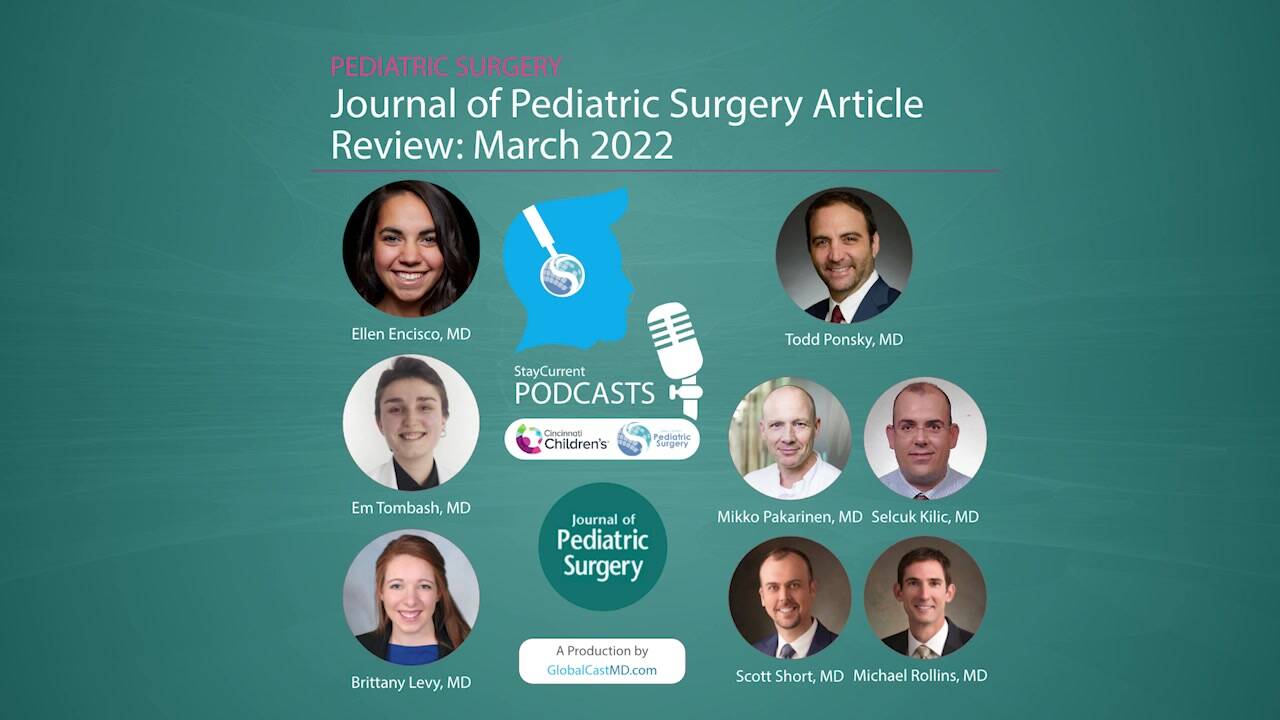
Journal of Pediatric Surgery Article Review: March 2022
 ▶
Ep 2 · 0:38
▶
Ep 2 · 0:38
host summary
Ellen Encisco summarizing the discussion: The meta-analysis included 4 randomized controlled trials and 36 case controlled trials comparing laparoscopic and open appendectomy for complicated appendicitis.
↗
▶
Ep 2 · 1:30
host summary
Ellen Encisco summarizing the discussion: Laparoscopic appendectomy is associated with shorter length of stay, lower rate of surgical site infection, and lower overall complication rate compared to open appendectomy.
↗
▶
Ep 2 · 1:50
host summary
Ellen Encisco summarizing the discussion: Rates of intra-abdominal abscess, post-operative fever, pneumonia, and ileus are similar between laparoscopic and open appendectomy groups.
↗
▶
Ep 2 · 2:05
host summary
Ellen Encisco summarizing the discussion: Open appendectomy has shorter operative time compared to laparoscopic appendectomy.
↗
▶
Ep 2 · 2:25
host summary
Ellen Encisco summarizing the discussion: In Turkey, surgeons prefer open appendectomies in nearly half of children, especially those with lower BMIs.
↗
▶
Ep 2 · 3:00
host summary
Ellen Encisco summarizing the discussion: I don't think it's a slam dunk that the laparoscopic appendectomy is necessarily better than the open appendectomy. I think there's two ways of doing it.
↗
▶
Ep 2 · 4:28
host summary
Ellen Encisco summarizing the discussion: The Turkish series successfully treated 14 of 19 congenital esophageal stenosis patients with a median of 5 dilatations.
↗
▶
Ep 2 · 4:45
host summary
Ellen Encisco summarizing the discussion: Three congenital esophageal stenosis patients required surgery after dilation attempts.
↗
▶
Ep 2 · 5:46
host summary
Ellen Encisco summarizing the discussion: The Turkish team tried balloon dilatation for every congenital esophageal stenosis patient first, then moved to surgery based on results.
↗
▶
Ep 2 · 6:05
host summary
Ellen Encisco summarizing the discussion: Surgery was indicated for congenital esophageal stenosis in cases with recurring lung infections, growth retardation, or when patient wasn't healthy enough for dilation program.
↗
▶
Ep 2 · 6:25
host summary
Ellen Encisco summarizing the discussion: Out of 19 congenital esophageal stenosis patients, 16 were successful with balloon dilation, 3 required operation, and overall 17 were symptom-free after 48 months follow-up.
↗
▶
Ep 2 · 6:50
host summary
Ellen Encisco summarizing the discussion: Up to 5 dilatations should be tried before considering operative treatment for congenital esophageal stenosis.
↗
▶
Ep 2 · 6:50
host summary
Ellen Encisco summarizing the discussion: Based on their findings, I would be willing to try up to 5 dilatations before considering operative treatment.
↗
▶
Ep 2 · 8:11
host summary
Ellen Encisco summarizing the discussion: The expedited protocol reduced hospital stay after appendicostomy from 3 days to 1 day without increasing complications or unplanned hospital visits.
↗
▶
Ep 2 · 9:00
host summary
Ellen Encisco summarizing the discussion: Having a protocol and standardization in care management can be beneficial even beyond the specific protocol details.
↗
▶
Ep 2 · 9:20
host summary
Ellen Encisco summarizing the discussion: Another example of us figuring out that we can break dogma and, and make things more efficient for the patient.
↗
Summaries Ellen gave as host · Congenital Diaphragmatic Hernia
14 summaries
Open the Congenital Diaphragmatic Hernia collection →
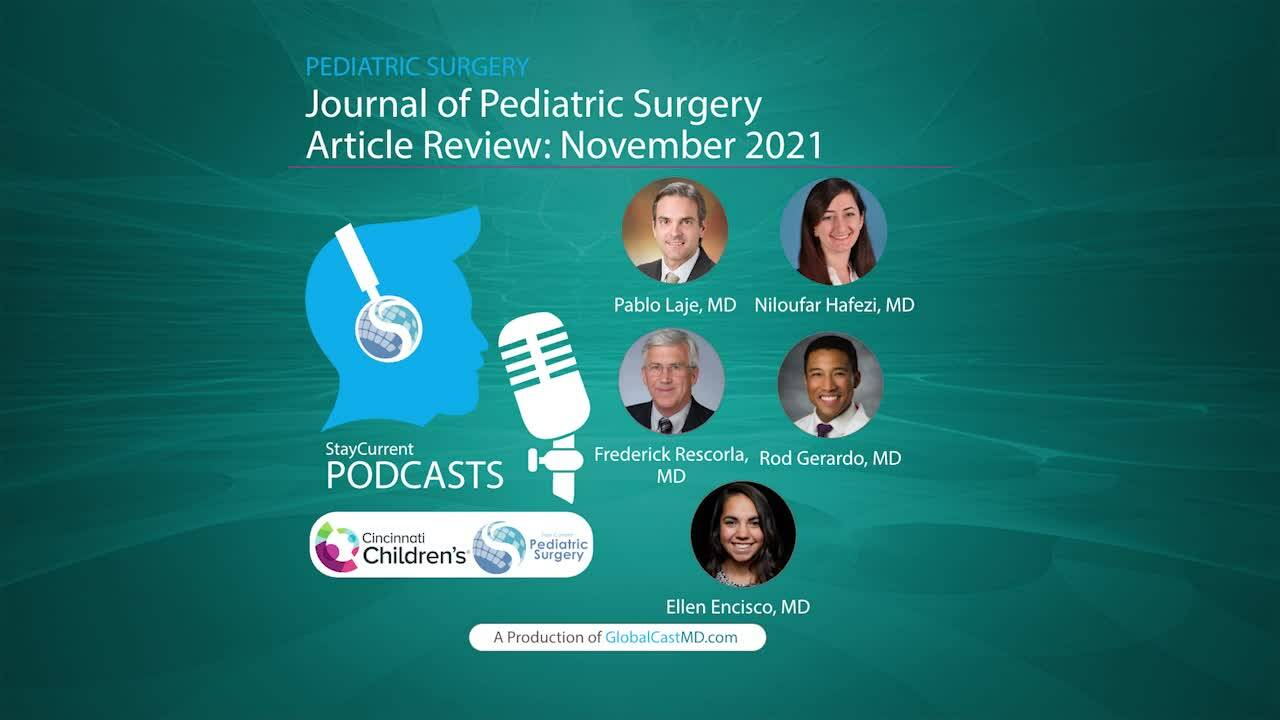
Journal of Pediatric Surgery Article Review: November 2021
 ▶
Ep 7 · 1:09
▶
Ep 7 · 1:09
host summary
Ellen Encisco summarizing the discussion: 40% of patients ultimately required a central venous line within 30 days after ECMO decannulation in the University of Michigan study
↗
▶
Ep 7 · 1:09
host summary
Ellen Encisco summarizing the discussion: 40% of patients ultimately required a central venous line within 30 days after ECMO decannulation in the University of Michigan study
↗
▶
Ep 7 · 2:27
host summary
Ellen Encisco summarizing the discussion: In neonates (babies less than 28 days), the primary reason for needing a central line after ECMO decannulation was access, with many being CDH babies
↗
▶
Ep 7 · 2:27
host summary
Ellen Encisco summarizing the discussion: In neonates (babies less than 28 days), the primary reason for needing a central line after ECMO decannulation was access, with many being CDH babies
↗
▶
Ep 7 · 2:41
host summary
Ellen Encisco summarizing the discussion: In older children or babies, the primary reason for needing a line after ECMO decannulation was hemodialysis
↗
▶
Ep 7 · 2:41
host summary
Ellen Encisco summarizing the discussion: In older children or babies, the primary reason for needing a line after ECMO decannulation was hemodialysis
↗
▶
Ep 7 · 8:40
host summary
Ellen Encisco summarizing the discussion: The Indianapolis partial splenectomy study reviewed cases over 17 years from 2002 to 2019
↗
▶
Ep 7 · 8:40
host summary
Ellen Encisco summarizing the discussion: The Indianapolis partial splenectomy study reviewed cases over 17 years from 2002 to 2019
↗
▶
Ep 7 · 9:40
host summary
Ellen Encisco summarizing the discussion: About 29% of patients required completion splenectomy after partial splenectomy
↗
▶
Ep 7 · 9:40
host summary
Ellen Encisco summarizing the discussion: About 29% of patients required completion splenectomy after partial splenectomy
↗
Neonatal Gastric Volvulus with Dr. Jason Frischer
 ▶
Ep 15 · 5:32
▶
Ep 15 · 5:32
host summary
Ellen Encisco summarizing the discussion: On upper GI contrast study in gastric volvulus, contrast probably does not go past the stomach if it makes it into the stomach.
↗
▶
Ep 15 · 5:32
host summary
Ellen Encisco summarizing the discussion: You would probably see that it doesn't go past the stomach if it makes it into the stomach.
↗
▶
Ep 15 · 5:53
host summary
Ellen Encisco summarizing the discussion: In organoaxial volvulus, if contrast gets past the GE junction into the stomach, the greater curvature appears flipped up.
↗
▶
Ep 15 · 6:02
host summary
Ellen Encisco summarizing the discussion: The greater curvature would be flipped up.
↗
Summaries Ellen gave as host · Congenital Diaphragmatic Hernia
4 summaries
Open the Congenital Diaphragmatic Hernia collection →
Neonatal Gastric Volvulus with Dr. Jason Frischer
▶
Ep 12 · 5:32
host summary
Ellen Encisco summarizing the discussion: You would probably see that it doesn't go past the stomach if it makes it into the stomach.
↗
▶
Ep 12 · 5:32
host summary
Ellen Encisco summarizing the discussion: On upper GI contrast study in gastric volvulus, contrast probably does not go past the stomach if it makes it into the stomach.
↗
▶
Ep 12 · 5:53
host summary
Ellen Encisco summarizing the discussion: In organoaxial volvulus, if contrast gets past the GE junction into the stomach, the greater curvature appears flipped up.
↗
▶
Ep 12 · 6:02
host summary
Ellen Encisco summarizing the discussion: The greater curvature would be flipped up.
↗
Summaries Ellen gave as host · Congenital Esophageal Stenosis
16 summaries
Open the Congenital Esophageal Stenosis collection →
Journal of Pediatric Surgery Article Review: March 2022
▶
Ep 2 · 0:38
host summary
Ellen Encisco summarizing the discussion: The meta-analysis included 4 randomized controlled trials and 36 case controlled trials comparing laparoscopic and open appendectomy for complicated appendicitis.
↗
▶
Ep 2 · 1:30
host summary
Ellen Encisco summarizing the discussion: Laparoscopic appendectomy is associated with shorter length of stay, lower rate of surgical site infection, and lower overall complication rate compared to open appendectomy.
↗
▶
Ep 2 · 1:50
host summary
Ellen Encisco summarizing the discussion: Rates of intra-abdominal abscess, post-operative fever, pneumonia, and ileus are similar between laparoscopic and open appendectomy groups.
↗
▶
Ep 2 · 2:05
host summary
Ellen Encisco summarizing the discussion: Open appendectomy has shorter operative time compared to laparoscopic appendectomy.
↗
▶
Ep 2 · 2:25
host summary
Ellen Encisco summarizing the discussion: In Turkey, surgeons prefer open appendectomies in nearly half of children, especially those with lower BMIs.
↗
▶
Ep 2 · 3:00
host summary
Ellen Encisco summarizing the discussion: I don't think it's a slam dunk that the laparoscopic appendectomy is necessarily better than the open appendectomy. I think there's two ways of doing it.
↗
▶
Ep 2 · 4:28
host summary
Ellen Encisco summarizing the discussion: The Turkish series successfully treated 14 of 19 congenital esophageal stenosis patients with a median of 5 dilatations.
↗
▶
Ep 2 · 4:45
host summary
Ellen Encisco summarizing the discussion: Three congenital esophageal stenosis patients required surgery after dilation attempts.
↗
▶
Ep 2 · 5:46
host summary
Ellen Encisco summarizing the discussion: The Turkish team tried balloon dilatation for every congenital esophageal stenosis patient first, then moved to surgery based on results.
↗
▶
Ep 2 · 6:05
host summary
Ellen Encisco summarizing the discussion: Surgery was indicated for congenital esophageal stenosis in cases with recurring lung infections, growth retardation, or when patient wasn't healthy enough for dilation program.
↗
▶
Ep 2 · 6:25
host summary
Ellen Encisco summarizing the discussion: Out of 19 congenital esophageal stenosis patients, 16 were successful with balloon dilation, 3 required operation, and overall 17 were symptom-free after 48 months follow-up.
↗
▶
Ep 2 · 6:50
host summary
Ellen Encisco summarizing the discussion: Based on their findings, I would be willing to try up to 5 dilatations before considering operative treatment.
↗
▶
Ep 2 · 6:50
host summary
Ellen Encisco summarizing the discussion: Up to 5 dilatations should be tried before considering operative treatment for congenital esophageal stenosis.
↗
▶
Ep 2 · 8:11
host summary
Ellen Encisco summarizing the discussion: The expedited protocol reduced hospital stay after appendicostomy from 3 days to 1 day without increasing complications or unplanned hospital visits.
↗
▶
Ep 2 · 9:00
host summary
Ellen Encisco summarizing the discussion: Having a protocol and standardization in care management can be beneficial even beyond the specific protocol details.
↗
▶
Ep 2 · 9:20
host summary
Ellen Encisco summarizing the discussion: Another example of us figuring out that we can break dogma and, and make things more efficient for the patient.
↗
Summaries Ellen gave as host · Congenital Lung Lesions (CPAM)
15 summaries
Open the Congenital Lung Lesions (CPAM) collection →
Journal of Pediatric Surgery Article Review: November 2021
▶
Ep 26 · 1:09
host summary
Ellen Encisco summarizing the discussion: 40% of patients ultimately required a central venous line within 30 days after ECMO decannulation in the University of Michigan study
↗
▶
Ep 26 · 2:27
host summary
Ellen Encisco summarizing the discussion: In neonates (babies less than 28 days), the primary reason for needing a central line after ECMO decannulation was access, with many being CDH babies
↗
▶
Ep 26 · 2:41
host summary
Ellen Encisco summarizing the discussion: In older children or babies, the primary reason for needing a line after ECMO decannulation was hemodialysis
↗
▶
Ep 26 · 8:40
host summary
Ellen Encisco summarizing the discussion: The Indianapolis partial splenectomy study reviewed cases over 17 years from 2002 to 2019
↗
▶
Ep 26 · 9:40
host summary
Ellen Encisco summarizing the discussion: About 29% of patients required completion splenectomy after partial splenectomy
↗
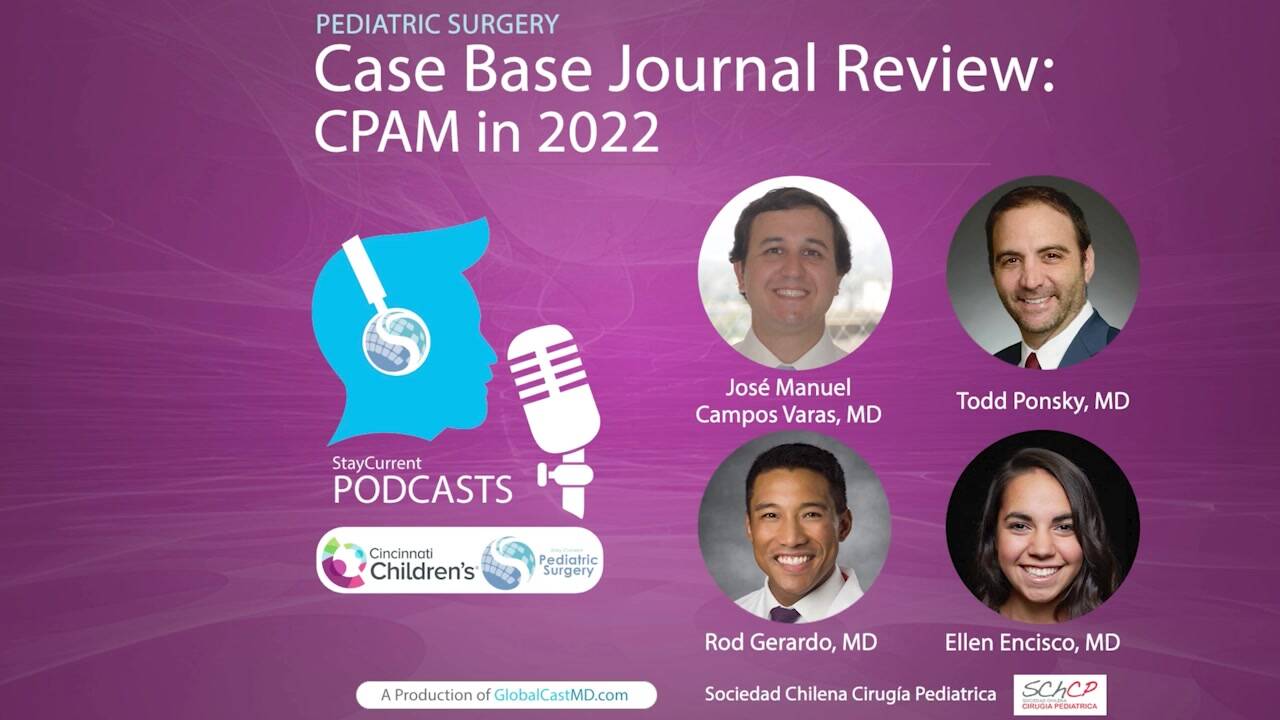
Case Based Journal Review - CPAM in 2022
 ▶
Ep 27 · 2:38
▶
Ep 27 · 2:38
host summary
Ellen Encisco summarizing the discussion: 57% (68 patients) of the 119 cases were managed conservatively, and none of those who could be followed up became symptomatic
↗
▶
Ep 27 · 2:38
host summary
Ellen Encisco summarizing the discussion: 57% (68 patients) of the 119 cases were managed conservatively, and none of those who could be followed up became symptomatic
↗
▶
Ep 27 · 4:36
host summary
Ellen Encisco summarizing the discussion: Out of 344 prenatally diagnosed lesions, none had malignant pathology when resected
↗
▶
Ep 27 · 4:36
host summary
Ellen Encisco summarizing the discussion: Out of 344 prenatally diagnosed lesions, none had malignant pathology when resected
↗
▶
Ep 27 · 5:03
host summary
Ellen Encisco summarizing the discussion: The risk of malignancy approached 10% for lung masses diagnosed postnatally
↗
▶
Ep 27 · 5:03
host summary
Ellen Encisco summarizing the discussion: The risk of malignancy approached 10% for lung masses diagnosed postnatally
↗
▶
Ep 27 · 7:08
host summary
Ellen Encisco summarizing the discussion: The study was retrospective and looked at about 90 patients undergoing thoracoscopic lung resections
↗
▶
Ep 27 · 7:08
host summary
Ellen Encisco summarizing the discussion: The study was retrospective and looked at about 90 patients undergoing thoracoscopic lung resections
↗
▶
Ep 27 · 10:07
host summary
Ellen Encisco summarizing the discussion: There were no differences in major complications, conversion rates, or readmissions between the three age groups
↗
▶
Ep 27 · 10:07
host summary
Ellen Encisco summarizing the discussion: There were no differences in major complications, conversion rates, or readmissions between the three age groups
↗
Summaries Ellen gave as host · Congenital Pulmonary Airway Malformation
5 summaries
Open the Congenital Pulmonary Airway Malformation collection →
Case Based Journal Review - CPAM in 2022
▶
Ep 22 · 2:38
host summary
Ellen Encisco summarizing the discussion: 57% (68 patients) of the 119 cases were managed conservatively, and none of those who could be followed up became symptomatic
↗
▶
Ep 22 · 4:36
host summary
Ellen Encisco summarizing the discussion: Out of 344 prenatally diagnosed lesions, none had malignant pathology when resected
↗
▶
Ep 22 · 5:03
host summary
Ellen Encisco summarizing the discussion: The risk of malignancy approached 10% for lung masses diagnosed postnatally
↗
▶
Ep 22 · 7:08
host summary
Ellen Encisco summarizing the discussion: The study was retrospective and looked at about 90 patients undergoing thoracoscopic lung resections
↗
▶
Ep 22 · 10:07
host summary
Ellen Encisco summarizing the discussion: There were no differences in major complications, conversion rates, or readmissions between the three age groups
↗
Summaries Ellen gave as host · Congenital Pulmonary Airway Malformation
5 summaries
Open the Congenital Pulmonary Airway Malformation collection →
Case Based Journal Review - CPAM in 2022
▶
Ep 22 · 2:38
host summary
Ellen Encisco summarizing the discussion: 57% (68 patients) of the 119 cases were managed conservatively, and none of those who could be followed up became symptomatic
↗
▶
Ep 22 · 4:36
host summary
Ellen Encisco summarizing the discussion: Out of 344 prenatally diagnosed lesions, none had malignant pathology when resected
↗
▶
Ep 22 · 5:03
host summary
Ellen Encisco summarizing the discussion: The risk of malignancy approached 10% for lung masses diagnosed postnatally
↗
▶
Ep 22 · 7:08
host summary
Ellen Encisco summarizing the discussion: The study was retrospective and looked at about 90 patients undergoing thoracoscopic lung resections
↗
▶
Ep 22 · 10:07
host summary
Ellen Encisco summarizing the discussion: There were no differences in major complications, conversion rates, or readmissions between the three age groups
↗
Summaries Ellen gave as host · Crohn's Disease
4 summaries
Open the Crohn's Disease collection →
Intestinal rehabilitation: What is intestinal rehab? - Episode 1
▶
Ep 2 · 6:30
host summary
Ellen Encisco summarizing the discussion: Mucosal defects in enteropathies lead to hypersecretion and profuse fluid losses, preventing nutrient absorption.
↗
▶
Ep 2 · 7:22
host summary
Ellen Encisco summarizing the discussion: Gastroschisis can involve all three categories: short bowel from nonviable tissue, inflammation affecting absorption, and motility issues.
↗
Journal of Pediatric Surgery Article Review: September 2021
 ▶
Ep 11 · 2:00
▶
Ep 11 · 2:00
host summary
Ellen Encisco summarizing the discussion: In the Chinese study, the early feeding group started feeds at 2 days compared to 6 days for the traditionally fed group
↗
▶
Ep 11 · 2:14
host summary
Ellen Encisco summarizing the discussion: There was no significant difference between early and traditional feeding groups in length of stay, time to full feeds, postoperative complications, 30-day mortality, or 30-day readmissions
↗
Summaries Ellen gave as host · Early Assessment and Management of Trauma
5 summaries
Open the Early Assessment and Management of Trauma collection →
ATLS 2021 Pediatric Surgery Update
 ▶
Ep 9 · 1:40
▶
Ep 9 · 1:40
host summary
Ellen Encisco summarizes what Dr. Rich Falcone said: MIST stands for mechanism of injury, injuries identified, Signs and symptoms, and Treatments
↗
▶
Ep 9 · 7:04
host summary
Ellen Encisco summarizes what Dr. Rich Falcone said: For needle cricothyroidotomy, a 10 mL syringe with IV catheter can be used and connects to the Ambu bag
↗
▶
Ep 9 · 8:28
host summary
Ellen Encisco summarizes what Dr. Rich Falcone said: An IO can be placed in the tibia, the humeral head, or in the distal femur
↗
▶
Ep 9 · 8:54
host summary
Ellen Encisco summarizes what Dr. Rich Falcone said: The new ATLS guideline is to give one 20 cc/kg bolus of crystalloid, and if there is transient or no response, go right to blood (10 cc/kg) as the next step
↗
▶
Ep 9 · 10:07
host summary
Ellen Encisco summarizes what Dr. Rich Falcone said: For a child to start showing signs of hemorrhagic shock, they would have to lose about 50% of their total blood volume
↗
Summaries Ellen gave as host · Esophageal Atresia
1 summary
Open the Esophageal Atresia collection →
Update Course Rewind: Magnet Therapy for Esophageal Atresia
 ▶
Ep 4 · 8:18
▶
Ep 4 · 8:18
host summary
Ellen Encisco summarizing the discussion: It's not meant to like make esophageal atresia. Care more accessible to everyone, if that makes sense.
↗
Summaries Ellen gave as host · Esophageal Atresia
20 summaries
Open the Esophageal Atresia collection →
Update Course Rewind: Magnet Therapy for Esophageal Atresia
▶
Ep 27 · 8:18
host summary
Ellen Encisco summarizing the discussion: It's not meant to like make esophageal atresia. Care more accessible to everyone, if that makes sense.
↗
Case Based Journal Review: Esophageal Atresia in 2022
 ▶
Ep 32 · 3:02
▶
Ep 32 · 3:02
host summary
Ellen Encisco summarizes what Dr. Jose Campos said: In a meta-analysis of almost 700 neonates, preserving the azygous vein resulted in significantly lower postoperative pneumonitis compared to division
↗
▶
Ep 32 · 3:11
host summary
Ellen Encisco summarizes what Dr. Jose Campos said: There was no significant difference in anastomotic leak rate or stricture rate between azygous vein preservation and division
↗
▶
Ep 32 · 6:43
host summary
Ellen Encisco summarizes what Dr. Jose Campos said: In the Quebec study of 244 patients, the overall anastomotic stricture rate at one year was 30%
↗
▶
Ep 32 · 6:50
host summary
Ellen Encisco summarizes what Dr. Jose Campos said: 36% of patients with transanastomotic tubes developed strictures compared to 19% without tubes, a difference that remained significant after multivariable analysis
↗
▶
Ep 32 · 7:06
host summary
Ellen Encisco summarizes what Dr. Jose Campos said: Patients with transanastomotic tubes had 2.72 times higher odds of developing a stricture compared to those without
↗
▶
Ep 32 · 14:54
host summary
Ellen Encisco summarizes what Dr. Jose Campos said: In the Midwest Pediatric Surgery Consortium study, antibiotics for more than 24 hours and acid suppression showed no difference in strictures or leaks
↗
Journal of Pediatric Surgery Article Review: February 2023, BAPS issue
▶
Ep 35 · 1:38
host summary
Ellen Encisco summarizing the discussion: In Poland, thoracoscopic esophageal atresia repair has been performed exclusively since 2005
↗
▶
Ep 35 · 1:47
host summary
Ellen Encisco summarizing the discussion: We were happy that our first procedure was successful. When we did another one, it was much easier. Of course, at the beginning, the first procedure took us almost 4 hours. Right now it's a 1 hour procedure, but of course it's very difficult, but we are very happy to have no conversion.
↗
▶
Ep 35 · 1:54
host summary
Ellen Encisco summarizing the discussion: The first thoracoscopic esophageal atresia procedure took almost 4 hours, but with experience it became a 1-hour procedure
↗
▶
Ep 35 · 1:59
host summary
Ellen Encisco summarizing the discussion: Dr. Patkowski's team has had no conversions from thoracoscopic to open approach since beginning the technique
↗
▶
Ep 35 · 2:06
host summary
Ellen Encisco summarizing the discussion: All esophageal atresia cases in Dr. Patkowski's center have been managed by one team using only the thoracoscopic approach since the beginning
↗
▶
Ep 35 · 2:25
host summary
Ellen Encisco summarizing the discussion: The first, you need experience in endoscopic surgery. And then just you need time, and you must be very experienced in endoscopic suturing. You must be very slow. If you do it slowly, you will do it fast.
↗
▶
Ep 35 · 2:58
host summary
Ellen Encisco summarizing the discussion: Even if this is a higher cost, but probably the costs of complications are much, much more higher than transportation.
↗
▶
Ep 35 · 2:58
host summary
Ellen Encisco summarizing the discussion: Centralizing care for esophageal atresia patients is important even if transportation costs are higher, because complication costs are much higher
↗
▶
Ep 35 · 3:06
host summary
Ellen Encisco summarizing the discussion: Dr. Patkowski's center handles 15 to 20 esophageal atresia cases per year, which provides sufficient volume for good experience
↗
▶
Ep 35 · 5:41
host summary
Ellen Encisco summarizing the discussion: In the stoma cohort, 38 patients had ileostomies and the remaining had colostomies
↗
▶
Ep 35 · 5:46
host summary
Ellen Encisco summarizing the discussion: The most common indication for initial stoma in Hirschsprung disease was washout failure, accounting for nearly 40% of cases
↗
▶
Ep 35 · 6:13
host summary
Ellen Encisco summarizing the discussion: Stomma doesn't mean always a failure. Sometimes it's a necessity. Comes with the nature of the disease.
↗
▶
Ep 35 · 8:10
host summary
Ellen Encisco summarizing the discussion: Sheffield primarily performs Duhamel pull-throughs while Cincinnati primarily performs Swenson procedures for Hirschsprung disease
↗
Summaries Ellen gave as host · Esophageal Atresia
19 summaries
Open the Esophageal Atresia collection →
Case Based Journal Review: Esophageal Atresia in 2022
▶
Ep 22 · 3:02
host summary
Ellen Encisco summarizes what Dr. Jose Campos said: In a meta-analysis of almost 700 neonates, preserving the azygous vein resulted in significantly lower postoperative pneumonitis compared to division
↗
▶
Ep 22 · 3:11
host summary
Ellen Encisco summarizes what Dr. Jose Campos said: There was no significant difference in anastomotic leak rate or stricture rate between azygous vein preservation and division
↗
▶
Ep 22 · 6:43
host summary
Ellen Encisco summarizes what Dr. Jose Campos said: In the Quebec study of 244 patients, the overall anastomotic stricture rate at one year was 30%
↗
▶
Ep 22 · 6:50
host summary
Ellen Encisco summarizes what Dr. Jose Campos said: 36% of patients with transanastomotic tubes developed strictures compared to 19% without tubes, a difference that remained significant after multivariable analysis
↗
▶
Ep 22 · 7:06
host summary
Ellen Encisco summarizes what Dr. Jose Campos said: Patients with transanastomotic tubes had 2.72 times higher odds of developing a stricture compared to those without
↗
▶
Ep 22 · 14:54
host summary
Ellen Encisco summarizes what Dr. Jose Campos said: In the Midwest Pediatric Surgery Consortium study, antibiotics for more than 24 hours and acid suppression showed no difference in strictures or leaks
↗
Journal of Pediatric Surgery Article Review: February 2023, BAPS issue
▶
Ep 23 · 1:38
host summary
Ellen Encisco summarizing the discussion: In Poland, thoracoscopic esophageal atresia repair has been performed exclusively since 2005
↗
▶
Ep 23 · 1:47
host summary
Ellen Encisco summarizing the discussion: We were happy that our first procedure was successful. When we did another one, it was much easier. Of course, at the beginning, the first procedure took us almost 4 hours. Right now it's a 1 hour procedure, but of course it's very difficult, but we are very happy to have no conversion.
↗
▶
Ep 23 · 1:54
host summary
Ellen Encisco summarizing the discussion: The first thoracoscopic esophageal atresia procedure took almost 4 hours, but with experience it became a 1-hour procedure
↗
▶
Ep 23 · 1:59
host summary
Ellen Encisco summarizing the discussion: Dr. Patkowski's team has had no conversions from thoracoscopic to open approach since beginning the technique
↗
▶
Ep 23 · 2:06
host summary
Ellen Encisco summarizing the discussion: All esophageal atresia cases in Dr. Patkowski's center have been managed by one team using only the thoracoscopic approach since the beginning
↗
▶
Ep 23 · 2:25
host summary
Ellen Encisco summarizing the discussion: The first, you need experience in endoscopic surgery. And then just you need time, and you must be very experienced in endoscopic suturing. You must be very slow. If you do it slowly, you will do it fast.
↗
▶
Ep 23 · 2:58
host summary
Ellen Encisco summarizing the discussion: Even if this is a higher cost, but probably the costs of complications are much, much more higher than transportation.
↗
▶
Ep 23 · 2:58
host summary
Ellen Encisco summarizing the discussion: Centralizing care for esophageal atresia patients is important even if transportation costs are higher, because complication costs are much higher
↗
▶
Ep 23 · 3:06
host summary
Ellen Encisco summarizing the discussion: Dr. Patkowski's center handles 15 to 20 esophageal atresia cases per year, which provides sufficient volume for good experience
↗
▶
Ep 23 · 5:41
host summary
Ellen Encisco summarizing the discussion: In the stoma cohort, 38 patients had ileostomies and the remaining had colostomies
↗
▶
Ep 23 · 5:46
host summary
Ellen Encisco summarizing the discussion: The most common indication for initial stoma in Hirschsprung disease was washout failure, accounting for nearly 40% of cases
↗
▶
Ep 23 · 6:13
host summary
Ellen Encisco summarizing the discussion: Stomma doesn't mean always a failure. Sometimes it's a necessity. Comes with the nature of the disease.
↗
▶
Ep 23 · 8:10
host summary
Ellen Encisco summarizing the discussion: Sheffield primarily performs Duhamel pull-throughs while Cincinnati primarily performs Swenson procedures for Hirschsprung disease
↗
Summaries Ellen gave as host · Etiologies (Gastroschisis/NEC/Atresia/Volvulus)
29 summaries
Open the Etiologies (Gastroschisis/NEC/Atresia/Volvulus) collection →
Journal of Pediatric Surgery Article Review: October 2021
▶
Ep 33 · 12:12
host summary
Ellen Encisco summarizing the discussion: After one year in the bowel management program, 30% of patients still struggled with fecal incontinence despite intensive resources.
↗
▶
Ep 33 · 14:46
host summary
Ellen Encisco summarizing the discussion: The Italian anorectal malformation study was a retrospective review of 350 patients between 1999 and 2019, representing one of the largest series.
↗
▶
Ep 33 · 15:29
host summary
Ellen Encisco summarizing the discussion: The Italian study demonstrated a close relationship between spinal cord abnormalities and spinal bone anomalies in anorectal malformation patients.
↗
▶
Ep 33 · 15:44
host summary
Ellen Encisco summarizing the discussion: Despite correlation between spinal bone and cord abnormalities, many patients without sacral or vertebral anomalies still had spinal cord abnormalities, making MRI necessary for screening.
↗
▶
Ep 33 · 16:01
host summary
Ellen Encisco summarizing the discussion: In typical US practice for anorectal malformations, ultrasound shortly after birth is usually sufficient to look for spinal cord abnormalities, whereas the Italian practice finds MRI necessary.
↗
Intestinal rehabilitation: What is intestinal rehab? - Episode 1
▶
Ep 33 · 6:30
host summary
Ellen Encisco summarizing the discussion: Mucosal defects in enteropathies lead to hypersecretion and profuse fluid losses, preventing nutrient absorption.
↗
▶
Ep 33 · 7:22
host summary
Ellen Encisco summarizing the discussion: Gastroschisis can involve all three categories: short bowel from nonviable tissue, inflammation affecting absorption, and motility issues.
↗
Neonatal Gastric Volvulus with Dr. Jason Frischer
▶
Ep 43 · 5:32
host summary
Ellen Encisco summarizing the discussion: On upper GI contrast study in gastric volvulus, contrast probably does not go past the stomach if it makes it into the stomach.
↗
▶
Ep 43 · 5:32
host summary
Ellen Encisco summarizing the discussion: You would probably see that it doesn't go past the stomach if it makes it into the stomach.
↗
▶
Ep 43 · 5:53
host summary
Ellen Encisco summarizing the discussion: In organoaxial volvulus, if contrast gets past the GE junction into the stomach, the greater curvature appears flipped up.
↗
▶
Ep 43 · 6:02
host summary
Ellen Encisco summarizing the discussion: The greater curvature would be flipped up.
↗
Quick Literature Updates Episode 6
▶
Ep 48 · 0:20
host summary
Ellen Encisco summarizing a resource: Teodoro et al. studied pediatric trauma patients presenting to a level one trauma center with gunshot wounds or MVCs between 2009 and 2019.
↗
▶
Ep 48 · 0:20
host summary
Ellen Encisco summarizing a resource: Gunshot wound victims were more likely to require immediate surgery and had increased mortality compared to MVC victims.
↗
▶
Ep 48 · 0:20
host summary
Ellen Encisco summarizing a resource: Gunshot wound victims were 7.8 times more likely to die than MVC victims.
↗
▶
Ep 48 · 0:20
host summary
Ellen Encisco summarizing a resource: In California statewide data, the case fatality rate for gunshot wound victims was higher than that for motor vehicle collisions.
↗
▶
Ep 48 · 0:20
host summary
Ellen Encisco summarizing a resource: Teodoro et al. examined California Department of Public Health data on pediatric gunshot wounds and MVCs from 2006 to 2015.
↗
Quick Literature Updates Episode 11
▶
Ep 51 · 0:46
host summary
Ellen Encisco summarizing a resource: There was a 55% lower firearm fatality rate for the states with the strongest gun laws compared to those with the weakest gun laws.
↗
▶
Ep 51 · 0:46
host summary
Ellen Encisco summarizing a resource: Stronger gun laws were associated with decreased fatality rates, with a 55% lower firearm fatality rate for states with the strongest gun laws compared to those with the weakest gun laws.
↗
▶
Ep 51 · 0:46
host summary
Ellen Encisco summarizing a resource: In recent years, the fatality rate for firearms has surpassed the fatality rate for automobiles in children.
↗
▶
Ep 51 · 0:46
host summary
Ellen Encisco summarizing a resource: As other recent studies had shown, in the last few years, the fatality rate for firearms has surpassed the fatality rate for automobiles in children.
↗
▶
Ep 51 · 0:46
host summary
Ellen Encisco summarizing a resource: Stevens et al. examined CDC Wonder database data between 1999 and 2020 for pediatric firearm and automobile fatalities.
↗
▶
Ep 51 · 0:46
host summary
Ellen Encisco summarizing a resource: Stevens et al. used the Gifford's Law Center annual gun law scorecard between 2014 and 2020 to assess state gun law scores.
↗
Quick Literature Updates Episode 16
▶
Ep 60 · 1:00
host summary
Ellen Encisco summarizes what Dr. Alex Halpern said: Connecticut Children's Medical Center implemented an algorithm for managing esophageal button batteries in 2019 that includes activating the critical airway response team.
↗
▶
Ep 60 · 1:12
host summary
Ellen Encisco summarizes what Dr. Alex Halpern said: The Brent et al. study compared patients presenting with esophageal button batteries before algorithm implementation (2015-2019) to those after implementation (2019-2022).
↗
▶
Ep 60 · 1:25
host summary
Ellen Encisco summarizes what Dr. Alex Halpern said: There was a significant reduction in time from chest X-ray to OR for button battery removal after implementing the new algorithm at Connecticut Children's.
↗
▶
Ep 60 · 1:34
host summary
Ellen Encisco summarizes what Dr. Alex Halpern said: Based on this data, it looks like the implementation of this algorithm helped the kids get the care they needed faster.
↗
▶
Ep 60 · 1:40
host summary
Ellen Encisco summarizes what Dr. Alex Halpern said: What does your institution do for oesophageal button batteries?
↗
Update Course Rewind: Omphalocele & Gastroschisis 2020
▶
Ep 73 · 10:26
host summary
Ellen Encisco summarizing the discussion: A Texas report described component separation use in nine children aged seven days to 10 years, mostly for omphaloceles and giant defects, achieving fascial closure in the vast majority with some mesh use for bridging
↗
▶
Ep 73 · 10:26
host summary
Ellen Encisco summarizing the discussion: Component separation technique involves separating tissue at the external oblique about a centimeter beyond the rectus sheath on both sides, dissecting between external and internal oblique, and optionally making an incision on the anterior rectus sheath for another centimeter of space
↗
Summaries Ellen gave as host · Gastroschisis
16 summaries
Open the Gastroschisis collection →
Quick Literature Updates Episode 6
▶
Ep 7 · 0:20
host summary
Ellen Encisco summarizing a resource: Teodoro et al. examined California Department of Public Health data on pediatric gunshot wounds and MVCs from 2006 to 2015.
↗
▶
Ep 7 · 0:20
host summary
Ellen Encisco summarizing a resource: In California statewide data, the case fatality rate for gunshot wound victims was higher than that for motor vehicle collisions.
↗
▶
Ep 7 · 0:20
host summary
Ellen Encisco summarizing a resource: Gunshot wound victims were 7.8 times more likely to die than MVC victims.
↗
▶
Ep 7 · 0:20
host summary
Ellen Encisco summarizing a resource: Gunshot wound victims were more likely to require immediate surgery and had increased mortality compared to MVC victims.
↗
▶
Ep 7 · 0:20
host summary
Ellen Encisco summarizing a resource: Teodoro et al. studied pediatric trauma patients presenting to a level one trauma center with gunshot wounds or MVCs between 2009 and 2019.
↗
Quick Literature Updates Episode 11
▶
Ep 20 · 0:46
host summary
Ellen Encisco summarizing a resource: Stronger gun laws were associated with decreased fatality rates, with a 55% lower firearm fatality rate for states with the strongest gun laws compared to those with the weakest gun laws.
↗
▶
Ep 20 · 0:46
host summary
Ellen Encisco summarizing a resource: As other recent studies had shown, in the last few years, the fatality rate for firearms has surpassed the fatality rate for automobiles in children.
↗
▶
Ep 20 · 0:46
host summary
Ellen Encisco summarizing a resource: There was a 55% lower firearm fatality rate for the states with the strongest gun laws compared to those with the weakest gun laws.
↗
▶
Ep 20 · 0:46
host summary
Ellen Encisco summarizing a resource: Stevens et al. examined CDC Wonder database data between 1999 and 2020 for pediatric firearm and automobile fatalities.
↗
▶
Ep 20 · 0:46
host summary
Ellen Encisco summarizing a resource: Stevens et al. used the Gifford's Law Center annual gun law scorecard between 2014 and 2020 to assess state gun law scores.
↗
▶
Ep 20 · 0:46
host summary
Ellen Encisco summarizing a resource: In recent years, the fatality rate for firearms has surpassed the fatality rate for automobiles in children.
↗
Quick Literature Updates Episode 16
▶
Ep 25 · 1:00
host summary
Ellen Encisco summarizes what Dr. Alex Halpern said: Connecticut Children's Medical Center implemented an algorithm for managing esophageal button batteries in 2019 that includes activating the critical airway response team.
↗
▶
Ep 25 · 1:12
host summary
Ellen Encisco summarizes what Dr. Alex Halpern said: The Brent et al. study compared patients presenting with esophageal button batteries before algorithm implementation (2015-2019) to those after implementation (2019-2022).
↗
▶
Ep 25 · 1:25
host summary
Ellen Encisco summarizes what Dr. Alex Halpern said: There was a significant reduction in time from chest X-ray to OR for button battery removal after implementing the new algorithm at Connecticut Children's.
↗
▶
Ep 25 · 1:34
host summary
Ellen Encisco summarizes what Dr. Alex Halpern said: Based on this data, it looks like the implementation of this algorithm helped the kids get the care they needed faster.
↗
▶
Ep 25 · 1:40
host summary
Ellen Encisco summarizes what Dr. Alex Halpern said: What does your institution do for oesophageal button batteries?
↗
Summaries Ellen gave as host · Gastroschisis
11 summaries
Open the Gastroschisis collection →
Quick Literature Updates Episode 11
▶
Ep 19 · 0:46
host summary
Ellen Encisco summarizing a resource: Stevens et al. used the Gifford's Law Center annual gun law scorecard between 2014 and 2020 to assess state gun law scores.
↗
▶
Ep 19 · 0:46
host summary
Ellen Encisco summarizing a resource: Stevens et al. examined CDC Wonder database data between 1999 and 2020 for pediatric firearm and automobile fatalities.
↗
▶
Ep 19 · 0:46
host summary
Ellen Encisco summarizing a resource: As other recent studies had shown, in the last few years, the fatality rate for firearms has surpassed the fatality rate for automobiles in children.
↗
▶
Ep 19 · 0:46
host summary
Ellen Encisco summarizing a resource: In recent years, the fatality rate for firearms has surpassed the fatality rate for automobiles in children.
↗
▶
Ep 19 · 0:46
host summary
Ellen Encisco summarizing a resource: Stronger gun laws were associated with decreased fatality rates, with a 55% lower firearm fatality rate for states with the strongest gun laws compared to those with the weakest gun laws.
↗
▶
Ep 19 · 0:46
host summary
Ellen Encisco summarizing a resource: There was a 55% lower firearm fatality rate for the states with the strongest gun laws compared to those with the weakest gun laws.
↗
Quick Literature Updates Episode 16
▶
Ep 24 · 1:00
host summary
Ellen Encisco summarizes what Dr. Alex Halpern said: Connecticut Children's Medical Center implemented an algorithm for managing esophageal button batteries in 2019 that includes activating the critical airway response team.
↗
▶
Ep 24 · 1:12
host summary
Ellen Encisco summarizes what Dr. Alex Halpern said: The Brent et al. study compared patients presenting with esophageal button batteries before algorithm implementation (2015-2019) to those after implementation (2019-2022).
↗
▶
Ep 24 · 1:25
host summary
Ellen Encisco summarizes what Dr. Alex Halpern said: There was a significant reduction in time from chest X-ray to OR for button battery removal after implementing the new algorithm at Connecticut Children's.
↗
▶
Ep 24 · 1:34
host summary
Ellen Encisco summarizes what Dr. Alex Halpern said: Based on this data, it looks like the implementation of this algorithm helped the kids get the care they needed faster.
↗
▶
Ep 24 · 1:40
host summary
Ellen Encisco summarizes what Dr. Alex Halpern said: What does your institution do for oesophageal button batteries?
↗
Summaries Ellen gave as host · Giant Omphalocele
2 summaries
Open the Giant Omphalocele collection →
Update Course Rewind: Omphalocele & Gastroschisis 2020
▶
Ep 8 · 10:26
host summary
Ellen Encisco summarizing the discussion: A Texas report described component separation use in nine children aged seven days to 10 years, mostly for omphaloceles and giant defects, achieving fascial closure in the vast majority with some mesh use for bridging
↗
▶
Ep 8 · 10:26
host summary
Ellen Encisco summarizing the discussion: Component separation technique involves separating tissue at the external oblique about a centimeter beyond the rectus sheath on both sides, dissecting between external and internal oblique, and optionally making an incision on the anterior rectus sheath for another centimeter of space
↗
Summaries Ellen gave as host · Giant Omphalocele
2 summaries
Open the Giant Omphalocele collection →
Update Course Rewind: Omphalocele & Gastroschisis 2020
▶
Ep 8 · 10:26
host summary
Ellen Encisco summarizing the discussion: Component separation technique involves separating tissue at the external oblique about a centimeter beyond the rectus sheath on both sides, dissecting between external and internal oblique, and optionally making an incision on the anterior rectus sheath for another centimeter of space
↗
▶
Ep 8 · 10:26
host summary
Ellen Encisco summarizing the discussion: A Texas report described component separation use in nine children aged seven days to 10 years, mostly for omphaloceles and giant defects, achieving fascial closure in the vast majority with some mesh use for bridging
↗
Summaries Ellen gave as host · Gunshot Wound
5 summaries
Open the Gunshot Wound collection →
Quick Literature Updates Episode 6
▶
Ep 2 · 0:20
host summary
Ellen Encisco summarizing a resource: Gunshot wound victims were 7.8 times more likely to die than MVC victims.
↗
▶
Ep 2 · 0:20
host summary
Ellen Encisco summarizing a resource: Gunshot wound victims were more likely to require immediate surgery and had increased mortality compared to MVC victims.
↗
▶
Ep 2 · 0:20
host summary
Ellen Encisco summarizing a resource: In California statewide data, the case fatality rate for gunshot wound victims was higher than that for motor vehicle collisions.
↗
▶
Ep 2 · 0:20
host summary
Ellen Encisco summarizing a resource: Teodoro et al. studied pediatric trauma patients presenting to a level one trauma center with gunshot wounds or MVCs between 2009 and 2019.
↗
▶
Ep 2 · 0:20
host summary
Ellen Encisco summarizing a resource: Teodoro et al. examined California Department of Public Health data on pediatric gunshot wounds and MVCs from 2006 to 2015.
↗
Summaries Ellen gave as host · Hirschsprung disease
44 summaries
Open the Hirschsprung disease collection →
Update Course Rewind: 2021 Top Ten Key Takeaways
 ▶
Ep 46 · 0:43
▶
Ep 46 · 0:43
host summary
Ellen Encisco summarizing the discussion: In the Petcova et al. study published in Annals of Surgery 2020, children with uncomplicated appendicitis were randomized to medical management with antibiotics or surgery, with 5-year follow-up.
↗
▶
Ep 46 · 1:22
host summary
Ellen Encisco summarizing the discussion: Medical management of acute uncomplicated appendicitis may be safe but is associated with a high failure rate, with many children ultimately requiring laparoscopic appendectomy.
↗
▶
Ep 46 · 4:43
host summary
Ellen Encisco summarizing the discussion: Indocyanine green (ICG) has become a topic of interest in the last few years for use in pediatric surgery, especially in minimally invasive procedures to improve visualization of structures.
↗
▶
Ep 46 · 5:20
host summary
Ellen Encisco summarizing the discussion: You can see very well the biliary anatomy is absolutely. Amazing, as you can see, the main biliary tree, the gallbladder, and then the cystic duct.
↗
▶
Ep 46 · 5:32
host summary
Ellen Encisco summarizing the discussion: For laparoscopic cholecystectomy, ICG must be administered intravenously 12 to 18 hours prior to surgery to allow time for accumulation in the extrahepatic ducts, or can be injected directly into the gallbladder during surgery.
↗
▶
Ep 46 · 5:48
host summary
Ellen Encisco summarizing the discussion: ICG applications in pediatric surgery include laparoscopic cholecystectomies, varicocele repairs, partial nephrectomies, and tumor excisions.
↗
▶
Ep 46 · 9:48
host summary
Ellen Encisco summarizing the discussion: The double rim sign or halo sign on X-ray indicates a child has swallowed a button battery rather than a coin.
↗
▶
Ep 46 · 10:00
host summary
Ellen Encisco summarizing the discussion: This strikes fear at the heart of of uh ENT surgeons, gastroenterologists, and pediatric surgeons.
↗
▶
Ep 46 · 10:13
host summary
Ellen Encisco summarizing the discussion: The main goal of button battery ingestion treatment is to remove the battery within 2 hours of ingestion.
↗
▶
Ep 46 · 10:20
host summary
Ellen Encisco summarizing the discussion: Sucralfate or honey can help reduce damage from button batteries on the child's esophagus as temporizing measures.
↗
▶
Ep 46 · 10:27
host summary
Ellen Encisco summarizing the discussion: What you need to do is cut down on the damage, the injury that this is doing. Sucralfate or honey can help.
↗
▶
Ep 46 · 10:35
host summary
Ellen Encisco summarizing the discussion: Children less than 1 year old should not receive honey due to risk of botulism and should instead receive 10 mL of sucralfate every 10 minutes for up to 3 doses for button battery ingestion.
↗
▶
Ep 46 · 10:51
host summary
Ellen Encisco summarizing the discussion: Children over age 1 with button battery ingestion should receive honey 10 mL every 10 minutes for up to 6 doses.
↗
▶
Ep 46 · 14:10
host summary
Ellen Encisco summarizing the discussion: Greenwood et al. showed that mortality amongst black newborns is 3 times that of white newborns.
↗
▶
Ep 46 · 14:19
host summary
Ellen Encisco summarizing the discussion: When black newborns are treated by black physicians, their mortality is reduced by 58% compared to black newborns treated by white physicians.
↗
▶
Ep 46 · 14:30
host summary
Ellen Encisco summarizing the discussion: Bias exists within medicine and can change outcomes; representation matters and can make a difference.
↗
▶
Ep 46 · 14:57
host summary
Ellen Encisco summarizing the discussion: recognizing that we all have biases and not being defensive when someone says there's bias in that because we all have bias. We know that we all have bias. And so the question is, what are your biases and how do they affect what you do? So I would push everyone. To say, as you're thinking about this work, as you, as you live in this space, you know, what are you doing about it?
↗
▶
Ep 46 · 15:21
host summary
Ellen Encisco summarizing the discussion: So let's not just settle to talk about it, but let's figure out what the system level changes are that make a difference and change the outcome.
↗
Update Course Rewind: Pediatric Colorectal Consortium 2021
▶
Ep 51 · 1:31
host summary
Ellen Encisco summarizing the discussion: There is literature suggesting a component of psychosocial, psychological dissociation in children on later testing related to anal dilations.
↗
▶
Ep 51 · 2:55
host summary
Ellen Encisco summarizing the discussion: The number of strictures, number needing anoplasties, and number of redo operations were the same between dilation and no-dilation groups.
↗
▶
Ep 51 · 3:04
host summary
Ellen Encisco summarizing the discussion: The number of patients who had rectal prolapse is consistent with the literature.
↗
▶
Ep 51 · 5:20
host summary
Ellen Encisco summarizing the discussion: A study of 30-day outcomes for ARM with perineal or rectovaginal fistulas divided patients into early repair (before 6 days old) and late repair (6-8 weeks), with 66 early and 231 late repairs among 291 patients.
↗
Journal of Pediatric Surgery Article Review: February 2023, BAPS issue
▶
Ep 55 · 1:38
host summary
Ellen Encisco summarizing the discussion: In Poland, thoracoscopic esophageal atresia repair has been performed exclusively since 2005
↗
▶
Ep 55 · 1:47
host summary
Ellen Encisco summarizing the discussion: We were happy that our first procedure was successful. When we did another one, it was much easier. Of course, at the beginning, the first procedure took us almost 4 hours. Right now it's a 1 hour procedure, but of course it's very difficult, but we are very happy to have no conversion.
↗
▶
Ep 55 · 1:54
host summary
Ellen Encisco summarizing the discussion: The first thoracoscopic esophageal atresia procedure took almost 4 hours, but with experience it became a 1-hour procedure
↗
▶
Ep 55 · 1:59
host summary
Ellen Encisco summarizing the discussion: Dr. Patkowski's team has had no conversions from thoracoscopic to open approach since beginning the technique
↗
▶
Ep 55 · 2:06
host summary
Ellen Encisco summarizing the discussion: All esophageal atresia cases in Dr. Patkowski's center have been managed by one team using only the thoracoscopic approach since the beginning
↗
▶
Ep 55 · 2:25
host summary
Ellen Encisco summarizing the discussion: The first, you need experience in endoscopic surgery. And then just you need time, and you must be very experienced in endoscopic suturing. You must be very slow. If you do it slowly, you will do it fast.
↗
▶
Ep 55 · 2:58
host summary
Ellen Encisco summarizing the discussion: Even if this is a higher cost, but probably the costs of complications are much, much more higher than transportation.
↗
▶
Ep 55 · 2:58
host summary
Ellen Encisco summarizing the discussion: Centralizing care for esophageal atresia patients is important even if transportation costs are higher, because complication costs are much higher
↗
▶
Ep 55 · 3:06
host summary
Ellen Encisco summarizing the discussion: Dr. Patkowski's center handles 15 to 20 esophageal atresia cases per year, which provides sufficient volume for good experience
↗
▶
Ep 55 · 5:41
host summary
Ellen Encisco summarizing the discussion: In the stoma cohort, 38 patients had ileostomies and the remaining had colostomies
↗
▶
Ep 55 · 5:46
host summary
Ellen Encisco summarizing the discussion: The most common indication for initial stoma in Hirschsprung disease was washout failure, accounting for nearly 40% of cases
↗
▶
Ep 55 · 6:13
host summary
Ellen Encisco summarizing the discussion: Stomma doesn't mean always a failure. Sometimes it's a necessity. Comes with the nature of the disease.
↗
▶
Ep 55 · 8:10
host summary
Ellen Encisco summarizing the discussion: Sheffield primarily performs Duhamel pull-throughs while Cincinnati primarily performs Swenson procedures for Hirschsprung disease
↗
Quick Literature Updates Episode 7
▶
Ep 58 · 3:35
host summary
Ellen Encisco summarizing a resource: Wounds were assessed at two weeks, six weeks, and more than six months after operation by surveying clinicians and parents.
↗
▶
Ep 58 · 3:35
host summary
Ellen Encisco summarizing a resource: Tendon et al. conducted a prospective randomized control trial between 2017 and 2018 comparing three skin closure methods: sutures with tissue adhesive, sutures with adhesive tape, and sutures alone.
↗
Quick Literature Updates Episode 15
▶
Ep 66 · 2:11
host summary
Ellen Encisco summarizing a resource: The choledochal cyst study used the nationwide readmissions database and identified 577 children who underwent choledochal cyst resection between 2016 and 2018.
↗
▶
Ep 66 · 2:21
host summary
Ellen Encisco summarizing a resource: The majority of pediatric choledochal cyst patients underwent open resection.
↗
▶
Ep 66 · 2:21
host summary
Ellen Encisco summarizing a resource: Patients who underwent laparoscopic choledochal cyst resection were more likely to have a hepaticoduodenostomy.
↗
▶
Ep 66 · 2:21
host summary
Ellen Encisco summarizing a resource: Patients who underwent open choledochal cyst resection were more likely to have a Roux-en-Y hepaticojejunostomy.
↗
▶
Ep 66 · 2:36
host summary
Ellen Encisco summarizing a resource: Patients who underwent open choledochal cyst resection had more complications than those who underwent laparoscopic resection.
↗
▶
Ep 66 · 2:36
host summary
Ellen Encisco summarizing a resource: Patients who underwent open choledochal cyst resection had higher total costs than those who underwent laparoscopic resection.
↗
▶
Ep 66 · 2:36
host summary
Ellen Encisco summarizing a resource: Patients who underwent open choledochal cyst resection were more likely to have a longer length of hospital stay.
↗
Summaries Ellen gave as host · Inflammatory Bowel Disease
7 summaries
Open the Inflammatory Bowel Disease collection →
Quick Literature Updates Episode 15
▶
Ep 5 · 2:11
host summary
Ellen Encisco summarizing a resource: The choledochal cyst study used the nationwide readmissions database and identified 577 children who underwent choledochal cyst resection between 2016 and 2018.
↗
▶
Ep 5 · 2:21
host summary
Ellen Encisco summarizing a resource: Patients who underwent open choledochal cyst resection were more likely to have a Roux-en-Y hepaticojejunostomy.
↗
▶
Ep 5 · 2:21
host summary
Ellen Encisco summarizing a resource: Patients who underwent laparoscopic choledochal cyst resection were more likely to have a hepaticoduodenostomy.
↗
▶
Ep 5 · 2:21
host summary
Ellen Encisco summarizing a resource: The majority of pediatric choledochal cyst patients underwent open resection.
↗
▶
Ep 5 · 2:36
host summary
Ellen Encisco summarizing a resource: Patients who underwent open choledochal cyst resection had more complications than those who underwent laparoscopic resection.
↗
▶
Ep 5 · 2:36
host summary
Ellen Encisco summarizing a resource: Patients who underwent open choledochal cyst resection had higher total costs than those who underwent laparoscopic resection.
↗
▶
Ep 5 · 2:36
host summary
Ellen Encisco summarizing a resource: Patients who underwent open choledochal cyst resection were more likely to have a longer length of hospital stay.
↗
Summaries Ellen gave as host · Intestinal Failure
22 summaries
Open the Intestinal Failure collection →
Intestinal rehabilitation: What is intestinal rehab? - Episode 1
▶
Ep 8 · 6:30
host summary
Ellen Encisco summarizing the discussion: Mucosal defects in enteropathies lead to hypersecretion and profuse fluid losses, preventing nutrient absorption.
↗
▶
Ep 8 · 7:22
host summary
Ellen Encisco summarizing the discussion: Gastroschisis can involve all three categories: short bowel from nonviable tissue, inflammation affecting absorption, and motility issues.
↗
Intestinal Rehabilitation, Episode 4: Surgical Management, Part 1
 ▶
Ep 18 · 1:50
▶
Ep 18 · 1:50
host summary
Ellen Encisco summarizing the discussion: In the 1980s and 1990s, babies with intestinal failure had poor outcomes primarily due to liver progression to inflammation and fibrosis associated with parenteral nutrition, lipids, and phytosterols.
↗
▶
Ep 18 · 9:36
host summary
Ellen Encisco summarizing the discussion: At birth, neonatal bowel is usually not dilated enough to apply the STEP procedure.
↗
▶
Ep 18 · 15:57
host summary
Ellen Encisco summarizing the discussion: If one part of the stepped bowel becomes dilated, the STEP segments can rotate away from each other separately, causing twisting and functional obstruction.
↗
Intestinal Rehabilitation, Episode 4: Surgical Management, Part 1
 ▶
Ep 19 · 1:50
▶
Ep 19 · 1:50
host summary
Ellen Encisco summarizing the discussion: In the 1980s and 1990s, babies with intestinal failure had poor outcomes primarily due to liver progression to inflammation and fibrosis associated with parenteral nutrition, lipids, and phytosterols.
↗
▶
Ep 19 · 9:36
host summary
Ellen Encisco summarizing the discussion: At birth, neonatal bowel is usually not dilated enough to apply the STEP procedure.
↗
▶
Ep 19 · 15:57
host summary
Ellen Encisco summarizing the discussion: If one part of the stepped bowel becomes dilated, the STEP segments can rotate away from each other separately, causing twisting and functional obstruction.
↗
Intestinal Rehabilitation, Episode 4: Surgical Management, Part 2
 ▶
Ep 20 · 2:04
▶
Ep 20 · 2:04
host summary
Ellen Encisco summarizing the discussion: STEP does not create new bowel but redistributes it to reestablish more normal caliber bowel, which helps improve motility overall.
↗
▶
Ep 20 · 3:33
host summary
Ellen Encisco summarizing the discussion: About 50% reduction in parental nutrition support can be expected after STEP.
↗
▶
Ep 20 · 6:32
host summary
Ellen Encisco summarizing the discussion: There is a whole spectrum of findings from ulcers at staple lines, from just having specks of blood in the stool to enough bleeding that kids might have to be transfused every week and a half.
↗
▶
Ep 20 · 6:47
host summary
Ellen Encisco summarizing the discussion: Staple line ulcers can recur after treatment.
↗
▶
Ep 20 · 7:21
host summary
Ellen Encisco summarizing the discussion: Teams have tried enteral omega 3 lipid supplements, bacterial overgrowth management with cycled antibiotics or probiotics, 5ASA, budesonide, and immune modulators like Remicade for staple line bleeding, but none have been the perfect remedy.
↗
▶
Ep 20 · 7:52
host summary
Ellen Encisco summarizing the discussion: The underlying issue in staple line bleeding is not in the bowel but actually in the mesentery.
↗
▶
Ep 20 · 8:17
host summary
Ellen Encisco summarizing the discussion: Mesenteric inflammation causes scarring and obstructs venous outflow, leading to enlarged veins and venous hypertension on the bowel, and even large lymph nodes from lymphatic obstruction.
↗
▶
Ep 20 · 9:00
host summary
Ellen Encisco summarizes what Dr. Michael Helmrath said: Dr. Helmrath typically revises the staple line with a hand sewn stitch when mesenteric scarring and venous hypertension are present.
↗
▶
Ep 20 · 10:25
host summary
Ellen Encisco summarizing the discussion: Doing things in a staged fashion is typical for the intestinal rehabilitation patient population.
↗
▶
Ep 20 · 10:45
host summary
Ellen Encisco summarizing the discussion: As intestinal rehabilitation patients grow and develop, more issues might arise requiring additional operations.
↗
▶
Ep 20 · 11:15
host summary
Ellen Encisco summarizing the discussion: Intestinal rehabilitation is a lifelong issue, and surgeons typically follow these patients for a long time.
↗
Intestinal Rehabilitation, Episode 6: Cholestasis
▶
Ep 21 · 6:04
host summary
Ellen Encisco summarizing the discussion: SMOF lipid emulsion is composed of soybean oil, medium chain triglycerides, olive oil, and fish oil.
↗
▶
Ep 21 · 6:41
host summary
Ellen Encisco summarizing the discussion: Patients on SMOF lipid emulsions can still develop cholestasis due to other factors beyond lipid composition.
↗
▶
Ep 21 · 11:36
host summary
Ellen Encisco summarizing the discussion: A lake drain helps identify proximal bowel and leaves the bowel at appropriate size to make future anastomosis easier without large size mismatch.
↗
Summaries Ellen gave as host · Intestinal Rehab
51 summaries
Open the Intestinal Rehab collection →
Journal of Pediatric Surgery Article Review: October 2021
▶
Ep 45 · 12:12
host summary
Ellen Encisco summarizing the discussion: After one year in the bowel management program, 30% of patients still struggled with fecal incontinence despite intensive resources.
↗
▶
Ep 45 · 14:46
host summary
Ellen Encisco summarizing the discussion: The Italian anorectal malformation study was a retrospective review of 350 patients between 1999 and 2019, representing one of the largest series.
↗
▶
Ep 45 · 15:29
host summary
Ellen Encisco summarizing the discussion: The Italian study demonstrated a close relationship between spinal cord abnormalities and spinal bone anomalies in anorectal malformation patients.
↗
▶
Ep 45 · 15:44
host summary
Ellen Encisco summarizing the discussion: Despite correlation between spinal bone and cord abnormalities, many patients without sacral or vertebral anomalies still had spinal cord abnormalities, making MRI necessary for screening.
↗
▶
Ep 45 · 16:01
host summary
Ellen Encisco summarizing the discussion: In typical US practice for anorectal malformations, ultrasound shortly after birth is usually sufficient to look for spinal cord abnormalities, whereas the Italian practice finds MRI necessary.
↗
Intestinal rehabilitation: What is intestinal rehab? - Episode 1
▶
Ep 45 · 6:30
host summary
Ellen Encisco summarizing the discussion: Mucosal defects in enteropathies lead to hypersecretion and profuse fluid losses, preventing nutrient absorption.
↗
▶
Ep 45 · 7:22
host summary
Ellen Encisco summarizing the discussion: Gastroschisis can involve all three categories: short bowel from nonviable tissue, inflammation affecting absorption, and motility issues.
↗
Neonatal Gastric Volvulus with Dr. Jason Frischer
▶
Ep 59 · 5:32
host summary
Ellen Encisco summarizing the discussion: On upper GI contrast study in gastric volvulus, contrast probably does not go past the stomach if it makes it into the stomach.
↗
▶
Ep 59 · 5:32
host summary
Ellen Encisco summarizing the discussion: You would probably see that it doesn't go past the stomach if it makes it into the stomach.
↗
▶
Ep 59 · 5:53
host summary
Ellen Encisco summarizing the discussion: In organoaxial volvulus, if contrast gets past the GE junction into the stomach, the greater curvature appears flipped up.
↗
▶
Ep 59 · 6:02
host summary
Ellen Encisco summarizing the discussion: The greater curvature would be flipped up.
↗
Intestinal Rehabilitation, Episode 4: Surgical Management, Part 1
▶
Ep 66 · 1:50
host summary
Ellen Encisco summarizing the discussion: In the 1980s and 1990s, babies with intestinal failure had poor outcomes primarily due to liver progression to inflammation and fibrosis associated with parenteral nutrition, lipids, and phytosterols.
↗
▶
Ep 66 · 9:36
host summary
Ellen Encisco summarizing the discussion: At birth, neonatal bowel is usually not dilated enough to apply the STEP procedure.
↗
▶
Ep 66 · 15:57
host summary
Ellen Encisco summarizing the discussion: If one part of the stepped bowel becomes dilated, the STEP segments can rotate away from each other separately, causing twisting and functional obstruction.
↗
Intestinal Rehabilitation, Episode 4: Surgical Management, Part 1
▶
Ep 66 · 1:50
host summary
Ellen Encisco summarizing the discussion: In the 1980s and 1990s, babies with intestinal failure had poor outcomes primarily due to liver progression to inflammation and fibrosis associated with parenteral nutrition, lipids, and phytosterols.
↗
▶
Ep 66 · 9:36
host summary
Ellen Encisco summarizing the discussion: At birth, neonatal bowel is usually not dilated enough to apply the STEP procedure.
↗
▶
Ep 66 · 15:57
host summary
Ellen Encisco summarizing the discussion: If one part of the stepped bowel becomes dilated, the STEP segments can rotate away from each other separately, causing twisting and functional obstruction.
↗
Intestinal Rehabilitation, Episode 4: Surgical Management, Part 2
▶
Ep 68 · 2:04
host summary
Ellen Encisco summarizing the discussion: STEP does not create new bowel but redistributes it to reestablish more normal caliber bowel, which helps improve motility overall.
↗
▶
Ep 68 · 3:33
host summary
Ellen Encisco summarizing the discussion: About 50% reduction in parental nutrition support can be expected after STEP.
↗
▶
Ep 68 · 6:32
host summary
Ellen Encisco summarizing the discussion: There is a whole spectrum of findings from ulcers at staple lines, from just having specks of blood in the stool to enough bleeding that kids might have to be transfused every week and a half.
↗
▶
Ep 68 · 6:47
host summary
Ellen Encisco summarizing the discussion: Staple line ulcers can recur after treatment.
↗
▶
Ep 68 · 7:21
host summary
Ellen Encisco summarizing the discussion: Teams have tried enteral omega 3 lipid supplements, bacterial overgrowth management with cycled antibiotics or probiotics, 5ASA, budesonide, and immune modulators like Remicade for staple line bleeding, but none have been the perfect remedy.
↗
▶
Ep 68 · 7:52
host summary
Ellen Encisco summarizing the discussion: The underlying issue in staple line bleeding is not in the bowel but actually in the mesentery.
↗
▶
Ep 68 · 8:17
host summary
Ellen Encisco summarizing the discussion: Mesenteric inflammation causes scarring and obstructs venous outflow, leading to enlarged veins and venous hypertension on the bowel, and even large lymph nodes from lymphatic obstruction.
↗
▶
Ep 68 · 9:00
host summary
Ellen Encisco summarizes what Dr. Michael Helmrath said: Dr. Helmrath typically revises the staple line with a hand sewn stitch when mesenteric scarring and venous hypertension are present.
↗
▶
Ep 68 · 10:25
host summary
Ellen Encisco summarizing the discussion: Doing things in a staged fashion is typical for the intestinal rehabilitation patient population.
↗
▶
Ep 68 · 10:45
host summary
Ellen Encisco summarizing the discussion: As intestinal rehabilitation patients grow and develop, more issues might arise requiring additional operations.
↗
▶
Ep 68 · 11:15
host summary
Ellen Encisco summarizing the discussion: Intestinal rehabilitation is a lifelong issue, and surgeons typically follow these patients for a long time.
↗
Quick Literature Updates Episode 6
▶
Ep 70 · 0:20
host summary
Ellen Encisco summarizing a resource: Teodoro et al. examined California Department of Public Health data on pediatric gunshot wounds and MVCs from 2006 to 2015.
↗
▶
Ep 70 · 0:20
host summary
Ellen Encisco summarizing a resource: Teodoro et al. studied pediatric trauma patients presenting to a level one trauma center with gunshot wounds or MVCs between 2009 and 2019.
↗
▶
Ep 70 · 0:20
host summary
Ellen Encisco summarizing a resource: In California statewide data, the case fatality rate for gunshot wound victims was higher than that for motor vehicle collisions.
↗
▶
Ep 70 · 0:20
host summary
Ellen Encisco summarizing a resource: Gunshot wound victims were 7.8 times more likely to die than MVC victims.
↗
▶
Ep 70 · 0:20
host summary
Ellen Encisco summarizing a resource: Gunshot wound victims were more likely to require immediate surgery and had increased mortality compared to MVC victims.
↗
Quick Literature Updates Episode 7
▶
Ep 71 · 3:35
host summary
Ellen Encisco summarizing a resource: Wounds were assessed at two weeks, six weeks, and more than six months after operation by surveying clinicians and parents.
↗
▶
Ep 71 · 3:35
host summary
Ellen Encisco summarizing a resource: Tendon et al. conducted a prospective randomized control trial between 2017 and 2018 comparing three skin closure methods: sutures with tissue adhesive, sutures with adhesive tape, and sutures alone.
↗
Intestinal Rehabilitation, Episode 6: Cholestasis
▶
Ep 73 · 6:04
host summary
Ellen Encisco summarizing the discussion: SMOF lipid emulsion is composed of soybean oil, medium chain triglycerides, olive oil, and fish oil.
↗
▶
Ep 73 · 6:41
host summary
Ellen Encisco summarizing the discussion: Patients on SMOF lipid emulsions can still develop cholestasis due to other factors beyond lipid composition.
↗
▶
Ep 73 · 11:36
host summary
Ellen Encisco summarizing the discussion: A lake drain helps identify proximal bowel and leaves the bowel at appropriate size to make future anastomosis easier without large size mismatch.
↗
Quick Literature Updates Episode 11
▶
Ep 75 · 0:46
host summary
Ellen Encisco summarizing a resource: There was a 55% lower firearm fatality rate for the states with the strongest gun laws compared to those with the weakest gun laws.
↗
▶
Ep 75 · 0:46
host summary
Ellen Encisco summarizing a resource: As other recent studies had shown, in the last few years, the fatality rate for firearms has surpassed the fatality rate for automobiles in children.
↗
▶
Ep 75 · 0:46
host summary
Ellen Encisco summarizing a resource: In recent years, the fatality rate for firearms has surpassed the fatality rate for automobiles in children.
↗
▶
Ep 75 · 0:46
host summary
Ellen Encisco summarizing a resource: Stevens et al. examined CDC Wonder database data between 1999 and 2020 for pediatric firearm and automobile fatalities.
↗
▶
Ep 75 · 0:46
host summary
Ellen Encisco summarizing a resource: Stevens et al. used the Gifford's Law Center annual gun law scorecard between 2014 and 2020 to assess state gun law scores.
↗
▶
Ep 75 · 0:46
host summary
Ellen Encisco summarizing a resource: Stronger gun laws were associated with decreased fatality rates, with a 55% lower firearm fatality rate for states with the strongest gun laws compared to those with the weakest gun laws.
↗
Quick Literature Updates Episode 16
▶
Ep 90 · 1:00
host summary
Ellen Encisco summarizes what Dr. Alex Halpern said: Connecticut Children's Medical Center implemented an algorithm for managing esophageal button batteries in 2019 that includes activating the critical airway response team.
↗
▶
Ep 90 · 1:12
host summary
Ellen Encisco summarizes what Dr. Alex Halpern said: The Brent et al. study compared patients presenting with esophageal button batteries before algorithm implementation (2015-2019) to those after implementation (2019-2022).
↗
▶
Ep 90 · 1:25
host summary
Ellen Encisco summarizes what Dr. Alex Halpern said: There was a significant reduction in time from chest X-ray to OR for button battery removal after implementing the new algorithm at Connecticut Children's.
↗
▶
Ep 90 · 1:34
host summary
Ellen Encisco summarizes what Dr. Alex Halpern said: Based on this data, it looks like the implementation of this algorithm helped the kids get the care they needed faster.
↗
▶
Ep 90 · 1:40
host summary
Ellen Encisco summarizes what Dr. Alex Halpern said: What does your institution do for oesophageal button batteries?
↗
Update Course Rewind: Omphalocele & Gastroschisis 2020
▶
Ep 105 · 10:26
host summary
Ellen Encisco summarizing the discussion: A Texas report described component separation use in nine children aged seven days to 10 years, mostly for omphaloceles and giant defects, achieving fascial closure in the vast majority with some mesh use for bridging
↗
▶
Ep 105 · 10:26
host summary
Ellen Encisco summarizing the discussion: Component separation technique involves separating tissue at the external oblique about a centimeter beyond the rectus sheath on both sides, dissecting between external and internal oblique, and optionally making an incision on the anterior rectus sheath for another centimeter of space
↗
Summaries Ellen gave as host · Intussusception
11 summaries
Open the Intussusception collection →
Case-Based Journal Review- Intussusception in 2022
 ▶
Ep 7 · 1:48
▶
Ep 7 · 1:48
host summary
Ellen Encisco summarizing a resource: I would only accept radiology because you have to do an intervention after that. So if it's positive, you have to do an intervention, whether it is enema reduction or surgery.
↗
▶
Ep 7 · 3:14
host summary
Ellen Encisco summarizing a resource: In resource-limited settings without 24-hour radiology, unnecessary laparotomies are sometimes performed for intussusception diagnosis in the middle of the night.
↗
▶
Ep 7 · 6:04
host summary
Ellen Encisco summarizing a resource: The 2% difference in success rates between hydrostatic and air reduction is not clinically significant enough to justify changing established practice.
↗
▶
Ep 7 · 7:05
host summary
Ellen Encisco summarizing a resource: My answer is go for it.
↗
▶
Ep 7 · 9:54
host summary
Ellen Encisco summarizing a resource: Sedation for pneumatic reduction showed slightly better success rate but higher recurrence rate (5.1% vs 1.3%, non-significant) and more perforations (3 vs 0, non-significant) in a 2017 Pediatric Anesthesia study.
↗
▶
Ep 7 · 11:47
host summary
Ellen Encisco summarizing a resource: If sedation shows no increased perforation risk compared to no sedation, then sedating children for comfort during reduction is justified.
↗
▶
Ep 7 · 14:45
host summary
Ellen Encisco summarizing a resource: I share that same feeling. I feel like I lie when I'm saying the number I have in my mind, but actually my number is 10%. That's the number I tell residents, not the number I tell families, 10%.
↗
▶
Ep 7 · 16:17
host summary
Ellen Encisco summarizing a resource: Both recent studies show lower recurrence rates (3.7-13.5%) than the traditionally quoted 15-20% that surgeons have been telling families.
↗
▶
Ep 7 · 16:59
host summary
Ellen Encisco summarizing a resource: Increasing tolerance for recurrence risk benefits the vast majority of children by avoiding unnecessary admission and its associated complications.
↗
▶
Ep 7 · 16:59
host summary
Ellen Encisco summarizing a resource: Increasing our recurrence or failure tolerance, it benefits the vast majority of children with lower chances of getting a complication.
↗
Journal of Pediatric Surgery Article Review: The Disruption Score
 ▶
Ep 8 · 1:01
▶
Ep 8 · 1:01
host summary
Ellen Encisco summarizing the discussion: It's called Shifting Paradigms, the Top 100 Most Disruptive Papers in core Pediatric Surgery Journals.
↗
Summaries Ellen gave as host · Intussusception
10 summaries
Open the Intussusception collection →
Case-Based Journal Review- Intussusception in 2022
▶
Ep 3 · 1:48
host summary
Ellen Encisco summarizing a resource: I would only accept radiology because you have to do an intervention after that. So if it's positive, you have to do an intervention, whether it is enema reduction or surgery.
↗
▶
Ep 3 · 3:14
host summary
Ellen Encisco summarizing a resource: In resource-limited settings without 24-hour radiology, unnecessary laparotomies are sometimes performed for intussusception diagnosis in the middle of the night.
↗
▶
Ep 3 · 6:04
host summary
Ellen Encisco summarizing a resource: The 2% difference in success rates between hydrostatic and air reduction is not clinically significant enough to justify changing established practice.
↗
▶
Ep 3 · 7:05
host summary
Ellen Encisco summarizing a resource: My answer is go for it.
↗
▶
Ep 3 · 9:54
host summary
Ellen Encisco summarizing a resource: Sedation for pneumatic reduction showed slightly better success rate but higher recurrence rate (5.1% vs 1.3%, non-significant) and more perforations (3 vs 0, non-significant) in a 2017 Pediatric Anesthesia study.
↗
▶
Ep 3 · 11:47
host summary
Ellen Encisco summarizing a resource: If sedation shows no increased perforation risk compared to no sedation, then sedating children for comfort during reduction is justified.
↗
▶
Ep 3 · 14:45
host summary
Ellen Encisco summarizing a resource: I share that same feeling. I feel like I lie when I'm saying the number I have in my mind, but actually my number is 10%. That's the number I tell residents, not the number I tell families, 10%.
↗
▶
Ep 3 · 16:17
host summary
Ellen Encisco summarizing a resource: Both recent studies show lower recurrence rates (3.7-13.5%) than the traditionally quoted 15-20% that surgeons have been telling families.
↗
▶
Ep 3 · 16:59
host summary
Ellen Encisco summarizing a resource: Increasing tolerance for recurrence risk benefits the vast majority of children by avoiding unnecessary admission and its associated complications.
↗
▶
Ep 3 · 16:59
host summary
Ellen Encisco summarizing a resource: Increasing our recurrence or failure tolerance, it benefits the vast majority of children with lower chances of getting a complication.
↗
Summaries Ellen gave as host · Long-gap Esophageal Atresia
13 summaries
Open the Long-gap Esophageal Atresia collection →
Journal of Pediatric Surgery Article Review: February 2023, BAPS issue
▶
Ep 4 · 1:38
host summary
Ellen Encisco summarizing the discussion: In Poland, thoracoscopic esophageal atresia repair has been performed exclusively since 2005
↗
▶
Ep 4 · 1:47
host summary
Ellen Encisco summarizing the discussion: We were happy that our first procedure was successful. When we did another one, it was much easier. Of course, at the beginning, the first procedure took us almost 4 hours. Right now it's a 1 hour procedure, but of course it's very difficult, but we are very happy to have no conversion.
↗
▶
Ep 4 · 1:54
host summary
Ellen Encisco summarizing the discussion: The first thoracoscopic esophageal atresia procedure took almost 4 hours, but with experience it became a 1-hour procedure
↗
▶
Ep 4 · 1:59
host summary
Ellen Encisco summarizing the discussion: Dr. Patkowski's team has had no conversions from thoracoscopic to open approach since beginning the technique
↗
▶
Ep 4 · 2:06
host summary
Ellen Encisco summarizing the discussion: All esophageal atresia cases in Dr. Patkowski's center have been managed by one team using only the thoracoscopic approach since the beginning
↗
▶
Ep 4 · 2:25
host summary
Ellen Encisco summarizing the discussion: The first, you need experience in endoscopic surgery. And then just you need time, and you must be very experienced in endoscopic suturing. You must be very slow. If you do it slowly, you will do it fast.
↗
▶
Ep 4 · 2:58
host summary
Ellen Encisco summarizing the discussion: Even if this is a higher cost, but probably the costs of complications are much, much more higher than transportation.
↗
▶
Ep 4 · 2:58
host summary
Ellen Encisco summarizing the discussion: Centralizing care for esophageal atresia patients is important even if transportation costs are higher, because complication costs are much higher
↗
▶
Ep 4 · 3:06
host summary
Ellen Encisco summarizing the discussion: Dr. Patkowski's center handles 15 to 20 esophageal atresia cases per year, which provides sufficient volume for good experience
↗
▶
Ep 4 · 5:41
host summary
Ellen Encisco summarizing the discussion: In the stoma cohort, 38 patients had ileostomies and the remaining had colostomies
↗
▶
Ep 4 · 5:46
host summary
Ellen Encisco summarizing the discussion: The most common indication for initial stoma in Hirschsprung disease was washout failure, accounting for nearly 40% of cases
↗
▶
Ep 4 · 6:13
host summary
Ellen Encisco summarizing the discussion: Stomma doesn't mean always a failure. Sometimes it's a necessity. Comes with the nature of the disease.
↗
▶
Ep 4 · 8:10
host summary
Ellen Encisco summarizing the discussion: Sheffield primarily performs Duhamel pull-throughs while Cincinnati primarily performs Swenson procedures for Hirschsprung disease
↗
Summaries Ellen gave as host · Long Gap Esophageal Atresia
13 summaries
Open the Long Gap Esophageal Atresia collection →
Journal of Pediatric Surgery Article Review: February 2023, BAPS issue
▶
Ep 5 · 1:38
host summary
Ellen Encisco summarizing the discussion: In Poland, thoracoscopic esophageal atresia repair has been performed exclusively since 2005
↗
▶
Ep 5 · 1:47
host summary
Ellen Encisco summarizing the discussion: We were happy that our first procedure was successful. When we did another one, it was much easier. Of course, at the beginning, the first procedure took us almost 4 hours. Right now it's a 1 hour procedure, but of course it's very difficult, but we are very happy to have no conversion.
↗
▶
Ep 5 · 1:54
host summary
Ellen Encisco summarizing the discussion: The first thoracoscopic esophageal atresia procedure took almost 4 hours, but with experience it became a 1-hour procedure
↗
▶
Ep 5 · 1:59
host summary
Ellen Encisco summarizing the discussion: Dr. Patkowski's team has had no conversions from thoracoscopic to open approach since beginning the technique
↗
▶
Ep 5 · 2:06
host summary
Ellen Encisco summarizing the discussion: All esophageal atresia cases in Dr. Patkowski's center have been managed by one team using only the thoracoscopic approach since the beginning
↗
▶
Ep 5 · 2:25
host summary
Ellen Encisco summarizing the discussion: The first, you need experience in endoscopic surgery. And then just you need time, and you must be very experienced in endoscopic suturing. You must be very slow. If you do it slowly, you will do it fast.
↗
▶
Ep 5 · 2:58
host summary
Ellen Encisco summarizing the discussion: Centralizing care for esophageal atresia patients is important even if transportation costs are higher, because complication costs are much higher
↗
▶
Ep 5 · 2:58
host summary
Ellen Encisco summarizing the discussion: Even if this is a higher cost, but probably the costs of complications are much, much more higher than transportation.
↗
▶
Ep 5 · 3:06
host summary
Ellen Encisco summarizing the discussion: Dr. Patkowski's center handles 15 to 20 esophageal atresia cases per year, which provides sufficient volume for good experience
↗
▶
Ep 5 · 5:41
host summary
Ellen Encisco summarizing the discussion: In the stoma cohort, 38 patients had ileostomies and the remaining had colostomies
↗
▶
Ep 5 · 5:46
host summary
Ellen Encisco summarizing the discussion: The most common indication for initial stoma in Hirschsprung disease was washout failure, accounting for nearly 40% of cases
↗
▶
Ep 5 · 6:13
host summary
Ellen Encisco summarizing the discussion: Stomma doesn't mean always a failure. Sometimes it's a necessity. Comes with the nature of the disease.
↗
▶
Ep 5 · 8:10
host summary
Ellen Encisco summarizing the discussion: Sheffield primarily performs Duhamel pull-throughs while Cincinnati primarily performs Swenson procedures for Hirschsprung disease
↗
Summaries Ellen gave as host · Meckel's Diverticulum
2 summaries
Open the Meckel's Diverticulum collection →
Journal of Pediatric Surgery Article Review: September 2021
▶
Ep 3 · 2:00
host summary
Ellen Encisco summarizing the discussion: In the Chinese study, the early feeding group started feeds at 2 days compared to 6 days for the traditionally fed group
↗
▶
Ep 3 · 2:14
host summary
Ellen Encisco summarizing the discussion: There was no significant difference between early and traditional feeding groups in length of stay, time to full feeds, postoperative complications, 30-day mortality, or 30-day readmissions
↗
Summaries Ellen gave as host · Motility / Pseudo-obstruction
2 summaries
Open the Motility / Pseudo-obstruction collection →
Intestinal rehabilitation: What is intestinal rehab? - Episode 1
▶
Ep 5 · 6:30
host summary
Ellen Encisco summarizing the discussion: Mucosal defects in enteropathies lead to hypersecretion and profuse fluid losses, preventing nutrient absorption.
↗
▶
Ep 5 · 7:22
host summary
Ellen Encisco summarizing the discussion: Gastroschisis can involve all three categories: short bowel from nonviable tissue, inflammation affecting absorption, and motility issues.
↗
Summaries Ellen gave as host · Necrotizing Enterocolitis
5 summaries
Open the Necrotizing Enterocolitis collection →
Journal of Pediatric Surgery Article Review: October 2021
▶
Ep 10 · 12:12
host summary
Ellen Encisco summarizing the discussion: After one year in the bowel management program, 30% of patients still struggled with fecal incontinence despite intensive resources.
↗
▶
Ep 10 · 14:46
host summary
Ellen Encisco summarizing the discussion: The Italian anorectal malformation study was a retrospective review of 350 patients between 1999 and 2019, representing one of the largest series.
↗
▶
Ep 10 · 15:29
host summary
Ellen Encisco summarizing the discussion: The Italian study demonstrated a close relationship between spinal cord abnormalities and spinal bone anomalies in anorectal malformation patients.
↗
▶
Ep 10 · 15:44
host summary
Ellen Encisco summarizing the discussion: Despite correlation between spinal bone and cord abnormalities, many patients without sacral or vertebral anomalies still had spinal cord abnormalities, making MRI necessary for screening.
↗
▶
Ep 10 · 16:01
host summary
Ellen Encisco summarizing the discussion: In typical US practice for anorectal malformations, ultrasound shortly after birth is usually sufficient to look for spinal cord abnormalities, whereas the Italian practice finds MRI necessary.
↗
Summaries Ellen gave as host · Necrotizing Enterocolitis
5 summaries
Open the Necrotizing Enterocolitis collection →
Journal of Pediatric Surgery Article Review: October 2021
▶
Ep 10 · 12:12
host summary
Ellen Encisco summarizing the discussion: After one year in the bowel management program, 30% of patients still struggled with fecal incontinence despite intensive resources.
↗
▶
Ep 10 · 14:46
host summary
Ellen Encisco summarizing the discussion: The Italian anorectal malformation study was a retrospective review of 350 patients between 1999 and 2019, representing one of the largest series.
↗
▶
Ep 10 · 15:29
host summary
Ellen Encisco summarizing the discussion: The Italian study demonstrated a close relationship between spinal cord abnormalities and spinal bone anomalies in anorectal malformation patients.
↗
▶
Ep 10 · 15:44
host summary
Ellen Encisco summarizing the discussion: Despite correlation between spinal bone and cord abnormalities, many patients without sacral or vertebral anomalies still had spinal cord abnormalities, making MRI necessary for screening.
↗
▶
Ep 10 · 16:01
host summary
Ellen Encisco summarizing the discussion: In typical US practice for anorectal malformations, ultrasound shortly after birth is usually sufficient to look for spinal cord abnormalities, whereas the Italian practice finds MRI necessary.
↗
Summaries Ellen gave as host · Neonatal & Pediatric Minimally Invasive Surgery
2 summaries
Open the Neonatal & Pediatric Minimally Invasive Surgery collection →
Update Course Rewind: Omphalocele & Gastroschisis 2020
▶
Ep 22 · 10:26
host summary
Ellen Encisco summarizing the discussion: A Texas report described component separation use in nine children aged seven days to 10 years, mostly for omphaloceles and giant defects, achieving fascial closure in the vast majority with some mesh use for bridging
↗
▶
Ep 22 · 10:26
host summary
Ellen Encisco summarizing the discussion: Component separation technique involves separating tissue at the external oblique about a centimeter beyond the rectus sheath on both sides, dissecting between external and internal oblique, and optionally making an incision on the anterior rectus sheath for another centimeter of space
↗
Summaries Ellen gave as host · Osteosarcoma
18 summaries
Open the Osteosarcoma collection →
Update Course Rewind: 2021 Top Ten Key Takeaways
▶
Ep 1 · 0:43
host summary
Ellen Encisco summarizing the discussion: In the Petcova et al. study published in Annals of Surgery 2020, children with uncomplicated appendicitis were randomized to medical management with antibiotics or surgery, with 5-year follow-up.
↗
▶
Ep 1 · 1:22
host summary
Ellen Encisco summarizing the discussion: Medical management of acute uncomplicated appendicitis may be safe but is associated with a high failure rate, with many children ultimately requiring laparoscopic appendectomy.
↗
▶
Ep 1 · 4:43
host summary
Ellen Encisco summarizing the discussion: Indocyanine green (ICG) has become a topic of interest in the last few years for use in pediatric surgery, especially in minimally invasive procedures to improve visualization of structures.
↗
▶
Ep 1 · 5:20
host summary
Ellen Encisco summarizing the discussion: You can see very well the biliary anatomy is absolutely. Amazing, as you can see, the main biliary tree, the gallbladder, and then the cystic duct.
↗
▶
Ep 1 · 5:32
host summary
Ellen Encisco summarizing the discussion: For laparoscopic cholecystectomy, ICG must be administered intravenously 12 to 18 hours prior to surgery to allow time for accumulation in the extrahepatic ducts, or can be injected directly into the gallbladder during surgery.
↗
▶
Ep 1 · 5:48
host summary
Ellen Encisco summarizing the discussion: ICG applications in pediatric surgery include laparoscopic cholecystectomies, varicocele repairs, partial nephrectomies, and tumor excisions.
↗
▶
Ep 1 · 9:48
host summary
Ellen Encisco summarizing the discussion: The double rim sign or halo sign on X-ray indicates a child has swallowed a button battery rather than a coin.
↗
▶
Ep 1 · 10:00
host summary
Ellen Encisco summarizing the discussion: This strikes fear at the heart of of uh ENT surgeons, gastroenterologists, and pediatric surgeons.
↗
▶
Ep 1 · 10:13
host summary
Ellen Encisco summarizing the discussion: The main goal of button battery ingestion treatment is to remove the battery within 2 hours of ingestion.
↗
▶
Ep 1 · 10:20
host summary
Ellen Encisco summarizing the discussion: Sucralfate or honey can help reduce damage from button batteries on the child's esophagus as temporizing measures.
↗
▶
Ep 1 · 10:27
host summary
Ellen Encisco summarizing the discussion: What you need to do is cut down on the damage, the injury that this is doing. Sucralfate or honey can help.
↗
▶
Ep 1 · 10:35
host summary
Ellen Encisco summarizing the discussion: Children less than 1 year old should not receive honey due to risk of botulism and should instead receive 10 mL of sucralfate every 10 minutes for up to 3 doses for button battery ingestion.
↗
▶
Ep 1 · 10:51
host summary
Ellen Encisco summarizing the discussion: Children over age 1 with button battery ingestion should receive honey 10 mL every 10 minutes for up to 6 doses.
↗
▶
Ep 1 · 14:10
host summary
Ellen Encisco summarizing the discussion: Greenwood et al. showed that mortality amongst black newborns is 3 times that of white newborns.
↗
▶
Ep 1 · 14:19
host summary
Ellen Encisco summarizing the discussion: When black newborns are treated by black physicians, their mortality is reduced by 58% compared to black newborns treated by white physicians.
↗
▶
Ep 1 · 14:30
host summary
Ellen Encisco summarizing the discussion: Bias exists within medicine and can change outcomes; representation matters and can make a difference.
↗
▶
Ep 1 · 14:57
host summary
Ellen Encisco summarizing the discussion: recognizing that we all have biases and not being defensive when someone says there's bias in that because we all have bias. We know that we all have bias. And so the question is, what are your biases and how do they affect what you do? So I would push everyone. To say, as you're thinking about this work, as you, as you live in this space, you know, what are you doing about it?
↗
▶
Ep 1 · 15:21
host summary
Ellen Encisco summarizing the discussion: So let's not just settle to talk about it, but let's figure out what the system level changes are that make a difference and change the outcome.
↗
Summaries Ellen gave as host · Pectus Carinatum
3 summaries
Open the Pectus Carinatum collection →
Quick Literature Updates Episode 5
 ▶
Ep 13 · 0:25
▶
Ep 13 · 0:25
host summary
Ellen Encisco summarizing a resource: Intercostal nerve cryoablation was associated with decreased total hospital costs compared to epidural.
↗
▶
Ep 13 · 0:25
host summary
Ellen Encisco summarizing a resource: Patients with intercostal nerve cryoablation had shorter hospital length of stay than those with thoracic epidural after Ravitch procedure.
↗
▶
Ep 13 · 0:25
host summary
Ellen Encisco summarizing a resource: Intercostal nerve cryoablation was associated with longer surgical time and increased total OR time compared to epidural.
↗
Summaries Ellen gave as host · Pectus Excavatum
19 summaries
Open the Pectus Excavatum collection →
Novel index to estimate the cephalocaudal extent of the excavation in pectus excavatum - JPS article
 ▶
Ep 29 · 0:11
▶
Ep 29 · 0:11
host summary
Ellen Encisco summarizing a resource: The Haller index and correction index are the currently primarily used indices for pectus excavatum and tell us about the severity of the deformity.
↗
▶
Ep 29 · 0:19
host summary
Ellen Encisco summarizing a resource: The Titanic index takes into account the extent of the pectus excavatum deformity.
↗
▶
Ep 29 · 0:25
host summary
Ellen Encisco summarizing a resource: The Titanic index is calculated as the percentage of the sternum that lies behind the anterior costal line as seen on CT scans.
↗
▶
Ep 29 · 0:35
host summary
Ellen Encisco summarizing a resource: The study was a retrospective review of patients at an institution in Argentina who had undergone minimally invasive repair of pectus excavatum.
↗
▶
Ep 29 · 0:46
host summary
Ellen Encisco summarizing a resource: The Titanic index might be more helpful for helping determine how many bars a patient is going to need for repair.
↗
▶
Ep 29 · 0:46
host summary
Ellen Encisco summarizing a resource: The study found a weak correlation between the Titanic index and the other indices (Haller and correction index).
↗
▶
Ep 29 · 0:57
host summary
Ellen Encisco summarizing a resource: The threshold established was 66.5%, meaning that patients with a higher Titanic index than that probably needed more than 2 bars.
↗
▶
Ep 29 · 0:57
host summary
Ellen Encisco summarizing a resource: The threshold they established here was 66.5%, meaning that patients with a higher titanic index than that probably needed more than 2 bars.
↗
▶
Ep 29 · 1:06
host summary
Ellen Encisco summarizing a resource: More study is needed for this index.
↗
Journal of pediatric surgery Article Review: April 2023, IPEG issue
▶
Ep 31 · 3:59
host summary
Ellen Encisco summarizing the discussion: The Titanic Index provides an objective way to determine bar number rather than guessing based on eyeballing or age.
↗
▶
Ep 31 · 5:36
host summary
Ellen Encisco summarizing the discussion: Severe outcomes in button battery ingestion were defined as deep mucosal erosion, perforation, mediastinitis, vascular or airway injury or fistula, or esophageal stricture development.
↗
▶
Ep 31 · 6:05
host summary
Ellen Encisco summarizing the discussion: The Boston Children's study included 143 patients under 21 years old from 2008 to 2021, with 24 having severe outcomes.
↗
▶
Ep 31 · 6:20
host summary
Ellen Encisco summarizing the discussion: Three predictive factors for severe button battery outcomes are: battery in esophagus at presentation, battery size ≥2cm, and presence of any symptoms.
↗
Quick Literature Updates Episode 13
 ▶
Ep 37 · 1:12
▶
Ep 37 · 1:12
host summary
Ellen Encisco summarizes what Dr. Alex Halpern said: The Haller index and correction index are currently primarily used indices for pectus excavatum and tell us about the severity of the deformity.
↗
▶
Ep 37 · 1:20
host summary
Ellen Encisco summarizes what Dr. Alex Halpern said: The Titanic index is the percentage of the sternum that lies behind the anterior costal line as seen on CT scans.
↗
▶
Ep 37 · 1:20
host summary
Ellen Encisco summarizes what Dr. Alex Halpern said: This new index, or the Titanic index as they're calling it, takes into account the extent of the deformity.
↗
▶
Ep 37 · 1:44
host summary
Ellen Encisco summarizes what Dr. Alex Halpern said: The Titanic index might be more helpful for determining how many bars a patient is going to need for pectus excavatum repair.
↗
▶
Ep 37 · 1:44
host summary
Ellen Encisco summarizes what Dr. Alex Halpern said: There is a weak correlation between the Titanic index and the other indices (Haller and correction indices).
↗
▶
Ep 37 · 1:55
host summary
Ellen Encisco summarizes what Dr. Alex Halpern said: A Titanic index threshold of 66.5% was established, meaning patients with a higher index than that probably needed more than 2 bars for pectus excavatum repair.
↗
Summaries Ellen gave as host · Pediatric Colorectal and Pelvic Reconstruction
22 summaries
Open the Pediatric Colorectal and Pelvic Reconstruction collection →
Update Course Rewind: 2021 Top Ten Key Takeaways
▶
Ep 4 · 0:43
host summary
Ellen Encisco summarizing the discussion: In the Petcova et al. study published in Annals of Surgery 2020, children with uncomplicated appendicitis were randomized to medical management with antibiotics or surgery, with 5-year follow-up.
↗
▶
Ep 4 · 1:22
host summary
Ellen Encisco summarizing the discussion: Medical management of acute uncomplicated appendicitis may be safe but is associated with a high failure rate, with many children ultimately requiring laparoscopic appendectomy.
↗
▶
Ep 4 · 4:43
host summary
Ellen Encisco summarizing the discussion: Indocyanine green (ICG) has become a topic of interest in the last few years for use in pediatric surgery, especially in minimally invasive procedures to improve visualization of structures.
↗
▶
Ep 4 · 5:20
host summary
Ellen Encisco summarizing the discussion: You can see very well the biliary anatomy is absolutely. Amazing, as you can see, the main biliary tree, the gallbladder, and then the cystic duct.
↗
▶
Ep 4 · 5:32
host summary
Ellen Encisco summarizing the discussion: For laparoscopic cholecystectomy, ICG must be administered intravenously 12 to 18 hours prior to surgery to allow time for accumulation in the extrahepatic ducts, or can be injected directly into the gallbladder during surgery.
↗
▶
Ep 4 · 5:48
host summary
Ellen Encisco summarizing the discussion: ICG applications in pediatric surgery include laparoscopic cholecystectomies, varicocele repairs, partial nephrectomies, and tumor excisions.
↗
▶
Ep 4 · 9:48
host summary
Ellen Encisco summarizing the discussion: The double rim sign or halo sign on X-ray indicates a child has swallowed a button battery rather than a coin.
↗
▶
Ep 4 · 10:00
host summary
Ellen Encisco summarizing the discussion: This strikes fear at the heart of of uh ENT surgeons, gastroenterologists, and pediatric surgeons.
↗
▶
Ep 4 · 10:13
host summary
Ellen Encisco summarizing the discussion: The main goal of button battery ingestion treatment is to remove the battery within 2 hours of ingestion.
↗
▶
Ep 4 · 10:20
host summary
Ellen Encisco summarizing the discussion: Sucralfate or honey can help reduce damage from button batteries on the child's esophagus as temporizing measures.
↗
▶
Ep 4 · 10:27
host summary
Ellen Encisco summarizing the discussion: What you need to do is cut down on the damage, the injury that this is doing. Sucralfate or honey can help.
↗
▶
Ep 4 · 10:35
host summary
Ellen Encisco summarizing the discussion: Children less than 1 year old should not receive honey due to risk of botulism and should instead receive 10 mL of sucralfate every 10 minutes for up to 3 doses for button battery ingestion.
↗
▶
Ep 4 · 10:51
host summary
Ellen Encisco summarizing the discussion: Children over age 1 with button battery ingestion should receive honey 10 mL every 10 minutes for up to 6 doses.
↗
▶
Ep 4 · 14:10
host summary
Ellen Encisco summarizing the discussion: Greenwood et al. showed that mortality amongst black newborns is 3 times that of white newborns.
↗
▶
Ep 4 · 14:19
host summary
Ellen Encisco summarizing the discussion: When black newborns are treated by black physicians, their mortality is reduced by 58% compared to black newborns treated by white physicians.
↗
▶
Ep 4 · 14:30
host summary
Ellen Encisco summarizing the discussion: Bias exists within medicine and can change outcomes; representation matters and can make a difference.
↗
▶
Ep 4 · 14:57
host summary
Ellen Encisco summarizing the discussion: recognizing that we all have biases and not being defensive when someone says there's bias in that because we all have bias. We know that we all have bias. And so the question is, what are your biases and how do they affect what you do? So I would push everyone. To say, as you're thinking about this work, as you, as you live in this space, you know, what are you doing about it?
↗
▶
Ep 4 · 15:21
host summary
Ellen Encisco summarizing the discussion: So let's not just settle to talk about it, but let's figure out what the system level changes are that make a difference and change the outcome.
↗
Update Course Rewind: Pediatric Colorectal Consortium 2021
▶
Ep 5 · 1:31
host summary
Ellen Encisco summarizing the discussion: There is literature suggesting a component of psychosocial, psychological dissociation in children on later testing related to anal dilations.
↗
▶
Ep 5 · 2:55
host summary
Ellen Encisco summarizing the discussion: The number of strictures, number needing anoplasties, and number of redo operations were the same between dilation and no-dilation groups.
↗
▶
Ep 5 · 3:04
host summary
Ellen Encisco summarizing the discussion: The number of patients who had rectal prolapse is consistent with the literature.
↗
▶
Ep 5 · 5:20
host summary
Ellen Encisco summarizing the discussion: A study of 30-day outcomes for ARM with perineal or rectovaginal fistulas divided patients into early repair (before 6 days old) and late repair (6-8 weeks), with 66 early and 231 late repairs among 291 patients.
↗
Summaries Ellen gave as host · Perforated Appendicitis
6 summaries
Open the Perforated Appendicitis collection →
Quick Literature Updates Episode 11
▶
Ep 3 · 0:46
host summary
Ellen Encisco summarizing a resource: Stevens et al. examined CDC Wonder database data between 1999 and 2020 for pediatric firearm and automobile fatalities.
↗
▶
Ep 3 · 0:46
host summary
Ellen Encisco summarizing a resource: Stronger gun laws were associated with decreased fatality rates, with a 55% lower firearm fatality rate for states with the strongest gun laws compared to those with the weakest gun laws.
↗
▶
Ep 3 · 0:46
host summary
Ellen Encisco summarizing a resource: In recent years, the fatality rate for firearms has surpassed the fatality rate for automobiles in children.
↗
▶
Ep 3 · 0:46
host summary
Ellen Encisco summarizing a resource: Stevens et al. used the Gifford's Law Center annual gun law scorecard between 2014 and 2020 to assess state gun law scores.
↗
▶
Ep 3 · 0:46
host summary
Ellen Encisco summarizing a resource: As other recent studies had shown, in the last few years, the fatality rate for firearms has surpassed the fatality rate for automobiles in children.
↗
▶
Ep 3 · 0:46
host summary
Ellen Encisco summarizing a resource: There was a 55% lower firearm fatality rate for the states with the strongest gun laws compared to those with the weakest gun laws.
↗
Summaries Ellen gave as host · Peritoneal Dialysis Access
6 summaries
Open the Peritoneal Dialysis Access collection →
Quick Literature Updates Episode 13
▶
Ep 7 · 1:12
host summary
Ellen Encisco summarizes what Dr. Alex Halpern said: The Haller index and correction index are currently primarily used indices for pectus excavatum and tell us about the severity of the deformity.
↗
▶
Ep 7 · 1:20
host summary
Ellen Encisco summarizes what Dr. Alex Halpern said: The Titanic index is the percentage of the sternum that lies behind the anterior costal line as seen on CT scans.
↗
▶
Ep 7 · 1:20
host summary
Ellen Encisco summarizes what Dr. Alex Halpern said: This new index, or the Titanic index as they're calling it, takes into account the extent of the deformity.
↗
▶
Ep 7 · 1:44
host summary
Ellen Encisco summarizes what Dr. Alex Halpern said: There is a weak correlation between the Titanic index and the other indices (Haller and correction indices).
↗
▶
Ep 7 · 1:44
host summary
Ellen Encisco summarizes what Dr. Alex Halpern said: The Titanic index might be more helpful for determining how many bars a patient is going to need for pectus excavatum repair.
↗
▶
Ep 7 · 1:55
host summary
Ellen Encisco summarizes what Dr. Alex Halpern said: A Titanic index threshold of 66.5% was established, meaning patients with a higher index than that probably needed more than 2 bars for pectus excavatum repair.
↗
Summaries Ellen gave as host · Pulmonary Hypertension
2 summaries
Open the Pulmonary Hypertension collection →
Update Course Rewind: Omphalocele & Gastroschisis 2020
▶
Ep 4 · 10:26
host summary
Ellen Encisco summarizing the discussion: A Texas report described component separation use in nine children aged seven days to 10 years, mostly for omphaloceles and giant defects, achieving fascial closure in the vast majority with some mesh use for bridging
↗
▶
Ep 4 · 10:26
host summary
Ellen Encisco summarizing the discussion: Component separation technique involves separating tissue at the external oblique about a centimeter beyond the rectus sheath on both sides, dissecting between external and internal oblique, and optionally making an incision on the anterior rectus sheath for another centimeter of space
↗
Summaries Ellen gave as host · Rectal Bladder Neck Fistula
4 summaries
Open the Rectal Bladder Neck Fistula collection →
Update Course Rewind: Pediatric Colorectal Consortium 2021
▶
Ep 1 · 1:31
host summary
Ellen Encisco summarizing the discussion: There is literature suggesting a component of psychosocial, psychological dissociation in children on later testing related to anal dilations.
↗
▶
Ep 1 · 2:55
host summary
Ellen Encisco summarizing the discussion: The number of strictures, number needing anoplasties, and number of redo operations were the same between dilation and no-dilation groups.
↗
▶
Ep 1 · 3:04
host summary
Ellen Encisco summarizing the discussion: The number of patients who had rectal prolapse is consistent with the literature.
↗
▶
Ep 1 · 5:20
host summary
Ellen Encisco summarizing the discussion: A study of 30-day outcomes for ARM with perineal or rectovaginal fistulas divided patients into early repair (before 6 days old) and late repair (6-8 weeks), with 66 early and 231 late repairs among 291 patients.
↗
Summaries Ellen gave as host · Sarcoma (Ewing/Rhabdo)
18 summaries
Open the Sarcoma (Ewing/Rhabdo) collection →
Update Course Rewind: 2021 Top Ten Key Takeaways
▶
Ep 13 · 0:43
host summary
Ellen Encisco summarizing the discussion: In the Petcova et al. study published in Annals of Surgery 2020, children with uncomplicated appendicitis were randomized to medical management with antibiotics or surgery, with 5-year follow-up.
↗
▶
Ep 13 · 1:22
host summary
Ellen Encisco summarizing the discussion: Medical management of acute uncomplicated appendicitis may be safe but is associated with a high failure rate, with many children ultimately requiring laparoscopic appendectomy.
↗
▶
Ep 13 · 4:43
host summary
Ellen Encisco summarizing the discussion: Indocyanine green (ICG) has become a topic of interest in the last few years for use in pediatric surgery, especially in minimally invasive procedures to improve visualization of structures.
↗
▶
Ep 13 · 5:20
host summary
Ellen Encisco summarizing the discussion: You can see very well the biliary anatomy is absolutely. Amazing, as you can see, the main biliary tree, the gallbladder, and then the cystic duct.
↗
▶
Ep 13 · 5:32
host summary
Ellen Encisco summarizing the discussion: For laparoscopic cholecystectomy, ICG must be administered intravenously 12 to 18 hours prior to surgery to allow time for accumulation in the extrahepatic ducts, or can be injected directly into the gallbladder during surgery.
↗
▶
Ep 13 · 5:48
host summary
Ellen Encisco summarizing the discussion: ICG applications in pediatric surgery include laparoscopic cholecystectomies, varicocele repairs, partial nephrectomies, and tumor excisions.
↗
▶
Ep 13 · 9:48
host summary
Ellen Encisco summarizing the discussion: The double rim sign or halo sign on X-ray indicates a child has swallowed a button battery rather than a coin.
↗
▶
Ep 13 · 10:00
host summary
Ellen Encisco summarizing the discussion: This strikes fear at the heart of of uh ENT surgeons, gastroenterologists, and pediatric surgeons.
↗
▶
Ep 13 · 10:13
host summary
Ellen Encisco summarizing the discussion: The main goal of button battery ingestion treatment is to remove the battery within 2 hours of ingestion.
↗
▶
Ep 13 · 10:20
host summary
Ellen Encisco summarizing the discussion: Sucralfate or honey can help reduce damage from button batteries on the child's esophagus as temporizing measures.
↗
▶
Ep 13 · 10:27
host summary
Ellen Encisco summarizing the discussion: What you need to do is cut down on the damage, the injury that this is doing. Sucralfate or honey can help.
↗
▶
Ep 13 · 10:35
host summary
Ellen Encisco summarizing the discussion: Children less than 1 year old should not receive honey due to risk of botulism and should instead receive 10 mL of sucralfate every 10 minutes for up to 3 doses for button battery ingestion.
↗
▶
Ep 13 · 10:51
host summary
Ellen Encisco summarizing the discussion: Children over age 1 with button battery ingestion should receive honey 10 mL every 10 minutes for up to 6 doses.
↗
▶
Ep 13 · 14:10
host summary
Ellen Encisco summarizing the discussion: Greenwood et al. showed that mortality amongst black newborns is 3 times that of white newborns.
↗
▶
Ep 13 · 14:19
host summary
Ellen Encisco summarizing the discussion: When black newborns are treated by black physicians, their mortality is reduced by 58% compared to black newborns treated by white physicians.
↗
▶
Ep 13 · 14:30
host summary
Ellen Encisco summarizing the discussion: Bias exists within medicine and can change outcomes; representation matters and can make a difference.
↗
▶
Ep 13 · 14:57
host summary
Ellen Encisco summarizing the discussion: recognizing that we all have biases and not being defensive when someone says there's bias in that because we all have bias. We know that we all have bias. And so the question is, what are your biases and how do they affect what you do? So I would push everyone. To say, as you're thinking about this work, as you, as you live in this space, you know, what are you doing about it?
↗
▶
Ep 13 · 15:21
host summary
Ellen Encisco summarizing the discussion: So let's not just settle to talk about it, but let's figure out what the system level changes are that make a difference and change the outcome.
↗
Summaries Ellen gave as host · Short Bowel Syndrome
7 summaries
Open the Short Bowel Syndrome collection →
Intestinal rehabilitation: What is intestinal rehab? - Episode 1
▶
Ep 3 · 6:30
host summary
Ellen Encisco summarizing the discussion: Mucosal defects in enteropathies lead to hypersecretion and profuse fluid losses, preventing nutrient absorption.
↗
▶
Ep 3 · 7:22
host summary
Ellen Encisco summarizing the discussion: Gastroschisis can involve all three categories: short bowel from nonviable tissue, inflammation affecting absorption, and motility issues.
↗
Intestinal Rehabilitation, Episode 4: Surgical Management, Part 1
▶
Ep 5 · 1:50
host summary
Ellen Encisco summarizing the discussion: In the 1980s and 1990s, babies with intestinal failure had poor outcomes primarily due to liver progression to inflammation and fibrosis associated with parenteral nutrition, lipids, and phytosterols.
↗
▶
Ep 5 · 9:36
host summary
Ellen Encisco summarizing the discussion: At birth, neonatal bowel is usually not dilated enough to apply the STEP procedure.
↗
▶
Ep 5 · 15:57
host summary
Ellen Encisco summarizing the discussion: If one part of the stepped bowel becomes dilated, the STEP segments can rotate away from each other separately, causing twisting and functional obstruction.
↗
Quick Literature Updates Episode 7
▶
Ep 6 · 3:35
host summary
Ellen Encisco summarizing a resource: Tendon et al. conducted a prospective randomized control trial between 2017 and 2018 comparing three skin closure methods: sutures with tissue adhesive, sutures with adhesive tape, and sutures alone.
↗
▶
Ep 6 · 3:35
host summary
Ellen Encisco summarizing a resource: Wounds were assessed at two weeks, six weeks, and more than six months after operation by surveying clinicians and parents.
↗
Summaries Ellen gave as host · Tracheoesophageal Fistula
6 summaries
Open the Tracheoesophageal Fistula collection →
Case Based Journal Review: Esophageal Atresia in 2022
▶
Ep 22 · 3:02
host summary
Ellen Encisco summarizes what Dr. Jose Campos said: In a meta-analysis of almost 700 neonates, preserving the azygous vein resulted in significantly lower postoperative pneumonitis compared to division
↗
▶
Ep 22 · 3:11
host summary
Ellen Encisco summarizes what Dr. Jose Campos said: There was no significant difference in anastomotic leak rate or stricture rate between azygous vein preservation and division
↗
▶
Ep 22 · 6:43
host summary
Ellen Encisco summarizes what Dr. Jose Campos said: In the Quebec study of 244 patients, the overall anastomotic stricture rate at one year was 30%
↗
▶
Ep 22 · 6:50
host summary
Ellen Encisco summarizes what Dr. Jose Campos said: 36% of patients with transanastomotic tubes developed strictures compared to 19% without tubes, a difference that remained significant after multivariable analysis
↗
▶
Ep 22 · 7:06
host summary
Ellen Encisco summarizes what Dr. Jose Campos said: Patients with transanastomotic tubes had 2.72 times higher odds of developing a stricture compared to those without
↗
▶
Ep 22 · 14:54
host summary
Ellen Encisco summarizes what Dr. Jose Campos said: In the Midwest Pediatric Surgery Consortium study, antibiotics for more than 24 hours and acid suppression showed no difference in strictures or leaks
↗
Summaries Ellen gave as host · Tracheoesophageal Fistula
6 summaries
Open the Tracheoesophageal Fistula collection →
Case Based Journal Review: Esophageal Atresia in 2022
▶
Ep 18 · 3:02
host summary
Ellen Encisco summarizes what Dr. Jose Campos said: In a meta-analysis of almost 700 neonates, preserving the azygous vein resulted in significantly lower postoperative pneumonitis compared to division
↗
▶
Ep 18 · 3:11
host summary
Ellen Encisco summarizes what Dr. Jose Campos said: There was no significant difference in anastomotic leak rate or stricture rate between azygous vein preservation and division
↗
▶
Ep 18 · 6:43
host summary
Ellen Encisco summarizes what Dr. Jose Campos said: In the Quebec study of 244 patients, the overall anastomotic stricture rate at one year was 30%
↗
▶
Ep 18 · 6:50
host summary
Ellen Encisco summarizes what Dr. Jose Campos said: 36% of patients with transanastomotic tubes developed strictures compared to 19% without tubes, a difference that remained significant after multivariable analysis
↗
▶
Ep 18 · 7:06
host summary
Ellen Encisco summarizes what Dr. Jose Campos said: Patients with transanastomotic tubes had 2.72 times higher odds of developing a stricture compared to those without
↗
▶
Ep 18 · 14:54
host summary
Ellen Encisco summarizes what Dr. Jose Campos said: In the Midwest Pediatric Surgery Consortium study, antibiotics for more than 24 hours and acid suppression showed no difference in strictures or leaks
↗
Summaries Ellen gave as host · Trauma
8 summaries
Open the Trauma collection →
ATLS 2021 Pediatric Surgery Update
▶
Ep 7 · 1:40
host summary
Ellen Encisco summarizes what Dr. Rich Falcone said: MIST stands for mechanism of injury, injuries identified, Signs and symptoms, and Treatments
↗
▶
Ep 7 · 7:04
host summary
Ellen Encisco summarizes what Dr. Rich Falcone said: For needle cricothyroidotomy, a 10 mL syringe with IV catheter can be used and connects to the Ambu bag
↗
▶
Ep 7 · 8:28
host summary
Ellen Encisco summarizes what Dr. Rich Falcone said: An IO can be placed in the tibia, the humeral head, or in the distal femur
↗
▶
Ep 7 · 8:54
host summary
Ellen Encisco summarizes what Dr. Rich Falcone said: The new ATLS guideline is to give one 20 cc/kg bolus of crystalloid, and if there is transient or no response, go right to blood (10 cc/kg) as the next step
↗
▶
Ep 7 · 10:07
host summary
Ellen Encisco summarizes what Dr. Rich Falcone said: For a child to start showing signs of hemorrhagic shock, they would have to lose about 50% of their total blood volume
↗
ATLS 2021 Pediatric Surgery Update
 ▶
Ep 10 · 8:28
▶
Ep 10 · 8:28
host summary
Ellen Encisco summarizes what Dr. Rich Falcone said: Intraosseous (IO) access can be placed in the tibia, humeral head, or distal femur; external IO is avoided in children.
↗
▶
Ep 10 · 9:56
host summary
Ellen Encisco summarizes what Dr. Rich Falcone said: For a child to show signs of hemorrhagic shock (both tachycardia and hypotension), they must lose about half their total blood volume.
↗
▶
Ep 10 · 11:58
host summary
Ellen Encisco summarizes what Dr. Rich Falcone said: Over 75% of pediatric trauma deaths are due to head injuries.
↗
Summaries Ellen gave as host · Trisomy 21
8 summaries
Open the Trisomy 21 collection →
Quick Literature Updates Episode 14
▶
Ep 9 · 1:13
host summary
Ellen Encisco summarizes what Dr. Alex Halpern said: 384 females with anorectal malformations were studied from the Pediatric Colorectal and Pelvic Learning Consortium database
↗
▶
Ep 9 · 1:22
host summary
Ellen Encisco summarizes what Dr. Alex Halpern said: About 27% of patients with anorectal malformations had a gynecologic anomaly
↗
▶
Ep 9 · 1:22
host summary
Ellen Encisco summarizes what Dr. Alex Halpern said: About 46% of females with anorectal malformations had VACTERL association (anorectal malformation plus two of: vertebral, cardiac, tracheoesophageal, renal, or limb anomaly)
↗
▶
Ep 9 · 1:39
host summary
Ellen Encisco summarizes what Dr. Alex Halpern said: Having VACTERL association was associated with more gynecologic anomalies compared to those without VACTERL
↗
▶
Ep 9 · 1:49
host summary
Ellen Encisco summarizes what Dr. Alex Halpern said: The association between VACTERL and gynecologic anomalies was especially true when renal anomalies were found
↗
▶
Ep 9 · 1:49
host summary
Ellen Encisco summarizes what Dr. Alex Halpern said: The association between VACTERL and gynecologic anomalies was especially true when patients had recto vestibular or rectal perineal fistulas
↗
▶
Ep 9 · 1:57
host summary
Ellen Encisco summarizes what Dr. Alex Halpern said: So for females with inner rectum malformations and veal association, especially renal anomalies, we should look carefully for gynecologic anomalies.
↗
▶
Ep 9 · 1:57
host summary
Ellen Encisco summarizes what Dr. Alex Halpern said: For females with anorectal malformations and VACTERL association, especially renal anomalies, clinicians should look carefully for gynecologic anomalies
↗
Summaries Ellen gave as host · Umbilical Hernia
3 summaries
Open the Umbilical Hernia collection →
Umbilical Pathologies Bonus Episode
 ▶
Ep 7 · 1:25
▶
Ep 7 · 1:25
host summary
Ellen Encisco summarizes what Dr. Mira Kotigal said: As far as I know, if the ultrasound shows one of those things, the next step is usually operative exploration.
↗
▶
Ep 7 · 1:25
host summary
Ellen Encisco summarizes what Dr. Mira Kotigal said: When ultrasound shows patent urachus or patent omphalomesenteric duct, the next step is usually operative exploration.
↗
▶
Ep 7 · 2:16
host summary
Ellen Encisco summarizes what Dr. Mira Kotigal said: On physical exam, an umbilical polyp has a stalk and can be moved around more freely, whereas granulomatous tissue is more stuck on at the base of the belly button.
↗
Summaries Ellen gave as host · Uncomplicated Appendicitis
18 summaries
Open the Uncomplicated Appendicitis collection →
Update Course Rewind: 2021 Top Ten Key Takeaways
▶
Ep 1 · 0:43
host summary
Ellen Encisco summarizing the discussion: In the Petcova et al. study published in Annals of Surgery 2020, children with uncomplicated appendicitis were randomized to medical management with antibiotics or surgery, with 5-year follow-up.
↗
▶
Ep 1 · 1:22
host summary
Ellen Encisco summarizing the discussion: Medical management of acute uncomplicated appendicitis may be safe but is associated with a high failure rate, with many children ultimately requiring laparoscopic appendectomy.
↗
▶
Ep 1 · 4:43
host summary
Ellen Encisco summarizing the discussion: Indocyanine green (ICG) has become a topic of interest in the last few years for use in pediatric surgery, especially in minimally invasive procedures to improve visualization of structures.
↗
▶
Ep 1 · 5:20
host summary
Ellen Encisco summarizing the discussion: You can see very well the biliary anatomy is absolutely. Amazing, as you can see, the main biliary tree, the gallbladder, and then the cystic duct.
↗
▶
Ep 1 · 5:32
host summary
Ellen Encisco summarizing the discussion: For laparoscopic cholecystectomy, ICG must be administered intravenously 12 to 18 hours prior to surgery to allow time for accumulation in the extrahepatic ducts, or can be injected directly into the gallbladder during surgery.
↗
▶
Ep 1 · 5:48
host summary
Ellen Encisco summarizing the discussion: ICG applications in pediatric surgery include laparoscopic cholecystectomies, varicocele repairs, partial nephrectomies, and tumor excisions.
↗
▶
Ep 1 · 9:48
host summary
Ellen Encisco summarizing the discussion: The double rim sign or halo sign on X-ray indicates a child has swallowed a button battery rather than a coin.
↗
▶
Ep 1 · 10:00
host summary
Ellen Encisco summarizing the discussion: This strikes fear at the heart of of uh ENT surgeons, gastroenterologists, and pediatric surgeons.
↗
▶
Ep 1 · 10:13
host summary
Ellen Encisco summarizing the discussion: The main goal of button battery ingestion treatment is to remove the battery within 2 hours of ingestion.
↗
▶
Ep 1 · 10:20
host summary
Ellen Encisco summarizing the discussion: Sucralfate or honey can help reduce damage from button batteries on the child's esophagus as temporizing measures.
↗
▶
Ep 1 · 10:27
host summary
Ellen Encisco summarizing the discussion: What you need to do is cut down on the damage, the injury that this is doing. Sucralfate or honey can help.
↗
▶
Ep 1 · 10:35
host summary
Ellen Encisco summarizing the discussion: Children less than 1 year old should not receive honey due to risk of botulism and should instead receive 10 mL of sucralfate every 10 minutes for up to 3 doses for button battery ingestion.
↗
▶
Ep 1 · 10:51
host summary
Ellen Encisco summarizing the discussion: Children over age 1 with button battery ingestion should receive honey 10 mL every 10 minutes for up to 6 doses.
↗
▶
Ep 1 · 14:10
host summary
Ellen Encisco summarizing the discussion: Greenwood et al. showed that mortality amongst black newborns is 3 times that of white newborns.
↗
▶
Ep 1 · 14:19
host summary
Ellen Encisco summarizing the discussion: When black newborns are treated by black physicians, their mortality is reduced by 58% compared to black newborns treated by white physicians.
↗
▶
Ep 1 · 14:30
host summary
Ellen Encisco summarizing the discussion: Bias exists within medicine and can change outcomes; representation matters and can make a difference.
↗
▶
Ep 1 · 14:57
host summary
Ellen Encisco summarizing the discussion: recognizing that we all have biases and not being defensive when someone says there's bias in that because we all have bias. We know that we all have bias. And so the question is, what are your biases and how do they affect what you do? So I would push everyone. To say, as you're thinking about this work, as you, as you live in this space, you know, what are you doing about it?
↗
▶
Ep 1 · 15:21
host summary
Ellen Encisco summarizing the discussion: So let's not just settle to talk about it, but let's figure out what the system level changes are that make a difference and change the outcome.
↗

