Introducing: Vic Garcia
Timestops (7)
Tools Used
Topic Overview
Keywords
Hashtags
Transcript
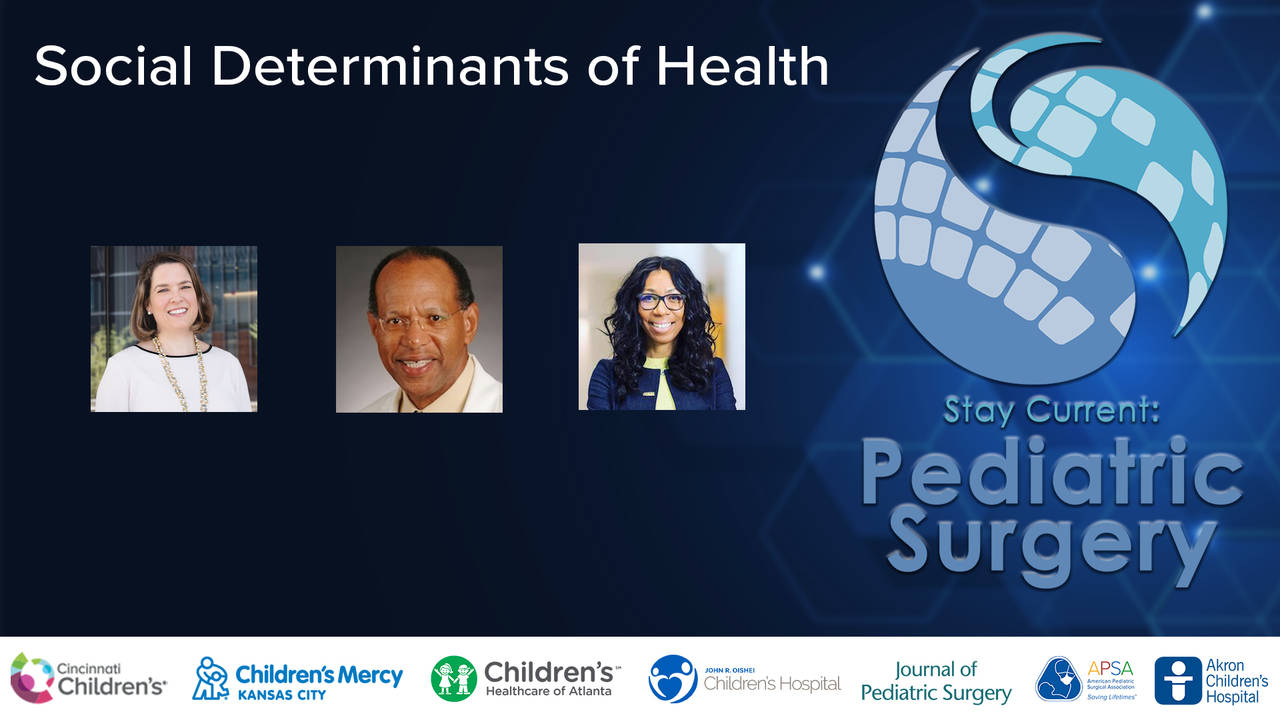
Hey there, listeners. If you haven't already, download the Stay Current in Pediatric Surgery app. It's in the Apple App Store, it's in the Google Play Store. You can listen to podcasts like this, watch technique videos, read up to-date guidelines, all of that in the app. So download it today, but until then, Enjoy the episode. As a busy general surgery resident, sometimes it's hard to remember that the care for our surgical patients doesn't just start and end in the OR. These patients come from these complex backgrounds of socioeconomic status, race, geography. All of this plays a role in their health. And that is what we're gonna talk about today from an expert. Let me introduce you to Vic Garcia. You know, the business that we're in is not necessarily the business of just providing healthcare or doing operations. The business that we're in is really improving the health and well-being of individuals. Doctor Vic Garcia is a pediatric surgeon at Cincinnati Children's Hospital. He's an expert on health disparities and how they potentially affect the pediatric surgical patients. I mean, he's done so much outside of the OR. He's teamed up with Toyota to make. Sure that children in the community have safe car seats. He works with the Cincinnati Police Department on injury prevention programs, but to get to know him before he was a pediatric surgeon, before he was a decorated man of the military, I had to ask, what about Young Vic? So like, it, it sounds like young Sheldon or young Turk. Vic grew up in New York City, in Harlem. I brought up that I also used to live in Harlem, and he was quick to laugh at me and point out that we did not live in the same Harlem. Yeah, that's, that's exactly what I was thinking, you know, you were there after Clinton. I was there decades before Bill Clinton, and it was certainly not a, a gentrified Harlem. Vic hasn't forgotten where he came from. We had our Harlem projects, 2190 Madison Avenue. And at that time, Vic didn't know he wanted to be a doctor, let alone a pediatric surgeon. So young Vic had no idea that he wanted to do pediatric surgery. Young Vic wanted to just survive. Survival was on his mind, you see. Vic's parents came to America on a boat from Puerto Rico. And so, um, you know, the suburbs were not something that was an option for them. They lived in a, you know, a barrio. For a sheltered millennial like myself, Vic's explanation helps to paint a picture, to start to understand what he was growing up around. Young Vic lived in an, in a, in, in a, you know, very highly segregated neighborhood. Um, and, um, and so there were, you know, characteristic disinvestment of these neighborhoods, and there were drugs, and there were gangs, and there was murders, and I mean, one of the things that I remember walking to this all Catholic, All Saints school was a, you know, a body that you saw, um, early in the morning. And uh you didn't wanna look over there for fear of what you were gonna see, you know, you didn't look left and right, you just went straight ahead. Vic says that's the code of the streets. You don't look at other people on the way to school, you just got to get to school. And that was one of the motivations for my father wanting to move out of that area too. Out of the barrio, and where did you guys end up? Uh, we, we ended up in, uh, Saint Albans, Queens, um, and, um, you know, uh, an, an interesting, an interesting perspective is my father was a New York City police officer. But not just any police officer. Vic's dad was a lieutenant, and at that time, he was the highest ranking Puerto Rican in the New York City Police Department. Uh, and that was in Saint Albans, Queens, which, uh, very quickly, within 5 years, we were the only black family or black Puerto Rican or black Hispanic family there. And then within 5 years, it was all, it was all black. Vic explains to me that this is a phenomenon known as white flight. Basically, the white families leaving the neighborhood because minorities are moving in. Now, Vic spent a lot of years in Queens, but then it was time for him to go to college. And he ended up going to the military. All right, well, number one, it wasn't because I was militant. A very simple answer is is that that's the only place my father could afford to send me. And so West Point was a place where they paid you to go. Uh, I had no aspirations of becoming a military officer. Uh, I had no idea that when I went to West Point, that it was 5 years of active duty and I could be sent to Vietnam. He's humble about it, but you and I know that West Point is like the cream of the crop. So there's already something really special about Vic at this young age, but he doesn't want to take any credit for it. Instead, he wants to give it to the drill sergeants and Well, this is how he explains it. When you get off the bus, this nappy-headed kid from, uh, you know, New York City, uh, and you're asked to report to the man in the red, red sash, and then he tells you to jump your, drop your bags, so all you had was one suitcase, and I had no idea that they would break you down and then build you up again. Um, I will tell you, Rob, that were it not for West Point and then my time at Children's Hospital in Philadelphia, I wouldn't be where I am right now. What do you have in your mind as a limitation is just that in your mind and that you can do more than what you could possibly do, not only mentally but physically. He keeps a picture in the back of his office to remind him of what he's capable of doing. Shows me in 1968 as one of five blacks in a class of 1013. Uh, leading a battalion of cadets. So, um, that was the kind of transformation that I went through there at West Point. And, um, Uh, and I think that that was, having gone to West Point will allowed me to be competitive to get into the University of Pennsylvania and ultimately, uh, to pediatric surgery at CHP. His time at the Children's Hospital of Philadelphia was another formidable moment for him because he got to work under the wing of a pediatric surgeon and surgeon general, Doctor Charles Everett Koop. He was, um, he, he, he was an extraordinary man. I mean, He, he had the courage of his convictions. Um, he was a technical genius. Doctor Koop is remembered for taking on big tobacco during the AIDS epidemic. He pushed for early safe sex education to go on in schools, proper condom use, things like that. So it's clear how Doctor Koop had a big influence on Vic early on in his career. I mean, he, he, he, he helped me understand that we, we had a responsibility not just simply to take care of kids in the operating room, but To look at the health and well-being. Uh, and as some of us may not know, is that he really saw himself as the health conscious of the country. What is, what is beneficial for the health of the country? And that was, that was then and it continues to be one of my motivations for Doing the work outside of the, the four walls of Cincinnati Children's Hospital. So you can start to get an idea of how strong Vic's convictions are when it comes to public health, but how do you explain that to your run of the mill surgeon who is operating, doing well, taking care of patients, but maybe he doesn't really think about health disparities on a regular basis? Well, I mean, I think, you know, as a, as a healthcare provider and specifically as a pediatric surgeon. Uh, but more generally as a healthcare provider, um, you know, you're res, you've take an oath, if you will, or you have your purpose in life, you're calling, it's not a job or a career, you're calling. Is uh to improve the health and well-being of, of, of people, of the population. And that can be the population uh within your sphere of uh of influence, or it could be a much larger population as far as the sphere of concern. And, um, and so, I think that You know, the business that we're in is not necessarily the business of just providing healthcare or doing operations. The business that we're in is really improving the health and well-being of individuals. And Rod, you know, the thing that we got to realize is that despite our spending more than 50% of the global healthcare dollars, we are at the bottom of the ranking of the OECD countries as far as health outcomes. And you can look at that, whether it's premature birth, uh, infant mortality, uh, longevity, OK. Uh, we're not doing that well. And so, you know, what is our role to do a lot of procedures, to make a lot of money, and then, you know, go off to Florida or Arizona, uh, or, you, you know, take it upon yourself, like Coop had uh like Chick Coop did, um, not to retire, um, but to retire and then continue the work that Needed to be done outside the walls of, at that time, CHOPS Children's Hospital of Philadelphia, and, and in my instance, outside of the walls of Cincinnati Children's Hospital Medical Center. If that doesn't bother you, I don't think you were listening close enough. Vic was explaining how in the United States, we spend a tremendous amount of money on healthcare, but by any international standards, We're at the bottom of the list. It's horrendous, and it makes me think of that pediatric surgical patient. It makes me want to do better, but how? That's a question we're not gonna answer in a ten-minute podcast. So instead, we're gonna start a new series. We're gonna talk to Vic on a regular basis about this. Healthcare disparities, socioeconomic status, race, and how all of these factors work together in a complex ecosystem to ultimately affect patient care. We're gonna call it Social Determinants of Health, The Next moonshot. So until the next episode, I'm Rod from Cincinnati Children's, and remember, knowledge should be free.