Intestinal rehabilitation: What is intestinal rehab? - Episode 1
Timestops (10)
Tools Used
Topic Overview
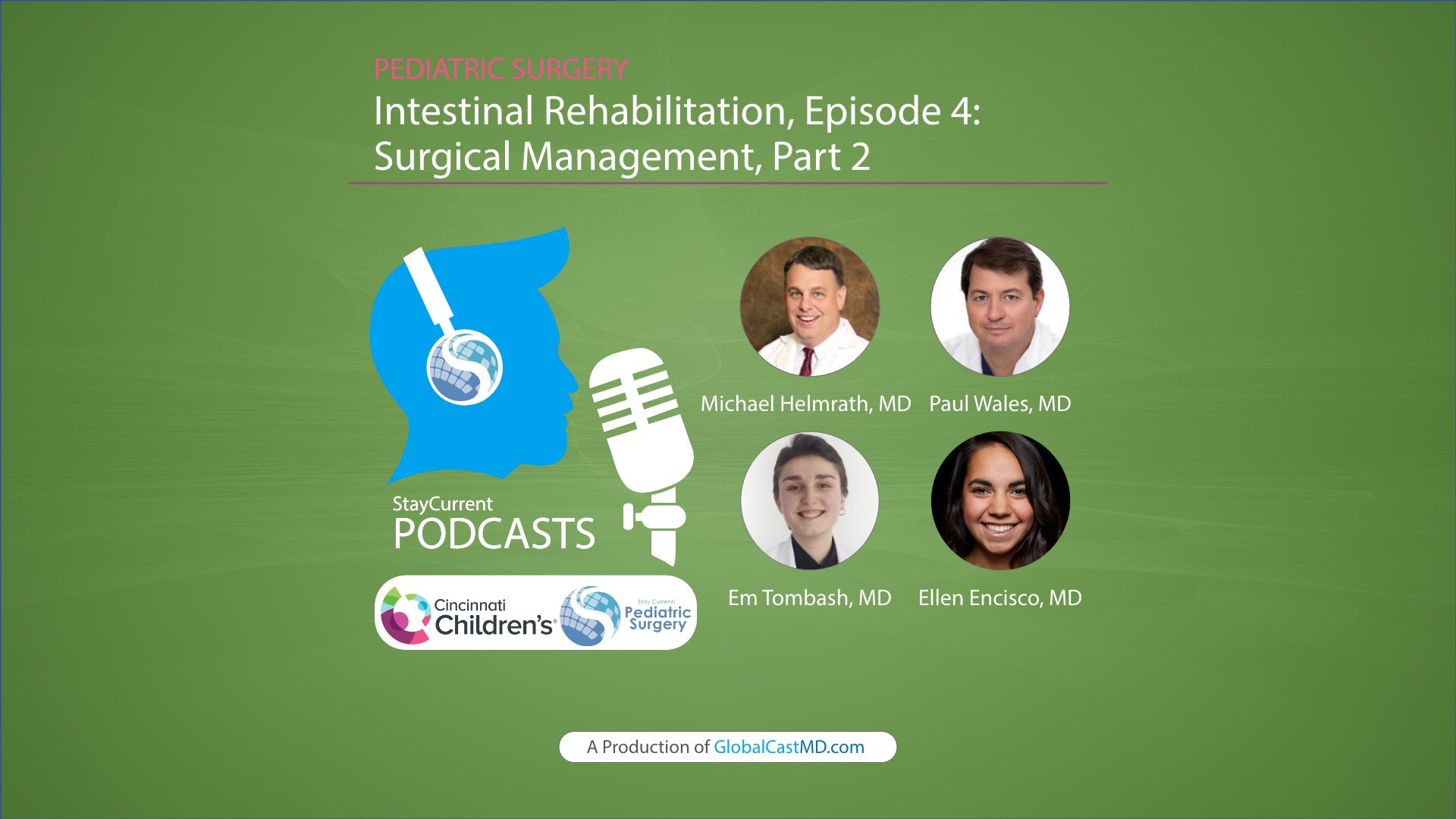
We’re starting a new series about intestinal rehabilitation and all of its intricacies. We’re joined by Drs. Michael Helmrath and Paul Wales, leaders of the Intestinal Rehabilitation Program at Cincinnati Children’s.
Hosted by: Todd Ponsky, Rod Gerardo, Ellen Encisco
100:00:04,080 --> 00:00:06,560Hey, there, listeners, this is Rod Gerardo.200:00:07,040 --> 00:00:08,400This is Ellen Encisco.
300:00:08,400 --> 00:00:12,800We are research residents at Cincinnati Children's Hospital Medical Center
400:00:13,040 --> 00:00:16,920and we're super excited because the intestinal
500:00:16,920 --> 00:00:20,280rehabilitation team at Children's is growing.
600:00:20,760 --> 00:00:22,960We've gained a new attending surgeon.
700:00:23,120 --> 00:00:25,280And to celebrate this, we're going to start a new series.
800:00:25,280 --> 00:00:28,480We're kicking this series off today about intestinal rehab.
900:00:28,520 --> 00:00:30,560What is it? What is the diagnosis?
1000:00:30,840 --> 00:00:32,960I know next to nothing about this.
1100:00:32,960 --> 00:00:35,120I don't know about you, Ellen. Not enough.
1200:00:35,840 --> 00:00:38,000This is the Stay Current Pediatric Surgery podcast.
1300:00:43,400 --> 00:00:44,240Hello.
1400:00:44,320 --> 00:00:46,240I'm Michael Helmrath That's Dr.
1500:00:46,240 --> 00:00:47,120Michael Helmrath.
1600:00:47,120 --> 00:00:49,000He's a pediatric surgeon at Cincinnati Children's
1700:00:49,000 --> 00:00:51,520Hospital Medical Center and the former director
1800:00:51,720 --> 00:00:54,320of the intestinal rehab program at Cincinnati Children's.
1900:00:54,520 --> 00:00:56,440He's excited to bring in his friend.
2000:00:56,440 --> 00:01:00,160I'm Paul Wales, I'm a pediatric surgeon,
2100:01:00,400 --> 00:01:04,160and he lead the intestinal rehab program at the Hospital for Sick Children
2200:01:04,520 --> 00:01:06,080and is now joining Cincinnati
2300:01:06,080 --> 00:01:09,760Children's as the new and current director of the intestinal rehab program.
2400:01:10,200 --> 00:01:11,160You know, Dr.
2500:01:11,160 --> 00:01:15,560Helmrath and I, we didn't work directly together for for many years.
2600:01:15,560 --> 00:01:19,520I've obviously been aware of a lot of his groundbreaking work
2700:01:19,520 --> 00:01:21,760that he's performed in tissue regeneration.
2800:01:22,400 --> 00:01:26,080A key part that Paul's team had come up with novel strategies
2900:01:26,080 --> 00:01:30,000how you introduce new pharma to these patients.
3000:01:31,320 --> 00:01:31,960Many of the
3100:01:31,960 --> 00:01:35,240patients require a very patient specific approach,
3200:01:35,240 --> 00:01:38,960which emphasizes understanding the natural history of disease.
3300:01:39,400 --> 00:01:43,240I guess, Ellen, the big question here is why do we even need intestinal rehab?
3400:01:43,240 --> 00:01:44,880But to answer that question?
3500:01:44,880 --> 00:01:46,880Dr. Wales brought up an initial question.
3600:01:46,880 --> 00:01:50,280Let's go back one step before that and sort of define
3700:01:50,280 --> 00:01:52,720what is intestinal failure, because that sort of leads
3800:01:52,720 --> 00:01:55,680into who's going to benefit from an intestinal rehab program.
3900:01:56,280 --> 00:01:59,600And up until recently, there really was no
4000:01:59,960 --> 00:02:02,600standardized definition for intestinal failure.
4100:02:03,040 --> 00:02:05,400It's it's really a functional problem.
4200:02:05,400 --> 00:02:09,120Essentially, when someone's gut for whatever the diagnosis,
4300:02:09,120 --> 00:02:13,000whatever the reason, their gut function is in insufficient
4400:02:13,000 --> 00:02:17,920to absorb enough nutrients, fluids, calories to support survival.
4500:02:17,920 --> 00:02:20,560And in the case of children growth,
4600:02:20,640 --> 00:02:23,760which is a big distinction between adults and children.
4700:02:24,320 --> 00:02:27,400Now these new guidelines, they say that for a patient
4800:02:27,400 --> 00:02:30,040to be defined as having intestinal failure,
4900:02:30,600 --> 00:02:35,640then they have to have inadequate intestinal function to the point
5000:02:36,120 --> 00:02:40,520where they necessitate parenteral support for at least 60 days.
5100:02:40,760 --> 00:02:45,440And so earlier recognition and taking advantage of the biology
5200:02:45,640 --> 00:02:49,360of the gut that wants to accommodate, we call it, adapt
5300:02:50,160 --> 00:02:53,960and meet the needs of the child, are time dependent.
5400:02:54,280 --> 00:02:56,040So with the intestinal rehabilitation
5500:02:56,040 --> 00:02:59,880programs, we are taking care of patients with intestinal failure.
5600:02:59,960 --> 00:03:04,360And so what is intestinal rehabilitation? So
5700:03:05,320 --> 00:03:07,600an intestinal rehabilitation program,
5800:03:08,320 --> 00:03:11,640as we defined also in these Aspen guidelines
5900:03:11,640 --> 00:03:16,600that just came out, is a multidisciplinary or interdisciplinary
6000:03:16,600 --> 00:03:19,440collaborative patient care paradigm
6100:03:20,000 --> 00:03:23,160that that brings coordinated care
6200:03:23,680 --> 00:03:28,320for children with intestinal failure through comprehensive management
6300:03:28,440 --> 00:03:33,480of their specialized nutrition and other associated needs that they have.
6400:03:33,640 --> 00:03:35,800It's like a dream team, but for pediatric guts.
6500:03:35,920 --> 00:03:38,000So on top of the nutrition, then you also have to think
6600:03:38,000 --> 00:03:41,080about the comorbidities, sepsis, liver disease,
6700:03:41,280 --> 00:03:43,920anything that would challenge the growth of this baby.
6800:03:44,400 --> 00:03:48,520It's an amalgamation of experts that come from different aspects of care,
6900:03:49,440 --> 00:03:53,760providing a holistic, comprehensive, coordinated approach
7000:03:53,760 --> 00:03:55,960to patient management.
7100:03:55,960 --> 00:03:59,080Hopefully, by doing that, you streamline care.
7200:03:59,400 --> 00:04:03,520You improve communication not only with with the family,
7300:04:03,520 --> 00:04:06,400but also between care providers and team members.
7400:04:07,160 --> 00:04:11,480What is intestinal rehabilitation really comes down to the key
7500:04:11,480 --> 00:04:15,160factors that drive that process, and that's nutrition in the gut,
7600:04:15,640 --> 00:04:18,640but it's also nutrition in the body and it's healing.
7700:04:19,000 --> 00:04:20,880People like Dr. Wales, Dr.
7800:04:20,880 --> 00:04:24,160Helmrath have taken care of patients with these issues before,
7900:04:24,240 --> 00:04:28,320so it's pattern recognition and that's what multiple eyes on a baby does.
8000:04:28,600 --> 00:04:29,920You see them over time.
8100:04:29,920 --> 00:04:31,200It's pattern recognition.
8200:04:31,200 --> 00:04:34,240But then on top of that, it's understanding all of these
8300:04:34,240 --> 00:04:37,600different causes of intestinal failure.
8400:04:37,840 --> 00:04:39,600They were able to break that down for us.
8500:04:39,600 --> 00:04:39,920Patients
8600:04:39,920 --> 00:04:43,200that are going to come to intestinal rehab program have intestinal failure,
8700:04:43,720 --> 00:04:45,760and we can divide
8800:04:46,520 --> 00:04:50,200the causes into of intestinal failure into three categories
8900:04:50,800 --> 00:04:55,600their short bowel syndrome, which by far is the most common category
9000:04:55,880 --> 00:05:00,760in pediatric patients with intestinal failure and causes of short bowel syndrome
9100:05:00,760 --> 00:05:05,440are usually related to diagnoses of or disorders of the neonate.
9200:05:05,840 --> 00:05:10,840So congenital anomalies such as intestinal atresia, malrotation, volvulus,
9300:05:12,360 --> 00:05:14,560gastroschisis,
9400:05:14,720 --> 00:05:18,040the long segment Hirschsprungs disease, things like that
9500:05:19,120 --> 00:05:22,760or acquired diseases of the newborn, such as necrotizing enterocolitis.
9600:05:23,200 --> 00:05:23,920Okay, so that makes sense.
9700:05:23,920 --> 00:05:28,520So basically, our first category for causes is any condition
9800:05:28,520 --> 00:05:32,520that may lead to loss of intestines or impair the intestinal formation
9900:05:33,040 --> 00:05:36,800and therefore leave the bowel shortened will therefore cause a child
10000:05:36,800 --> 00:05:37,600to not be able to absorb
10100:05:37,600 --> 00:05:41,120nutrients as well, which we mentioned at the beginning is key.
10200:05:41,600 --> 00:05:44,960Oh. Category number two, that is motility disorders.
10300:05:45,520 --> 00:05:47,520So if we think of the intestine like a pipe
10400:05:47,760 --> 00:05:51,160and that pipe is made of muscle that contracts in the coordinated way
10500:05:51,160 --> 00:05:55,000to push food and stool from one end to the other, you can have abnormalities
10600:05:55,000 --> 00:05:59,320of the muscle itself or of the nerves that control that muscle,
10700:06:00,040 --> 00:06:03,720and the bowel is unable to push things through in a coordinated way.
10800:06:03,720 --> 00:06:07,280So, so these children basically have difficulty
10900:06:07,560 --> 00:06:10,840passing the nutrients through their intestines as a result,
11000:06:10,840 --> 00:06:13,240and they're therefore dependent on intravenous support.
11100:06:13,520 --> 00:06:15,640And then and then there's a third category,
11200:06:16,120 --> 00:06:19,000and that's kind of like the opposite of slow transit
11300:06:19,120 --> 00:06:23,400what we call the mucosal enteropathies or the congenital diarrheas.
11400:06:23,920 --> 00:06:27,360And these are conditions where the patient has all of their bowel.
11500:06:27,360 --> 00:06:31,320But the mucosa, the inside lining that that absorbs,
11600:06:31,960 --> 00:06:33,880digests and absorbs doesn't work.
11700:06:33,880 --> 00:06:35,440Contents move too fast.
11800:06:35,440 --> 00:06:38,920In order for the bowel to have time to absorb any any of the nutrients.
11900:06:39,280 --> 00:06:40,600So three different flavors.
12000:06:40,600 --> 00:06:43,880first, you don't have enough bowel to absorb nutrients.
12100:06:44,520 --> 00:06:48,240second, the food moves too slow and you can't absorb it.
12200:06:48,440 --> 00:06:51,120And then the third category of intestinal failure.
12300:06:51,480 --> 00:06:55,120So not only are the contents moving too fast,
12400:06:55,320 --> 00:07:00,560but this occurs due to the bowels inability to digest in combination
12500:07:00,760 --> 00:07:05,200with increased secretions, and that's oftentimes congenital ideologies.
12600:07:05,440 --> 00:07:09,040The reason it's important to at least identify these three categories
12700:07:09,040 --> 00:07:12,520is that some patients will have elements of one, two
12800:07:12,520 --> 00:07:15,960or three of the cattery categories the way they present.
12900:07:16,440 --> 00:07:18,640For example, think about gastroschisis.
13000:07:18,640 --> 00:07:21,160The bowel could be short because it was not available.
13100:07:21,280 --> 00:07:23,280It could be inflamed so it doesn't absorb well.
13200:07:23,560 --> 00:07:26,560And all of these issues might affect motility, too.
13300:07:27,320 --> 00:07:31,360So a kid with gastroschisis could essentially have all three categories.
13400:07:31,880 --> 00:07:32,240Right.
13500:07:32,240 --> 00:07:36,400So any patient that that that fits one of those
13600:07:36,400 --> 00:07:39,640three categories is going to be referred to intestinal rehab program.
13700:07:40,120 --> 00:07:42,720And although most of them are infants or babies,
13800:07:42,720 --> 00:07:45,560there are some older kids that develop.
13900:07:45,760 --> 00:07:46,800Wait a minute.
14000:07:46,800 --> 00:07:51,280You see intestinal failure in older pediatric patients to things like
14100:07:51,400 --> 00:07:55,280inflammatory bowel disease or Crohn's disease, where they've had, you know, lost
14200:07:55,840 --> 00:08:00,960gut as a result of complications of that trauma, malignancy,
14300:08:01,960 --> 00:08:04,720vascular thrombosis that has led to gut loss.
14400:08:05,040 --> 00:08:09,960These are these are diagnoses that we tend to see more in older patients or
14500:08:09,960 --> 00:08:14,880in adult series and less so in pediatrics, like we're going to discuss,
14600:08:14,920 --> 00:08:18,840we're going to get into the details, of all of these things in later podcasts.
14700:08:19,360 --> 00:08:21,640Yeah, those will be subcategories of this whole.
14800:08:21,640 --> 00:08:22,760That's why we're going to a series.
14900:08:22,760 --> 00:08:24,800We're going to dove deep into each of these.
15000:08:24,800 --> 00:08:30,280Certainly families that live within the region can get given the opportunities
15100:08:30,360 --> 00:08:32,680to understand deliberate from the beginning,
15200:08:32,680 --> 00:08:35,920this is probably going to be beneficial for a lot of the patients.
15300:08:36,000 --> 00:08:40,720The main reason I think we're doing this podcast is because access
15400:08:40,720 --> 00:08:45,280and availability to an intestinal rehab program is still very, very rare.
15500:08:45,480 --> 00:08:46,480There's really three
15600:08:47,760 --> 00:08:50,400time points where families reach to us.
15700:08:50,840 --> 00:08:54,600OK, so there's three different categories of intestinal failure.
15800:08:54,880 --> 00:08:58,000There are also three general time points
15900:08:58,320 --> 00:09:00,680that these diagnoses can be picked up.
16000:09:01,000 --> 00:09:05,840And by picked up we mean also like and then referred to intestinal rehab centers.
16100:09:06,520 --> 00:09:09,320The first one is a prenatal diagnosis.
16200:09:09,640 --> 00:09:11,280Prenataly
16300:09:11,600 --> 00:09:13,880when there's a prenatal diagnosis.
16400:09:14,080 --> 00:09:18,880It typically ends up being an atresia that could be with cystic
16500:09:18,880 --> 00:09:22,960fibrosis gastroschisis very commonly.
16600:09:23,360 --> 00:09:26,680The second time point would be postnataly,
16700:09:26,920 --> 00:09:30,440with acquired problems such as vovulus or neck.
16800:09:30,720 --> 00:09:34,440The third one, which is patients who are discharged,
16900:09:34,680 --> 00:09:38,560they don't really progress outside of the hospital and then they come back
17000:09:38,560 --> 00:09:43,640and then they have a later diagnosis that maybe leads to short gut or the
17100:09:44,320 --> 00:09:47,200something other diagnosis that leads them to necessitating
17200:09:47,200 --> 00:09:48,720intestinal rehabilitation.
17300:09:48,720 --> 00:09:50,480So those are the three time points.
17400:09:50,480 --> 00:09:52,280The fact that we have these different
17500:09:52,280 --> 00:09:55,440times and people present have to have infrastructure to be able to
17600:09:56,400 --> 00:09:58,960have the families get the support they need when they need it.
17700:09:59,200 --> 00:10:00,960Now you just brought in.
17800:10:00,960 --> 00:10:04,840That's Todd Ponsky he's a pediatric surgeon at Cincinnati Children's Hospital.
17900:10:05,080 --> 00:10:08,480The two of you being the two world's experts, all under one roof.
18000:10:08,720 --> 00:10:09,920Why did you do that?
18100:10:09,920 --> 00:10:14,560So I long believed that your ideas at first come to your head
18200:10:14,560 --> 00:10:19,760always have ways to improve in that that you only see things through one way.
18300:10:19,760 --> 00:10:20,760Innovation comes
18400:10:20,760 --> 00:10:24,800from multiple approaches to the problem and different visions of the problem.
18500:10:25,160 --> 00:10:29,680The more expertize you bring in, the better the outcome.
18600:10:30,040 --> 00:10:32,120So that combined knowledge of Dr.
18700:10:32,120 --> 00:10:33,000Helmrath and Dr.
18800:10:33,000 --> 00:10:37,160Wales along with the experience that we have at Cincinnati Children's
18900:10:37,160 --> 00:10:41,760Hospital, is great because there are a lot of next
19000:10:41,760 --> 00:10:45,400level questions that honestly need some better answers.
19100:10:45,600 --> 00:10:48,960How do you take the older child who has had intestinal failure
19200:10:49,120 --> 00:10:52,280and entering their late teen years and later destined to be
19300:10:52,280 --> 00:10:56,520a major obstacle that we need to address that is currently not being met?
19400:10:56,560 --> 00:11:00,320How do you integrate new strategies of therapy?
19500:11:00,400 --> 00:11:05,240How do you look at new therapies like drug therapies and say now who can get it?
19600:11:05,560 --> 00:11:09,320Previously, we didn't really have good robust data to answer these questions.
19700:11:09,320 --> 00:11:14,000So, so since children's is really uniquely situated in this endeavor,
19800:11:14,240 --> 00:11:17,880now that these two surgeons are under the same roof. But
19900:11:18,400 --> 00:11:22,520to have the team approach an integrated approach to the complex patients,
20000:11:24,040 --> 00:11:26,480it just is a rare thing to find and
20100:11:26,640 --> 00:11:30,960and we are going to expand it to a point that it's never been done.
20200:11:30,960 --> 00:11:33,040Pheonominal. All right, Rod.
20300:11:33,640 --> 00:11:37,960So having the whole team of everyone necessary is key.
20400:11:38,000 --> 00:11:40,680Obviously, we have the surgeons, we have the GI doctors
20500:11:41,280 --> 00:11:44,080now, but we also have a neonatologist and probably more importantly,
20600:11:44,080 --> 00:11:46,560the part of the team that is not physicians.
20700:11:47,040 --> 00:11:51,600But you can't say enough about the dieticians
20800:11:51,600 --> 00:11:55,280in understanding the nutritional needs of a child as they are met.
20900:11:55,360 --> 00:11:57,840Social work is really key.
21000:11:57,880 --> 00:12:02,080I think the the other aspect is that our extended providers,
21100:12:03,040 --> 00:12:07,160the people that are at the bedside our nurse practitioners are fantastic.
21200:12:07,440 --> 00:12:09,640And the list just keeps going.
21300:12:10,080 --> 00:12:13,320Some people would say pharmacy as well and as well as social work,
21400:12:13,400 --> 00:12:16,160really good interventional radiology, for instance.
21500:12:17,080 --> 00:12:18,400Pathology and all the other
21600:12:18,400 --> 00:12:22,000sort of ologies you know, like endocrinology nephrology.
21700:12:22,280 --> 00:12:25,760With improvements like transplant and multidisciplinary organizations,
21800:12:25,920 --> 00:12:28,680we can see some really big strides forward in this field.
21900:12:28,920 --> 00:12:33,960The survival overall in big programs is usually over 90% long term survival.
22000:12:34,240 --> 00:12:37,040And while this is a cause for celebration on its own,
22100:12:37,800 --> 00:12:40,000keep in mind that is also raised a lot of new issues.
22200:12:40,800 --> 00:12:43,440But now what we're seeing is we have kids that have developed
22300:12:43,440 --> 00:12:46,560chronic co-morbidities that co-morbidities that never
22400:12:46,560 --> 00:12:49,560we didn't really see to the same extent because they didn't live long enough.
22500:12:49,720 --> 00:12:50,320Now Dr.
22600:12:50,320 --> 00:12:51,280Helmrath and Dr.
22700:12:51,280 --> 00:12:56,000Wales are seeing diseases like renal dysfunction and metabolic bone disease, and
22800:12:57,520 --> 00:12:57,960then the
22900:12:57,960 --> 00:13:02,080neurocognitive issues and, you know, the quality of life issues.
23000:13:02,080 --> 00:13:04,200And that's why having a coordinated team
23100:13:05,200 --> 00:13:08,640that can track these problems long term is vital.
23200:13:08,920 --> 00:13:12,480OK, so if you're listening to this podcast and you're thinking to yourself,
23300:13:12,680 --> 00:13:14,280What am I going to get out of this series?
23400:13:14,280 --> 00:13:15,520How is it going to help me?
23500:13:15,520 --> 00:13:19,720I think the big key to a person watching a podcast is that they get hope.
23600:13:19,720 --> 00:13:23,440These are wonderful children, their opportunities to grow up,
23700:13:23,440 --> 00:13:25,520and they live the lives that their families want.
23800:13:25,520 --> 00:13:27,120Is really in front of them.
23900:13:27,120 --> 00:13:30,040You're going to hear some experts talk about their process
24000:13:30,040 --> 00:13:32,720for taking care of these patients, how they think about them,
24100:13:33,080 --> 00:13:36,640what important things to know when you encounter one of these patients
24200:13:36,760 --> 00:13:40,120and may or may not need to refer them to a dedicated center?
24300:13:40,240 --> 00:13:44,280And people can't believe the culture that happens in the NICU.
24400:13:44,320 --> 00:13:49,200My goodness, I saw no way forward and look this little child full of light.
24500:13:49,440 --> 00:13:50,520And there's nothing
24600:13:50,520 --> 00:13:54,760that puts more energy back into you wanting to do better than that home.
24700:13:55,920 --> 00:13:58,600Like I said, we work for her.
24800:14:00,440 --> 00:14:01,120There you have it.
24900:14:01,120 --> 00:14:04,760Episode one of our series on intestinal rehab.
25000:14:05,280 --> 00:14:08,400If you like this or learn something.
25100:14:08,440 --> 00:14:09,920Make sure to follow us on social media.
25200:14:09,920 --> 00:14:11,040Subscribe to our YouTube channel.
25300:14:11,040 --> 00:14:12,760Download the Stay Current in Pediatric Surgery app,
25400:14:12,760 --> 00:14:15,040which is in the Apple App Store and the Google Play Store.
25500:14:15,040 --> 00:14:19,120But until then, I'm Rod and I'm Ellen, and remember
25600:14:19,920 --> 00:14:23,400knowledge should be free, It was a little lagging.
25700:14:24,160 --> 00:14:25,160Should we do it again?
25800:14:25,160 --> 00:14:26,840No that's, That's OK.
25900:14:26,840 --> 00:14:27,960I think it's better this way.
Keywords
Hashtags
Transcript
Hey there, listeners. This is Rod Gerardo. This is Ellen and Cisco. We are research residents at Cincinnati Children's Hospital Medical Center, and we're super excited because the uh intestinal rehabilitation team at Cincinnati Children's is growing. We've gained a new attending surgeon. And to celebrate this, we're gonna start a new series. We're kicking this series off today about intestinal rehab. What is it? What are the diagnoses? I know next to nothing about this. I don't know about you, Ellen. Not enough. This is the Stay Current Pediatric Surgery podcast. Hello, uh, I'm Michael Helmrath. That's Dr. Michael Helmrath. He's a pediatric surgeon at Cincinnati Children's Hospital Medical Center and the former director of the intestinal rehab program at Cincinnati Children's. He's excited to bring in his friend. I'm Paul Wales. I'm a pediatric surgeon, and he led the intestinal rehab program. At the Hospital for Sick Children and is now joining Cincinnati Children's as the new and current director of the intestinal rehab program. You know, I, Doctor Helmroth and I, we didn't work directly together for many years. I've obviously been aware of a lot of his groundbreaking work that he's performed in tissue regeneration. A key part that Paul's team had come up with novel strategies, how you introduce new pharma to these patients. Many of the patients require a very patient-specific approach which emphasizes understanding the natural history of the disease. I guess, Alan, the big question here is why do we even need intestinal rehab, but to answer that question, Dr. Wells brought up an initial question. Well, let's go back one step before that and sort of define what is intestinal failure because that sort of leads into who's going to benefit from an intestinal rehab program. And uh up until recently, there really was no standardized definition for intestinal failure. It it's, it's really a functional problem. Essentially, when someone's gut for whatever the diagnosis, whatever the reason, their gut function is insufficient to absorb enough nutrients, fluids, calories to support survival and in the in the case of children, growth, which is a big distinction between adults and children. Now these new guidelines, they say that for a patient to be defined as having intestinal failure, then they have to have inadequate intestinal function to the point, Where they necessitate parental support for at least 60 days. And so earlier recognition and and taking advantage of the biology of the gut that wants to accommodate, we call it adapt um and meet the needs of the child um are time dependent. So with the intestinal rehabilitation programs, we are taking care of patients with intestinal failure and so what is intestinal rehabilitation? So, um, an intestinal rehabilitation program, as we defined also in these Aspen guidelines that just came out, is a multidisciplinary or interdisciplinary collaborative patient care paradigm that that brings coordinated care for children with intestinal failure through comprehensive management of Their specialized nutrition and other associated needs that they have. It's like a dream team, but for pediatric guts. So on top of the nutrition, then you also have to think about the comorbidities, sepsis, liver disease, anything that would challenge the growth of this baby. It's an amalgamation of experts that come from different aspects of care, providing a holistic, comprehensive, coordinated approach to patient management. Um, hopefully, by doing that, you streamline care, you improve communication, not only with, with the family, but also between care providers and team members. What is intestinal rehabilitation really comes down to the key factors that drive that process, and that's nutrition in the gut. But it's also nutrition in the body, and it's healing. People like Dr. Wales, Doctor Helmrath have taken care of patients with these issues before. So it's pattern recognition, and that's Multiple eyes on a baby does, who've seen them over time. It's pattern recognition, but then on top of that, it's understanding all of these different causes of intestinal failure. They were able to break that down for us. Patients that are gonna come to intestinal rehab program have intestinal failure, and we can divide the causes of intestinal failure into three categories. There's short bowel syndrome, which by far is the most common category in pediatric patients with intestinal failure, and causes of short bowel syndrome are usually related to diagnoses of or, or disorders of the neonate. So congenital anomalies such as intestinal atresia, malrotation, volvulus, um, gastroschisis, uh, uh, long segment Hirschprung's disease, things like that. Um, or acquired diseases of the newborn such as necrotizing enterocolitis. OK, so that makes sense. So basically, our first category for causes is any condition that may lead to the loss of intestines or impair the intestinal formation and therefore leave the bowel shortened, will therefore cause a child to not be able to absorb nutrients as well, which we mentioned at the beginning is key. Oh, and category number 2, that is motility disorders. So if we think of the intestine like a pipe, and that pipe is made of muscle that contracts in a coordinated way to push food and stool from one end to the other, you can have abnormalities of the muscle itself, or of the nerves that control that muscle. And the bowel is unable to push things through in a coordinated way. So, these children basically have difficulty passing the nutrients through their intestines as a result. And they are therefore dependent on intravenous support. Yeah, and then, and then there's a third category, what we call the ecos. Enteropathies or the congenital diarrheas, and these are conditions where the patient has all of their bowel, but the mucosa, the inside lining that, that absorbs, uh, digests and absorbs doesn't work. And since we have these mucosal defects, they lead to hypersecretion and profuse fluid losses, such that, you know, the bowel is unable to tolerate or absorb nutrients. So 3 different flavors. First, you don't have enough bowel to absorb nutrients. And second, motility issues. So, the food's moving too slow, or in rare occasions it's moving too fast, and then the, the third category of intestinal failure, so not only are the contents moving too fast, but this occurs due to the bowel's inability to digest in combination with increased secretions, and that, that's oftentimes. Genital etiologies. The reason it's important to at least identify these three categories is that some patients will have elements of 12, or 3 of the categories, the way they present. For example, think about gastroschisis. The bowel could be short because it was not all viable. It could be inflamed, so it doesn't absorb well, and all of these issues might affect mobility too. So a kid with gastroschisis could essentially have all three categories. Right? So any patient that, that, that fits one of those three categories is going to be referred to an intestinal rehab program. And although most of them are infants or babies, they're There are some older kids that, that, that develop, wait a minute, do you see intestinal failure in older pediatric patients too? Things like inflammatory bowel disease or Crohn's disease where they've had, you know, lost uh gut as a result of complications of that. Trauma, malignancy, um, vascular thrombosis that has led to gut loss. These are, these are diagnoses that we tend to see more in older patients or in, in adult series, um, and less so in pediatrics. Like we're gonna discuss, we're gonna get into the, the details of all of these things in later podcasts. Yeah, those will be subcategories of this whole, that's why we're gonna do a series. We're gonna dive deep into each of these. Certainly, families that live uh within the region can um be given the opportunities to understand delivery from the beginning is, is probably going to be beneficial for a lot of the patients. The main reason that I think we're doing this podcast is because access and availability to an intestinal rehab program is still very, very rare. There's really 3. You know, time points where families reach to us. OK, so there's 3 different categories of intestinal failure. There are also 3 general time points that these diagnoses could be picked up. And, and by picked up, we mean also like, and then referred to intestinal rehab centers. The first one is a prenatal diagnosis. Prenatally, um, when there's a prenatal diagnosis, that typically ends up being Um, an atresia could be with cystic fibrosis, gastroschisis, um, very commonly. The second time point would be postnatally with acquired problems such as volvulus or neck. The third one, which is patients who are discharged, they don't really progress outside of the hospital and then they come back and then they have a later diagnosis that maybe leads to shortcut or they Something other diagnosis that leads them to necessitating intestinal rehabilitation. So those are the three time points. The fact that we have these different times and people present, we have to have the infrastructure to be able to Have the families get the support they need when they need it. Now you just brought in, that's Todd Ponsky. He's a pediatric surgeon at Cincinnati Children's Hospital. The two of you being the two world's experts, all under one roof. Why did you do that? So, I've long believed that your ideas that first come to your head always have ways to improve, and that, that you only see things through one way. Innovation comes from multiple approaches to the problem and Different visions of the problem, the more expertise you bring in, um, the better the outcome is. So that combined knowledge of Doctor Helmrath and Doctor Wales along with the experience that we have at Cincinnati Children's Hospital is great because there are a lot of next-level questions that honestly need some better answers. How do you take the older child who's had intestinal failure and they're entering In their late teen years and later. That's gonna be a major obstacle that we need to address that is currently not being met. How do you integrate new strategies of therapy? How do you look at new therapies like drug therapies and say, now who can get it? Previously, we didn't really have good robust data to answer these questions. So, so Cincinnati Children's is really uniquely situated in this endeavor, now that these two surgeons are under the same roof. But to have the team approach and integrated approach to the complex patients, um, uh, it's just, it's a rare thing to find and, and we are gonna expand it to a point that it's never been done before. Phenomenal. All right, Rod. OK, so having the, the whole team of everyone necessary is key. Obviously, we have the surgeons, we have the GI doctors. Uh, but we also have a neonatologist and probably more importantly, the part of the team that is not physicians. But, uh, you can't say enough about um the dietitians and understanding the nutritional needs of a child as they are met. Social work, um, is a really key. I think the, the other aspect is that our extended providers, we, uh, the people that are at the bedside, our nurse practitioners are fantastic. And the list just keeps going. Some people would say pharmacy as well and as well as social work, really good interventional radiology, for instance, um, pathology and all the other sort of ologies, you know, like endocrinology, nephrology. With improvements like transplant and multidisciplinary organizations, we can see some really big strides forward in this field. The survival overall in big programs is usually over 90% long-term survival, and while this is a cause for celebration on its own, Keep in mind that it's also raised a lot of new issues. But now what we're seeing is we have kids that have developed chronic comorbidities, that comorbidities that never, we didn't really see to the same extent because they didn't live long enough. Now, Doctor Helmras and Doctor Well are seeing diseases like renal dysfunction and metabolic bone disease and um and then the neurocognitive issues and, you know, the quality of life issues, and that's why having a coordinated team. Uh, that can track these problems long term is, is vital. OK, so if you're listening to this podcast and you're thinking to yourself, what am I going to get out of this series? How is it going to help me? I think the big key to a person watching the podcast is that they get hope. These are wonderful children. They're, they're opportunities to grow up and to live the lives that their families want is really in front of them. You're gonna hear some experts talk about their process for taking care of these patients. Patients, how they think about them, what, you know, important things to know when you encounter one of these patients and may or may not need to refer them to a dedicated center. And people can't believe the culture that happened in the NICU. My goodness, I saw no way forward. And look, there's this little child full of life, and there's nothing that puts more energy back into you wanting to go better uh than that hug. Um, like I said, we work for hugs. There you have it. Episode one of our series on intestinal rehab. If you like this or learn something, uh, make sure to follow us on social media. Subscribe to our YouTube channel. Download the stay current pediatric surgery app, which is in the Apple App Store or the Google Play Store. But until then, I'm Rod and I'm Ellen, and remember knowledge should be free, free. Yeah, it's a little lagged up. Should Should we do it again? Yeah, that's not, that's OK. I think it's better this way.