


From
StayCurrentMD
Update Course Rewind 2025: Hirschsprung + ARM: Rare but Real
hosted by Dr. Jill Knepprath
Chapter 1 of 3 · Fundamentals
Introduction and Clinical Scenario
Expert statements on this page
No expert statements were drawn from this page.
Host summaries · secondary, not cited in answers
Educational content from recorded physician discussions — not medical advice. Talk to your (or your child's) care team about your situation.
Video
Cuidado de transición en malformación anorrectal y enfermedad de Hirschsprung
1 min · Published Jul 2024
Video
2025 Pediatric Surgery Update Course - Updates in Colorectal: Debunking Dogma
30 min · Published Aug 2025
Video
Colorectal Quiz: Episode 41 - Perineal Hypospadias
Marc Levitt · 17 min · Published Nov 2024
Video
Episode 19 - Interview with Dr Marc Levitt, Chief of Colorectal & Pelvic Reconstruction, Children‘s
Marc Levitt · 54 min · Published Oct 2021
Video
Malone appendicostomy in a Patient with Prior Abdominal Surgery via a prior abdominal incision
5 min · Published Oct 2022
Podcast
Journal of Pediatric Surgery Article Review: 2nd Quarter (Apr-Jun) 2024
17 min · Published Sep 2024
Video
Validation of an anorectal malformation trainer - Can a high-fidelity model simulate real life?
1 min · Published Jun 2026
Video
Complications and Long-Term Outcomes of Patients With Cloacal Malformation After Bowel Neovagina...
1 min · Published Jun 2026
Video
Safety and utility of long-acting steroid injection for management of post-operative stricture...
1 min · Published Jun 2026
Video
Association Between Social Determinants of Health and Choice of Urinary Reconstruction in Children
1 min · Published Jun 2026
Video
The Perineal Body Preserving PSARP (PPP)
11 min · Published Jun 2026
Video
Update Course Rewind 2025: Botox for Hirschsprung’s: Where, When, and Why
1 min · Published May 2026
Video
Intestinal Atresia Types Explained: Grossfeld Classification for Pediatric Surgery
1 min · Published Sep 2026
Video
Derivation and validation of the Pediatric Community-Acquired Pneumonia Severity (PedCAPS) score: A prospective cohort study
50 s · Published Sep 2026
Video
FETO for Late-Diagnosed Severe Congenital Diaphragmatic Hernia (CDH) at Cincinnati Children's with Dr. Beth Rymeski
4 min · Published Sep 2026
Video
Severe Congenital Diaphragmatic Hernia (CDH) Case: FETO Management & Unexpected Findings with Dr. Beth Rymeski
3 min · Published Sep 2026
Video
Fetoscopic Endoluminal Tracheal Occlusion (FETO) Procedure: Step-by-Step Guide with Dr. Beth Rymeski
4 min · Published Sep 2026
Video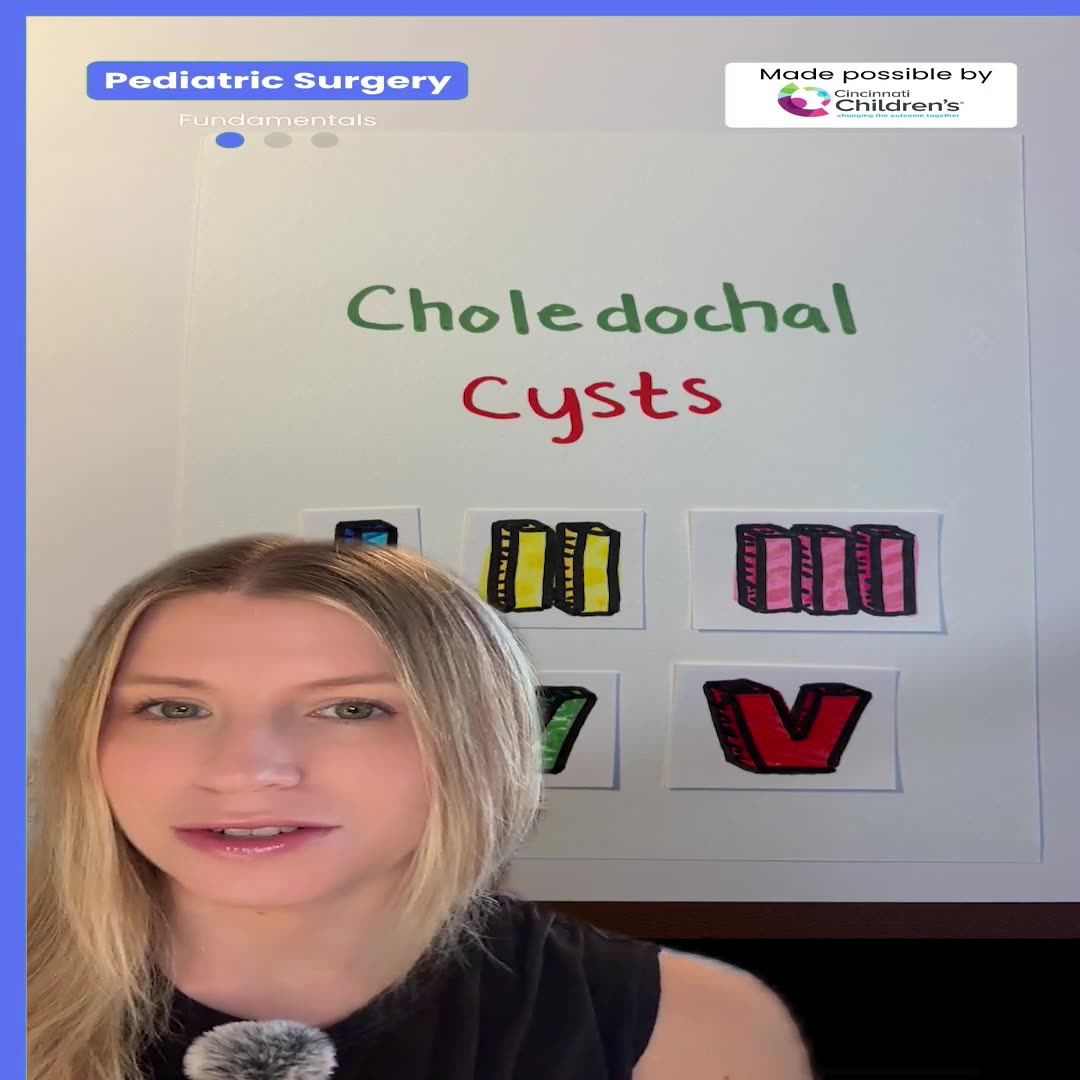
Choledochal Cyst Types Explained: Pediatric Surgery Fundamentals
1 min · Published Sep 2026
What the experts said
A single-center study examined rectal fistula specimens obtained during posterior sagittal anorectoplasty (PSARP) procedures
Rectal fistula tissue is not physiologic tissue
Patients with both Hirschsprung disease and ARM tend to have chromosomal anomalies
Chromosomal anomalies associated with both conditions include trisomy 21 and Pallister-Killian syndrome
The rate of Hirschsprung disease and anorectal malformation occurring together is less than 2%
The co-occurrence of Hirschsprung disease and ARM is something to keep in mind for patients with trisomy 21
Ganglion cells were found in 91% of rectal fistula specimens
Hypo or absent ganglion cells were found in the remaining rectal fistula specimens
Absent ganglion cells in fistula tissue does not necessarily mean the patient has Hirschsprung disease
Three patients (4% of the study cohort) had both Hirschsprung disease and anorectal malformation
Two of the three patients with both conditions had trisomy 21
Complex anorectal malformation patients with chromosomal anomalies who do not respond to laxatives or enemas should be worked up for Hirschsprung disease