


From
StayCurrentMD
Urologic and Gynecologic Aspects in Anorectal Malformations: Pediatric...
With Dr. Shamael Elam & Dr. Donald Shaw & Dr. Brad Crop
Chapter 1 of 7 · Diagnosis & Workup
VCUG interpretation
Urologic evaluation in ARM: VCUG interpretation and high-risk indicators
Expert statements on this page
No expert statements were drawn from this page.
Host summaries · secondary, not cited in answers
Educational content from recorded physician discussions — not medical advice. Talk to your (or your child's) care team about your situation.
Video
Collaborative work: Complex Pediatric Anorectal Malformations 2017
Dr. Todd Ponsky · 23 min · Published Jun 2017
Video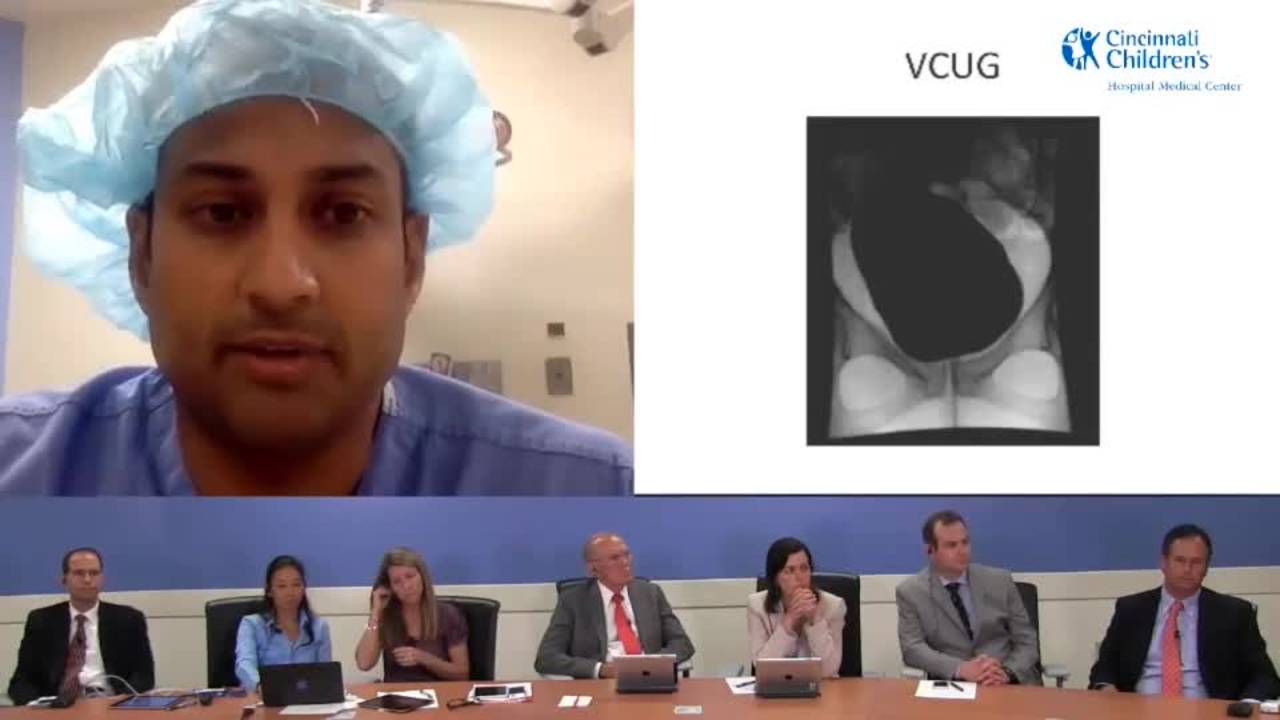
Surgical Management and Follow-Up: Cloaca and Complex ARMs 2015
25 min · Published Oct 2015
Video
Is Multi-disciplinary care the future of medicine?
24 min · Published Oct 2023
Video
Colorectal Surgery: What does the anesthesia provider need to know?
24 min · Published Oct 2023
Podcast
Colorectal Quiz Episode 28: Female ARM Management - Perineal Fistula
19 min · Published Feb 2022
Video
Anorectal Malformation Radiology: Pediatric Colorectal Controversies 2014
61 min · Published Apr 2012
Video
Validation of an anorectal malformation trainer - Can a high-fidelity model simulate real life?
1 min · Published Jun 2026
Video
Complications and Long-Term Outcomes of Patients With Cloacal Malformation After Bowel Neovagina...
1 min · Published Jun 2026
Video
Safety and utility of long-acting steroid injection for management of post-operative stricture...
1 min · Published Jun 2026
Video
Association Between Social Determinants of Health and Choice of Urinary Reconstruction in Children
1 min · Published Jun 2026
Video
The Perineal Body Preserving PSARP (PPP)
11 min · Published Jun 2026
Video
Update Course Rewind 2025: Hirschsprung + ARM: Rare but Real
1 min · Published May 2026
Only a few other public items share this expert — go deeper there →
Video
Intestinal Atresia Types Explained: Grossfeld Classification for Pediatric Surgery
1 min · Published Sep 2026
Video
Derivation and validation of the Pediatric Community-Acquired Pneumonia Severity (PedCAPS) score: A prospective cohort study
50 s · Published Sep 2026
Video
FETO for Late-Diagnosed Severe Congenital Diaphragmatic Hernia (CDH) at Cincinnati Children's with Dr. Beth Rymeski
4 min · Published Sep 2026
Video
Severe Congenital Diaphragmatic Hernia (CDH) Case: FETO Management & Unexpected Findings with Dr. Beth Rymeski
3 min · Published Sep 2026
Video
Fetoscopic Endoluminal Tracheal Occlusion (FETO) Procedure: Step-by-Step Guide with Dr. Beth Rymeski
4 min · Published Sep 2026
Video
Choledochal Cyst Types Explained: Pediatric Surgery Fundamentals
1 min · Published Sep 2026
What the experts said
A voiding cystourethrogram showing high-grade reflux with ureteral dilation, tortuosity, and renal pelvis dilation indicates a child at relatively high risk who should be followed closely and warrants urologic evaluation.
A normal appearing kidney on ultrasound can still have high-grade reflux and bladder pathology.
A normal ultrasound is very reassuring that the kidneys at the time of birth are in good shape, but it doesn't give all the answers.
Every child with an anorectal malformation must have initial ultrasonography of the urinary tract at presentation and in follow-up.
Renal scan showing no uptake on one side most likely indicates renal agenesis, meaning the patient has half the normal number of nephrons.
Solitary kidney patients are at higher risk for further injury of that solitary kidney, generally in the case of unrecognized or underdiagnosed neurogenic bladder.
All humans are born with all the nephrons they will have for the rest of their lives, with continued nephron development only for the first 6 months after birth.
Children with high-grade reflux, solitary kidney, and bladder neck fistula need very close follow-up with serial ultrasonography, sterile urine maintenance, blood work (serum creatinine, cystatin C), and regular urodynamic studies.
Reflux itself does not damage kidneys, but infection does. Reflux in conjunction with bladder dysfunction can damage kidneys.
In ARM patients at risk with solitary kidney, height and weight growth and development are very important to track—a creatinine of 0.3 may be normal but a child at the 4th percentile for height and weight is not normal.
A patient with solitary kidney, high-grade reflux, and bladder neck fistula might warrant a divided colostomy at birth rather than a loop colostomy to ensure complete diversion.
Total urogenital mobilization eliminates any future function of the external urinary sphincter, making continence dependent on bladder neck function.
Women who have had total urogenital mobilization will have some degree of cough incontinence or Valsalva-induced incontinence.
Continence in post-cloaca repair patients depends more on bladder function and bladder compliance than on the bladder neck.
A 12-year-old ex-cloaca repair patient who is voiding well, has urinary control, and no UTIs may still have underlying neuropathic bladder that could lead to renal failure by age 30.
Neuropathic bladder does not always mean the patient leaks or has urinary tract infections—there are subtleties requiring renal function studies (cystatin C) to assess GFR and overall kidney health.
The bladder stores urine for about 23 hours and 40 minutes during the day and empties for only a short time—the storage function is more important than the emptying function.
Asking a patient if they are continent is not enough to assess bladder health—evidence of how the bladder is storing urine is required to know if the bladder is healthy.
ARM patients with bladder neck fistula, single kidney, reflux, and tethered cord are at high risk for neurogenic bladder, and expectations should not be set for volitional voiding.
The split appendix technique uses the proximal appendix (closest to cecum) for Malone and the distal appendix for Mitrofanoff.
Even if a child has malrotation, the appendix should not be removed electively in ARM patients because it may be needed for Mitrofanoff or Malone.
The appendix makes a better Mitrofanoff with longer durability than a tapered ileal piece.
When using split appendix technique, implant the Mitrofanoff first and then see where the Malone goes—pushing the Malone to the umbilicus after Mitrofanoff implantation can cause blood supply problems and reports of ripping.
At the time cloaca patients start going through puberty, periodic pelvic ultrasounds are needed to ensure there is no undrained menstrual fluid.
If rudimentary uterine structures are left in place during cloaca repair, parents must be educated that at the onset of puberty, monitoring for undrained fluid collections is necessary.
For a cervix to carry a pregnancy, the distal end of the fallopian tube must be connected to the uterine Müllerian structure, which must be connected to a cervix, which must be connected to a vaginal outflow tract.
It is important to know whether an ARM patient has reflux before undertaking a cloaca repair, which may require cystoscopy to get a catheter into the bladder for VCUG.
If a cloaca repair involves mobilizing the bladder neck and separating the vagina from the urinary system, reimplanting the ureter later is a totally difficult operation—the reimplant should be done at the time of cloaca repair.
The biggest complication of a ureterostomy is stenosis, and a ureterostomy cannot be done unless the ureter is dilated.
A massively dilated ectopic ureter is a situation where it would be safer to do a ureterostomy up front rather than primary reconstruction, with reimplantation deferred to a later date.
Five centimeter common channel cloaca patients rarely have volitional voiding that is functional later in life.
If a newborn requires vaginostomy and/or vesicostomy, those structures will need to be taken down to accomplish cloaca repair.
After closing vesicostomy and vaginostomy and performing cloaca repair, bladder drainage can be accomplished with a Foley catheter rather than recreating a vesicostomy.
A circle stent (small 6 or 8 French elastic catheter) that comes out of the urethral repair and bladder and ties to itself, protected with a suprapubic tube, allows 100% certainty about urethral healing and avoids a perineal catheter that can be pulled.
Patients who need vesicostomy probably have some impairment in bladder function and may need intermittent catheterization.
A suprapubic cystostomy tube after cloaca repair diverts urine, keeps the perineum drier, and automatically provides a way to assess whether the child is emptying the bladder well.
Teaching families intermittent catheterization gives them control of bladder access and prevents situations where they are caught in a no-care zone unable to manage bladder emptying.
Excellent nursing staff who can work with families to show them how to do intermittent catheterization is as important as any surgical procedure.
Teaching families intermittent catheterization in the operating room with the child asleep alleviates anxiety and allows them to practice multiple times before the child wakes up.
The number one reason families need to know why they are catheterizing—if they don't understand the importance, they will stop when the child gets angry.
If total urogenital mobilization does not get the urethral opening as far out on the perineum as possible, it leaves girls with a female hypospadias or an introitus that is harder for them to find for catheterization.
In cloaca patients with bilateral symmetric vaginal systems, both systems must drain eventually, and any non-functioning uterine remnants should be removed during surgery.
Anytime an ARM patient has a febrile urinary tract infection, the immediate assumption must be that the bladder is not successfully emptying, and pre- and post-void residual must be assessed.