


From
StayCurrentMD
Thoracoscopic TEF Repair, Is It Really Better Than Open? Update Course 2018
With Dr. Alex Gibbons & Dr. Steven Rothenberg · hosted by Dr. Todd Ponsky
Chapter 1 of 13 · Fundamentals
Introduction
Introduction and session framing
Expert statements on this page
No expert statements were drawn from this page.
Host summaries · secondary, not cited in answers
Educational content from recorded physician discussions — not medical advice. Talk to your (or your child's) care team about your situation.
Video
QUAD #10 Pt.1: History of Thoracoscopic Repair of Esophageal Atresia (EA) & Tracheoesophageal Fistula (TEF) with Dr. Steve Rothenberg
Dr. Steve Rothenberg · 6 min · Published Jun 2024
Video
Esophageal Atresia in Brief: Presentation, Workup, Diagnosis, and Treatment
Dr. Todd Ponsky · Published Feb 2022
Video
Update Course 2013: EA & TEF
38 min · Published Sep 2013
Video
Esophageal Atresia/Tracheoesophageal Fistula Bronchoscopy and Surgical Technique
Dr. Todd Ponsky · 16 min · Published Nov 2021
Video
QUAD #10 Pt.3: Advantages of Thoracoscopic Repair of Esophageal Atresia with Dr. Steve Rothenberg
Dr. Steve Rothenberg · Published Jun 2024
Video
Thoracoscopic Repair of Tracheo-esophageal Fistula Tricks: Pediatric Surgery...
19 min · Published Jul 2017
Podcast
Update Course Rewind: Perforated Appendicitis 2019
12 min · Published Apr 2021
Podcast
Update Course Rewind: Pilonidal Disease 2019
13 min · Published Apr 2021
Podcast
Airway Foreign Bodies: Diagnosis and Treatment
17 min · Published Mar 2021
Video
7th Annual Pediatric Surgery Update Course 2019 - FULL SHOW
285 min · Published Jul 2020
Video
APSA 2018 Practice Gaps
Published Mar 2020
Video
How effective is POEM in children?
Published Oct 2019
Video
Intestinal Atresia Types Explained: Grossfeld Classification for Pediatric Surgery
1 min · Published Sep 2026
Video
Derivation and validation of the Pediatric Community-Acquired Pneumonia Severity (PedCAPS) score: A prospective cohort study
50 s · Published Sep 2026
Video
FETO for Late-Diagnosed Severe Congenital Diaphragmatic Hernia (CDH) at Cincinnati Children's with Dr. Beth Rymeski
4 min · Published Sep 2026
Video
Severe Congenital Diaphragmatic Hernia (CDH) Case: FETO Management & Unexpected Findings with Dr. Beth Rymeski
3 min · Published Sep 2026
Video
Fetoscopic Endoluminal Tracheal Occlusion (FETO) Procedure: Step-by-Step Guide with Dr. Beth Rymeski
4 min · Published Sep 2026
Video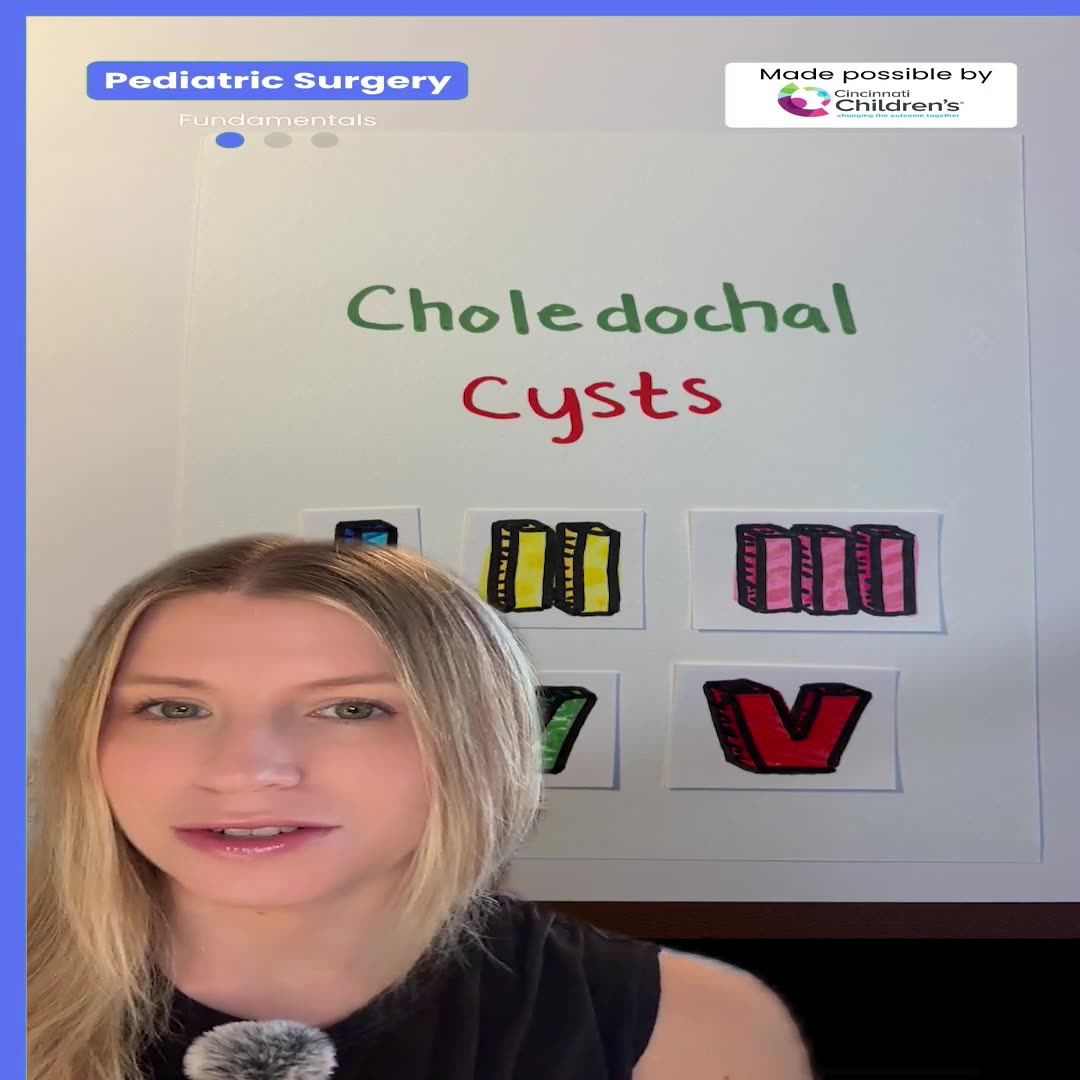
Choledochal Cyst Types Explained: Pediatric Surgery Fundamentals
1 min · Published Sep 2026
What the experts said
The retrospective data suggest no difference in leak rate or stricture rate between thoracoscopic and open TEF repair.
The primary reason for doing thoracoscopic TEF repair is eliminating the thoracotomy and its associated morbidity.
There is potential benefit with thoracoscopic approach in time to extubation, time to first oral feeding, overall hospital length of stay, and musculoskeletal sequelae.
No matter what kind of thoracotomy is performed, there is morbidity associated with having a thoracotomy as an infant.
The chief limitation of thoracoscopic TEF repair is the technical demand, specifically the challenge of the anastomosis done in situ.
There remains a need for a powered randomized controlled trial comparing thoracoscopic and open TEF repair.
In US training programs, fellows who are not as experienced as staff are being trained to do the TEF operation, making them perhaps the least experienced person in the operating room.
In the multi-center report from 13-14 years ago, the surgeons were very experienced in MIS, which contributed to the good results (3 recurrences in 104 patients).
Thoracoscopic TEF repair requires surgeons who are skilled in MIS to perform it and pass that skill on to trainees.
Rothenberg reports he has never had to resect a diverticulum after thoracoscopic TEF repair, whereas he has had to resect a number of diverticulums that were all done open.
Thoracoscopically, the fistula is seen coming in directly at 90 degrees perpendicular, which is not seen when the operation is done open.
The first successful open repair of tracheoesophageal fistula was performed in 1941 by Dr. Cameron Haight.
In the year 2000, Dr. Steven Rothenberg performed the first successful repair of a tracheoesophageal fistula with a minimally invasive approach (esophageal atresia had been the year before).
In Rothenberg's first decade of experience with 62 patients, he reported that thoracoscopic approach offered better visualization of the anatomy.
Rothenberg reported that performing the operation entirely in situ reduced manipulation of the trachea and therefore potentially reduced risk for tracheomalacia.
Rothenberg reported decreased tension on the esophageal anastomosis with thoracoscopic approach.
Rothenberg reported that smaller incisions would result in fewer musculoskeletal deformities such as scapular winging, chest wall asymmetry, and scoliosis.
The Tübingen Germany single-center study found the minimally invasive group was slightly larger at about 2,700g compared to 2,100g in the open group.
The Tübingen study found slightly more associated anomalies in the minimally invasive group at about 40% compared to 31% in the open group.
The Tübingen study found no statistically significant difference between groups in complication rate or time to postoperative extubation.
The Tübingen study found operative time was slightly longer at about half an hour longer in the minimally invasive group than in the open group.
The Tübingen study found higher intraoperative PaCO2 in the MIS group, but postoperatively there was no statistically significant difference.
The Holcomb multi-center study included 6 hospitals (Stanford California, Kansas City Missouri, Denver Colorado, Buenos Aires Argentina, Utrecht Netherlands, and Hong Kong China) with 104 total patients.
The Holcomb study found results equivalent to historical open controls in mortality rate and need for postoperative fundoplication.
The Holcomb study found results compared favorably to historical controls in terms of leak and recurrence.
The Japanese multi-center study of 7 hospitals with 58 patients found equivalence in mortality, leak rate, and recurrence between MIS and open approaches.
The Japanese study found a higher stricture rate in the minimally invasive group at about 48% compared to 17% in the open group.
The Hanover Germany study of patients who had minimally invasive or open thoracic procedures for benign conditions found improved rate of mild scoliosis in MIS group: over 50% in thoracotomy group compared to less than 10% in minimally invasive group.
The Hanover study found patients were more satisfied with scarring in the MIS group based on Manchester scarring criteria.
The Hanover study found chest wall asymmetry was improved in the minimally invasive group, specifically in chest wall diameter and distance of nipple to xiphoid.
The Hanover study found no difference in shoulder range of motion between MIS and open groups.
A 2012 meta-analysis of 4 articles representing 166 patients (69 MIS, 97 open) found no statistically significant difference in stricture rate, leak rate, operative time, or time to postoperative extubation.
A 2016 meta-analysis of 8 articles with 452 patients (221 MIS, 231 open) found no difference in stricture rate or leak rate.
The 2016 meta-analysis found operative time was about 20 minutes longer in the minimally invasive group.
The 2016 meta-analysis found time to postoperative extubation and first postoperative feeding were about 2.5 days sooner in the MIS group.
The 2016 meta-analysis found hospital length of stay was almost 11 days shorter in the MIS group.
A pilot randomized controlled trial at Children's Hospital London with 10 patients (randomized to MIS or open) found no difference in intraoperative PaCO2, pH, time in OR, peak inspiratory pressure, or length of ICU stay.
The London pilot RCT found 1 stricture in the open group compared to 3 strictures in the thoracoscopic group, and 1 leak in the thoracoscopic group compared to none in the open group.
A recent study from the Midwest Consortium of approximately 10 hospitals showed less than 15% of TEF cases were done thoracoscopically in major US training centers.