


Chapter 1 of 11 · Fundamentals
Introduction
Introduction and Guest Credentials
Expert statements on this page
No expert statements were drawn from this page.
Host summaries · secondary, not cited in answers
Educational content from recorded physician discussions — not medical advice. Talk to your (or your child's) care team about your situation.
Video
DrBeen Medical Lectures: Dr. Marc Levitt, MD Discusses Hirschsprung Disease
53 min · Published Dec 2022
Video
Colorectal Quiz: Episode 46 - Hirschsprung's Disease
Marc Levitt · 29 min · Published Apr 2025
Podcast
Colorectal Quiz Episode 3: Hirschsprung Disease
20 min · Published Feb 2021
Podcast
Colorectal Quiz: Episode 46
Marc Levitt · 29 min · Published Apr 2025
Video
Meconium Plug Syndrome (MPS)
Published Mar 2020
Video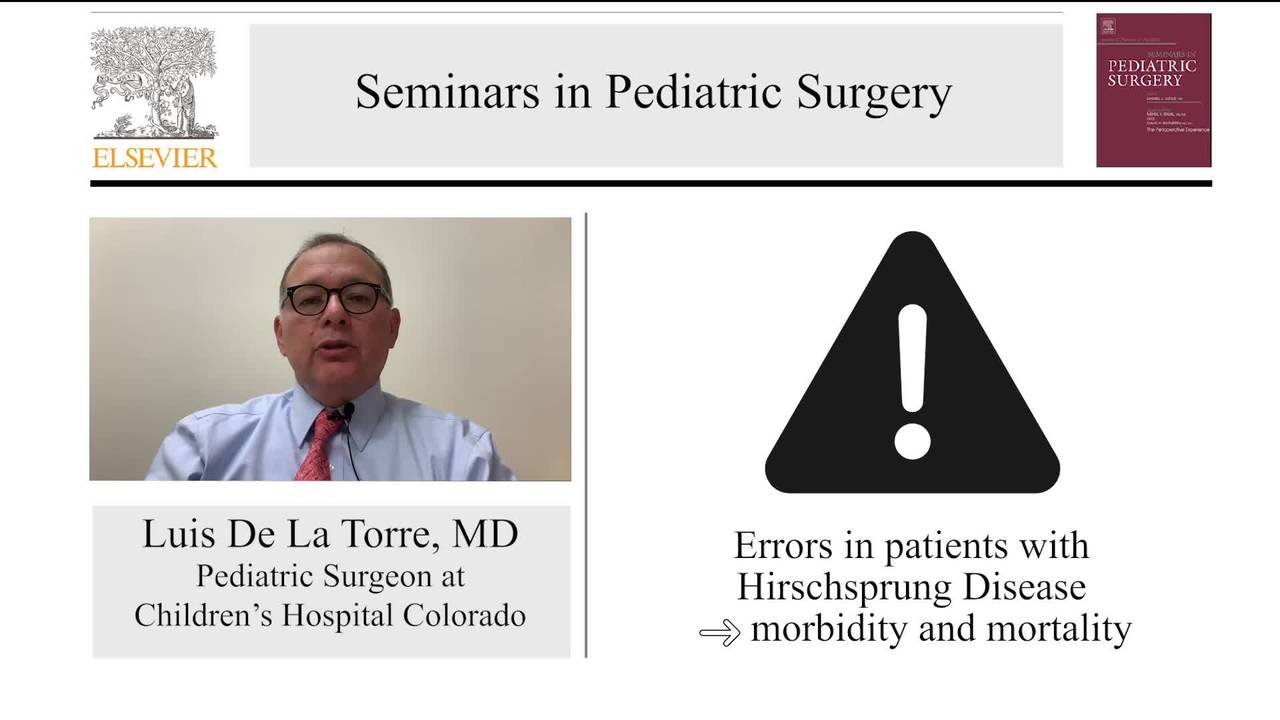
Error Traps and Culture of Safety in Hirschsprung Disease
CCHMC Pediatric Surgery · Published Oct 2019
Video
Validation of an anorectal malformation trainer - Can a high-fidelity model simulate real life?
1 min · Published Jun 2026
Video
Complications and Long-Term Outcomes of Patients With Cloacal Malformation After Bowel Neovagina...
1 min · Published Jun 2026
Video
Safety and utility of long-acting steroid injection for management of post-operative stricture...
1 min · Published Jun 2026
Video
Association Between Social Determinants of Health and Choice of Urinary Reconstruction in Children
1 min · Published Jun 2026
Video
The Perineal Body Preserving PSARP (PPP)
11 min · Published Jun 2026
Video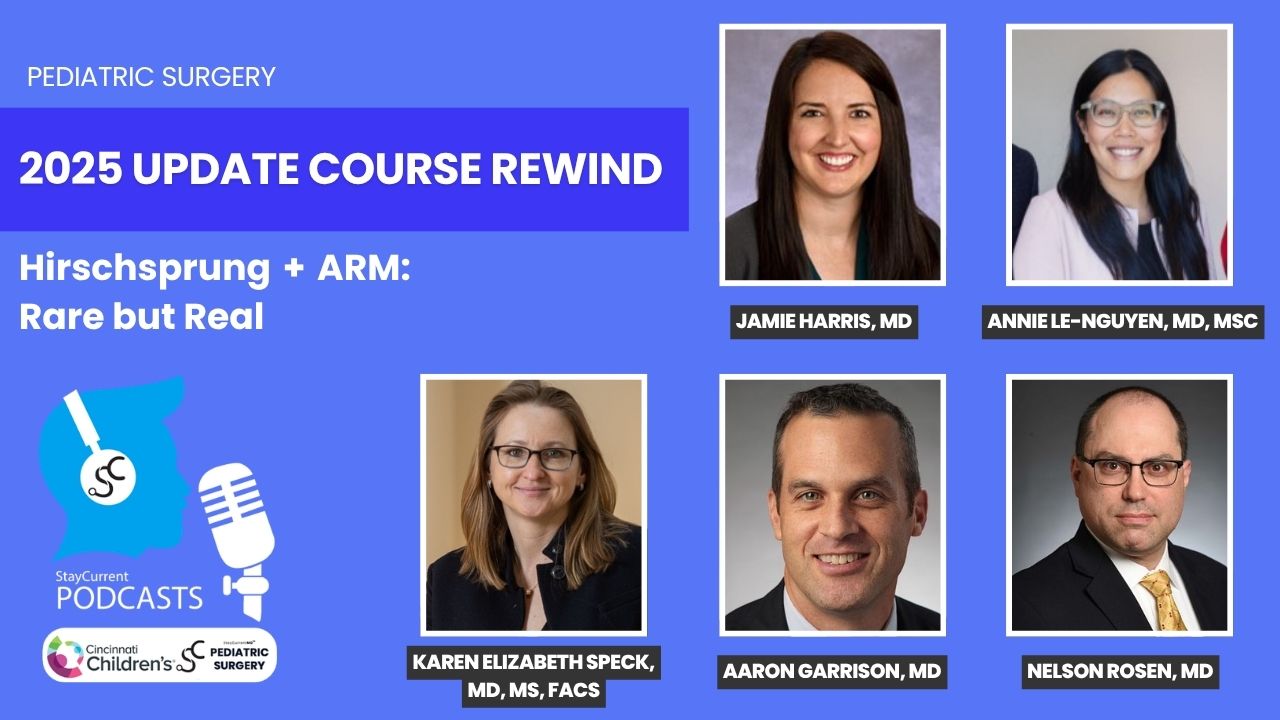
Update Course Rewind 2025: Hirschsprung + ARM: Rare but Real
1 min · Published May 2026
Video
Colorectal Quiz Ep. 50 -16th Annual European Pediatric Colorectal & Pelvic Reconstruction Conference
Marc Levitt · Published Mar 2026
Podcast
Colorectal Quiz: Episode 50 - 16th Annual European Pediatric Colorectal and Pelvic Reconstruction Conference, Stockholm, Sweden, October 2025 - What did we learn?
24 min · Published Mar 2026
Video
Colorectal Quiz Episode 33: Cloaca Exstrophy
Marc Levitt · 22 min · Published Sep 2025
Video
The Colorectal Quiz Episode 21: The History of Hirschsprung Disease
Marc Levitt · 15 min · Published Sep 2025
Video
Colorectal Quiz: Episode 49 – Collaborating for Kids: Colorectal & Pelvic Care (with Help from AI)
Marc Levitt · 40 min · Published Jul 2025
Podcast
Colorectal Quiz: Episode 49 - Collaborating for Kids: Colorectal & Pelvic Solutions (with a Little Help from AI)
Marc Levitt · 40 min · Published Jul 2025
What the experts said
Hirschsprung disease affects approximately 1 in 5,000 children.
In Hirschsprung disease, nerve ganglia are absent in the distal colon, causing the affected segment to remain contracted and unable to relax.
The proximal colon dilates as it attempts to push stool through the contracted distal segment.
Stasis of stool in the dilated proximal colon allows bacterial overgrowth, creating a 'swamp' that can lead to enterocolitis.
Girls are slightly more commonly affected by Hirschsprung disease, but the difference is not dramatic; approximately half of patients are boys and half are girls.
There are no racial or ethnic differences in Hirschsprung disease incidence.
Down syndrome is associated with a higher incidence of Hirschsprung disease than the general population.
Hirschsprung disease shows familial clustering, with documented cases spanning three generations (grandparent, parent, child).
Nerve ganglia normally migrate from proximal to distal during bowel development; in Hirschsprung disease, this migration is incomplete, always affecting the distal bowel with no skip areas.
Most infants with Hirschsprung disease fail to pass meconium in the first 24 hours of life; suspicion increases if no stool has passed by 48 hours.
Affected infants develop abdominal distention, irritability, and vomiting.
Infants with very short-segment Hirschsprung disease may not present in the newborn period and can eat and stool, though never well, remaining chronically distended.
Older children with undiagnosed Hirschsprung disease typically show failure to thrive, chronic abdominal distention, and episodes of diarrhea (which are actually enterocolitis).
Anorectal malformation (imperforate anus) is a key differential diagnosis; careful inspection of the perineum is essential to confirm an anal opening exists.
Maternal magnesium sulfate (used to slow contractions during difficult delivery) can cause transient bowel dysmotility in newborns lasting several days.
Hypothyroidism and maternal narcotic exposure can both cause severe neonatal bowel dysmotility.
Cystic fibrosis can present with neonatal bowel obstruction and typically has a characteristic X-ray appearance.
Diagnosis begins with plain abdominal X-ray showing colonic distention, followed by contrast enema demonstrating a narrow distal segment with proximal dilation.
Definitive diagnosis requires rectal biopsy showing both absence of ganglion cells AND hypertrophied nerve trunks; both criteria are necessary.
Water-soluble contrast is preferred over barium for contrast enemas in suspected Hirschsprung disease.
Initial management requires rectal catheter insertion to decompress the colon, allowing gas and liquid stool to rush out.
Rectal irrigations (not enemas) must be performed repeatedly to wash the colonic lining and prevent bacterial overgrowth; irrigations involve continuous fluid exchange, not simple instillation.
Historically, Hirschsprung disease required three operations over six months: colostomy creation, pull-through procedure, and colostomy closure.
Modern surgical technique allows the entire operation to be performed transanally with no abdominal incisions, sometimes with laparoscopic assistance.
Modern single-stage repair can be performed in the first week of life, with hospital discharge several days later.
Enterocolitis in Hirschsprung disease is diarrhea occurring proximal to the obstruction, invisible to clinicians because stool cannot exit the anus.
Fluid shifts from the infant's body into the obstructed colon cause severe dehydration without visible diarrhea.
Several infants die annually in the United States from Hirschsprung enterocolitis; mortality is higher in developing countries.
Inflamed colonic mucosa allows bacterial translocation into the bloodstream, causing sepsis.
Bowel perforation can occur in the most distended area if enterocolitis progresses, though this is extremely rare.
Rectal irrigations performed by skilled neonatal nurses break the enterocolitis cycle and prevent progression to perforation and sepsis.
An elegantly performed operation should result in normal bowel emptying and 100% normal bowel function.
Imperfect initial surgery can leave anatomic problems causing either obstructive symptoms or fecal incontinence.
Children with persistent problems after Hirschsprung surgery should not be expected to improve over time; anatomic causes can almost always be identified and corrected.
Re-evaluation of children with persistent problems should include contrast study, rectal biopsy to confirm adequate bowel was used, and surgical examination of the pull-through segment.
Even after anatomically perfect operations, some children have mild constipation requiring laxatives and dietary modifications, similar to functional constipation management.
Current research priorities include identifying the specific genetic mutations causing Hirschsprung disease.
A key research question is why the colonic mucosa in Hirschsprung patients is uniquely susceptible to bacterial translocation and enterocolitis, unlike normal children with constipation.
Research is ongoing to understand why anatomically normal colon after successful repair sometimes still has slow motility.
The Center for Colorectal and Pelvic Reconstruction unifies four traditionally independent teams: colorectal surgery, urology, gynecology, and gastroenterology/motility.
The center has treated patients from all 50 U.S. states and 88 countries.
Dr. Levitt has performed over 5,000 colorectal procedures.