


From
StayCurrentMD
Hirschsprung Disease: History
With CCHMC Pediatric Surgery · hosted by Dr. Todd Ponsky
Chapter 1 of 5 · Fundamentals
Early theories
Early History and Initial Theories of Hirschsprung Disease
Expert statements on this page
No expert statements were drawn from this page.
Host summaries · secondary, not cited in answers
Educational content from recorded physician discussions — not medical advice. Talk to your (or your child's) care team about your situation.
Video
History of Hirschsprung Disease
CCHMC Pediatric Surgery · 18 min · Published Nov 2018
Video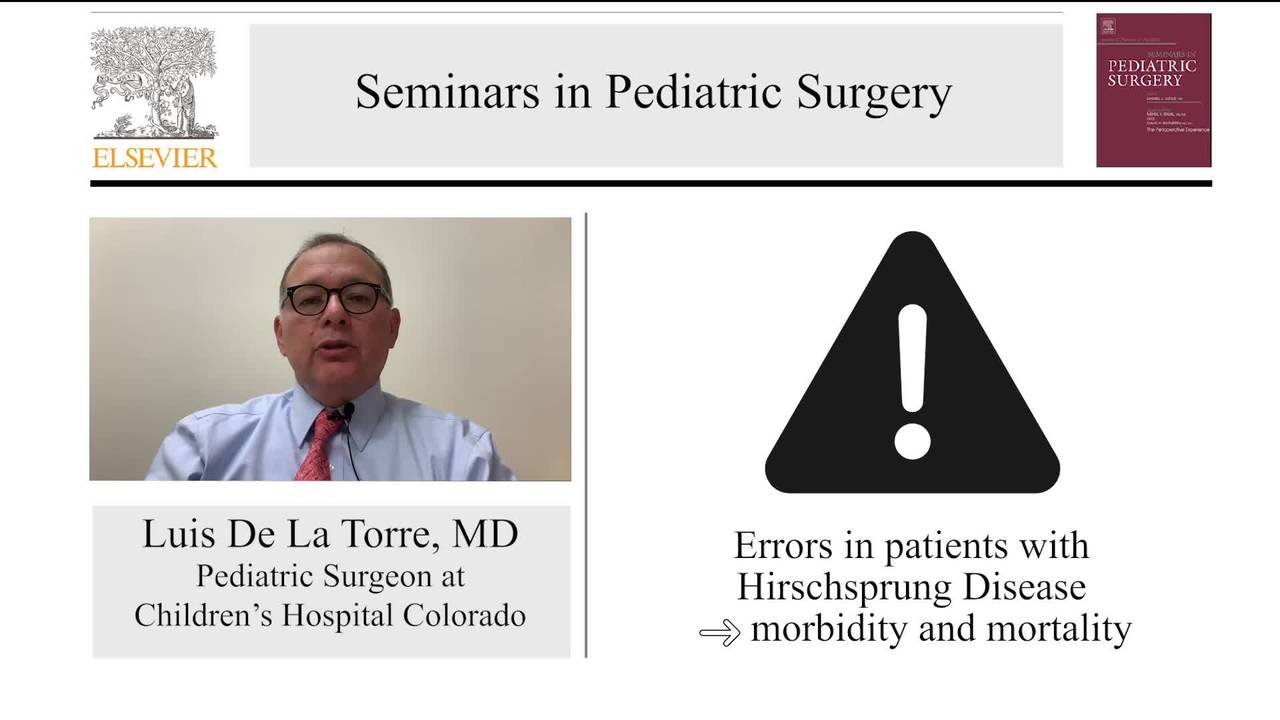
Error Traps and Culture of Safety in Hirschsprung Disease
CCHMC Pediatric Surgery · Published Oct 2019
Podcast
The Colorectal Quiz Episode 5: Proximal Hirschsprung Disease Surgical Technique
14 min · Published Mar 2021
Video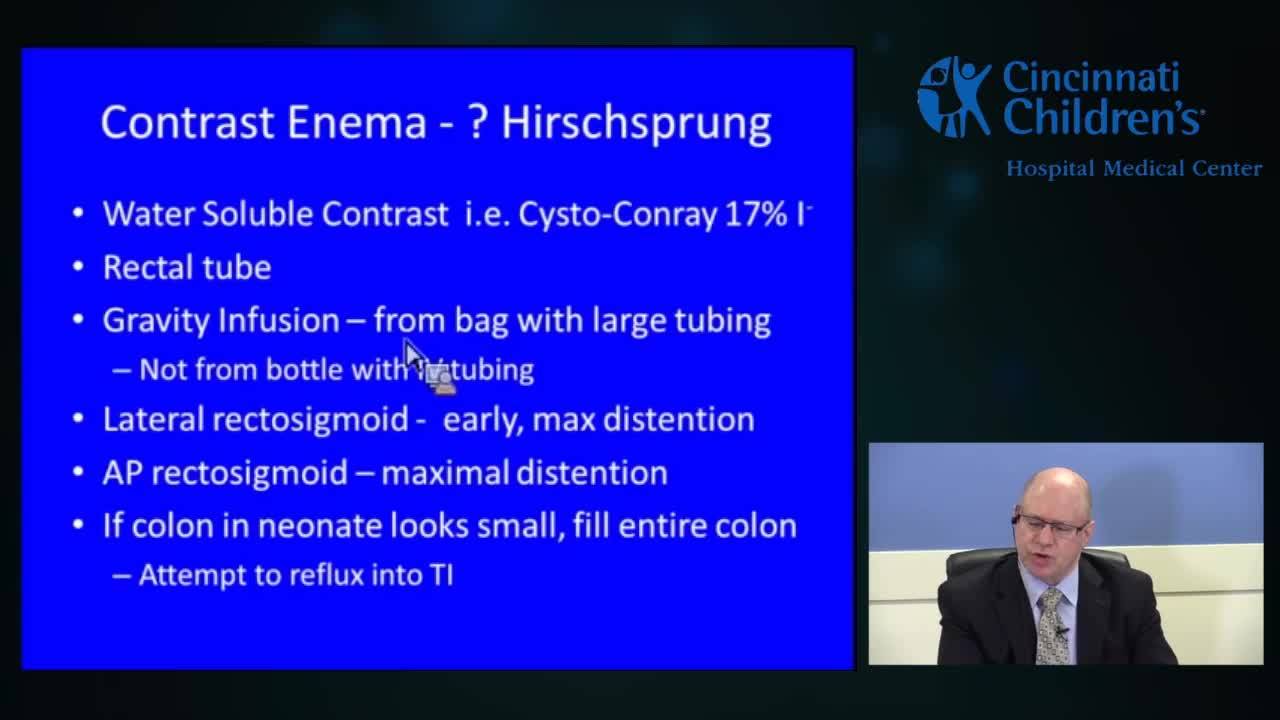
Contrast Enema for Hirschsprung Disease
11 min · Published Feb 2015
Video
Hirschsprung Disease: Pathology Aspect
CCHMC Pediatric Surgery · 42 min · Published Feb 2015
Podcast
Hirschsprung Disease â PediaCast 287
Marc Levitt · 38 min · Published May 2014
Video
Validation of an anorectal malformation trainer - Can a high-fidelity model simulate real life?
1 min · Published Jun 2026
Video
Complications and Long-Term Outcomes of Patients With Cloacal Malformation After Bowel Neovagina...
1 min · Published Jun 2026
Video
Safety and utility of long-acting steroid injection for management of post-operative stricture...
1 min · Published Jun 2026
Video
Association Between Social Determinants of Health and Choice of Urinary Reconstruction in Children
1 min · Published Jun 2026
Video
The Perineal Body Preserving PSARP (PPP)
11 min · Published Jun 2026
Video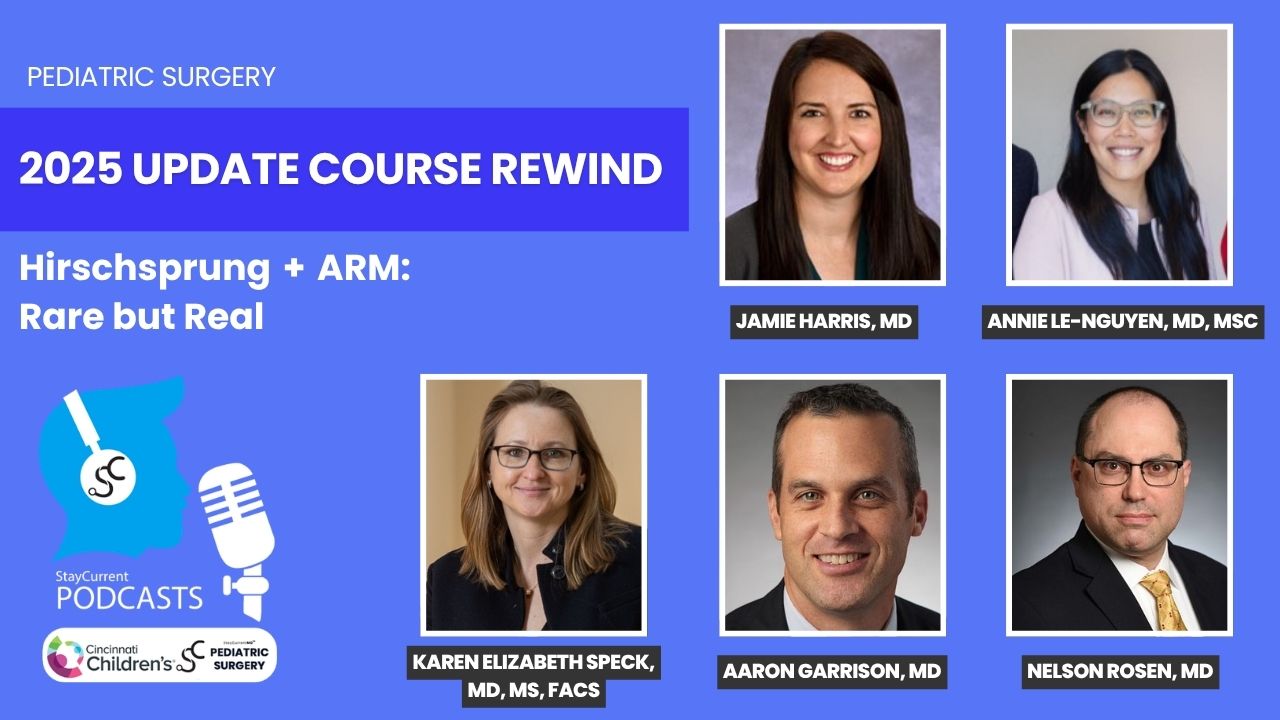
Update Course Rewind 2025: Hirschsprung + ARM: Rare but Real
1 min · Published May 2026
Video
Intestinal Atresia Types Explained: Grossfeld Classification for Pediatric Surgery
1 min · Published Sep 2026
Video
Derivation and validation of the Pediatric Community-Acquired Pneumonia Severity (PedCAPS) score: A prospective cohort study
50 s · Published Sep 2026
Video
FETO for Late-Diagnosed Severe Congenital Diaphragmatic Hernia (CDH) at Cincinnati Children's with Dr. Beth Rymeski
4 min · Published Sep 2026
Video
Severe Congenital Diaphragmatic Hernia (CDH) Case: FETO Management & Unexpected Findings with Dr. Beth Rymeski
3 min · Published Sep 2026
Video
Fetoscopic Endoluminal Tracheal Occlusion (FETO) Procedure: Step-by-Step Guide with Dr. Beth Rymeski
4 min · Published Sep 2026
Video
Choledochal Cyst Types Explained: Pediatric Surgery Fundamentals
1 min · Published Sep 2026
What the experts said
Electric enemas were described around 1908 and involved passing a tube through the rectum with an electrode inside and another electrode on the abdomen, delivering about 40 milliamps of interrupted cycling current to facilitate expulsion of saline solution from the colon.
Barry Shandling worked in Canada.
Dr. Lester Martin was the chief of pediatric surgery at Cincinnati Children's Hospital.
Harald Hirschsprung presented a paper on constipation in newborns due to dilation and hypertrophy of the colon in 1886 at the Society of Pediatrics in Berlin.
Dr. Hirschsprung was a pediatrician who developed the hydrostatic reduction of ileocolonic intussusception, a contribution unrelated to Hirschsprung's disease.
Early theories to explain Hirschsprung disease etiology included: obstruction (mechanical blockage from redundant colon or rectal valves), malformation (hypertrophied colon as primary congenital defect), and spastic distal colon causing functional obstruction.
The malformation theory (hypertrophied colon as primary defect) came first among early theories, but all theories were wrong because they focused on the dilated portion as diseased rather than as a consequence of the disease.
William Osler, one of the four founding professors of Johns Hopkins and creator of the residency system, proposed colostomy or rectal tube and irrigation as possible treatments for Hirschsprung's disease.
The finding of no ganglion cells in the narrow rectal sigmoid was finally recognized as the cause of Hirschsprung disease in 1946 by Orvar Swenson.
Others before Swenson, including Dr. Dalalé in 1920, recognized absent ganglion cells in the distal portion but thought it was an acquired condition rather than the cause of the disease.
Treatments used for Hirschsprung disease prior to 1946 included anal sphincter dilation, rectosigmoid myotomy, spinal anesthesia, lumbar sympathectomy, and electric enemas, but not resection of the distal non-dilated portion.
Barium enema technique became the standard diagnostic test for Hirschsprung's disease in 1948, with Dr. Swenson involved in this publication.
Barry Shandling proposed punch biopsies for newborns that required no closure nor anesthesia.
Dr. Sydegaard from Sweden performed the first successful operation for total colonic aganglionosis in 1953, doing a colon resection with an ileoanal anastomosis.
Swenson observed that when patients had a colostomy, the obstruction was relieved, but when the colostomy was closed, the disease returned.
Swenson scoped from the rectum in patients with colostomy and saw there was no true mechanical obstruction.
Swenson used a probe on the proximal stoma and observed normal peristalsis, but when he put a probe in the distal stoma, there was no peristalsis.
Swenson performed contrast studies and observed a non-dilated portion followed by a dilated portion, leading him to conclude that the distal portion was the diseased one.