


From
Colorectal Channel
Hirschsprung Disease Audience Q&A with Dr. Marc Levitt
With Dr. Scott Ingham & Dr. Marc Levitt · hosted by Dr. Em Gootee
Chapter 1 of 6 · Fundamentals
Introduction
Introduction and Question Setup
Expert statements on this page
No expert statements were drawn from this page.
Host summaries · secondary, not cited in answers
Educational content from recorded physician discussions — not medical advice. Talk to your (or your child's) care team about your situation.
Podcast
Colorectal Quiz: Episode 46
Marc Levitt · 29 min · Published Apr 2025
Video
Colorectal Quiz: Episode 46 - Hirschsprung's Disease
Marc Levitt · 29 min · Published Apr 2025
Podcast
Hirschsprung's Disease
20 min · Published Oct 2020
Podcast
Colorectal Quiz Episode 19: Hirschsprung Disease - The Obstructed Patient Part 1
24 min · Published Aug 2021
Podcast
The Colorectal Quiz Episode 20: Hirschsprung Disease Obstruction Part 2
21 min · Published Sep 2021
Video
Hirschsprung Disease: Cases and Complications
103 min · Published Feb 2015
Video
Validation of an anorectal malformation trainer - Can a high-fidelity model simulate real life?
1 min · Published Jun 2026
Video
Complications and Long-Term Outcomes of Patients With Cloacal Malformation After Bowel Neovagina...
1 min · Published Jun 2026
Video
Safety and utility of long-acting steroid injection for management of post-operative stricture...
1 min · Published Jun 2026
Video
Association Between Social Determinants of Health and Choice of Urinary Reconstruction in Children
1 min · Published Jun 2026
Video
The Perineal Body Preserving PSARP (PPP)
11 min · Published Jun 2026
Video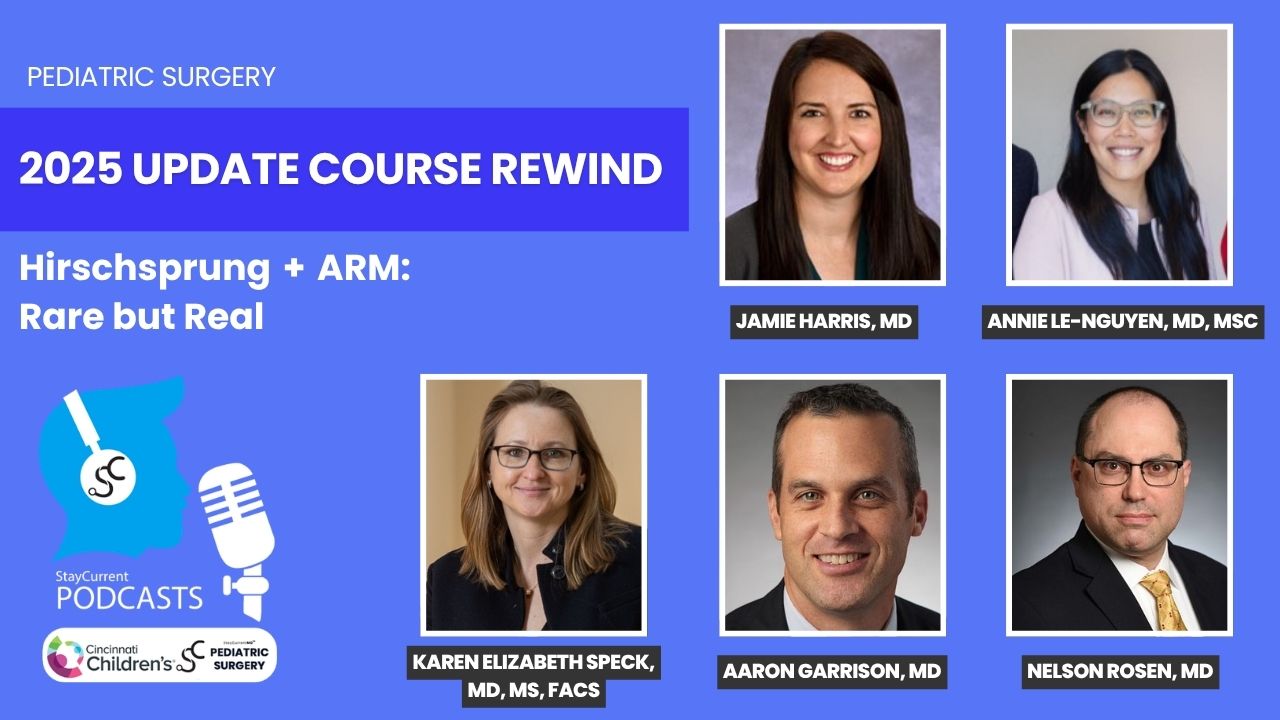
Update Course Rewind 2025: Hirschsprung + ARM: Rare but Real
1 min · Published May 2026
Only a few other public items share this expert — go deeper there →
Podcast
Long-term obstetric and gynecologic care for patients with anorectal malformations
21 min · Published Sep 2026
Podcast
Post-pubertal gynecologic evaluation and management of patients with anorectal malformations
22 min · Published Sep 2026
Podcast
Pre-pubertal gynecologic evaluation and management of patients with anorectal malformations
23 min · Published Sep 2026
Podcast
Methods of gynecologic evaluation for patients with anorectal malformations
21 min · Published Sep 2026
Podcast
Gynecologic care in patients with anorectal malformations: A primer and call to action
18 min · Published Sep 2026
Podcast
Evaluation and Management of Postsurgical Patient With Hirschsprung Disease Neurogastroenterology & Motility Committee: Position Paper of North American Society of Pediatric Gastroenterology, Hepatology, and Nutrition (NASPGHAN)
17 min · Published Sep 2026
What the experts said
Botox paralyzes skeletal muscle but clearly has some impact on smooth muscle
Babies have very tight anal sphincter with or without Hirschsprung's disease, and if they hold stool in successfully, normal babies get constipated while Hirschsprung babies get enterocolitis
After a perfectly done operation that preserves 1 centimeter of anal canal without hurting sphincters, high tone will occur in a baby that doesn't know how to relax
Botox is valuable for babies coming back with enterocolitis episodes after ensuring no anatomic or pathologic problem with the pull-through
In the early period up to one year of age, bad behavior by the patient can occur even with a perfectly done pull-through
After one year of age, there may be an anatomic or pathologic problem, and Botox is not very valuable because the underlying problem must be identified
A retained cuff that is too big, not split completely, or rolled up is particularly offensive to the ability of the pull-through to empty
Patients with retained cuff will get better temporarily with Botox but will continue to fail every 2 or 3 months
Nerves greater than 40 microns indicate a transition zone pull-through
Many pathologists are not measuring nerve caliber, and pediatric surgeons should demand that their pathologists do this to avoid doing a pull-through in the transition zone
When anatomic and pathologic issues are completely ruled out (no twist, stricture, cuff, etc.), Botox may be done once or maybe twice and then the patient is done
If a patient over 1 year of age keeps misbehaving, there is likely an anatomic or pathologic problem
Dr. Levitt has never met a patient with Hirschsprung disease that is anatomically perfect (no stricture, cuff, duhamel pouch causing trouble, twist) with normal ganglion cells and nerves less than 40 microns who does not spontaneously empty, except rare patients under one year who have not learned to relax their anal canal
If symptoms persist in an older child, there is an anatomic or pathologic problem that has not yet been identified
Dr. Levitt's Botox technique: 100 units in 10 cc saline, injecting 2.5 cc submucosal into each quadrant with a very small gauge needle
Dr. Levitt will never do internal sphincterotomy because it is permanent Botox and could cause permanent incontinence
Most practitioners use between 60 and 100 units of Botox for Hirschsprung patients
Some practitioners use much less volume (1 mL total with 0.25 mL per quadrant) compared to Dr. Levitt's 10 mL technique
A dilated pull-through segment may be secondary to noncompliance with dilations or bowel regimen, or the surgeon may not have taken out enough bowel at the original surgery
Patients with dilated segment and no other anatomic abnormality who continue to misbehave may be offered redo surgery to remove the dilated segment, though this is exceedingly rare
Almost always there is something causing the dilation, either a cuff or a transition zone segment of bowel
The workup for patients with dilated segments includes contrast study, examination under anesthesia, and rectal biopsy
For redo pull-through, Dr. Levitt performs transanal approach saving the anal canal, delivers bowel into abdomen, then decides whether tapering is needed
A tapered segment will be fairly dysmotile for many months
Dr. Levitt always diverts patients with an ileostomy if tapering or redo is required
Most likely the dilated segment can be removed and healthy segment brought down without tapering
It is critical to ensure removal of any distal obstruction during redo surgery; Dr. Levitt has seen patients redone with Soave cuff left alone, requiring redo of the redo to remove the cuff before improvement