


From
StayCurrentMD
Enterocolitis in Hirschsprung Disease: Update Course 2015
With CCHMC Pediatric Surgery
Chapter 1 of 2 · Diagnosis & Workup
Sphincter assessment
Sphincter assessment and MRI utility in Hirschsprung disease
Expert statements on this page
No expert statements were drawn from this page.
Host summaries · secondary, not cited in answers
Educational content from recorded physician discussions — not medical advice. Talk to your (or your child's) care team about your situation.
Video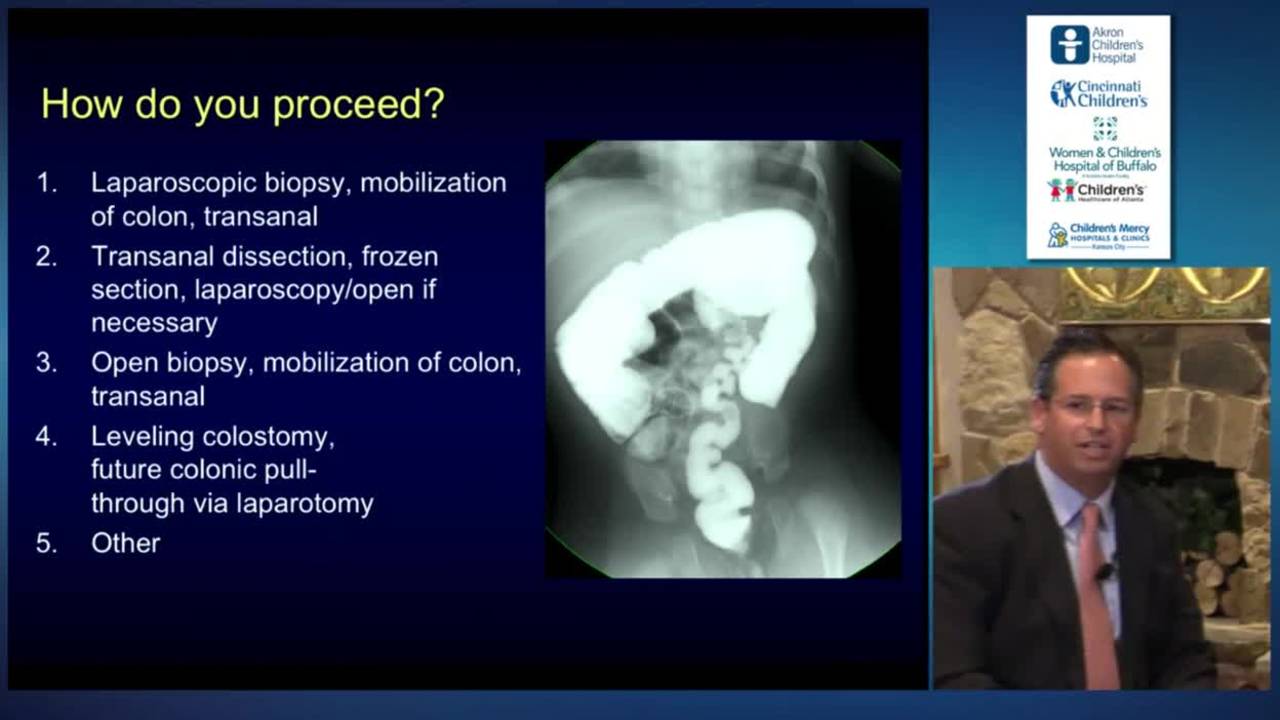
Hirschsprung Disease Rapid Fire: Update Course 2015
CCHMC Pediatric Surgery · 12 min · Published Nov 2015
Video
Finnish Pediatric Surgery Hub - From Centralization to Collective Learning and Sharing of Expertise
48 s · Published Feb 2025
Video
Bowel Management - Bowel Management In Communities With Limited Resources
9 min · Published Nov 2018
Podcast
The Colorectal Quiz Episode 23: Hirschsprung Disease - The Soiling Patient...
26 min · Published Dec 2021
Video
Colorectal Surgery: What does the anesthesia provider need to know?
24 min · Published Oct 2023
Video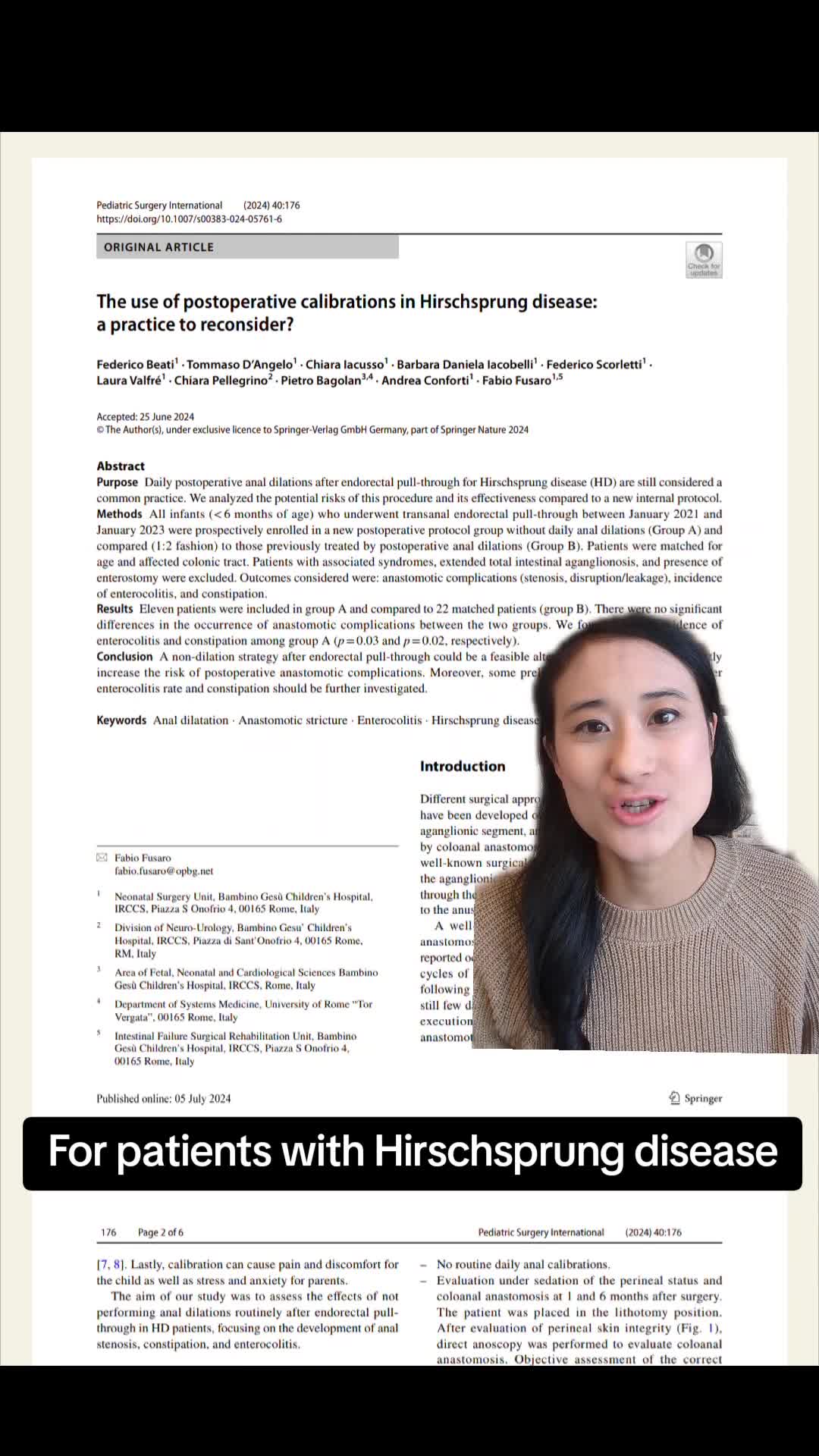
The use of postoperative calibrations in Hirschsprung disease
59 s · Published Nov 2024
Video
Validation of an anorectal malformation trainer - Can a high-fidelity model simulate real life?
1 min · Published Jun 2026
Video
Complications and Long-Term Outcomes of Patients With Cloacal Malformation After Bowel Neovagina...
1 min · Published Jun 2026
Video
Safety and utility of long-acting steroid injection for management of post-operative stricture...
1 min · Published Jun 2026
Video
Association Between Social Determinants of Health and Choice of Urinary Reconstruction in Children
1 min · Published Jun 2026
Video
The Perineal Body Preserving PSARP (PPP)
11 min · Published Jun 2026
Video
Update Course Rewind 2025: Hirschsprung + ARM: Rare but Real
1 min · Published May 2026
Video
Intestinal Atresia Types Explained: Grossfeld Classification for Pediatric Surgery
1 min · Published Sep 2026
Video
Derivation and validation of the Pediatric Community-Acquired Pneumonia Severity (PedCAPS) score: A prospective cohort study
50 s · Published Sep 2026
Video
FETO for Late-Diagnosed Severe Congenital Diaphragmatic Hernia (CDH) at Cincinnati Children's with Dr. Beth Rymeski
4 min · Published Sep 2026
Video
Severe Congenital Diaphragmatic Hernia (CDH) Case: FETO Management & Unexpected Findings with Dr. Beth Rymeski
3 min · Published Sep 2026
Video
Fetoscopic Endoluminal Tracheal Occlusion (FETO) Procedure: Step-by-Step Guide with Dr. Beth Rymeski
4 min · Published Sep 2026
Video
Choledochal Cyst Types Explained: Pediatric Surgery Fundamentals
1 min · Published Sep 2026
What the experts said
A patulous anus can be identified by observation; Hirschsprung anus should be a normal appearing anus with a normal anal canal.
In anorectal malformations, MRI is used to assess placement of the anus within the sphincters, whereas in Hirschsprung disease the dissection goes right through the sphincter and anal canal without placing the anus.
Jason goes approximately 1 centimeter above the dentate line for anal-rectal dissection in Hirschsprung disease.
A dissection distance of 1 centimeter in a newborn might become 2.5 or 3 centimeters when the child is 7 years old, potentially creating what some would call short segment or ultra short segment Hirschsprung disease.
If the dissection is not high enough and a biopsy is taken, it might show transition zone tissue.
Injury to the dentate line can render patients fecally incontinent, which is a devastating injury.
One surgeon goes 1 centimeter or slightly less above the top of the anal columns.
Jason defines the dentate line as the transition of columnar epithelium, the transition from squamous epithelium to columnar epithelium.
Jason uses the columns as a landmark, going 1 centimeter above the line where the transition from squamous to columnar epithelium is visible.
In J pouch procedures for ulcerative colitis or FAP patients, Jason goes right at the top of the columns, or may hedge lower if polyps are present in that region.
The distance from anoderm to the top of the columns grows with the patient but is almost always the same in newborns.
The dentate line (also called the pectinate line) is pointed to variably in anatomic illustrations and dissections from different sources.
Jason defines the dentate line as the transition from squamous to columnar epithelium, which is where the bottom of the columns lie.
Belinda uses the tops of the columns as a standard landmark for dissection level.
One surgical approach goes to the top of the columns, deliberately leaving a zone of aganglionosis, reasoning that this can be overcome with laxatives whereas fecal incontinence cannot be overcome.
Jason's approach hedges on the side of leaving an ultra short segment Hirschsprung disease versus injuring the anal canal.