

From
Colorectal Channel
Colorectal Quiz: Episode 50 - 16th Annual European Pediatric Colorectal and Pelvic Reconstruction Conference, Stockholm, Sweden, October 2025 - What did we learn?
With Dr. Lindsey Clarke & Dr. Meghan Mesa & Dr. Felipe Gli · hosted by Dr. Marc Levitt
Chapter 1 of 9 · Surgical Management
Irrigation competency
Introduction and Hirschsprung Irrigation Competency
Expert statements on this page
No expert statements were drawn from this page.
Host summaries · secondary, not cited in answers
Educational content from recorded physician discussions — not medical advice. Talk to your (or your child's) care team about your situation.
Video
Problematic Anorectal Malformation Cases: Pediatric Colorectal Controversies...
13 min · Published Apr 2012
Podcast
Colorectal Quiz: Episode 46
Marc Levitt · 29 min · Published Apr 2025
Podcast
Update Course Rewind: Pediatric Colorectal Consortium 2021
14 min · Published Apr 2022
Podcast
The Colorectal Quiz Episode 5: Proximal Hirschsprung Disease Surgical Technique
14 min · Published Mar 2021
Video
Colorectal Quiz: Episode 41 - Perineal Hypospadias
Marc Levitt · 17 min · Published Nov 2024
Podcast
Anorectal Malformations Complications
Marc Levitt · 48 min · Published Feb 2016
Video
Validation of an anorectal malformation trainer - Can a high-fidelity model simulate real life?
1 min · Published Jun 2026
Video
Complications and Long-Term Outcomes of Patients With Cloacal Malformation After Bowel Neovagina...
1 min · Published Jun 2026
Video
Safety and utility of long-acting steroid injection for management of post-operative stricture...
1 min · Published Jun 2026
Video
Association Between Social Determinants of Health and Choice of Urinary Reconstruction in Children
1 min · Published Jun 2026
Video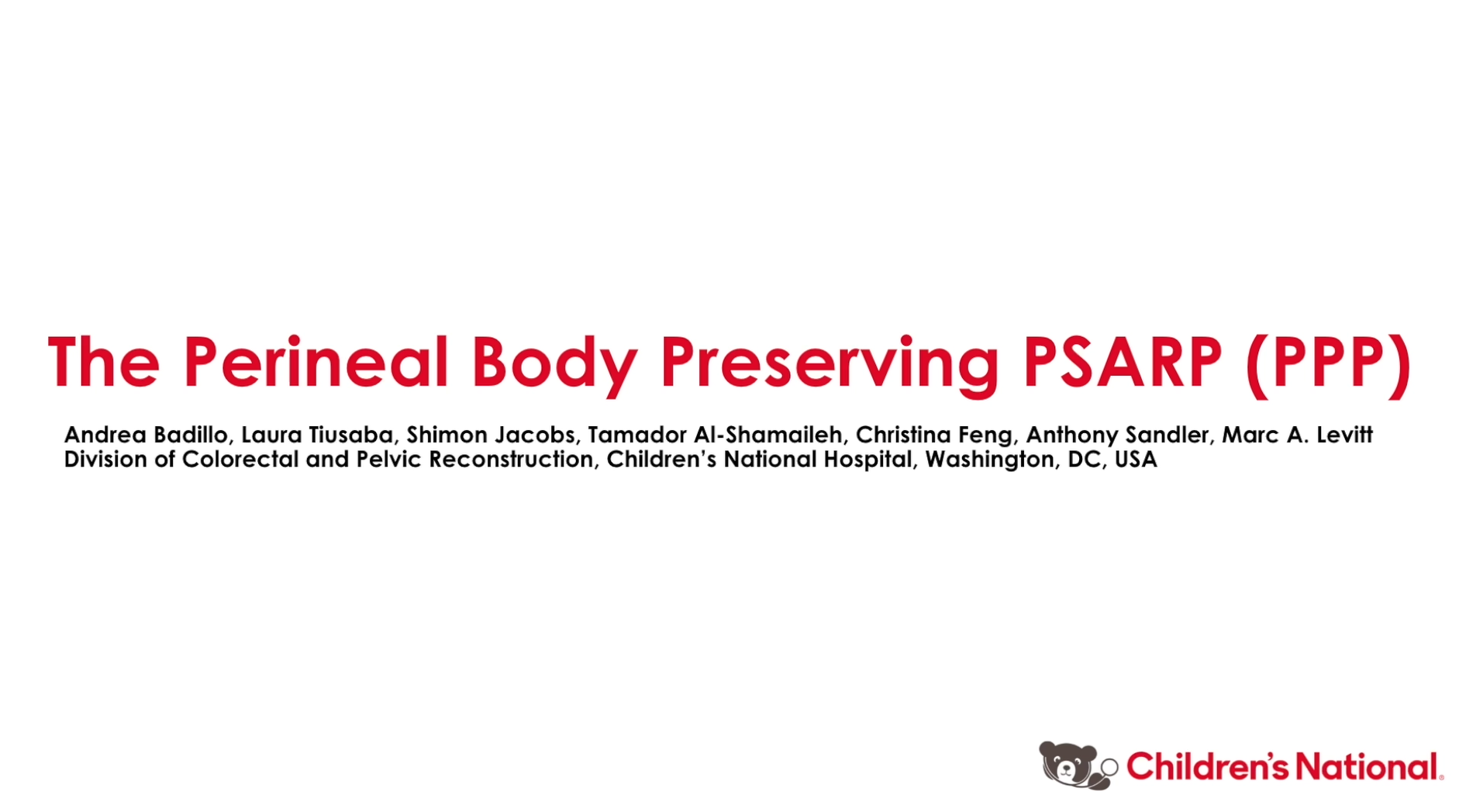
The Perineal Body Preserving PSARP (PPP)
11 min · Published Jun 2026
Video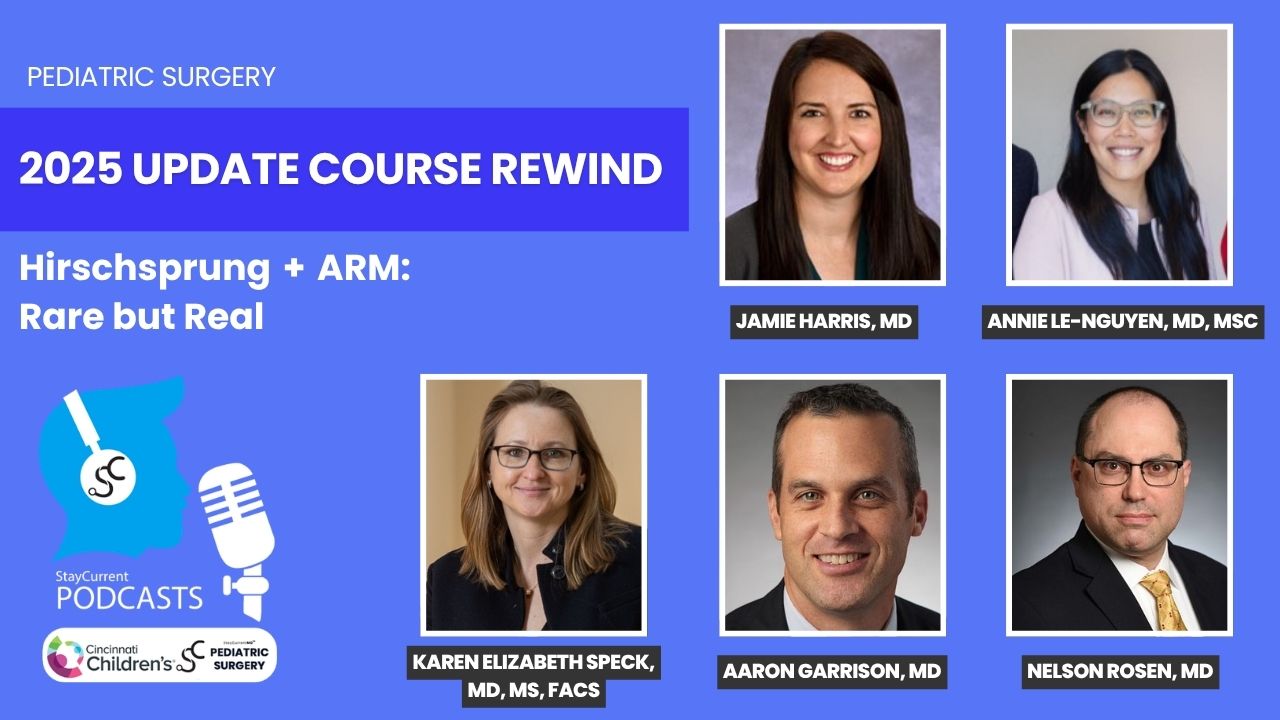
Update Course Rewind 2025: Hirschsprung + ARM: Rare but Real
1 min · Published May 2026
Only a few other public items share this expert — go deeper there →
Podcast
Long-term obstetric and gynecologic care for patients with anorectal malformations
21 min · Published Sep 2026
Podcast
Post-pubertal gynecologic evaluation and management of patients with anorectal malformations
22 min · Published Sep 2026
Podcast
Pre-pubertal gynecologic evaluation and management of patients with anorectal malformations
23 min · Published Sep 2026
Podcast
Methods of gynecologic evaluation for patients with anorectal malformations
21 min · Published Sep 2026
Podcast
Gynecologic care in patients with anorectal malformations: A primer and call to action
18 min · Published Sep 2026
Podcast
Evaluation and Management of Postsurgical Patient With Hirschsprung Disease Neurogastroenterology & Motility Committee: Position Paper of North American Society of Pediatric Gastroenterology, Hepatology, and Nutrition (NASPGHAN)
17 min · Published Sep 2026
What the experts said
Many centers are starting irrigation competency even with an ostomy in place, particularly for total colonic Hirschsprung patients, to ease the transition after takedown.
Total colonic Hirschsprung patients with a stoma are the highest risk group for enterocolitis and must receive irrigation teaching before pull-through.
Diet management for Hirschsprung patients is not one size fits all; families must identify individual food triggers through pattern recognition.
Most Hirschsprung pull-throughs that decompensate had good original pathology but were not aggressively managed post-operatively with laxatives and Botox when needed.
The 16th European Pediatric Colorectal meeting had the largest nursing attendance of any of the previous 15 meetings.
Without nursing partners, surgeons cannot achieve good functional outcomes; two patients with identical technical repairs can have totally different results based on nursing care quality.
Adult colorectal surgeons need to understand what Hirschsprung disease and anorectal malformation patients might need when they are 50 years old with complications like rectal prolapse.
In vestibular fistula repair, dissection does not need to reach the areolar plane between anterior rectum and posterior vagina; the key is ensuring the rectum has no tension during anoplasty.
Mullerian structures that look atretic may actually grow into real useful structures, supporting a strategy of waiting rather than immediate reconstruction.
A bowel neovagina can bridge the gap when native vagina does not reach after urogenital separation, and can be removed in the future when the native vagina is pulled through after puberty.
The 16th European Pediatric Colorectal meeting had well over 250 attendees from diverse international locations including Asia, Bangladesh, Thailand, Vietnam, and multiple U.S. states.
Enterocolitis remains a risk for Hirschsprung patients even after pull-through, at about a rate of 20% of all patients.
Regular irrigations minimize enterocolitis risk in Hirschsprung patients.
Most centers still do some kind of stool crusting—putting stool on the patient's bottom while they have a stoma for small periods of time—to help get their bottom used to it.
Betel leaf was used in Bangladesh as a barrier for peristomal skin with excellent results, showing pristine skin underneath.
There have been advances in robotic-assisted Hirschsprung repair and the use of ICG (indocyanine green fluorescence imaging) to check blood supply of pull-throughs.
ICG fluorescence imaging is used to assess real-time tissue perfusion and vascularity during pull-throughs and can reduce the risk of leaks and ischemia.
High-frequency ultrasound measurement of internal muscle thickness can help determine the segment of aganglionic bowel in Hirschsprung disease, potentially avoiding biopsy.
Robotic colorectal surgery is becoming feasible in children less than 10 kg because equipment is improving.
Robotic surgery is not as expensive anymore as it used to be; expenses are almost equivalent to other techniques.
Single-incision laparoscopic Malone procedures were presented with really great results and better post-operative recovery.
Goblet cells increase from proximal to distal colon, and the mucosal mucus layer has a protective role; more proximal resection may increase enterocolitis risk because proximal segments produce less mucus.
Mechanical stress and distension on the bowel wall leads to increased gut microbial dysbiosis and breakdown of the mucosal lining and barrier, with upregulation of pro-inflammatory factors affecting immune response.
Transition programs for pediatric colorectal patients often fail or are lacking in many parts of the world; patients need sexologists, gynecologists, and urologists more than adult colorectal surgeons.
The Ready Steady Go program uses patient questionnaires to assess knowledge of disease, symptoms, and readiness for transition to adult care.
The perineal-preserving PSARP (PPP) avoids perineal body dissection and the risk of dehiscence, potentially eliminating the need for colostomies in some patients.
The posterectal advancement anoplasty (PRAA) mobilizes only the posterior rectal wall in males with perineal fistula and some females when the fistula is in the anteriormost extent of the sphincteric ellipse.
Delaying vaginal reconstruction in cloaca may allow for other surgical options with less morbidity and avoid bowel vaginoplasty.
A bowel neovagina can hold the spot in cloaca patients and be resected later in life when the patient is older.
Cloaca patients need long-term follow-up during puberty to avoid menstrual obstruction, incapacity for egress, and risk of endometriosis and damage to uterus and fallopian tubes.
Removal of the skin tag in chronic anal fissure can lead to better long-term healing, along with injection of 20 to 50 units of Botox.
There is a higher incidence of perianal disease in children with Crohn disease, and perianal disease can be the first hint that a patient will develop Crohn disease.
Enteral nutrition is as effective as steroids in treating transmural inflammation or stenosis of the small bowel in Crohn disease.