


From
Live Event Content
BOB Ped Surg 2023 - Ismael Elhalaby, PAPSA - Presentation
With Dr. Ismail Halabi
Chapter 1 of 4 · Fundamentals
Study rationale
Introduction and study rationale
Expert statements on this page
No expert statements were drawn from this page.
Host summaries · secondary, not cited in answers
Educational content from recorded physician discussions — not medical advice. Talk to your (or your child's) care team about your situation.
Video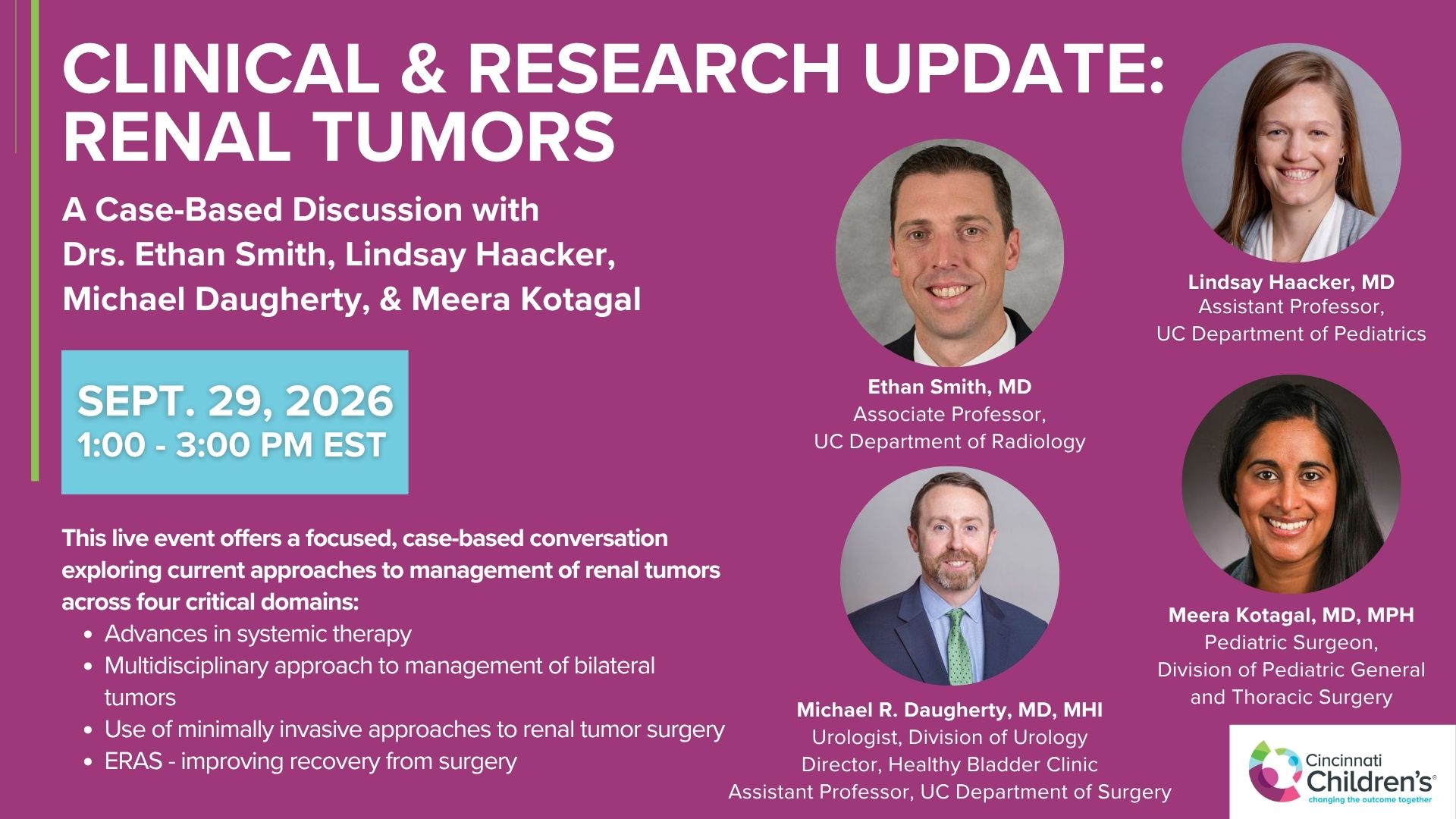
Clinical & Research Update: Renal Tumors with Drs. Ethan Smith, Lindsay Haacker, Michael Daugherty, and Meera Kotagal
71 min · Published Sep 2026
Video
Clinical & Research Update: Neuroblastoma with Drs. Katherine Somers, Cara Morin, Juan Gurria, and Meera Kotagal
67 min · Published Sep 2026
Video
Clinical & Research Update: Sarcoma w/ Drs. Roshni Dasgupta, Joseph Pressey, Arthur Meyer, Luke Pater
66 min · Published Sep 2026
Video
2026 Laparoscopic Pediatric Hernia Repair
123 min · Published Jun 2026
Video
Beyond the Spectrum: Diagnosis, Myths & Management - Caitlin Couch & Leslie Lopez - APP Conference 2026
50 min · Published May 2026
Video
Dysautonomia: Navigating the Journey - Martha Willis - APP Conference 2026
55 min · Published May 2026
What the experts said
Hyperhidrosis is excessive perspiration beyond physiological needs that can cause significant psychological, social and occupational inconvenience when present in significant amounts in the palms
Both T2, T3 and T4 sympathectomy can produce resolution of palmar symptoms but have different post-operative results and patient satisfaction
The study included 32 patients randomized into two groups: group one with 18 patients (14 bilateral, 4 unilateral) and group two with 14 patients (11 bilateral, 3 unilateral)
Operations were performed sequentially, operating on the dominant hand first and then the other hand a few months later
Age distribution ranged from 5 years to 18 years old and was comparable between both groups
The majority of patients rated their pre-operative quality of life as very poor (score of 1 on a 1-5 scale)
The surgical technique used a semi-Fowler position with camera port at fifth intercostal space mid-axillary line and working port at fourth intercostal space anterior axillary line
Seven of 32 patients underwent the procedure on only one side: five were satisfied with primary surgery and did not want the other side done, and two patients were lost to follow-up after three months
No compensatory sweating was noticed in any of the seven patients who had unilateral sympathectomy only
Operative time was comparable in both groups and both operations were feasible and safe with no intraoperative complications
Post-operative hand over-dryness was noticed in five patients in group one (T2/T3) and was not noticed in any patients in group two (T4)
Compensatory sweating was present at slightly higher rates in group one (T2/T3) compared to group two (T4)
Horner syndrome occurred temporarily in one patient in group one (T2/T3)
Post-operatively, 25 patients rated their quality of life as excellent, five patients rated it as very good, and two patients were lost to follow-up after three months
In group one (T2/T3), none of the patients rated their pre-operative quality of life as good, but 12 patients post-operatively rated their quality of life as good
In group two (T4), all 13 patients scored their post-operative quality of life as good, unlike their pre-operative scores
Both T2/T3 and T4 sympathectomy are safe and effective treatments for primary palmar hyperhidrosis
Post-operative compensatory hyperhidrosis seems to be more common with T2/T3 sympathectomy compared to bilateral T4, although there was no statistical difference between the groups
Compensatory hyperhidrosis was not evident in any of the patients who underwent unilateral sympathectomy, but this is a small subgroup that needs further study
Hand over-dryness occurred in a significantly higher proportion in the T2/T3 sympathectomy group (group one)
Mild moistness of the hand occurred more commonly in the T4 group and was not found in any patients in the T2/T3 group
Mild hand moistness in the T4 group was very well tolerated by the majority of patients, unlike hand over-dryness in the T2/T3 group which was distressing for patients
T4 sympathectomy is recommended to be preferred over T2/T3 thoracoscopic sympathectomy due to proven efficacy of both approaches but less frequent post-operative complications and more patient satisfaction in the T4 group