


From
StayCurrentMD
Journal of Pediatric Surgery Article REview: August Issue 2023
With Dr. Whit Holcomb & Dr. Crystal Lai & Dr. Shawn St. Peter & Dr. Regan Williams · hosted by Dr. Cecilia Gigena & Dr. Em Gootee
Chapter 1 of 4 · Evidence & Research
Nuss cryoablation outcomes
Cryoablation in Nuss Procedures: Impact on Hospital Stay and Opioid Use
Expert statements on this page
No expert statements were drawn from this page.
Host summaries · secondary, not cited in answers
Educational content from recorded physician discussions — not medical advice. Talk to your (or your child's) care team about your situation.
Video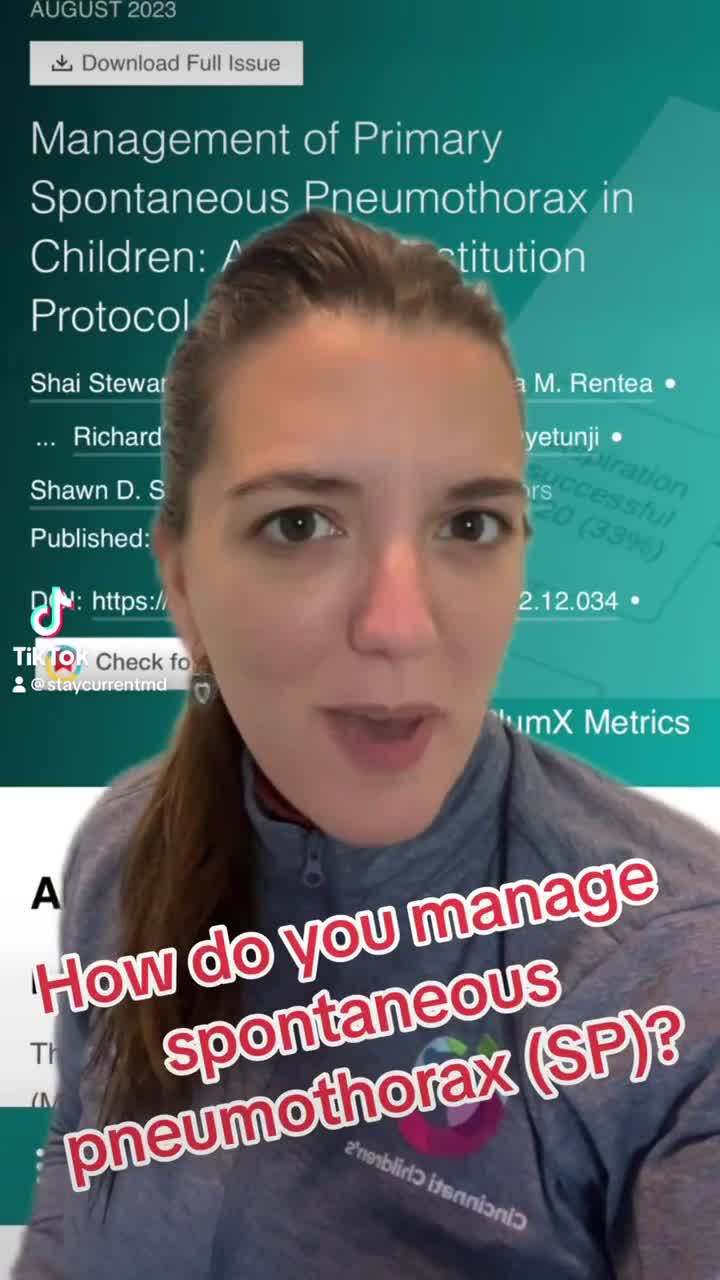
Management of Primary Spontaneous Pneumothorax in Children
Published Sep 2023
Podcast
Journal of Pediatric Surgery Article Review: October 2023
12 min · Published Apr 2024
Podcast
Spontaneous Pneumothorax
33 min · Published Aug 2019
Video
Panel Discussion: Pediatric Thoracic Surgery Part 1-Lung Lesions 2012
61 min · Published Jul 2017
Video
Spontaneous Pneumothorax: Lung Lesions
22 min · Published Aug 2012
Podcast
Journal of Pediatric Surgery Article Review: 3rd Quarter (Jul-Sep) 2024
19 min · Published Oct 2024
Podcast
Journal of Pediatric Surgery Article Review: 2nd Quarter (Apr-Jun) 2024
17 min · Published Sep 2024
Podcast
Pediatric Gastroesophageal Reflux Disease
81 min · Published Aug 2018
Podcast
Gastroesophageal Reflux Disease
81 min · Published Aug 2018
Podcast
Biliary Atresia, Appendicitis, Intestinal Failure, and Anesthetic...
44 min · Published May 2017
Podcast
Appendicitis with Dr. Whit Holcomb
58 min · Published Apr 2017
Video
Intestinal Atresia Types Explained: Grossfeld Classification for Pediatric Surgery
1 min · Published Sep 2026
Video
Derivation and validation of the Pediatric Community-Acquired Pneumonia Severity (PedCAPS) score: A prospective cohort study
50 s · Published Sep 2026
Video
FETO for Late-Diagnosed Severe Congenital Diaphragmatic Hernia (CDH) at Cincinnati Children's with Dr. Beth Rymeski
4 min · Published Sep 2026
Video
Severe Congenital Diaphragmatic Hernia (CDH) Case: FETO Management & Unexpected Findings with Dr. Beth Rymeski
3 min · Published Sep 2026
Video
Fetoscopic Endoluminal Tracheal Occlusion (FETO) Procedure: Step-by-Step Guide with Dr. Beth Rymeski
4 min · Published Sep 2026
Video
Choledochal Cyst Types Explained: Pediatric Surgery Fundamentals
1 min · Published Sep 2026
What the experts said
The entire treatment algorithm for spontaneous pneumothorax is split upon whether the patient is actively leaking air or had a bleb that popped and sealed
Solid organ injury management decisions should be based on clinical symptoms and signs of ongoing bleeding rather than solely on grade of injury
Visual analog scale pain scores were similar across all slipping rib syndrome groups, but opioid requirement was significantly less in the cryoablation group
Abdominal wall laxity after T9 and T10 cryoablation was seen only once, in a pectus patient rather than a slipping rib patient
From the first quarter compared to the fourth quarter of the study, there was 74% less opioid use in Nuss procedures with cryoablation
80% of patients achieved early discharge home by postoperative day number 2 in the fourth quarter of the Nuss cryoablation study
The reduction in opioid use and length of stay was primarily related to discontinuing use of IV PCA during the study period
IV PCA does not seem to be necessary for Nuss procedures with cryoablation and can be eliminated fairly early in a surgeon's experience
The learning curve for cryoablation in Nuss procedures is not about technique but about pain protocols used around the time of surgery
Cryoablation implementation requires a protocol or regimen including pain team involvement preoperatively and postoperatively, with adjuncts such as gabapentin
Simple aspiration was successful in 33% of children with primary spontaneous pneumothorax
66% of children with primary spontaneous pneumothorax still required VATS after aspiration
Median length of stay with successful aspiration for pneumothorax was 20 hours (less than a day)
Median length of stay after VATS for pneumothorax was 3 days
For patients who went to VATS immediately after failed aspiration, median length of stay was 3.1 days, compared to 6 days for patients from the Midwest Pediatric Surgery Consortium
Updated APSA guidelines for solid organ injury management use the APSA framework: Admission, Procedures, Set free (discharge), and Aftercare
The most important change in the updated APSA guidelines is that discharge of a patient is not related to the severity of the injury but to the clinical condition of the patient
Activity restriction for solid organ injuries should be for two weeks at first, then adjusted based on level of injury
In the slipping rib syndrome study, 68 patients had rib resection without cryoablation (receiving other blocks), 22 had extrathoracic cryoablation, and 8 had slipping ribs resected as part of Nuss procedure
91% of cryoablation patients had cryoablation of T9 and T10 intercostal nerves with no documented abdominal wall laxity at 16-day follow-up
Patients who underwent rib excision with cryoablation used significantly less opioids in hospital compared to rib excision without cryoablation
Median length of stay was 1 day for patients with rib excision with cryoablation compared to 2 days for patients with rib excision without cryoablation
Patients with very low pectus deformities may have more discomfort in the lower costal margin area because it gets out of the field of T7 and T8 where most cryoablation is performed