


From
Live Event Content
Wrap Up Discussions - 2024 Pediatric Bariatric Surgery Update Course
hosted by Dr. Todd Ponsky
Part of
Obesity 30 items
Chapter 1 of 4 · Fundamentals
Accreditation criteria
MBSAQIP Accreditation Requirements for Pediatric Surgeons
Expert statements on this page
No expert statements were drawn from this page.
Host summaries · secondary, not cited in answers
Educational content from recorded physician discussions — not medical advice. Talk to your (or your child's) care team about your situation.
Video
Marc Michalsky, MD - 2024 Pediatric Bariatric Surgery Update Course
14 min · Published Feb 2024
Video
Stephanie Walsh, MD - 2024 Pediatric Bariatric Surgery Update Course
16 min · Published Feb 2024
Video
Justin Ryder, MD- 2024 Pediatric Bariatric Surgery Update Course
12 min · Published Feb 2024
Video
StayCurrent Forums - Obesity in Children
Dr. Todd Ponsky · Published Apr 2022
Video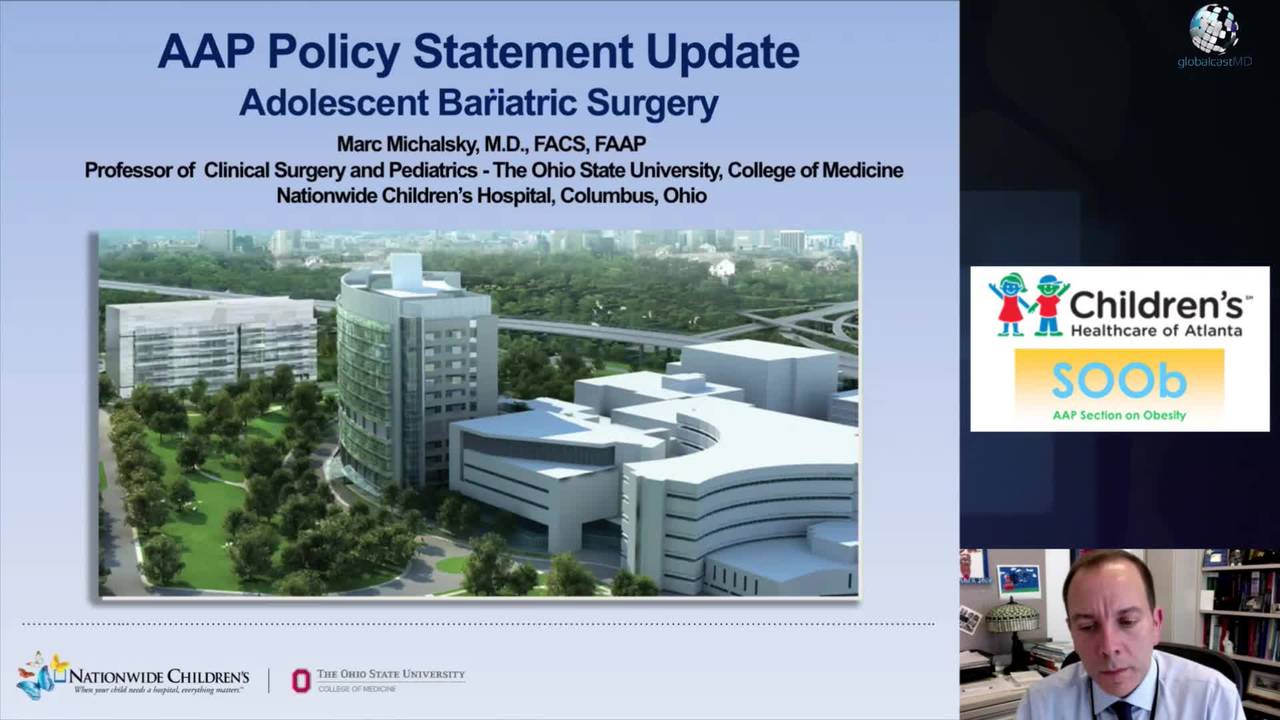
AAP Policy for Adolescent Bariatric Surgery: Pediatric Obesity 2017
27 min · Published Feb 2018
Video
Preoperative Optimization and Management - Caren Mangarelli, MD - 2024 Pediatric Bariatric Surgery Update Course
26 min · Published Feb 2024
Video
Clinical & Research Update: Renal Tumors with Drs. Ethan Smith, Lindsay Haacker, Michael Daugherty, and Meera Kotagal
71 min · Published Sep 2026
Video
Clinical & Research Update: Neuroblastoma with Drs. Katherine Somers, Cara Morin, Juan Gurria, and Meera Kotagal
67 min · Published Sep 2026
Video
Clinical & Research Update: Sarcoma w/ Drs. Roshni Dasgupta, Joseph Pressey, Arthur Meyer, Luke Pater
66 min · Published Sep 2026
Video
2026 Laparoscopic Pediatric Hernia Repair
123 min · Published Jun 2026
Video
Beyond the Spectrum: Diagnosis, Myths & Management - Caitlin Couch & Leslie Lopez - APP Conference 2026
50 min · Published May 2026
Video
Dysautonomia: Navigating the Journey - Martha Willis - APP Conference 2026
55 min · Published May 2026
What the experts said
MBSAQIP criteria for freestanding pediatric centers require 100 lifetime cases, 75 of which can be completed during fellowship training, and 20 cases per year to maintain accreditation as MBS director or verified MBS surgeon
If partnering with an adult bariatric program, pediatric surgeons do not need to meet the verified surgeon criteria because adult surgeons serve as the verified surgeons, allowing the pediatric surgeon to practice without independent credentialing
Annual case volume requirement was reduced to 15 cases per year for pediatric centers
A pediatric surgeon can partner with an adult surgeon for 1-3 years until reaching 100 cases and 15 annual cases in their program, then practice independently
Medicaid reimbursement for facility fees averages approximately 50% for bariatric surgery, which is better than many private payers in some regions
The robotic surgical system has an excellent simulator that allows surgeons to train for many hours before operating on patients
The gut microbiome changes after bariatric surgery in adolescents, with increases in Firmicutes and other beneficial species associated with better health
It is nearly impossible to separate whether microbiome changes cause weight loss or result from weight loss and surgery, even in adult data
Twenty years ago there was a huge disparity between adolescents receiving bariatric surgery and those who needed it
An adult bariatric surgeon completed 4 bariatric cases by 11 AM using robotic surgery with two operating rooms flipping, demonstrating efficiency potential
Even with 500 pediatric bariatric cases performed, the field is not moving the needle on the overall problem of adolescent obesity
The pharmaceutical industry has significant interest in proving GLP-1 medications are the best method for treating obesity
The vast majority of medical schools do not adequately teach about the disease of obesity in pathophysiology curricula
Gastric bands in teenagers show modest early weight loss but at 5 and 10 years, weight regain and band replacement or explantation is the rule
Gastric bands were never FDA approved for use in teenagers
Non-nutritive sweeteners do not decrease weight and may actually increase weight gain, similar to sugar-sweetened drinks