


Chapter 1 of 5 · Fundamentals
Risk stratification
Urologic Risk Stratification and Management Framework for Cloacal Malformations
Expert statements on this page
No expert statements were drawn from this page.
Host summaries · secondary, not cited in answers
Educational content from recorded physician discussions — not medical advice. Talk to your (or your child's) care team about your situation.
Video
Collaborative work: Complex Pediatric Anorectal Malformations 2017
Dr. Todd Ponsky · 23 min · Published Jun 2017
Video
Urologic intervention: Cincinnati Fetal Center
28 min · Published Nov 2018
Video
Surgical Management and Follow-Up: Cloaca and Complex ARMs 2015
25 min · Published Oct 2015
Video
ERN eUROGEN ARM Webinar Series: Management of Cloacal Malformations – what is new in 2021?
48 min · Published Dec 2022
Video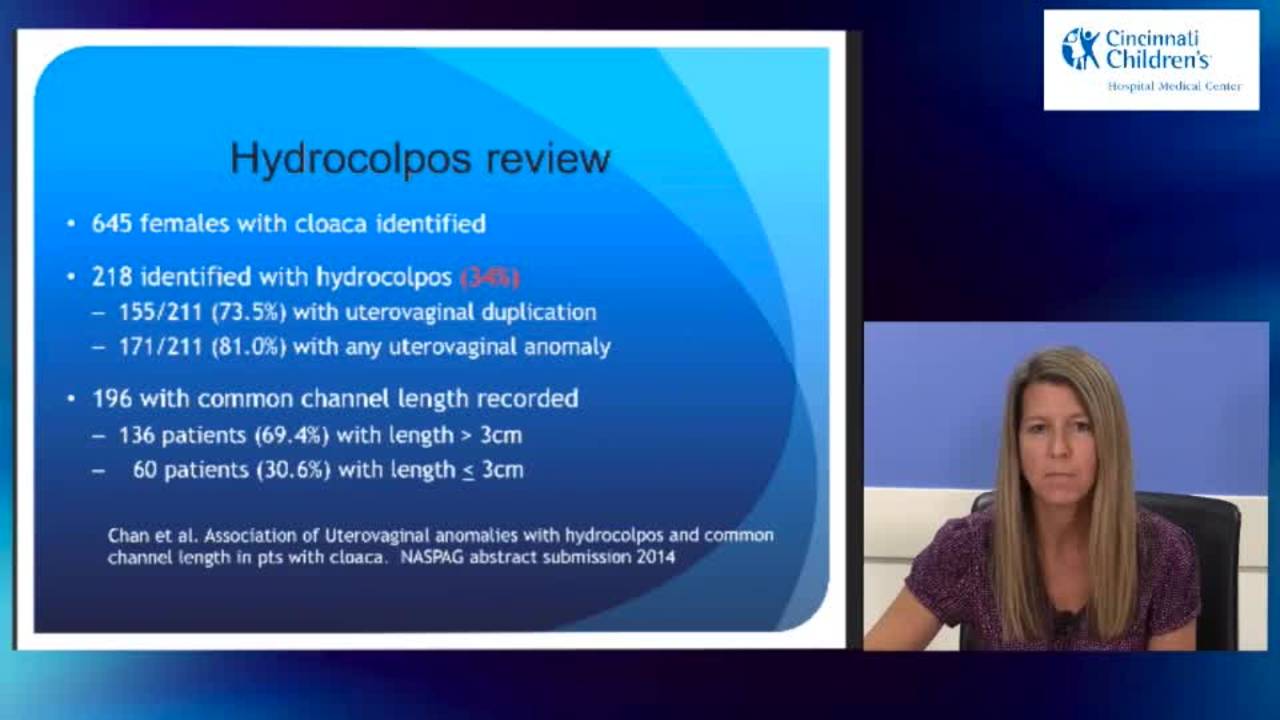
Case Presentations Part I: Cloaca and Complex ARMs 2015
45 min · Published Oct 2015
Video
Is Multi-disciplinary care the future of medicine?
24 min · Published Oct 2023
Video
Intestinal Atresia Types Explained: Grossfeld Classification for Pediatric Surgery
1 min · Published Sep 2026
Video
Derivation and validation of the Pediatric Community-Acquired Pneumonia Severity (PedCAPS) score: A prospective cohort study
50 s · Published Sep 2026
Video
FETO for Late-Diagnosed Severe Congenital Diaphragmatic Hernia (CDH) at Cincinnati Children's with Dr. Beth Rymeski
4 min · Published Sep 2026
Video
Severe Congenital Diaphragmatic Hernia (CDH) Case: FETO Management & Unexpected Findings with Dr. Beth Rymeski
3 min · Published Sep 2026
Video
Fetoscopic Endoluminal Tracheal Occlusion (FETO) Procedure: Step-by-Step Guide with Dr. Beth Rymeski
4 min · Published Sep 2026
Video
Choledochal Cyst Types Explained: Pediatric Surgery Fundamentals
1 min · Published Sep 2026
What the experts said
Preoperative and postoperative urodynamic studies in cloaca patients with common channel <2 cm repaired via posterior sagittal approach have not demonstrated very deleterious effects.
Cloacas are the highest-risk patients among anorectal malformation patients for bladder dysfunction.
In the speaker's institutional cohort of cloaca patients (mean age 4.5 years), almost half had CKD stage 2 or 3 (GFR 30-90 mL/min).
In a study of 44 cloaca patients at the speaker's institution (mean common channel 4 cm, high percentage with neurogenic bladder on active management), none showed CKD stage progression over mean 5-year follow-up.
The speaker proposes lower-risk cloaca category: common channel <2 cm, normal spinal cord, no structural anomalies, primary repair.
The speaker proposes higher-risk cloaca category: common channel >3 cm, abnormal spinal cord, structural anomalies (solitary kidney, hydrocolpos), reoperative surgery.
Annual surveillance for cloaca patients should include renal ultrasound and history up until toilet training age.
Blood pressure measurement is important in cloaca follow-up because hypertension can be a manifestation of chronic kidney disease.
Measuring serum creatinine alone is insufficient; glomerular filtration rate should be calculated using formulas that incorporate patient weight, height, and creatinine.
VCUG and urodynamics should be reserved for select cloaca patients; shorter common channel cases with normal renal ultrasounds and no concerning history may reasonably omit these studies in routine follow-up.
Preoperative urodynamics are very helpful in reoperative cloaca cases to understand bladder function before surgery.
Vesicostomy is not the speaker's first choice for bladder drainage; preference is to keep bladder closed rather than create vesicostomy where capacity and management can be more difficult.
Vesicostomy may be indicated in cases with solitary renal unit, massively dilated renal unit or hydroureter, or intraoperative concerns about urethral viability for catheterization or voiding.
Intermittent catheterization is extremely stressful and difficult for families; experienced nurses and peer family support are important resources.
For cloaca patients with common channel 2 cm, normal sacrum, no tethered cord, and uncomplicated repair, Dr. Pena leaves only a Foley catheter (not suprapubic) for 2-3 weeks, expecting the patient will void spontaneously after removal.
For more complicated cloaca cases (common channel ≥3 cm, tethered cord, abnormal sacrum), Dr. Pena uses suprapubic tube to enable urodynamic studies and avoid nighttime voiding emergencies.
For patients with very poor bladder, mega-ureter, single kidney, hydronephrosis, and reflux, Dr. Pena considers vesicostomy necessary.
Database review at Cincinnati Children's identified high-risk group for kidney transplant: patients with kidney failure at birth, ectopic ureters, cloaca, and strictured common channel.
Mitrofanoff is not performed at time of primary cloaca repair; it is done at older age when fecal incontinence and bowel management needs are clearer (toilet-training age).
When both Mitrofanoff and Malone are needed, the appendix can potentially be divided if vascular anatomy and length permit, allowing use for both procedures.
Some U.S. centers place Malone antegrade continence enema at time of colostomy closure, but the speaker's institution waits to assess laxative response first, as Dr. Pena has seen successful laxative management in cases where he had zero confidence.
Girls are often able to catheterize themselves per urethra with supervision by age 6-7 years.
Mitrofanoff placement in cloaca patients is no different technically than in other patient populations such as spina bifida, posterior urethral valves, or bladder exstrophy.
In Dr. Pena's series of 193 cloaca patients old enough to assess continence with common channel <3 cm, almost one-third were on intermittent catheterization for infections, radiographic findings, or incontinence.
In cloaca patients with common channel >3 cm, the rate of intermittent catheterization was much higher than in those with <3 cm channels.
In a study of anorectal malformations, up to 40% of patients with abnormal spinal cord had urodynamic evidence of bladder abnormalities, higher than those with normal spinal cord.
In children with solitary kidneys and CAKUT (congenital anomalies of kidney and urinary tract), 50% had chronic kidney disease and were on antihypertensive medication by age 9, compared to 33% in those without CAKUT.
Long-term renal outcomes in cloaca patients show 44-75% develop chronic kidney disease across multiple centers (Great Ormond Street, Riley Hospital, Sick Kids).
End-stage renal disease occurs in 10-15% of cloaca patients, much higher than the general population.
Patients born with single kidney and hydronephrosis are very high risk and most likely will end up with kidney transplant.