


From
Grand Rounds
Ovarian Cysts with Dr. Roshni Dasgupta
With Dr. Roshni Dasgupta
Part of
Ovarian Cyst 3 items
Chapter 1 of 3 · Diagnosis & Workup
Neonatal cysts
Neonatal ovarian cysts: prenatal diagnosis and initial management
Expert statements on this page
No expert statements were drawn from this page.
Host summaries · secondary, not cited in answers
Educational content from recorded physician discussions — not medical advice. Talk to your (or your child's) care team about your situation.
Video
Ovarian Torsion Rapid Fire: Update Course 2015
12 min · Published Nov 2015
Video
Ovarian Salvage (Torsion & Benign Tumor): Practice Gap discussion at Update...
14 min · Published Aug 2018
Video
Mesenteric and Omental Cysts
CCHMC Pediatric Surgery · Published May 2020
Video
GYN #3 Management of an Adnexal Torsion with a Healthy Appearing Ovary with Dr. Lesley Breech
CCHMC Pediatric Surgery · Published May 2024
Video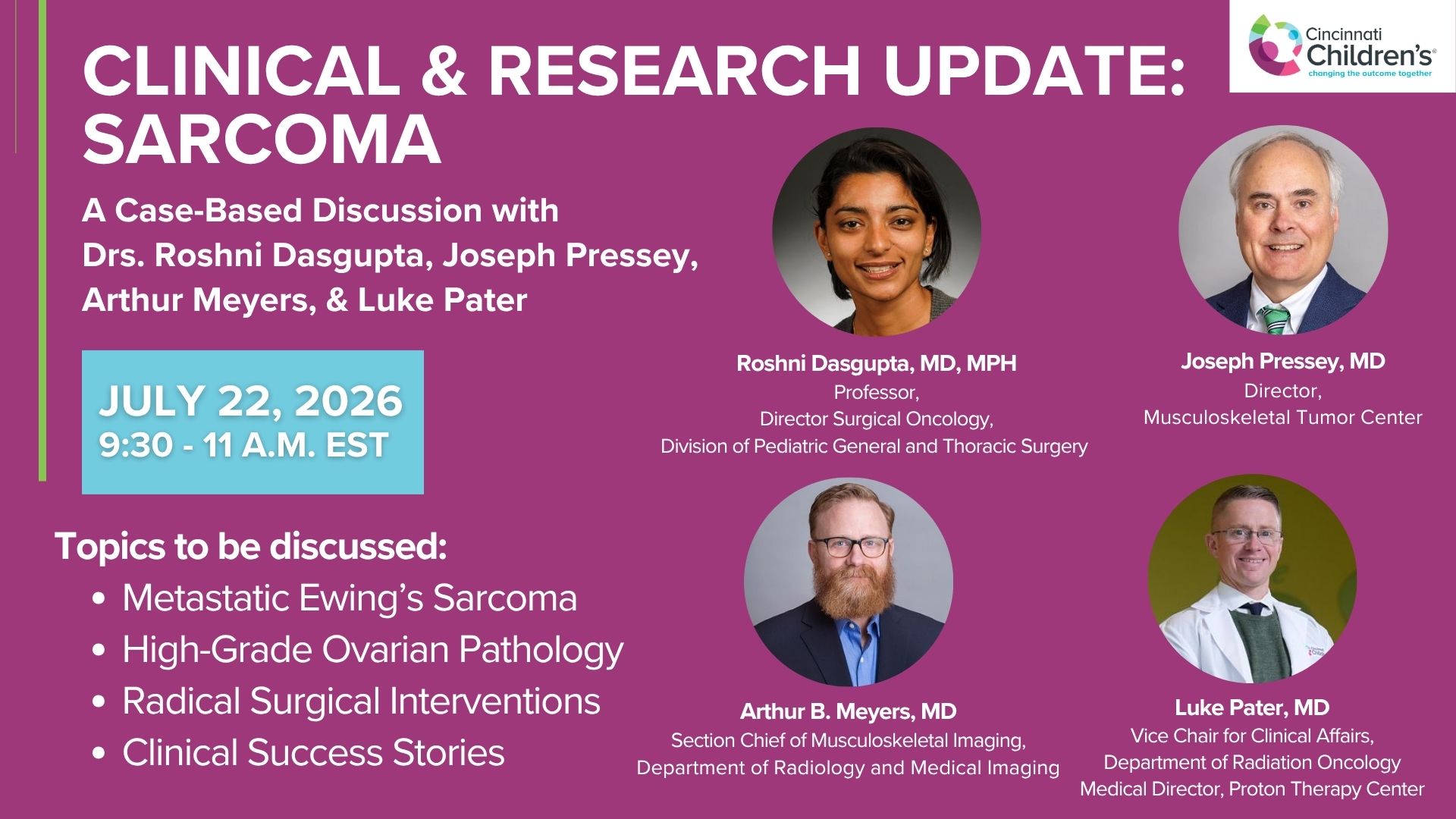
Clinical & Research Update: Sarcoma w/ Drs. Roshni Dasgupta, Joseph Pressey, Arthur Meyer, Luke Pater
66 min · Published Sep 2026
Video
Ovarian Torsion with Dr. Dasgupta
Published Sep 2022
Video
Ovarian Tumors with Dr. Roshni Dasgupta
CCHMC Pediatric Surgery · Published Sep 2022
Video
Update Course Rewind: Thoracotomy vs VATS for Lung Metastases
Dr. Todd Ponsky · 9 min · Published Dec 2021
Video
GYN #4 Management of Tubal Torsion: When to Consider Salpingectomy with Dr. Lesley Breech
CCHMC Pediatric Surgery · Published Oct 2024
Podcast
Pyloric Stenosis with Dr. Alex Bondoc
16 min · Published Jun 2024
Video
GYN #2 Oophoropexy in Adnexal Torsion with Dr. Lesley Breech
CCHMC Pediatric Surgery · Published May 2024
Video
GYN #1 Importance of Documenting Reproductive Anatomy with Dr. Lesley Breech
CCHMC Pediatric Surgery · Published Feb 2024
Podcast
Esophageal Replacement with Dr. Dan von Allmen
13 min · Published Nov 2023
Podcast
Hepatic Infections: Hepatitis, Abscess & Cysts with Dr. Alex Bondoc
15 min · Published Oct 2023
What the experts said
Cysts diagnosed prenatally have a differential including ovarian cyst, mesenteric cyst, duplication cyst, complex meconium cyst, or renal cyst.
There is not much to do in utero for prenatally diagnosed pelvic cysts.
For a thriving neonate with a truly cystic mass, serial imaging at about 12 weeks is appropriate if it is a simple cyst, which should get smaller in that timeframe.
If abnormal ovaries or no ovaries are seen on imaging, intrauterine torsion may have occurred, leaving a free floating cyst.
Prenatal ovarian cysts are really common and usually diagnosed around 28 weeks gestation.
Prenatal ovarian cysts are rarely associated with malignancy and most go away by themselves.
Indications for surgery include development of symptoms, cysts over 5 centimeters (increased risk of torsion), or persistence for greater than 6 months with no decrease in size.
If a cyst persists for greater than 6 months with no decrease in size, it may not be part of the ovary and could be a mesenteric cyst or something else requiring further investigation.
In adolescence, the same rules apply for ovarian cysts, with main concern being size due to increased risk of torsion, and serial imaging can be used.
Other kinds of ovarian cysts found in adolescence can be pretty large, composed of granulosa and thecal cells, and can cause torsion.
When ovarian cysts are seen incidentally during appendicitis workup, they should be left alone and followed with ultrasound in about 6 weeks.
Paraovarian cysts are hard to differentiate from follicular cysts on imaging.
The big concern with paraovarian cysts is torsion of the fallopian tube itself, not just the ovary.
Paraovarian cysts are usually in the mesosalpinx.
If paraovarian cysts are greater than 3 centimeters, enucleation is recommended to prevent torsion of the tube.
If paraovarian cysts are smaller than 3 centimeters, most people do not intervene, but they can be opened and drained if desired.
Ovarian pathology can affect children at all stages of life, with differential and workup differing based on age of presentation and size of mass.