


From
Colorectal Channel
Colorectal Quiz Episode 26: Perianal Crohn's Disease
With Dr. Jason Frischer & Dr. Marc Levitt & Dr. Cristine Velazco & Dr. Lisa McMahon · hosted by Dr. Shimon Jacobs
Chapter 1 of 8 · Case-Based Learning
Introduction
Introduction and case presentation setup
Expert statements on this page
No expert statements were drawn from this page.
Host summaries · secondary, not cited in answers
Educational content from recorded physician discussions — not medical advice. Talk to your (or your child's) care team about your situation.
Video
Journal of Pediatric Surgery Article Review: September 2021
Todd Ponsky · 11 min · Published Jul 2026
Video
Inflammatory Bowel Disease (IBD) - Samir Pandya: Update Course 2014
28 min · Published Nov 2018
Video
Inflammatory Bowel Disease: Update Course 2014
28 min · Published Sep 2014
Podcast
Colorectal Quiz Episode 19: Hirschsprung Disease - The Obstructed Patient Part 1
24 min · Published Aug 2021
Video
Persistent Abdominal Pain - Median Arcuate Ligament Syndrome: Update Course 2014
22 min · Published Nov 2018
Video
Trinity Ileal resection w narration
Dr. Steve Rothenberg · 10 min · Published May 2026
Video
Validation of an anorectal malformation trainer - Can a high-fidelity model simulate real life?
1 min · Published Jun 2026
Video
Complications and Long-Term Outcomes of Patients With Cloacal Malformation After Bowel Neovagina...
1 min · Published Jun 2026
Video
Safety and utility of long-acting steroid injection for management of post-operative stricture...
1 min · Published Jun 2026
Video
Association Between Social Determinants of Health and Choice of Urinary Reconstruction in Children
1 min · Published Jun 2026
Video
The Perineal Body Preserving PSARP (PPP)
11 min · Published Jun 2026
Video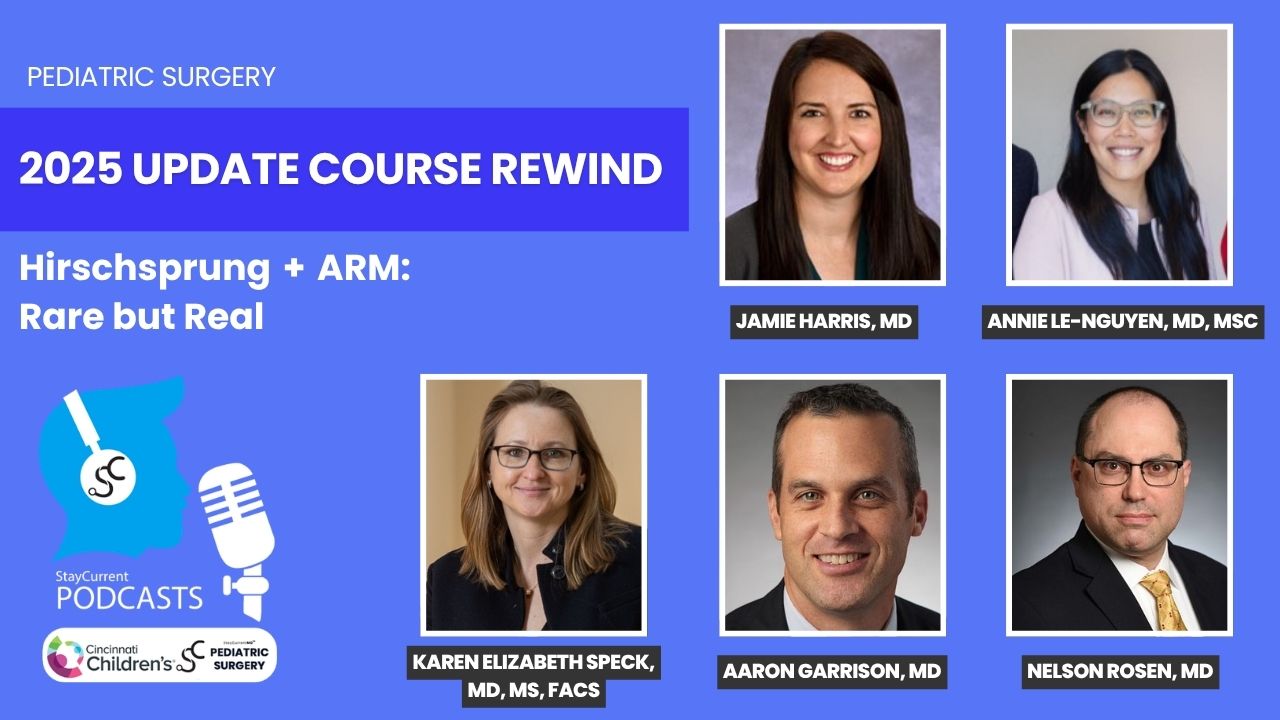
Update Course Rewind 2025: Hirschsprung + ARM: Rare but Real
1 min · Published May 2026
Podcast
Colorectal Quiz: Episode 47
Marc Levitt · 22 min · Published May 2025
Video
Colorectal Quiz: Episode 46 - Hirschsprung's Disease
Marc Levitt · 29 min · Published Apr 2025
Podcast
Colorectal Quiz: Episode 46
Marc Levitt · 29 min · Published Apr 2025
Video
Colorectal Quiz: Episode 44 - HD Frozen Section
Marc Levitt · 18 min · Published Feb 2025
Podcast
Colorectal Quiz: Episode 43
Marc Levitt · 23 min · Published Jan 2025
Video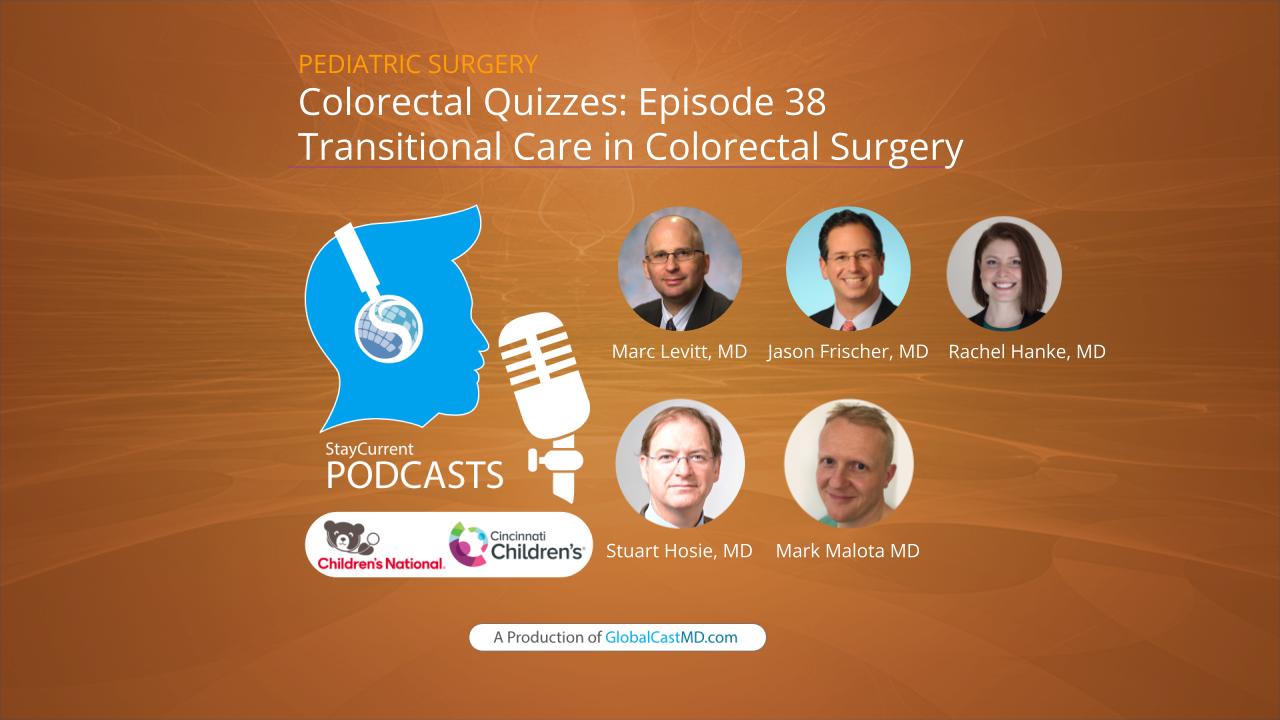
Colorectal Quiz Episode 38: Transitional Care in Colorectal Surgery
25 min · Published Mar 2024
Podcast
Long-term obstetric and gynecologic care for patients with anorectal malformations
21 min · Published Sep 2026
Podcast
Post-pubertal gynecologic evaluation and management of patients with anorectal malformations
22 min · Published Sep 2026
Podcast
Pre-pubertal gynecologic evaluation and management of patients with anorectal malformations
23 min · Published Sep 2026
Podcast
Methods of gynecologic evaluation for patients with anorectal malformations
21 min · Published Sep 2026
Podcast
Gynecologic care in patients with anorectal malformations: A primer and call to action
18 min · Published Sep 2026
Podcast
Evaluation and Management of Postsurgical Patient With Hirschsprung Disease Neurogastroenterology & Motility Committee: Position Paper of North American Society of Pediatric Gastroenterology, Hepatology, and Nutrition (NASPGHAN)
17 min · Published Sep 2026
What the experts said
When the colonoscope cannot intubate the terminal ileum, capsule endoscopy or fecal calprotectin can be used to aid diagnosis.
If terminal ileum cannot be intubated, gastroenterologists may treat presumptively and re-scope after a few months of treatment when inflammation has decreased.
Real risks of biologic agents include infectious complications such as tuberculosis and risk of lymphoma.
The highest risk factors for lymphoma with biologic therapy are male gender, teenage age, and combination therapy with methotrexate.
It is common to have perianal disease in Crohn's; this patient had a delay in diagnosis and had perianal disease for quite some time with multiple skin tags and fissures.
Male gender over the age of 10, and presence of a fistula are risk factors with much higher incidence of Crohn's disease being diagnosed in patients presenting with perianal lesions to the emergency room.
In pediatric patients, unlike adult patients, the first presenting factor for Crohn's disease can often be perianal disease.
The mucosa heals first compared to skin in perianal disease, so leaving a mucosal opening without a seton risks recurrent abscess when biologics heal the mucosa.
Making a large cruciate incision and packing a perianal abscess in a child with undiagnosed Crohn's disease may result in non-healing and potentially require colostomy or ileostomy.
Hydrogen peroxide is preferred over methylene blue for identifying fistula tracts because it is neater; 3% hydrogen peroxide in a syringe with 16-20 gauge angiocath is used with a speculum in the anus.
When a fistula opening cannot be found despite hydrogen peroxide testing, a seton should not be placed at that time to avoid creating a hole where there isn't one.
Source control of infection must be achieved before starting immunosuppressive therapy including steroids and biologics.
If an abscess is not adequately drained, reimaging should be performed before giving biologics or steroids.
Setons should remain in place for at least 6 months to allow the inflammatory tract to become non-inflammatory.
For recurrent patients requiring repeat seton placement, repeat imaging should be obtained before seton removal.
Literature shows about a 10% response rate for perianal fistulas even without biologics if a seton is placed and removed, with much better outcomes with biologics.
Before removing a seton, the bottom must look better, drainage must be better, the patient must be symptom-free, and they must have reached steady state of biologic (loading dose plus at least 3 more doses, typically 2-3 months from start).
Inflammatory markers including fecal calprotectin, ESR, and CRP should be checked before removing a seton to ensure systemic disease is under control.
Remicade (infliximab) has the most literature on healing perianal disease; Humira also has good evidence but less literature; Stelara and vedolizumab are sometimes used with less information available.
The initial Remicade paper from 1998 or 1999 in the New England Journal of Medicine was on perianal disease and demonstrated improved healing time and improved length of time between recurrence when combination of seton and infliximab is used versus either separately.