


From
StayCurrentMD
Update Course Rewind: Perforated Appendicitis 2019
With Dr. Whit Holcomb & Dr. Matt Carbon & Dr. Alex Gibbons · hosted by Dr. Rod Gerardo
Part of
Appendicitis 29 items
Chapter 1 of 6 · Fundamentals
Introduction
Introduction and Context for Perforated Appendicitis Discussion
Expert statements on this page
No expert statements were drawn from this page.
Host summaries · secondary, not cited in answers
Educational content from recorded physician discussions — not medical advice. Talk to your (or your child's) care team about your situation.
Video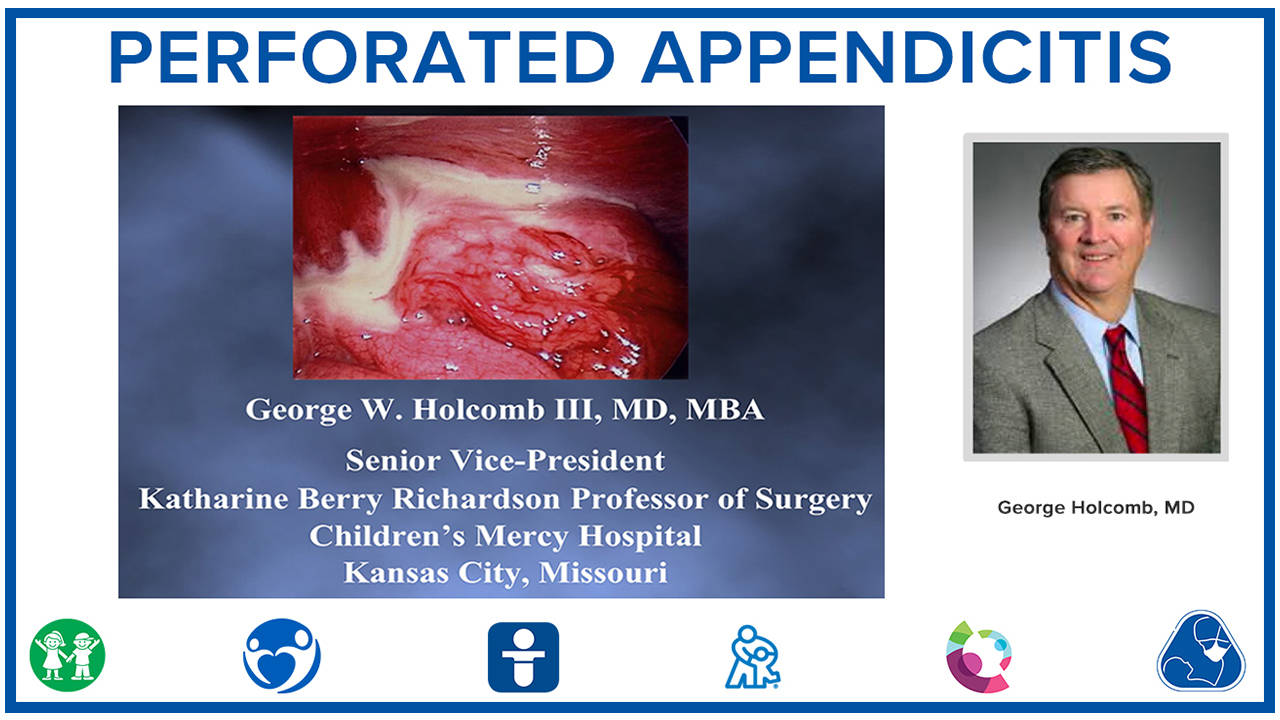
Perforated Appendicitis
18 min · Published Mar 2020
Podcast
Journal Club: Appendicitis in 2021
15 min · Published Aug 2021
Video
Update Course Rewind: Management of Appendicitis 2022
Published May 2023
Podcast
Evidence-based diagnosis and management of pediatric appendicitis with Dr. Whit Holcomb
58 min · Published Apr 2017
Video
Appendicitis Management & APPY Trial: Update Course 2016
31 min · Published Oct 2018
Video
Update Course 2021: DEI – CONCORDANCE AND POST OP COMPLICATION STUDIES
Published May 2022
Podcast
Journal of Pediatric Surgery Article Review: 3rd Quarter (Jul-Sep) 2024
19 min · Published Oct 2024
Podcast
Journal of Pediatric Surgery Article Review: 2nd Quarter (Apr-Jun) 2024
17 min · Published Sep 2024
Podcast
Pediatric Gastroesophageal Reflux Disease
81 min · Published Aug 2018
Podcast
Gastroesophageal Reflux Disease
81 min · Published Aug 2018
Podcast
Biliary Atresia, Appendicitis, Intestinal Failure, and Anesthetic...
44 min · Published May 2017
Podcast
Appendicitis with Dr. Whit Holcomb
58 min · Published Apr 2017
Video
Intestinal Atresia Types Explained: Grossfeld Classification for Pediatric Surgery
1 min · Published Sep 2026
Video
Derivation and validation of the Pediatric Community-Acquired Pneumonia Severity (PedCAPS) score: A prospective cohort study
50 s · Published Sep 2026
Video
FETO for Late-Diagnosed Severe Congenital Diaphragmatic Hernia (CDH) at Cincinnati Children's with Dr. Beth Rymeski
4 min · Published Sep 2026
Video
Severe Congenital Diaphragmatic Hernia (CDH) Case: FETO Management & Unexpected Findings with Dr. Beth Rymeski
3 min · Published Sep 2026
Video
Fetoscopic Endoluminal Tracheal Occlusion (FETO) Procedure: Step-by-Step Guide with Dr. Beth Rymeski
4 min · Published Sep 2026
Video
Choledochal Cyst Types Explained: Pediatric Surgery Fundamentals
1 min · Published Sep 2026
What the experts said
Both arms of the irrigation trial had abscess rates of 18-19%, which is higher than some other studies, potentially due to the definition of perforation used.
The best quality study on irrigation showed no difference in outcomes, while a more recent but less well-designed study showed a difference favoring standardized large-volume irrigation.
In a study of 200 CT scans reviewed by 6 surgeons (including 2 fellows) and 2 radiologists, reviewers were only 72% accurate in determining whether an appendix was perforated or non-perforated.
Among 110 surgeons (62 attendings and 48 fellows, including adult and pediatric surgeons from university, community, and children's hospitals), inter-observer agreement in defining intraoperative images as perforated or non-perforated appendicitis was 27%.
In Doctor Ponsky's study, when the same laparoscopic image was shown upside down and flipped, surgeons did not agree with their own previous assessment, demonstrating intra-observer variability close to chance alone.
At Kansas City (Doctor Saint Peter's group), perforated appendicitis is defined as a hole in the appendix or a fecalith in the abdomen.
When patients did not have either a hole in the appendix or stool in the abdomen, the incidence of postoperative abscess was less than 5%.
After implementing a standardized definition for perforated appendicitis, the non-perforation abscess rate decreased and the perforation abscess rate increased, suggesting previous misclassification of cases.
In a randomized trial with 110 patients per arm using minimum 500cc irrigation (average 850cc), there was no difference in postoperative abscess rate, length of stay, hospital cost, or operative time between irrigation and no irrigation groups.
In a study comparing standardized large-volume irrigation (3-12 liters in small focused aliquots) to surgeon preference irrigation, patients receiving standardized irrigation had 0% abscess rate versus 19% with surgeon discretion.
A 2018 meta-analysis comparing suction alone versus irrigation in children and adults found no difference in the rate of postoperative abscess.