


From
StayCurrentMD
Update Course Rewind: 2020 Colorectal Part 2
With Dr. Eunice Huang & Dr. Beth Rymeski & Dr. Shawn St. Peter · hosted by Dr. Em Gootee
Chapter 1 of 4 · Case-Based Learning
Introduction
Introduction to Update Course Rewind and Rectal Prolapse Topic
Expert statements on this page
No expert statements were drawn from this page.
Host summaries · secondary, not cited in answers
Educational content from recorded physician discussions — not medical advice. Talk to your (or your child's) care team about your situation.
Video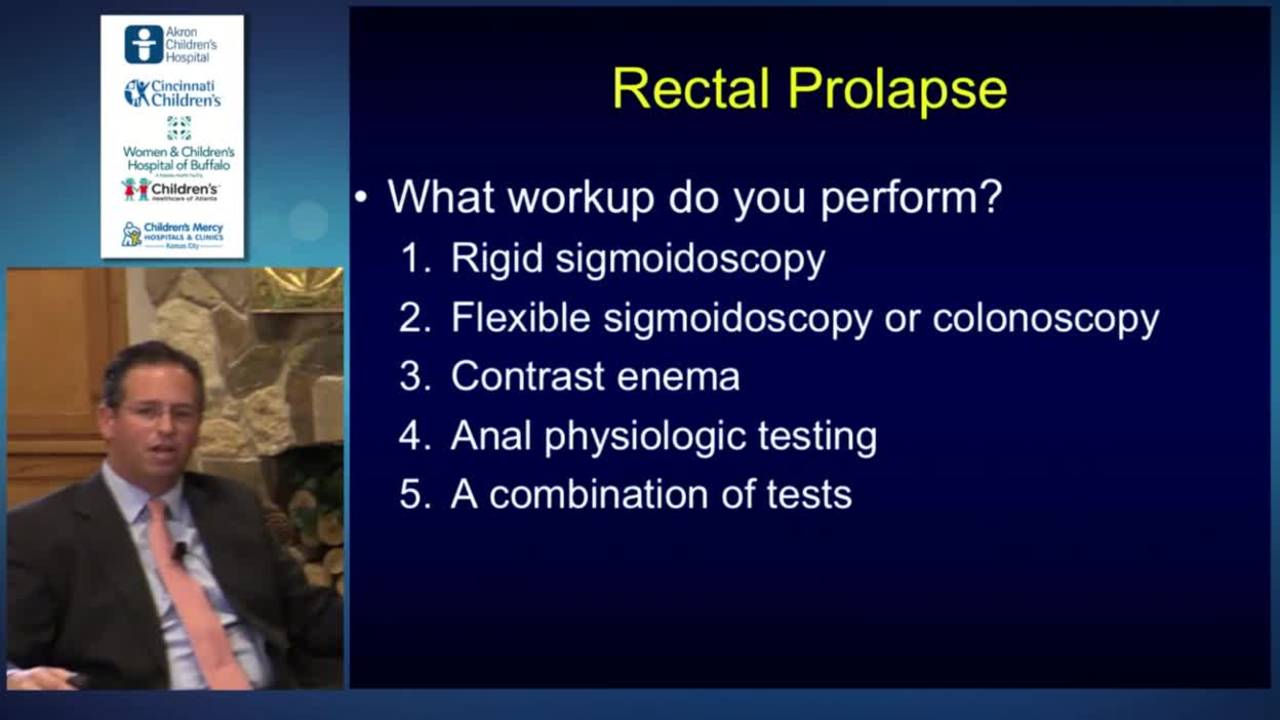
Rectal Prolapse Rapid Fire: Update Course 2015
CCHMC Pediatric Surgery · 5 min · Published Nov 2015
Video
Problematic Anorectal Malformation Cases: Pediatric Colorectal Controversies...
13 min · Published Apr 2012
Video
Hirschsprung Disease - Imperforate Anus - Rectal Prolapse: Update Course 2015
CCHMC Pediatric Surgery · 25 min · Published Nov 2018
Video
Hirschsprung Disease: Cases and Complications
103 min · Published Feb 2015
Podcast
The Colorectal Quiz Episode 22: Hirschsprung Disease - the Soiling Patient Part 1
19 min · Published Nov 2021
Podcast
Colorectal Quiz Episode 15: Bowel Management in Spinal Patients - Need for a UrologistPart 1
17 min · Published Jun 2021
Video
Validation of an anorectal malformation trainer - Can a high-fidelity model simulate real life?
1 min · Published Jun 2026
Video
Complications and Long-Term Outcomes of Patients With Cloacal Malformation After Bowel Neovagina...
1 min · Published Jun 2026
Video
Safety and utility of long-acting steroid injection for management of post-operative stricture...
1 min · Published Jun 2026
Video
Association Between Social Determinants of Health and Choice of Urinary Reconstruction in Children
1 min · Published Jun 2026
Video
The Perineal Body Preserving PSARP (PPP)
11 min · Published Jun 2026
Video
Update Course Rewind 2025: Hirschsprung + ARM: Rare but Real
1 min · Published May 2026
Video
Intestinal Atresia Types Explained: Grossfeld Classification for Pediatric Surgery
1 min · Published Sep 2026
Video
Derivation and validation of the Pediatric Community-Acquired Pneumonia Severity (PedCAPS) score: A prospective cohort study
50 s · Published Sep 2026
Video
FETO for Late-Diagnosed Severe Congenital Diaphragmatic Hernia (CDH) at Cincinnati Children's with Dr. Beth Rymeski
4 min · Published Sep 2026
Video
Severe Congenital Diaphragmatic Hernia (CDH) Case: FETO Management & Unexpected Findings with Dr. Beth Rymeski
3 min · Published Sep 2026
Video
Fetoscopic Endoluminal Tracheal Occlusion (FETO) Procedure: Step-by-Step Guide with Dr. Beth Rymeski
4 min · Published Sep 2026
Video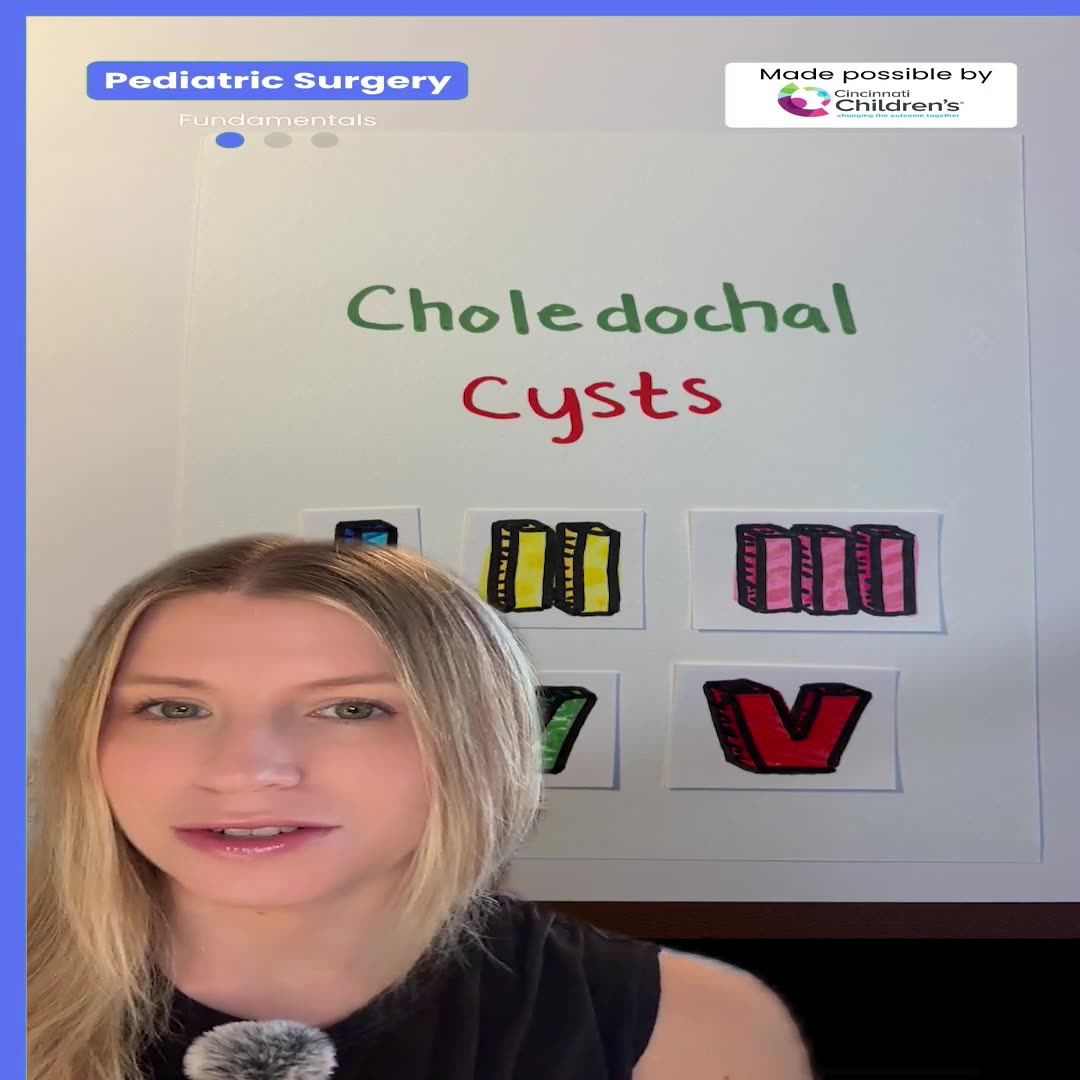
Choledochal Cyst Types Explained: Pediatric Surgery Fundamentals
1 min · Published Sep 2026
What the experts said
Rectal prolapse is a relatively unusual problem in pediatric surgery.
Children develop rectal prolapse because of their anatomy: they have a very weak pelvic floor and the rectum is very low, so it tends to pop out easily if they strain hard enough.
Conservative treatment includes managing constipation, teaching proper toilet sitting with a smaller seat so children don't fall through, providing a step for proper upright posture, and limiting time on the toilet without distractions like iPads.
Sclerotherapy has a low threshold for use because it is simple, innocuous, and can provide a window of a couple months without prolapse that allows younger children to see less frequent episodes.
Dr. Sean St. Peter's sclerotherapy technique uses 5 ccs of Sotradechol injected in 4 quadrants with any remaining volume injected in between.
A systematic review in the Journal of Pediatric Surgery included 27 publications with 900 patients: 300 underwent sclerotherapy (8 studies, 3 sclerosing agents) and 600 underwent operative management (22 studies, 17 different procedures).
The large number of different operative procedures (17 procedures across studies) indicates uncertainty about which is the best procedure for rectal prolapse.
Transabdominal procedures have a pretty high success rate for correcting rectal prolapse based on published data.
The complication rate of sclerotherapy is mostly negligible, complications are acute, and there is minimal risk of long-term problems.
Patients with rectal prolapse should be evaluated to rule out underlying diseases, especially cystic fibrosis.
Some patients with rectal prolapse and anxiety develop a feedback loop where prolapse becomes an emotional release mechanism for evacuating stool.
Pelvic floor therapy is useful in strengthening pelvic floor musculature and, when combined with sclerotherapy and support for anxiety, leads to more durable outcomes.
The majority of pediatric rectal prolapse cases do not need surgery.
The most common reasons for rectal prolapse in children are constipation, sitting on the potty too long, or sitting on it incorrectly.
Physical exam is key to distinguish rectal prolapse from intussusception, polyps, and rectal hemorrhoids.
Parents should be taught how to safely reduce a prolapse to avoid incarceration.
A 2019 Journal of Pediatric Surgery review of sclerotherapy publications found that alcohol is the most popular sclerosing agent and is pretty effective.
Alcohol as a sclerosing agent is probably really easy to obtain in the hospital setting.
Sclerotherapy with ethyl alcohol is the recommended first option after failed conservative management, can be performed up to 3 times, and has an estimated cumulative success rate of a little bit over 80%.
Laparoscopic rectopexy is the recommended operative approach for patients who fail sclerotherapy because it has the lowest complication rate and the highest success rate.
Patients with rectal prolapse may benefit from a multidisciplinary team approach including behavioral therapy and physical therapy.