


Chapter 1 of 3 · Fundamentals
Technique overview
Introduction to cloacal endoscopy and technique
Expert statements on this page
No expert statements were drawn from this page.
Host summaries · secondary, not cited in answers
Educational content from recorded physician discussions — not medical advice. Talk to your (or your child's) care team about your situation.
Video
Toshio Harumatsu, MD, PhD - Best of the Best in Pediatric Surgery 2024
Dr. Todd Ponsky · 6 min · Published Feb 2024
Video
Heat 1 Winner: Dariusz Patkowski, MD, PhD - Best of the Best in Pediatric Surgery 2024
2 min · Published Feb 2024
Podcast
Gynecologic care in patients with anorectal malformations: A primer and call to action
18 min · Published Sep 2026
Podcast
Methods of gynecologic evaluation for patients with anorectal malformations
21 min · Published Sep 2026
Podcast
Pre-pubertal gynecologic evaluation and management of patients with anorectal malformations
23 min · Published Sep 2026
Video
Intestinal Atresia Types Explained: Grossfeld Classification for Pediatric Surgery
1 min · Published Sep 2026
Video
Derivation and validation of the Pediatric Community-Acquired Pneumonia Severity (PedCAPS) score: A prospective cohort study
50 s · Published Sep 2026
Video
FETO for Late-Diagnosed Severe Congenital Diaphragmatic Hernia (CDH) at Cincinnati Children's with Dr. Beth Rymeski
4 min · Published Sep 2026
Video
Severe Congenital Diaphragmatic Hernia (CDH) Case: FETO Management & Unexpected Findings with Dr. Beth Rymeski
3 min · Published Sep 2026
Video
Fetoscopic Endoluminal Tracheal Occlusion (FETO) Procedure: Step-by-Step Guide with Dr. Beth Rymeski
4 min · Published Sep 2026
Video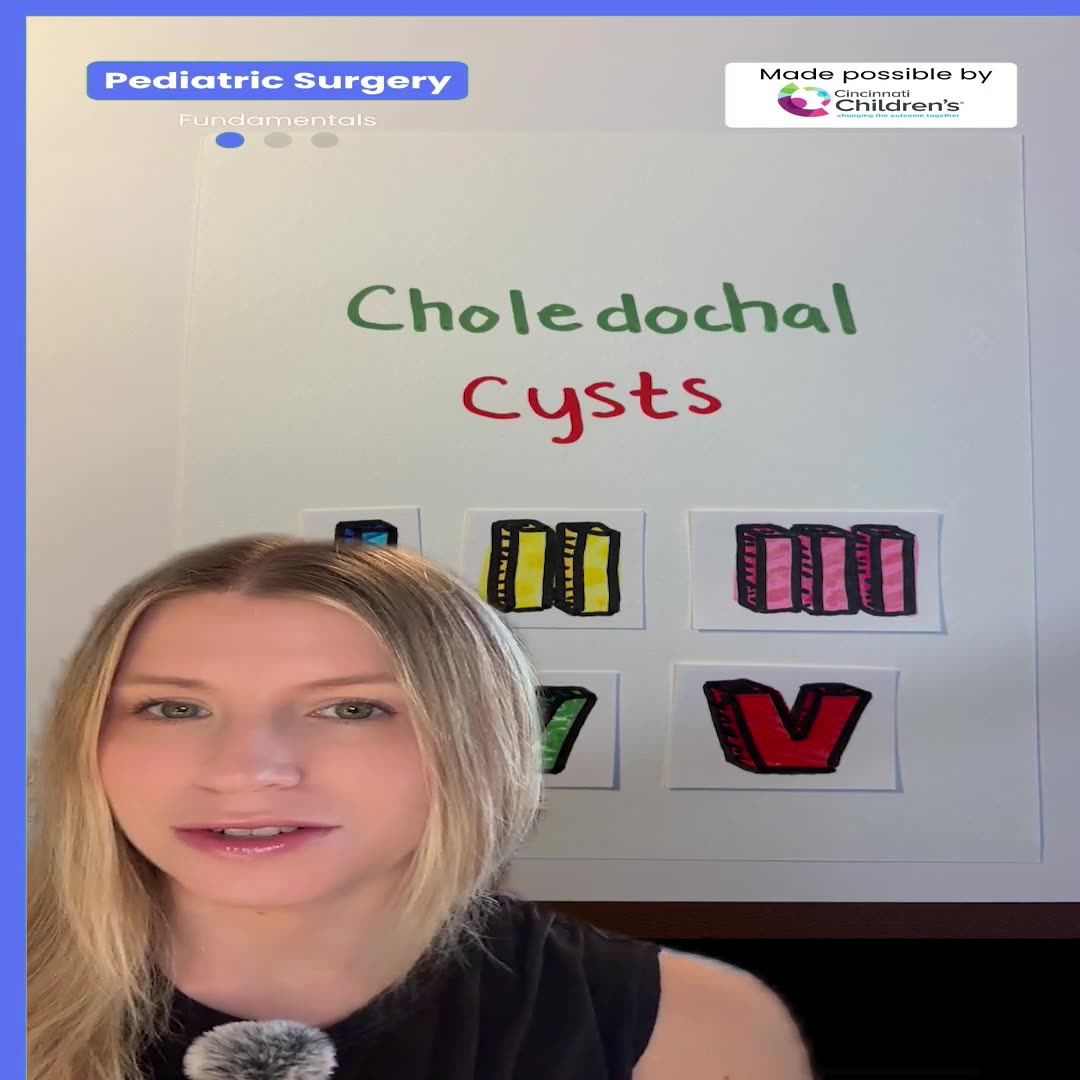
Choledochal Cyst Types Explained: Pediatric Surgery Fundamentals
1 min · Published Sep 2026
What the experts said
Persistent cloaca is one of the most complex anorectal anomalies.
In persistent cloaca, the length of the common channel is directly related to the complexity of the reconstruction.
Cloacal endoscopy is a very important component of the workup of persistent cloaca patients.
Cloacal endoscopy is performed using a pediatric cystoscope.
In short common channel cases, all three orifices (urethra, vagina, and rectum) are identified within a short distance of the perineum.
A longitudinal septum resulting in two hemivaginas is commonly seen in persistent cloaca.
In the demonstrated short common channel case, the common channel measured approximately 2.5 centimeters.
In the demonstrated long common channel case, the first bifurcation was seen approximately 3 centimeters from the perineum.
In the long common channel case, a trifurcation was seen another 3 centimeters more proximal to the first bifurcation.
In the long common channel case, the trifurcation was formed by two hemivaginas anteriorly and the rectum posteriorly.
Each hemivagina terminates in a cervical os.
In the demonstrated long common channel case, the common channel measured approximately 6 centimeters.