

From
Dr. Marc Levitt
The Colorectal Quiz Episode 21: The History of Hirschsprung Disease
With Dr. Marc Levitt & Dr. Jason Frischer · hosted by Dr. Amanda Jensen
Chapter 1 of 6 · Fundamentals
Introduction
Introduction and Episode Setup
Expert statements on this page
No expert statements were drawn from this page.
Host summaries · secondary, not cited in answers
Educational content from recorded physician discussions — not medical advice. Talk to your (or your child's) care team about your situation.
Video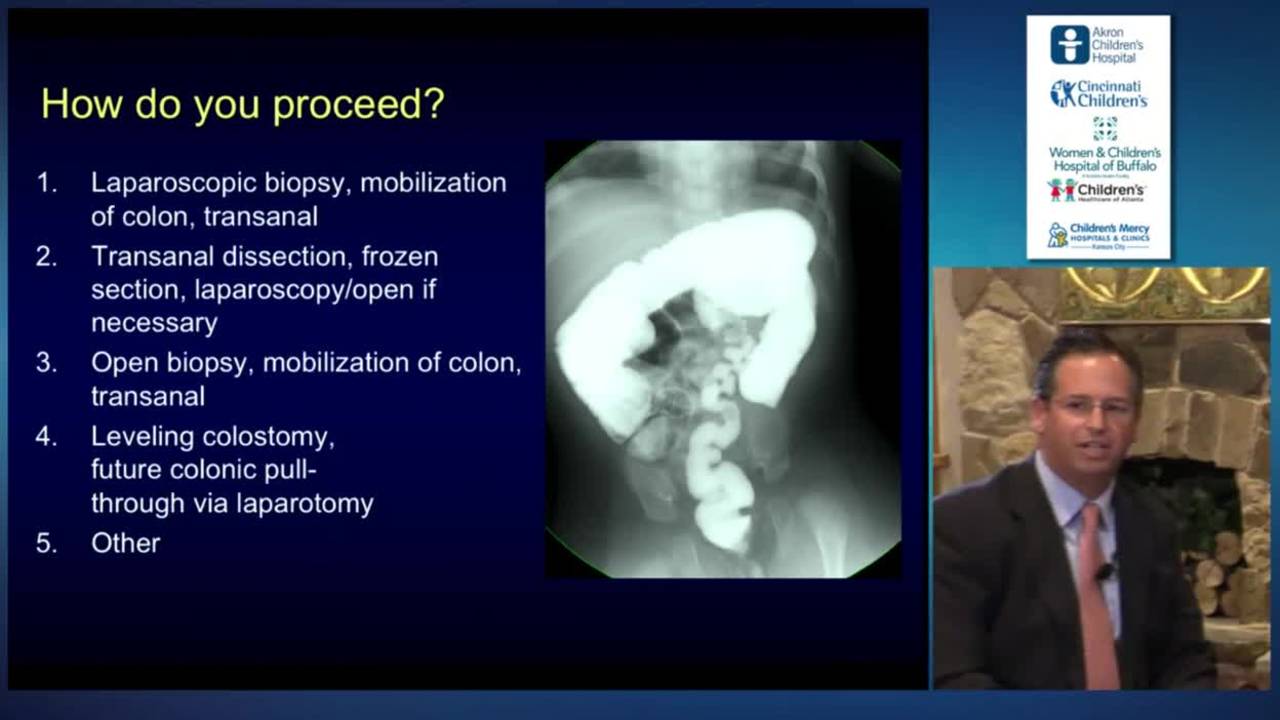
Hirschsprung Disease Rapid Fire: Update Course 2015
CCHMC Pediatric Surgery · 12 min · Published Nov 2015
Video
Hirschsprung Disease: Surgical Procedures
128 min · Published Feb 2015
Video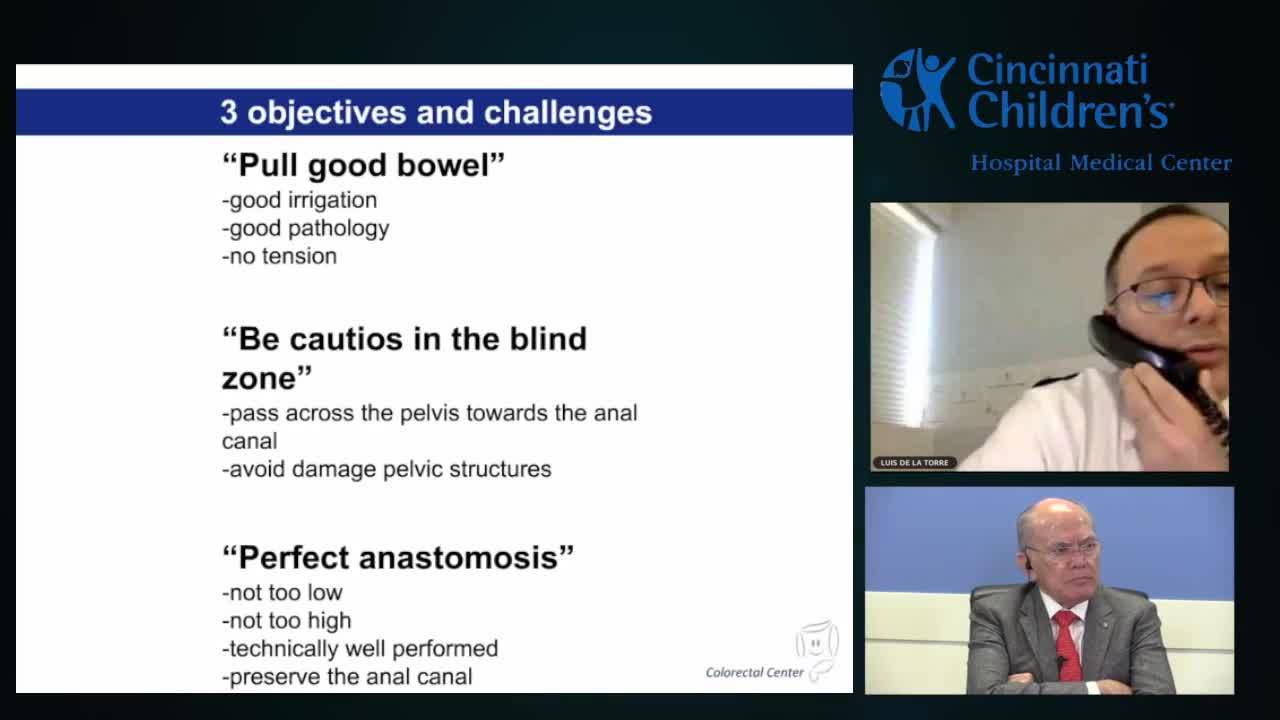
Surgical Procedures for Hirschsprung Disease
128 min · Published Nov 2018
Video
Update Course Rewind 2025: Hirschsprung’s Pull-Through: Why Family Training May Save Lives
2 min · Published May 2026
Video
Surgical treatment for Hirschsprung’s Disease: An ERNICA animation for parents and families
3 min · Published Dec 2023
Podcast
Hirschsprung's Disease
20 min · Published Oct 2020
Video
Validation of an anorectal malformation trainer - Can a high-fidelity model simulate real life?
1 min · Published Jun 2026
Video
Complications and Long-Term Outcomes of Patients With Cloacal Malformation After Bowel Neovagina...
1 min · Published Jun 2026
Video
Safety and utility of long-acting steroid injection for management of post-operative stricture...
1 min · Published Jun 2026
Video
Association Between Social Determinants of Health and Choice of Urinary Reconstruction in Children
1 min · Published Jun 2026
Video
The Perineal Body Preserving PSARP (PPP)
11 min · Published Jun 2026
Video
Update Course Rewind 2025: Hirschsprung + ARM: Rare but Real
1 min · Published May 2026
Video
Colorectal Quiz Ep. 50 -16th Annual European Pediatric Colorectal & Pelvic Reconstruction Conference
Marc Levitt · Published Mar 2026
Podcast
Colorectal Quiz: Episode 50 - 16th Annual European Pediatric Colorectal and Pelvic Reconstruction Conference, Stockholm, Sweden, October 2025 - What did we learn?
24 min · Published Mar 2026
Video
Colorectal Quiz Episode 33: Cloaca Exstrophy
Marc Levitt · 22 min · Published Sep 2025
Video
Colorectal Quiz: Episode 49 – Collaborating for Kids: Colorectal & Pelvic Care (with Help from AI)
Marc Levitt · 40 min · Published Jul 2025
Podcast
Colorectal Quiz: Episode 49 - Collaborating for Kids: Colorectal & Pelvic Solutions (with a Little Help from AI)
Marc Levitt · 40 min · Published Jul 2025
Podcast
Colorectal Quiz: Episode 47
Marc Levitt · 22 min · Published May 2025
What the experts said
Harold Hirschsprung identified that a baby could be sick due to this problem but did not understand the pathology.
The disease is named Hirschsprung disease, not apostrophe S.
Orvar Swenson figured out the pathology by going to the pathology lab and defined the fact that there were no ganglion cells.
Prior to Swenson's work, removal of the dilated colon was the treatment, which was a mistake; it was the distal narrow colon that was the problem.
Swenson developed the first operation for Hirschsprung disease, a full-thickness rectal dissection.
Some surgeons still do Suave procedures, but they are becoming more Swenson-like with maybe a one-centimeter cuff; Dan von Allman calls those 'Suavesons with a one-centimeter cuff.'
Dr. Yancey was the first surgeon to describe a submucosal dissection for Hirschsprung disease, but published in a journal not widely read; Dr. Suave published later in a more widely read journal, so the technique is called Suave rather than Yancey.
The Suave technique was developed because people said the Swenson caused fecal and urinary incontinence or voiding dysfunction; Swenson himself wrote that the operation was good but surgeons were doing it wrong by dissecting too wide.
Doing a proper Swenson right on the bowel wall, like a PSARP right on the bowel wall, avoids nerve injury; if you see fat you can get closer, as the nerves are in the fatty layer.
Swenson was 105 when he died and used to write letters to Levitt and Alberto Pena asking them to promote the Swenson operation.
Duhamel had the idea to leave the original rectum behind and do a pull-through next to it, then mate the two lumens.
The Duhamel is now really only appropriate for an ilio-Duhamel, although Levitt would still do an ilioanal.
Rabine did a low anterior resection for Hirschsprung disease, leaving about six centimeters behind; some patients did fine as ganglionated bowel pooped through the six centimeters of aganglionated bowel, but that operation has gone to the wayside.
Dr. Boley was the first to do the primary coloanal anastomosis of a Suave, eliminating the need to leave the bowel hanging out and come back at day seven; the proper description is the Suave technique with the Boley modification, i.e., a Suave-Boley.
Henry So was a pediatric surgeon in the Philippines and the first to do a primary pull-through (transabdominal) with no preceding stoma, because patients with stomas at home in the Philippines faced such social stigma that babies were basically left to die by their families.
Dr. Martin was the first surgeon-in-chief and pediatric surgeon at Cincinnati Children's Hospital.
Dr. Martin developed the Martin procedure, an expansion of the Duhamel for long-segment Hirschsprung disease, leaving a longer aganglionated segment of rectum and pulling through ganglionated bowel.
Dr. Martin's biggest contribution was in ulcerative colitis; in 1977, before the J-pouch, he took the endorectal pull-through technique used in Hirschsprung disease and applied it to ulcerative colitis, doing a total proctocolectomy with ilioanal anastomosis.
The transanal dissection and Suave plane dissection is the same concept as the mucosectomy in ulcerative colitis.
Helen Noblet figured out the suction rectal biopsy; she is from Melbourne, Australia.
Keith Jorgensen did the laparoscopic version of the Suave; in his original description (with Tom Inge on the paper), they talked about leaving a five-centimeter cuff, which nowadays would be way too much.
Jack Langer approached Hirschsprung disease transanally, doing a transanal resection of the rectosigmoid with or without laparoscopy or laparotomy.
Luis de la Torre also did transanal resection around the same time as Jack Langer; some places around the world are doing transanal only, and Levitt does that in certain circumstances.
Dan Teitelbaum did an incredible amount of work in Hirschsprung disease, particularly significant research in enterocolitis; he passed away from a brain tumor.