


From
StayCurrentMD
Aerodigestive & Esophageal Surgery: Dual Endoscopy Discussion
With Dr. Todd Ponsky
Part of
Aerodigestive / ENT 27 items
Chapter 1 of 1 · Surgical Management
Dual endoscopy
Dual-Endoscopy Technique for Aerodigestive Cases
Expert statements on this page
No expert statements were drawn from this page.
Host summaries · secondary, not cited in answers
Educational content from recorded physician discussions — not medical advice. Talk to your (or your child's) care team about your situation.
Video
Acute Cholecystitis
Todd Ponsky · 32 min · Published Jul 2026
Video
Update Course Rewind 2025: Updates in NEC Management
11 min · Published Jul 2026
Video
Pediatric Pre-Operative Bowel Prep
Todd Ponsky · 1 min · Published Jul 2026
Video
Journal of Pediatric Surgery Article Review: September 2021
Todd Ponsky · 11 min · Published Jul 2026
Video
22. HerniaTalk LIVE Q&A: Pediatric Hernias
Todd Ponsky · 59 min · Published Jul 2026
Video
ATLS 2021 Pediatric Surgery Update
Todd Ponsky · 16 min · Published Jul 2026
Video
Intestinal Atresia Types Explained: Grossfeld Classification for Pediatric Surgery
1 min · Published Sep 2026
Video
Derivation and validation of the Pediatric Community-Acquired Pneumonia Severity (PedCAPS) score: A prospective cohort study
50 s · Published Sep 2026
Video
FETO for Late-Diagnosed Severe Congenital Diaphragmatic Hernia (CDH) at Cincinnati Children's with Dr. Beth Rymeski
4 min · Published Sep 2026
Video
Severe Congenital Diaphragmatic Hernia (CDH) Case: FETO Management & Unexpected Findings with Dr. Beth Rymeski
3 min · Published Sep 2026
Video
Fetoscopic Endoluminal Tracheal Occlusion (FETO) Procedure: Step-by-Step Guide with Dr. Beth Rymeski
4 min · Published Sep 2026
Video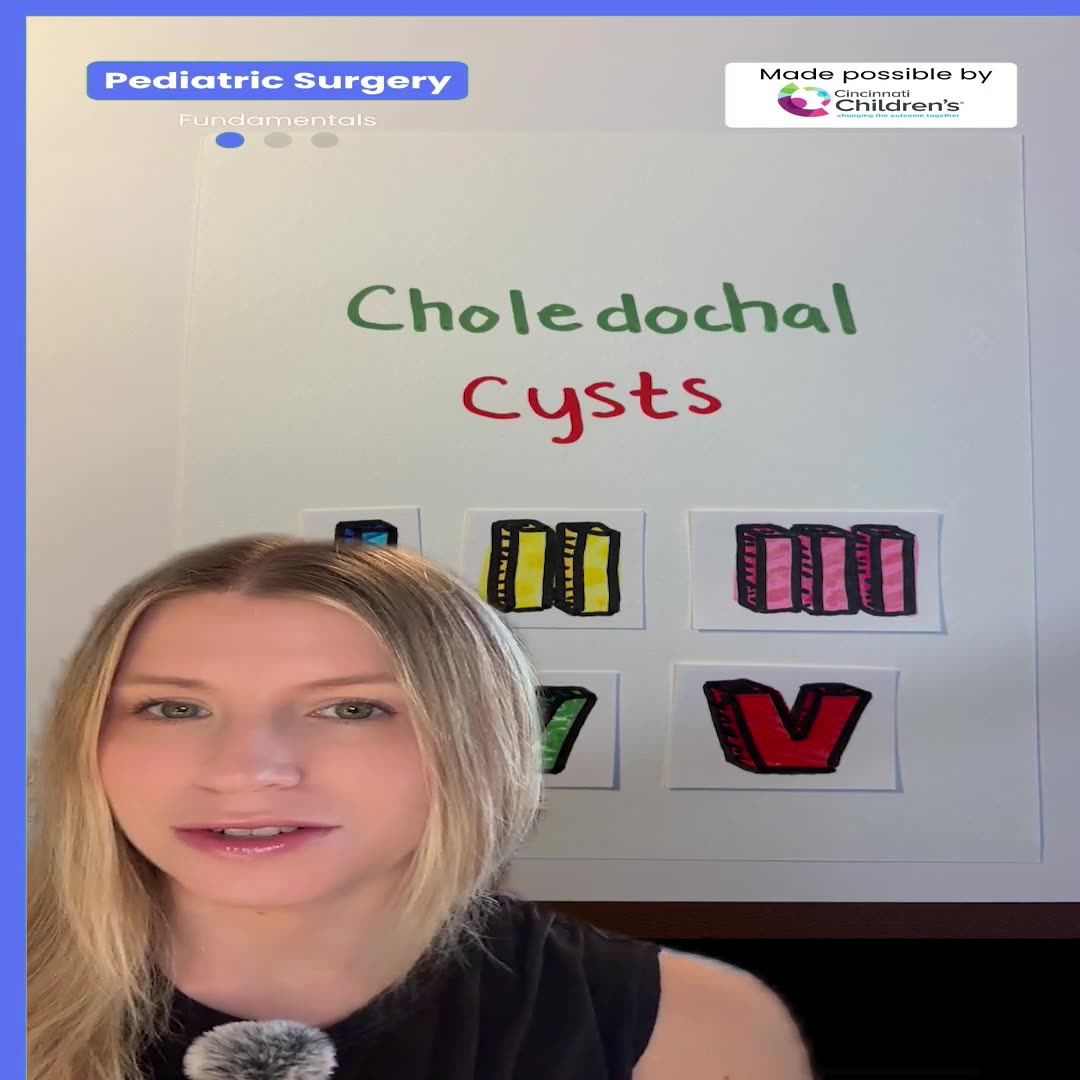
Choledochal Cyst Types Explained: Pediatric Surgery Fundamentals
1 min · Published Sep 2026
What the experts said
Multiple scopes provide different information and complementary advantages in complicated aerodigestive patients.
Simultaneous dual endoscopy is easier in patients with a tracheostomy, but feasible even without one.
Typical dual-scope setup uses a flexible bronchoscope through the nose and a flexible GI scope through the mouth or retrograde via a gastrostomy tube.
Transillumination allows one operator to see the light from the other scope through the esophageal or airway wall.
Injection of saline or insufflation of air can reveal subtle perforations or fistulae by demonstrating passage of material or bubbles through the wall.
One operator can turn off their light so the other can see transillumination and confirm anatomic localization.
A 2.8 mm flexible bronchoscope is typically used for the airway component of dual endoscopy.
An infant GI scope (5.4 or 6 mm outer diameter) is used for the esophageal component and will fit retrograde through a 16 French gastrostomy tube.
A 14 French gastrostomy tube is too small for retrograde passage of an infant GI scope without dilation.
Intraoperative dilation of a gastrostomy tract with Hagar dilators allows passage of a larger scope; the tract will contract back down by the end of the case.
A bronchoscope can be used retrograde through the esophagus when a larger GI scope will not fit.