


From
StayCurrentMD
Chronic Pancreatitis - Pancreatic Pathologies by Cincinnati Children's Pancreas Care Center
With Dr. Maisaabel Haija & Dr. Andrew Trout · hosted by Dr. Em Gootee
Chapter 1 of 7 · Fundamentals
Introduction
Introduction to Chronic Pancreatitis Educational Series
Expert statements on this page
No expert statements were drawn from this page.
Host summaries · secondary, not cited in answers
Educational content from recorded physician discussions — not medical advice. Talk to your (or your child's) care team about your situation.
Video
Chronic Pancreatitis, Function Tests, & Pain Management: Pancreatic Disease
51 min · Published Sep 2016
Video
Update Course Rewind: Management of Recurrent Pancreatitis
CCHMC Pediatric Surgery · 6 min · Published May 2024
Video
Function Tests & Pain Management: Pancreatic Disease
26 min · Published Sep 2016
Podcast
Acute Pancreatitis
45 min · Published Jul 2017
Video
Overview of the Surgical Management of Acute and Chronic Pancreatitis in Children with Dr. Juan Gurria
66 min · Published Apr 2026
Video
Update Course 2023 - Updates in Pancreatitis
32 min · Published Aug 2023
Video
Pancreatitis in pediatric patients with pancreatic solid pseudopapillary neoplasms- a single center experience
59 s · Published Apr 2026
Podcast
Update Course Rewind: Pediatric Biliary Stones - Preventing Gallstone Pancreatitis 2024
Jeffrey Ponsky · 3 min · Published Aug 2025
Video
Update Course Rewind: Pediatric Biliary Stones - Surgery First Mindset 2024
Dr. Todd Ponsky · 7 min · Published Jul 2025
Video
Multi-Institutional Analysis of Choledocholithiasis in Pediatric vs Adult Patients
59 s · Published Mar 2025
Video
Total pancreatectomy with islet autotransplantation (TPIAT) - Cincinnati Children's Pancreas Care Center
CCHMC Pediatric Surgery · 10 min · Published Dec 2024
Video
Exploración laparoscópica trancística del conducto biliar común en pacientes pediátricos con coledocolitiasis
1 min · Published Jul 2024
Only a few other public items share this expert — go deeper there →
Video
Intestinal Atresia Types Explained: Grossfeld Classification for Pediatric Surgery
1 min · Published Sep 2026
Video
Derivation and validation of the Pediatric Community-Acquired Pneumonia Severity (PedCAPS) score: A prospective cohort study
50 s · Published Sep 2026
Video
FETO for Late-Diagnosed Severe Congenital Diaphragmatic Hernia (CDH) at Cincinnati Children's with Dr. Beth Rymeski
4 min · Published Sep 2026
Video
Severe Congenital Diaphragmatic Hernia (CDH) Case: FETO Management & Unexpected Findings with Dr. Beth Rymeski
3 min · Published Sep 2026
Video
Fetoscopic Endoluminal Tracheal Occlusion (FETO) Procedure: Step-by-Step Guide with Dr. Beth Rymeski
4 min · Published Sep 2026
Video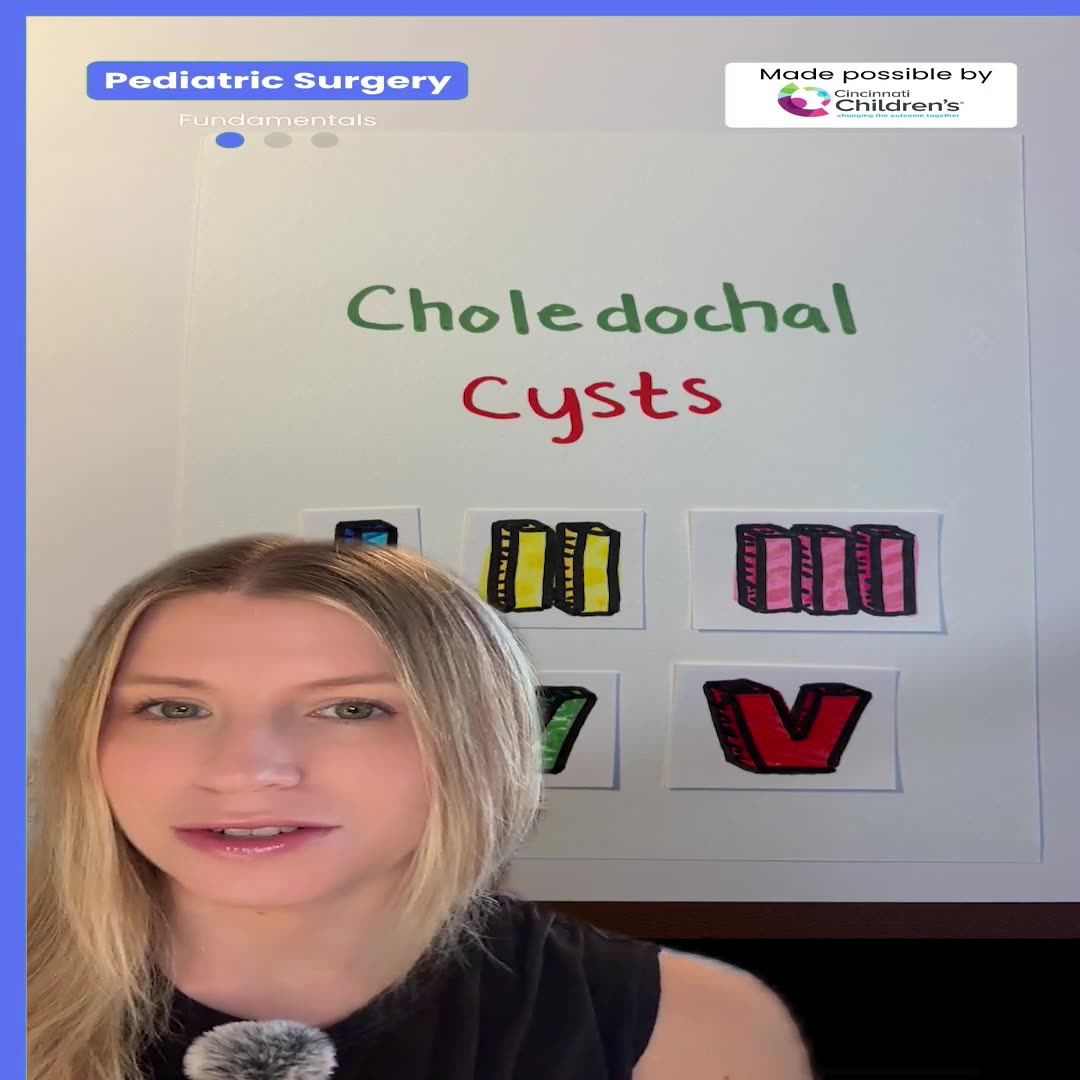
Choledochal Cyst Types Explained: Pediatric Surgery Fundamentals
1 min · Published Sep 2026
What the experts said
Chronic pancreatitis is a chronic inflammatory condition where inflammation over time results in damage and destruction of the pancreas, potentially causing replacement of healthy tissue with fibrosis.
When acinar cells are diseased or destructed in chronic pancreatitis, there is less production of pancreatic enzymes.
Diagnosis of chronic pancreatitis mostly relies on imaging findings.
For CT imaging of chronic pancreatitis, a single phase with portal venous contrast is adequate.
MRI has advantages over CT in terms of soft tissue contrast from multiple different MRI sequences, providing the best visualization of both parenchymal and duct changes in chronic pancreatitis.
Non-contrast CT is essentially never needed in a child with pancreatitis because calcifications can be seen on post-contrast phases of imaging.
The key MRI sequences for chronic pancreatitis are the 3D MRCP sequence to characterize the duct and its relationship to the bile duct, and a T1 weighted sequence to understand parenchymal health.
Before sending genetic testing, it is advised to work closely with a genetic counselor to help the family choose the test and interpret it afterwards.
In chronic pancreatitis, exocrine and endocrine function need to be assessed because they can decline over time.
Problems associated with chronic pancreatitis include macro and micronutrient deficiencies, growth problems, small intestinal bacterial overgrowth, and risk for tumors later in adult life.
Treatment of chronic pancreatitis starts with assessing the stage of disease, finding out the extent of exocrine or endocrine problems, and correcting nutrient abnormalities, nutrition, and growth.
When medical management has failed and the patient continues to have symptoms, endoscopic management can be considered.
ERCP is an imaging and interventional modality where the endoscopist can evaluate the pancreatic duct or biliary ducts and treat problems with scarring or strictures that are part of chronic pancreatitis.
Multidisciplinary pain management includes a pain specialist, psychologist, and physical therapist to address all aspects that pain can have on a patient's body.
Ongoing damage in chronic pancreatitis affects acinar cells, ductal cells, and islet cells which are responsible for producing insulin.
When islet cells which produce insulin are damaged by chronic pancreatitis, it can lead to endocrine issues such as diabetes.
Chronic pancreatitis is a progressive inflammatory disorder that results in irreversible loss of pancreatic function.
Diagnosis of chronic pancreatitis involves identifying calcifications, ductal obstruction, or dilation combined with one of three criteria: pain consistent with pancreatic origin, exocrine dysfunction, or endocrine dysfunction.
In adults, CT with IV contrast often includes multiple phases (non-contrast, arterial, and portal venous), but this is avoided in children because it markedly increases radiation dose without providing much additional diagnostic information.
According to Dr. Trout, arterial phase imaging is reserved for specific questions about arterial pseudoaneurysms or when characterizing potential masses.
At initial characterization of a patient with acute recurrent or chronic pancreatitis, IV contrast can be useful to understand vascular complications or fluid collections, but in many cases MRI exams can be done without IV contrast.
Cincinnati Children's has an in-house 10-gene pancreatitis risk panel to screen for genetic links to pancreatitis.
For pancreatic enzyme replacement, cystic fibrosis guidelines are followed for dosing, and enzymes are reserved only for cases with documented exocrine pancreatic insufficiency.
Endoscopic therapy for chronic pancreatitis relies on two methods: endoscopic ultrasound (EUS) and endoscopic retrograde cholangiopancreatography (ERCP).
Pain management in chronic pancreatitis follows a stepwise ladder approach, starting with opiate-sparing medications and reserving opiates for severe pain cases.
Opiate-sparing chronic pain medications include neuropathic medications like amitriptyline and gabapentin, usually prescribed in partnership with a pain specialist as part of multidisciplinary management.
At Cincinnati Children's, cognitive behavioral therapy (CBT) is incorporated in multidisciplinary pain management and has been shown in other chronic conditions to be helpful in managing pain.