


From
StayCurrentMD
Collaborative work: Complex Pediatric Anorectal Malformations 2017
With Dr. Todd Ponsky
Chapter 1 of 6 · Fundamentals
Team building
Building Collaborative Teams in Complex Pediatric Care
Expert statements on this page
No expert statements were drawn from this page.
Host summaries · secondary, not cited in answers
Educational content from recorded physician discussions — not medical advice. Talk to your (or your child's) care team about your situation.
Podcast
Cloaca Management with Dr. Marc Levitt & Dr. Aaron Garrison
43 min · Published Dec 2016
Video
Surgical Management Of Female Anorectal Malformation Patients Including...
57 min · Published Nov 2018
Video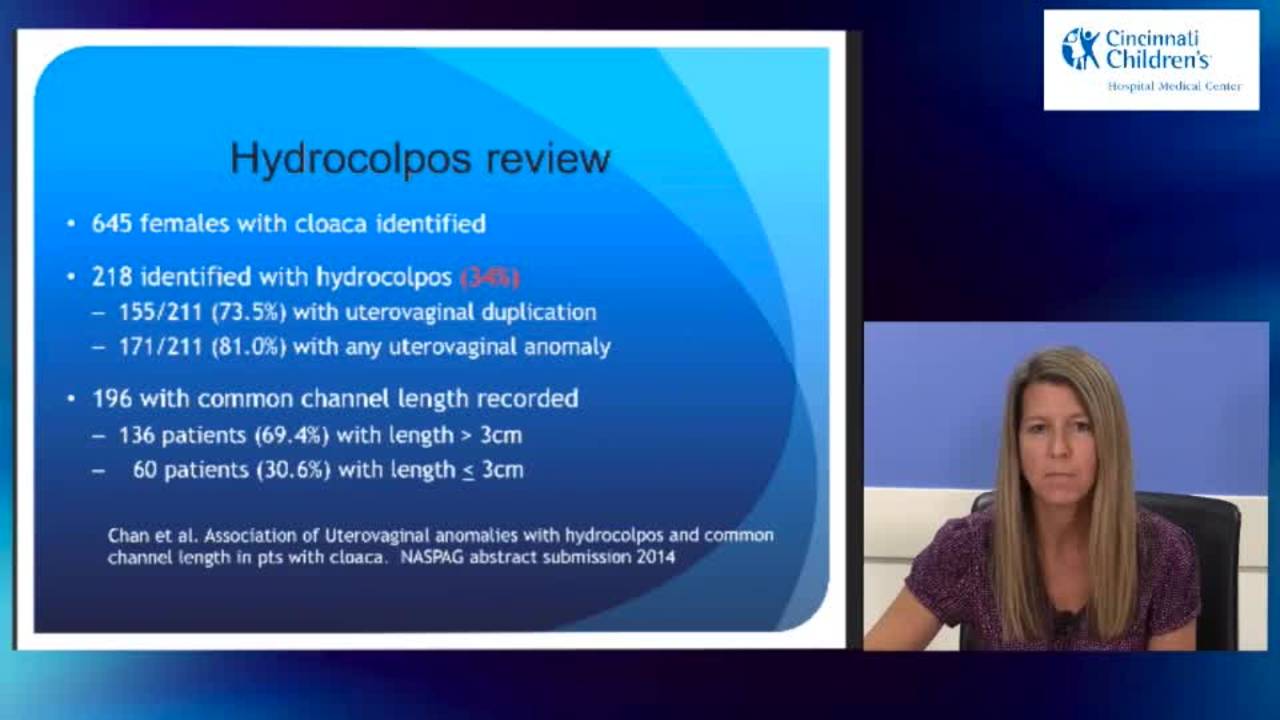
Case Presentations Part I: Cloaca and Complex ARMs 2015
45 min · Published Oct 2015
Video
Cloaca - Case Presentations
45 min · Published Nov 2018
Video
Urologic and Gynecologic Aspects in Anorectal Malformations: Pediatric...
Dr. Todd Ponsky · 41 min · Published Apr 2012
Video
Anorectal Malformation Management of Female Patients Part II: Pediatric...
28 min · Published Apr 2012
Video
Validation of an anorectal malformation trainer - Can a high-fidelity model simulate real life?
1 min · Published Jun 2026
Video
Complications and Long-Term Outcomes of Patients With Cloacal Malformation After Bowel Neovagina...
1 min · Published Jun 2026
Video
Safety and utility of long-acting steroid injection for management of post-operative stricture...
1 min · Published Jun 2026
Video
Association Between Social Determinants of Health and Choice of Urinary Reconstruction in Children
1 min · Published Jun 2026
Video
The Perineal Body Preserving PSARP (PPP)
11 min · Published Jun 2026
Video
Update Course Rewind 2025: Hirschsprung + ARM: Rare but Real
1 min · Published May 2026
Video
Acute Cholecystitis
Todd Ponsky · 32 min · Published Jul 2026
Video
Update Course Rewind 2025: Updates in NEC Management
11 min · Published Jul 2026
Video
Pediatric Pre-Operative Bowel Prep
Todd Ponsky · 1 min · Published Jul 2026
Video
Journal of Pediatric Surgery Article Review: September 2021
Todd Ponsky · 11 min · Published Jul 2026
Video
Journal of Pediatric Surgery Article Review: January 2022 - APSA Issue
Todd Ponsky · 13 min · Published Jul 2026
Video
Why?PediatricSurgery - More to do
Todd Ponsky · 1 min · Published Jul 2026
Video
Intestinal Atresia Types Explained: Grossfeld Classification for Pediatric Surgery
1 min · Published Sep 2026
Video
Derivation and validation of the Pediatric Community-Acquired Pneumonia Severity (PedCAPS) score: A prospective cohort study
50 s · Published Sep 2026
Video
FETO for Late-Diagnosed Severe Congenital Diaphragmatic Hernia (CDH) at Cincinnati Children's with Dr. Beth Rymeski
4 min · Published Sep 2026
Video
Severe Congenital Diaphragmatic Hernia (CDH) Case: FETO Management & Unexpected Findings with Dr. Beth Rymeski
3 min · Published Sep 2026
Video
Fetoscopic Endoluminal Tracheal Occlusion (FETO) Procedure: Step-by-Step Guide with Dr. Beth Rymeski
4 min · Published Sep 2026
Video
Choledochal Cyst Types Explained: Pediatric Surgery Fundamentals
1 min · Published Sep 2026
What the experts said
The institutional environment, not the individual surgeon, is the determining factor of patient outcomes in complex pediatric cases.
Effective multidisciplinary teams start with 2-3 completely dedicated practitioners and build incrementally, not with 30 members from the start.
True collaborative care requires coordination of time: shared clinic appointments, shared OR time, and dedicated conference time (Wednesdays at 9 a.m. for one hour in this team's case).
The team is supported by nurses who serve as 'the glue that hold us all together' and back office staff who coordinate ORs, clinics, and conferences.
The team recently added a physical therapist and behavioral medicine team as the program grew and needs expanded.
When a vagina is filled with fluid/urine in a cloaca, it can prohibit urine emptying and put pressure on the ureters, threatening kidney health.
Draining the vagina in hydrocolpos is primarily for kidney health and enabling urine release, not for the vagina's sake.
Drainage approaches for hydrocolpos include: bladder drainage, vaginal drainage via tube through abdomen (placed at colostomy or laparoscopically), interventional radiology-placed tube, or vesicostomy.
In patients with two hemivaginas, it is important to drain both adequately, sometimes requiring merging the vaginas or creating a defect in the septum.
Vesicostomy is used when vaginostomy tube does not provide adequate drainage, evidenced by persistent hydronephrosis, persistent bladder distention, or urinary tract infections.
Hydronephrosis in cloaca is caused by pressure on the trigone and ureteral insertion points from vaginal distention and hydrocolpos.
Creating a vesicostomy will impair future surgery, so it must be taken down to facilitate tension-free mobilization of pelvic organs, then reassessed for need after surgery.
After any drainage procedure for hydrocolpos, verification with ultrasound is essential to confirm the system is draining what it should; failure to verify can lead to continued renal damage.
Ultrasound is a powerful tool in cloaca care: no radiation, widely available, and useful for evaluating pelvis, bladder, vagina, and kidneys.
Even with a short common channel, if the rectal insertion is very high on the vagina, a posterior sagittal approach from below will not work.
In the presented case, the distal colonic segment from the mucous fistula was long enough to complete the pull-through; sometimes it is too short and the mucous fistula must be closed.
At Cincinnati Children's, cloaca patients undergo serial ultrasounds until about 6 months after onset of menstruation to ensure no obstruction.
The presented patient is hopeful for fecal continence based on normal sacrum, no tethered cord, and relatively short common channel.
Native vagina is always preferred for vaginal reconstruction when possible because it is hormonally responsive and has proven long-term function.
When selecting vaginal replacement tissue, key considerations are durability, availability, and avoiding negative impact on the patient's future function.
Rectum is considered for vaginal replacement when there is poor prognosis for bowel control (tethered cord, poor sacrum, multiple surgeries) or when avoiding abdominal surgery is advantageous due to geographic proximity.
Colon is the tissue of choice for vaginal replacement at Cincinnati Children's, having proven durable for future vaginal function.
Any patient with vaginal replacement requires cesarean section for delivery.
Small bowel for vaginal replacement has limitations with pedicle, blood supply, and reaching the pelvis, but is used when all colon must be preserved for bowel function.
Buccal graft acts more like native vagina than colon segments and is increasingly used, typically in pubertal patients requiring about one week hospitalization with minimal mobilization and a vaginal stent while the graft takes.
Buccal grafts have been used more for augmentation vaginoplasty in patients with strictures rather than in prepubertal patients.
For short common channel with normal spinal cord, urethral catheter alone may suffice post-operatively, with family taught intermittent catheterization if needed.
Setting expectations at each 'toll gate' in the care pathway is critical when managing children with ongoing complex surgical needs.
Post-void residual checks after catheter removal may reveal temporary voiding dysfunction from edema or stunned bladder that improves over time.
For longer common channels, suprapubic catheter is recommended: urethral catheter removed as stent, SP tube clamped/unclamped to assess emptying and prevent bladder overdistention during bladder rehabilitation.
Incomplete bladder emptying causes muscle overstretching where cross bridges in muscle fibers no longer connect and cannot contract.
In overtly neurogenic bladder where safe voiding is impossible and upper tracts are at risk, temporary vesicostomy is recommended to protect lower tracts and prevent blind catheterization of the reconstructed urethra.