


WILMS: NEPHRON-SPARING OR RADICAL? | CHONGQING CHINA | SYSTEMATIC REVIEW AND META-ANALYSIS | 24 | 1998 - 2019 | NEPHRON SPARING SURGERY | RADICAL NEPHRECTOMY | UNILATERAL, NON METASTATIC WILMS TUMOR, <18 YEARS | STUDIES THAT COMPARE BOTH TECHNIQUES | 20 RETROSPECTIVE, 5 PROSPECTIVE, 1 RCT | VS | n=657 | n=10322 | SURVIVAL | 95% VS 92% | p=0.226 | RECURRENCE | 5% VS 12% | p=0.114 | RENAL DYSFUNCTION | 6% VS 28% | p=0.2 | HYPERTENSION | 3% VS 19% | p=0.06 | Shan Li et. al., Dec 2023, DOI: 10.1007/s00383-023-05611-x | PEDIATRIC SURGERY International | Solid Manual Designs Values | Authors: @cjpediatrics_design
From
StayCurrentMD
Efficacy and late kidney effects of nephron-sparing surgery in the management of unilateral Wilms tumor
Part of
Pediatric Oncology 696 items
Infographic · Mar 2024 · 1 min read
In brief
In brief
Systematic review comparing nephron-sparing surgery to radical nephrectomy in unilateral Wilms tumor found NSS preserves renal function without compromising oncological outcomes. Meta-analysis of 10,979 patients showed NSS significantly improved eGFR at follow-up with similar survival and recurrence rates to radical nephrectomy.
- Nephron-sparing surgery significantly increased eGFR at follow-up compared to baseline, while radical nephrectomy showed no significant change
- NSS and RN showed no significant differences in survival, recurrence, renal dysfunction, or hypertension rates in unilateral Wilms tumor
- Meta-analysis of 10,979 patients demonstrates NSS is safe and effective, preserving renal function without compromising oncologic outcomes
- Current evidence supports NSS as preferred approach for unilateral Wilms tumor when technically feasible
Written by the GCMD Library team from the infographic.
The infographic uses a left-to-right layout with anatomical kidney illustrations showing surgical approaches. A red sidebar on the left contains study metadata. The center compares two surgical techniques with kidney diagrams - one showing partial removal, one showing complete removal. The right side displays outcome metrics in orange and gray with statistical comparisons, using icons for survival, recurrence, renal dysfunction, and hypertension.
New infographic by Dr. Jose Campos and the chilean society of pediatric surgeons
"Efficacy and late kidney effects of nephron-sparing surgery in the management of unilateral Wilms tumor: a systematic review and meta-analysis"
Authors: Shan Li, Jinkui Wang, Mujie Li, Zhaoxia Zhang, Tao Mi, Xin Wu, Zhang Wang, Liming Jin, Dawei He
Full article: https://gcmd.co/3vgzJ9c
Abstract
To evaluate the efficiency and long-term renal function of nephron sparing surgery (NSS) in unilateral WT patients compared with radical nephrectomy (RN). The review was performed following Cochrane Handbook guidelines and Preferred Reporting Items for Systematic Reviews and Meta-Analyses (PRISMA). We searched five databases (Pubmed, Embase, Scopus, Web of Science and Cochrane) for studies reporting the efficiency and late renal function of NSS and/or RN on February 10, 2023. Comparative studies were evaluated by Risk of Bias in Non-randomized Studies of Interventions (ROBINS-I) and RoB 2.0. Assessed outcomes included survival rate, relapse rate, eGFR, renal dysfunction and hypertension. 26 studies involving 10322 unilateral WT cases underwent RN and 657 unilateral WT cases underwent NSS were enrolled. Overall effect estimates demonstrated that NSS significantly increased eGFR at follow-up (SMD, 0.38; 95% CI 0.05-0.72; p = 0.025) compared to that at diagnosis, and RN did not significantly decrease eGFR at follow-up (SMD, - 0.33; 95% CI - 0.77-0.11; p = 0.142) compared to that at diagnosis. Moreover, no significant difference was found in outcomes of survivability (OR, 1.38; 95% CI 0.82-2.32; p = 0.226), recurrence (OR, 0.62; 95% CI 0.34-1.12; p = 0.114), eGFR at follow-up (SMD, 0.16; 95% CI - 0.36-0.69; p = 0.538), renal dysfunction (OR, 0.36; 95% CI 0.07-1.73; p = 0.200) and hypertension (OR, 0.17; 95% CI 0.03-1.10; p = 0.063). Current evidence suggests that NSS is safe and effective for unilateral WT patients, because it causes better renal function and similar oncological outcomes compared with RN. Future efforts to conduct more high-quality studies and explore sources of heterogeneity is recommended.
The text in the image
Educational content from recorded physician discussions — not medical advice. Talk to your (or your child's) care team about your situation.
Video
Oncology Tumor Board Showdown: Pediatric Oncology 5 Question Quiz
1 min · Published Oct 2026
Article
Minimally invasive surgery for abdominal and thoracic neuroblastic tumors: A systematic review by the APSA Cancer committee
Juan Pablo Gurria · Published Oct 2026
Video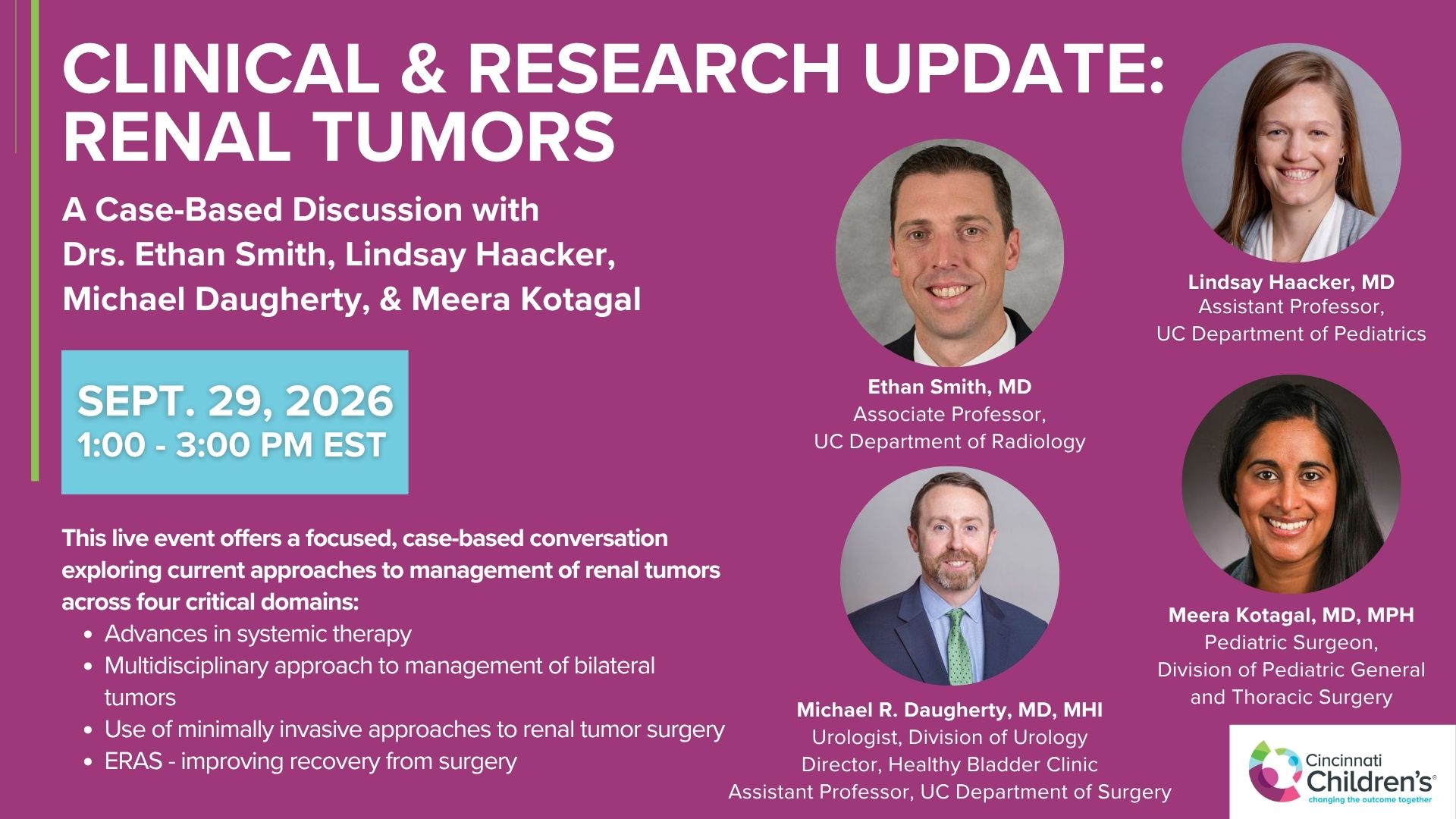
Clinical & Research Update: Renal Tumors with Drs. Ethan Smith, Lindsay Haacker, Michael Daugherty, and Meera Kotagal
71 min · Published Sep 2026
Video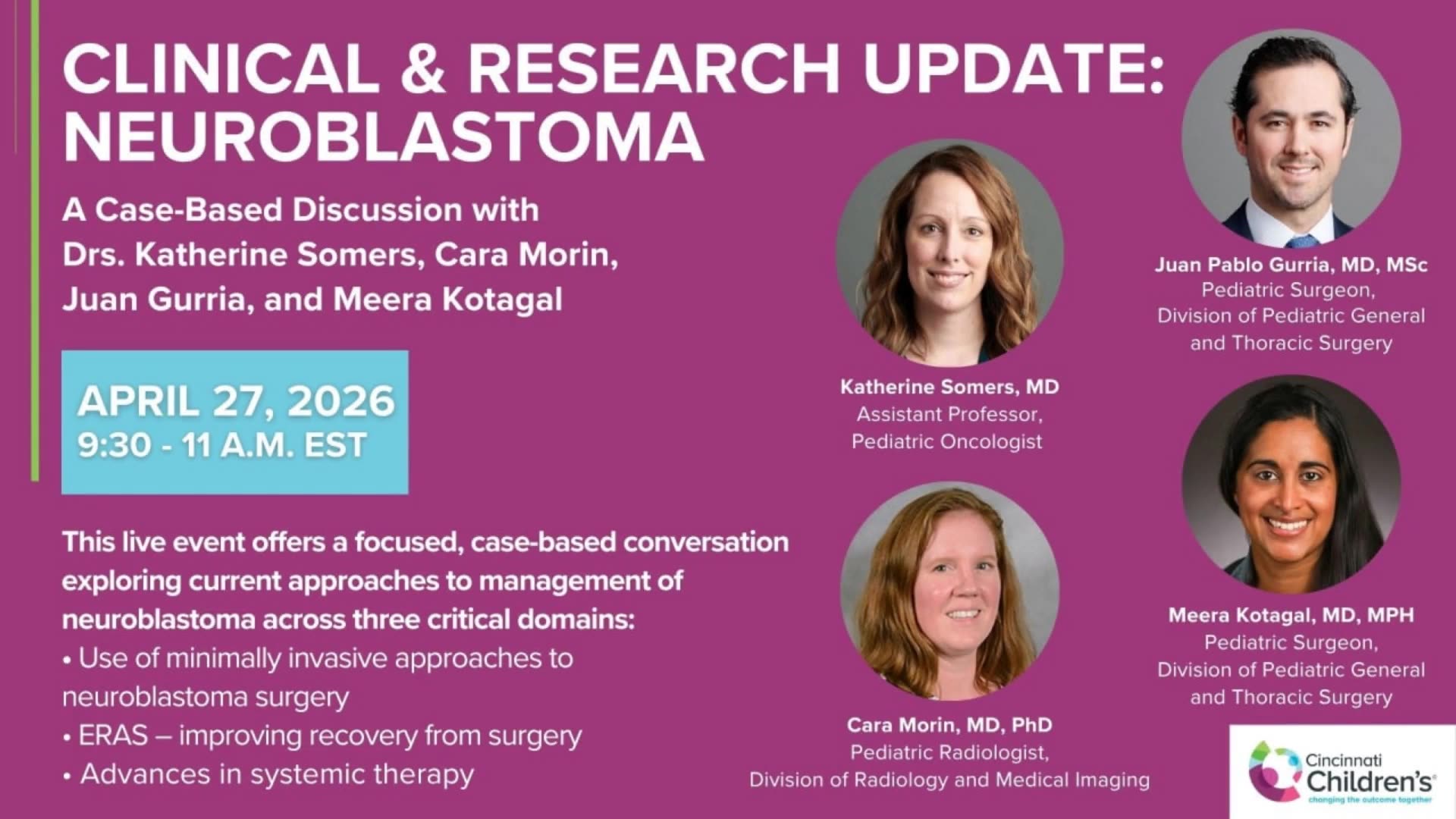
Clinical & Research Update: Neuroblastoma with Drs. Katherine Somers, Cara Morin, Juan Gurria, and Meera Kotagal
67 min · Published Sep 2026
Video
Clinical & Research Update: Sarcoma w/ Drs. Roshni Dasgupta, Joseph Pressey, Arthur Meyer, Luke Pater
66 min · Published Sep 2026
Video
Update Course Rewind 2025: Nerve Monitoring in Pediatric Thyroid Surgery
6 min · Published Jul 2026
Video
Intestinal Atresia Types Explained: Grossfeld Classification for Pediatric Surgery
1 min · Published Sep 2026
Video
Derivation and validation of the Pediatric Community-Acquired Pneumonia Severity (PedCAPS) score: A prospective cohort study
50 s · Published Sep 2026
Video
FETO for Late-Diagnosed Severe Congenital Diaphragmatic Hernia (CDH) at Cincinnati Children's with Dr. Beth Rymeski
4 min · Published Sep 2026
Video
Severe Congenital Diaphragmatic Hernia (CDH) Case: FETO Management & Unexpected Findings with Dr. Beth Rymeski
3 min · Published Sep 2026
Video
Fetoscopic Endoluminal Tracheal Occlusion (FETO) Procedure: Step-by-Step Guide with Dr. Beth Rymeski
4 min · Published Sep 2026
Video
Choledochal Cyst Types Explained: Pediatric Surgery Fundamentals
1 min · Published Sep 2026