


From
StayCurrentMD
Update Course Rewind: Ovarian Torsion Management 2023
With Dr. Lesley Breech · hosted by Dr. M. Goldie
Part of
Ovarian Torsion 8 items
Chapter 1 of 7 · Fundamentals
Series intro
Introduction to Update Course Rewind Series
Expert statements on this page
No expert statements were drawn from this page.
Host summaries · secondary, not cited in answers
Educational content from recorded physician discussions — not medical advice. Talk to your (or your child's) care team about your situation.
Video
Ovarian Torsion Rapid Fire: Update Course 2015
12 min · Published Nov 2015
Video
Ovarian Torsion with Dr. Dasgupta
Published Sep 2022
Podcast
Ovarian Torsion with Dr. Jennifer Dietrich
47 min · Published Jan 2017
Podcast
Ovarian Tumors Video Podcast
34 min · Published Mar 2018
Podcast
Pediatric Ovarian Tumors Video Podcast
34 min · Published Mar 2018
Video
Ovarian Teratoma - Ovarian Torsion - Soft Tissue Sarcoma: Update Course 2015
34 min · Published Nov 2018
Video
GYN #3 Management of an Adnexal Torsion with a Healthy Appearing Ovary with Dr. Lesley Breech
CCHMC Pediatric Surgery · Published May 2024
Video
GYN #2 Oophoropexy in Adnexal Torsion with Dr. Lesley Breech
CCHMC Pediatric Surgery · Published May 2024
Video
GYN #1 Importance of Documenting Reproductive Anatomy with Dr. Lesley Breech
CCHMC Pediatric Surgery · Published Feb 2024
Video
Intestinal Atresia Types Explained: Grossfeld Classification for Pediatric Surgery
1 min · Published Sep 2026
Video
Derivation and validation of the Pediatric Community-Acquired Pneumonia Severity (PedCAPS) score: A prospective cohort study
50 s · Published Sep 2026
Video
FETO for Late-Diagnosed Severe Congenital Diaphragmatic Hernia (CDH) at Cincinnati Children's with Dr. Beth Rymeski
4 min · Published Sep 2026
Video
Severe Congenital Diaphragmatic Hernia (CDH) Case: FETO Management & Unexpected Findings with Dr. Beth Rymeski
3 min · Published Sep 2026
Video
Fetoscopic Endoluminal Tracheal Occlusion (FETO) Procedure: Step-by-Step Guide with Dr. Beth Rymeski
4 min · Published Sep 2026
Video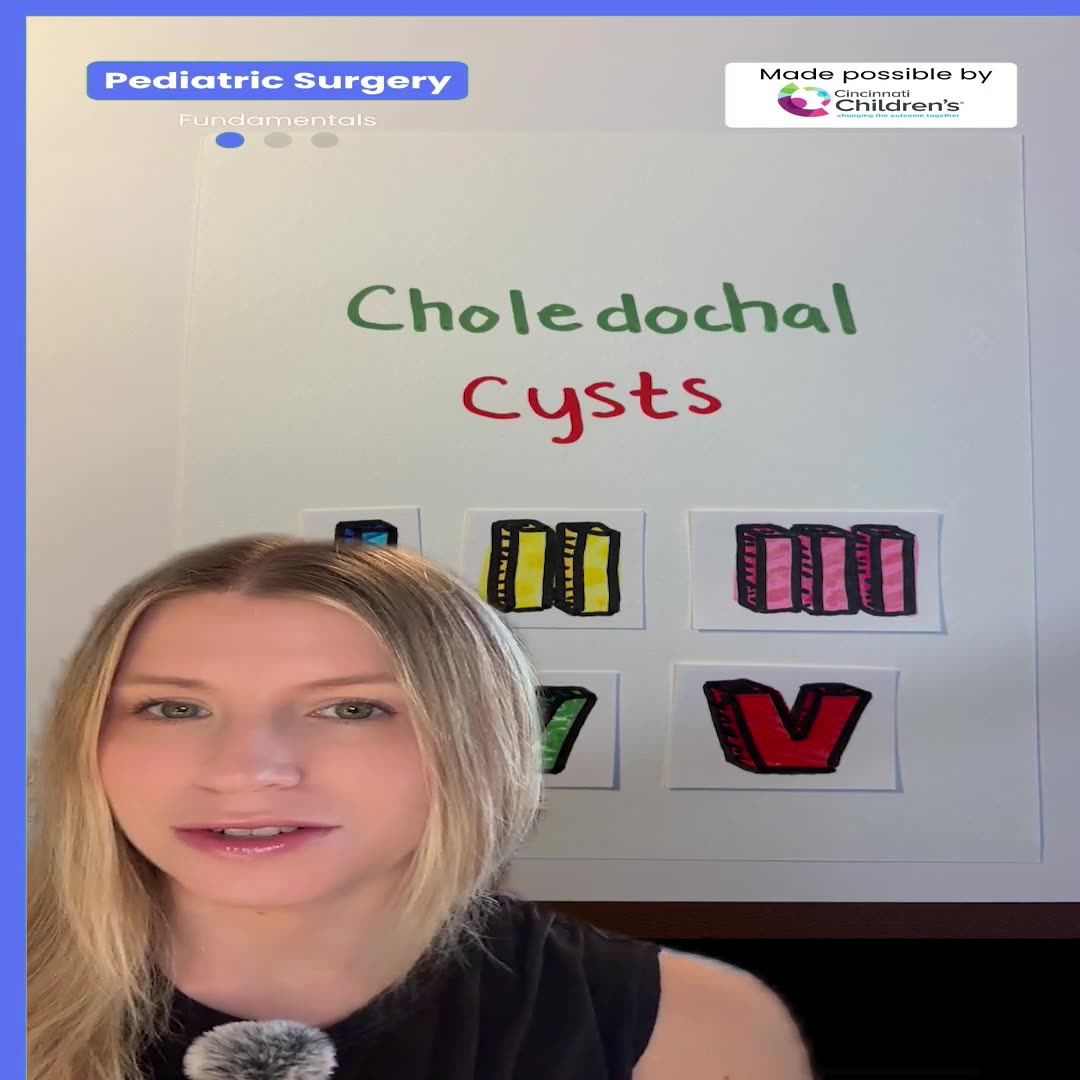
Choledochal Cyst Types Explained: Pediatric Surgery Fundamentals
1 min · Published Sep 2026
What the experts said
Apparent cystic areas on ultrasound in ovarian torsion cases are often actually edema of the fallopian tube rather than true cysts.
Oophorectomy should not be performed in ovarian torsion cases.
There is no good data showing a timeline or appearance that would indicate an ovary will not survive after torsion.
The standard approach is to always detorse the ovary and leave it in place.
In a recent quality improvement project, some institutions performed oophorectomy in as many as 25% of ovarian torsion cases.
For a black, edematous fallopian tube in a prepubertal girl, there is plenty of time to figure out management.
In adolescent patients with edematous fallopian tubes, future tubal function is a concern because the tube must be patent and have open fimbria to function properly.
Scarring of the fallopian tube is a concern for future fertility and increases risk for ectopic pregnancies.
Some surgeons perform oophoropexy in cases where there is nothing clearly causing the torsion, as a strategy to prevent recurrence.
A good percentage of patients with ovarian torsion will have nothing wrong with the ovary itself.
Some surgeons incise the ovarian cortex to release edema and reduce swelling in edematous ovaries.
With significant edema, it is difficult to determine intraoperatively if there is underlying pathology in the ovary that needs to be removed.
Most gynecologists untwist the ovary, leave it in place, and obtain follow-up imaging to identify any underlying ovarian pathology that might have caused the torsion.
Paratubal or paraovarian cysts increase the risk of torsion and should be removed rather than aspirated to prevent recurrence.
The highest risk of torsion in an edematous ovary is in prepubertal girls.
In pubertal females, the posterior cul-de-sac has sufficient room to accommodate a 4-5 centimeter ovary with a cyst, which occurs monthly with ovulation.
A paper suggested the risk of re-torsion could be anywhere between 10 to 15%, but it does not stratify immediate recurrence versus patients already at risk for re-torsion.
Patients who have already had torsion three, four, or five times, or who are gymnasts, or who have long ligaments, have predisposing factors for recurrent torsion.
There is a risk of re-torsion in an edematous ovary, but time should be given for the edema to resolve while attempting to preserve the ovary.