


GLOBAL INCOME DISPARITIES: IMPACT ON PEDIATRIC CANCER OUTCOMES | MEMPHIS USA | META-ANALYSIS | 2010 - 2021 | TREATMENT RELATED MORTALITY | COUNTRIES CLASSIFIED ACCORDING TO INCOME | 501 STUDIES | n= 68,351 | DOES COUNTRY INCOME LEVEL AFFECT TREATMENT RELATED MORTALITY IN CHILDHOOD CANCER? | MORTALITY | COUNTRY INCOME LEVEL | TREND | 4.5% | UPPER-MIDDLE | 9.2% | LOWER-MIDDLE | 14.2% | LOW | Bella S Ehrlich, et al. JUL 2023 DOI: 10.1016/S1470-2045(23)00318-2 | THE LANCET Oncology
From
StayCurrentMD
Treatment-related mortality in children with cancer in low-income and middle-income countries
Part of
Pediatric Oncology 696 items
Infographic · Oct 2023 · 2 min read
In brief
In brief
Systematic review of 501 studies across 68,351 pediatric cancer patients in LMICs reveals treatment-related mortality of 6.82% overall, with stark disparities by income level: 14.19% in low-income countries versus 4.47% in upper-middle-income countries. Treatment-related deaths account for nearly one-third of all mortality in these settings.
- Treatment-related mortality in LMICs is 6.82% overall, but reaches 14.19% in low-income countries—triple the 3-5% rate in high-income countries.
- One in 15 children receiving cancer treatment in LMICs dies from treatment complications, accounting for 31% of all childhood cancer deaths.
- Treatment-related mortality inversely correlates with country income level and has not improved over time in low- and lower-middle-income countries.
- Upper-middle-income countries show declining treatment-related mortality, demonstrating that improvement is achievable with adequate resources.
- Targeted supportive care interventions are urgently needed to address the preventable deaths driving global disparities in childhood cancer survival.
Written by the GCMD Library team from the infographic.
The infographic uses a red and white color scheme with icons representing treatment mortality, geographic location, and death. A central flow diagram shows how country income level affects mortality outcomes. Three mortality percentages are displayed on the right with corresponding trend indicators (up/down arrows) for upper-middle, lower-middle, and low-income countries.
New infographic by Dr. Jose Campos and the Chilean society of pediatric surgery
"Treatment-related mortality in children with cancer in low-income and middle-income countries: a systematic review and meta-analysis"
Authors: Bella S Ehrlich, Michael J McNeil, Linh T D Pham, Yichen Chen, Jocelyn Rivera, Carlos Acuna, Liz Sniderman, Firas M Sakaan, Alejandra Mendez Aceituno, Cesar A Villegas, Lisa M Force, Nancy S Bolous, Parima P Wiphatphumiprates, Jeremy S Slone, Angela K Carrillo, Srinithya R Gillipelli, Caitlyn Duffy, Anita V Arias, Meenakshi Devidas, Carlos Rodriguez-Galindo, Sheena Mukkada, Asya Agulnik
Full article: https://pubmed.ncbi.nlm.nih.gov/37517410/
Background: Approximately 90% of children with cancer live in low-income and middle-income countries (LMICs), where 5-year survival is lower than 20%. Treatment-related mortality in high-income countries is approximately 3-5%; however, in LMICs, treatment-related mortality has been reported in up to 45% of children with cancer. This study aimed to systematically explore the burden of treatment-related mortality in children with cancer in LMICs and to explore the association between country income level and treatment-related mortality.
Methods: For this systematic review and meta-analysis we identified articles published between Jan 1, 2010, and June 22, 2021, describing treatment-related mortality in paediatric patients (aged 0-21 years) with cancer in LMICs. We searched PubMed, Trip, Web of Science, Embase, and the WHO Global Metric Index databases. The search was limited to full-text articles and excluded case reports (<10 patients) and haematopoietic stem-cell transplantation recipients. Two reviewers independently screened studies for eligibility, extracted data from included publications, and evaluated data quality. Random and mixed-effects models were used to estimate treatment-related mortality burden and trends. The Cochran-Q statistic was used to assess heterogeneity between studies. This study is registered on PROSPERO (CRD42021264849).
Findings: Of 13 269 identified abstracts, 501 studies representing 68 351 paediatric patients with cancer were included. The treatment-related mortality estimate was 6·82% (95% CI 5·99-7·64), accounting for 30·9% of overall mortality (4437 of 14 358 deaths). Treatment-related mortality was inversely related to country income. Treatment-related mortality was 14·19% (95% CI 9·65-18·73) in low-income countries, 9·21% (7·93-10·49) in lower-middle-income countries, and 4·47% (3·42-5·53) in upper-middle-income countries (Cochran-Q 42·39, p<0·0001). In upper-middle-income countries, the incidence of treatment-related mortality decreased over time (slope -0·002, p=0·0028); however, outcomes remained unchanged in low-income (p=0·21) and lower-middle-income countries (p=0·16).
Interpretation: Approximately one in 15 children receiving cancer treatment in LMICs die from treatment-related complications. Although treatment-related mortality has decreased in upper-middle-income countries over time, it remains unchanged in LMICs. There is an urgent need for targeted supportive care interventions to reduce global disparities in childhood cancer survival.
The text in the image
Educational content from recorded physician discussions — not medical advice. Talk to your (or your child's) care team about your situation.
Video
Oncology Tumor Board Showdown: Pediatric Oncology 5 Question Quiz
1 min · Published Oct 2026
Article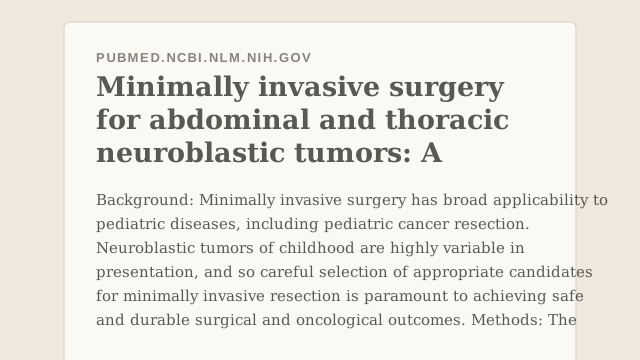
Minimally invasive surgery for abdominal and thoracic neuroblastic tumors: A systematic review by the APSA Cancer committee
Juan Pablo Gurria · Published Oct 2026
Video
Clinical & Research Update: Renal Tumors with Drs. Ethan Smith, Lindsay Haacker, Michael Daugherty, and Meera Kotagal
71 min · Published Sep 2026
Video
Clinical & Research Update: Neuroblastoma with Drs. Katherine Somers, Cara Morin, Juan Gurria, and Meera Kotagal
67 min · Published Sep 2026
Video
Clinical & Research Update: Sarcoma w/ Drs. Roshni Dasgupta, Joseph Pressey, Arthur Meyer, Luke Pater
66 min · Published Sep 2026
Video
Update Course Rewind 2025: Nerve Monitoring in Pediatric Thyroid Surgery
6 min · Published Jul 2026
Video
Intestinal Atresia Types Explained: Grossfeld Classification for Pediatric Surgery
1 min · Published Sep 2026
Video
Derivation and validation of the Pediatric Community-Acquired Pneumonia Severity (PedCAPS) score: A prospective cohort study
50 s · Published Sep 2026
Video
FETO for Late-Diagnosed Severe Congenital Diaphragmatic Hernia (CDH) at Cincinnati Children's with Dr. Beth Rymeski
4 min · Published Sep 2026
Video
Severe Congenital Diaphragmatic Hernia (CDH) Case: FETO Management & Unexpected Findings with Dr. Beth Rymeski
3 min · Published Sep 2026
Video
Fetoscopic Endoluminal Tracheal Occlusion (FETO) Procedure: Step-by-Step Guide with Dr. Beth Rymeski
4 min · Published Sep 2026
Video
Choledochal Cyst Types Explained: Pediatric Surgery Fundamentals
1 min · Published Sep 2026