


Chapter 1 of 5 · Case-Based Learning
Optimal Kasai timing
Case presentation and optimal age for Kasai procedure
Expert statements on this page
No expert statements were drawn from this page.
Host summaries · secondary, not cited in answers
Educational content from recorded physician discussions — not medical advice. Talk to your (or your child's) care team about your situation.
Video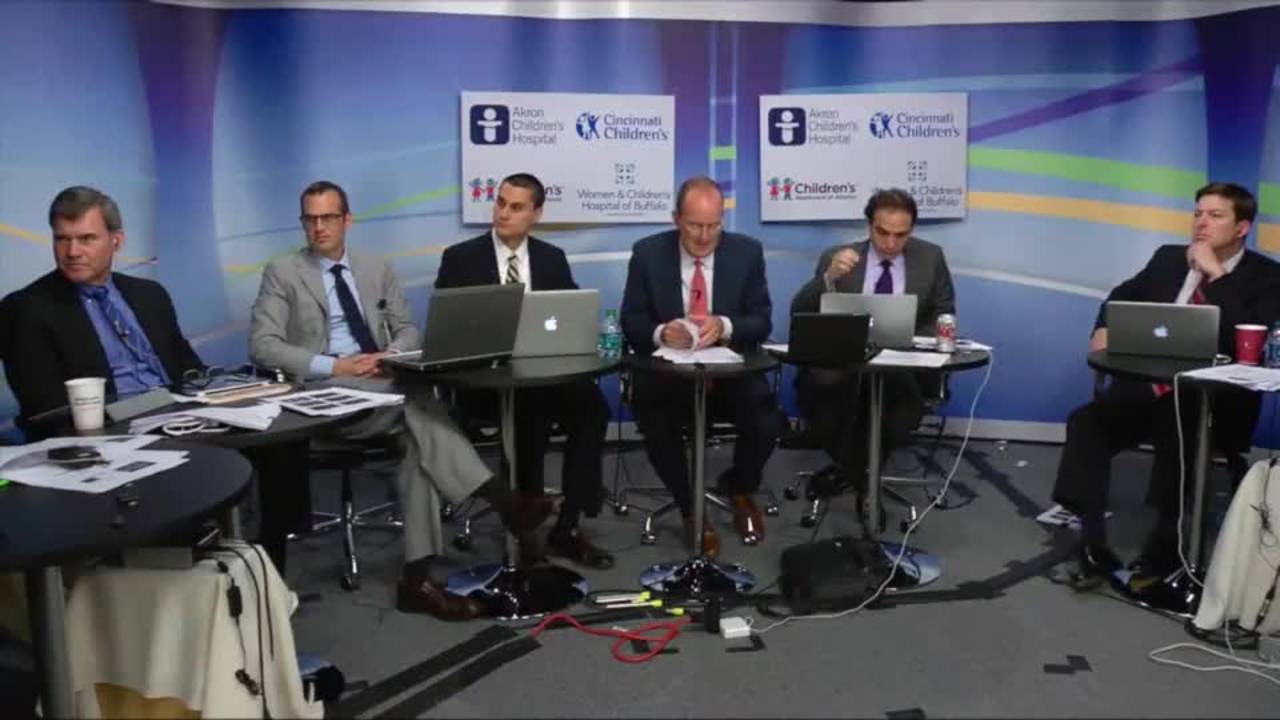
Biliary Atresia-Case Presentation and Panel Discussion: Update Course 2014
23 min · Published Jul 2017
Video
Biliary Atresia: Where are we now? Advanced Practice Providers Pediatric...
Dr. Todd Ponsky · 48 min · Published Jul 2017
Podcast
Atresia de Vias Biliares - Resumen de la 5ta sesión Nacional de Residentes de Mexico
16 min · Published May 2023
Video
Biliary Atresia with Dr. Greg Tiao
CCHMC Pediatric Surgery · 11 min · Published Jun 2022
Video
Prof. Shilpa Sharma - Best of the Best in Pediatric Surgery 2024
Dr. Todd Ponsky · 5 min · Published Feb 2024
Podcast
Liver transplant with Dr. Jonathan Merola
14 min · Published Jul 2024
Video
Intestinal Atresia Types Explained: Grossfeld Classification for Pediatric Surgery
1 min · Published Sep 2026
Video
Derivation and validation of the Pediatric Community-Acquired Pneumonia Severity (PedCAPS) score: A prospective cohort study
50 s · Published Sep 2026
Video
FETO for Late-Diagnosed Severe Congenital Diaphragmatic Hernia (CDH) at Cincinnati Children's with Dr. Beth Rymeski
4 min · Published Sep 2026
Video
Severe Congenital Diaphragmatic Hernia (CDH) Case: FETO Management & Unexpected Findings with Dr. Beth Rymeski
3 min · Published Sep 2026
Video
Fetoscopic Endoluminal Tracheal Occlusion (FETO) Procedure: Step-by-Step Guide with Dr. Beth Rymeski
4 min · Published Sep 2026
Video
Choledochal Cyst Types Explained: Pediatric Surgery Fundamentals
1 min · Published Sep 2026
What the experts said
In the Michigan series, children who had Kasai after 3 months had the best drainage and long-term outcome, though patient selection bias may explain this finding.
Under 60 days there was a clear difference in outcomes; procedures were done emergently on weekends if approaching that deadline.
The critical factor determining outcome may be the degree of cirrhosis present at the time of Kasai, which does not always correlate directly with chronologic age.
In most biliary atresia cases, jaundice and pale stools are present from the first week of life; timing of referral to tertiary centers varies based on pediatrician vigilance.
Reversal of portal flow is a very concerning finding because patients can achieve good biliary drainage and normal bilirubin but still progress to transplant due to profound portal hypertension.
Performing Kasai even in advanced disease may buy months of time, expanding the donor pool and making eventual transplant technically easier with lower hepatic artery thrombosis risk.
Hepatologists can manage biliary atresia patients medically for up to a year in the absence of Kasai or transplant, though nutritional status suffers.
In patients with end-stage liver disease signs (profound fibrosis, reversed portal flow), Kasai may not improve outcomes and the operative stress may worsen their condition.
The Kasai operation itself is not technically demanding or high-risk, so reoperation when uncertain about initial success is reasonable.
Some biliary atresia patients show delayed response to Kasai, with bilirubin remaining elevated for months then dropping to normal at 5 months post-op, suggesting a race between hepatocyte regeneration and fibrosis progression.
If a liver biopsy is suggestive of biliary atresia, additional workup tests are not needed.
Pathologists' understanding of biliary atresia histology has improved significantly compared to 20 years ago.
Interventional radiologists can perform percutaneous liver biopsy safely and routinely, making it a low-barrier test.
A patent gallbladder is extremely rare in true biliary atresia.
Prenatal ultrasound diagnosis of biliary atresia based on absent gallbladder is unreliable and angle-dependent, with at least one reported case of near-abortion for a normal fetus.
French registry data show children who had Kasai at less than 1 month of age have nearly twice the 5- and 10-year native liver survival rate compared to those done after 90 days.
Rich Ricketts' series showed not statistically significant better results with Kasai at 76 days or older compared to 0-75 days, possibly representing a different disease phenotype in late presenters.
Peter Altman recommended performing Kasai between 60 and 75 days based on the largest U.S. series from Columbia.
HIDA scan with phenobarbital has high sensitivity and specificity for biliary atresia, requiring at least 5 days of phenobarbital at therapeutic levels.
In the Children's National study, approximately one-third of initially negative HIDA scans converted to positive for biliary atresia when repeated with adequate phenobarbital levels.
A recent paper in Gastroenterology described a scoring system using liver biopsy plus clinical parameters with nearly 100% ability to predict biliary atresia.
In Milwaukee, percutaneous cholangiography is combined with liver biopsy when a gallbladder is present, with one surgical complication in 46 attempts.
Japanese surgeons still recommend postoperative steroids either routinely or when bile drainage decreases, despite studies questioning their efficacy.
Yamataka's group at Juntendo University performs Kasai dissection much wider than the classic technique, uses more superficial sutures to avoid ductule damage, and avoids sutures at 10 and 3 o'clock positions where bile ducts bifurcate, claiming improved results.
Japanese surgeons are attempting to refute IPEG's recommendation against laparoscopic Kasai by demonstrating equivalent results with laparoscopic technique.