

From
Grand Rounds
Meconium Ileus: Presentation, Workup, Diagnosis & Treatment Options
With Dr. Beth Romesky · hosted by Dr. M Tom Bash
Chapter 1 of 7 · Fundamentals
Introduction
Introduction and episode overview
Expert statements on this page
No expert statements were drawn from this page.
Host summaries · secondary, not cited in answers
Educational content from recorded physician discussions — not medical advice. Talk to your (or your child's) care team about your situation.
More about this diagnosis
Meconium ileusPodcast
Hirschsprung
Marc Levitt · 22 min · Published Jun 2019
Video
Meconium Plug Syndrome (MPS)
Published Mar 2020
Video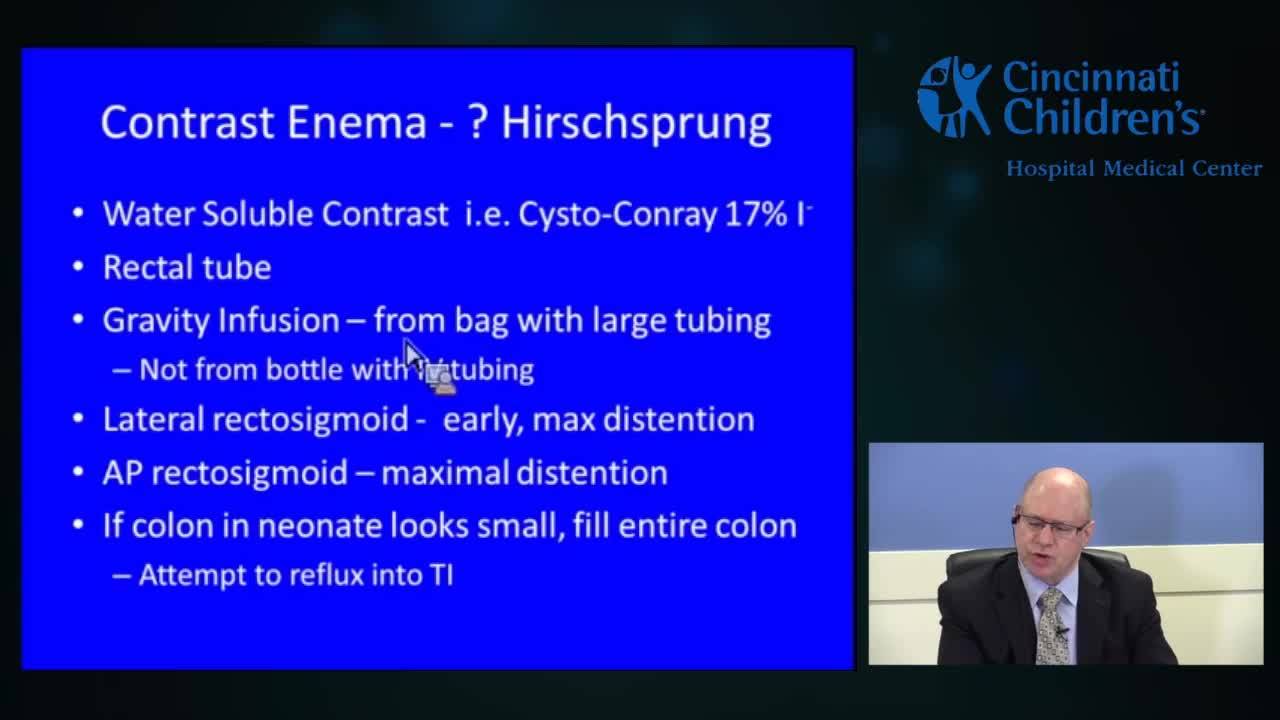
Contrast Enema for Hirschsprung Disease
11 min · Published Feb 2015
Podcast
Colorectal Quiz Episode 3: Hirschsprung Disease
20 min · Published Feb 2021
Video
DrBeen Medical Lectures: Dr. Marc Levitt, MD Discusses Hirschsprung Disease
53 min · Published Dec 2022
Podcast
The Colorectal Quiz Episode 10: Total Colonic Hirschsprung Disease Part 1
12 min · Published Apr 2021
Video
GYN #4 Management of Tubal Torsion: When to Consider Salpingectomy with Dr. Lesley Breech
CCHMC Pediatric Surgery · Published Oct 2024
Podcast
Pyloric Stenosis with Dr. Alex Bondoc
16 min · Published Jun 2024
Video
GYN #3 Management of an Adnexal Torsion with a Healthy Appearing Ovary with Dr. Lesley Breech
CCHMC Pediatric Surgery · Published May 2024
Video
GYN #2 Oophoropexy in Adnexal Torsion with Dr. Lesley Breech
CCHMC Pediatric Surgery · Published May 2024
Video
GYN #1 Importance of Documenting Reproductive Anatomy with Dr. Lesley Breech
CCHMC Pediatric Surgery · Published Feb 2024
Podcast
Esophageal Replacement with Dr. Dan von Allmen
13 min · Published Nov 2023
What the experts said
Meconium ileus is a problem affecting newborns where thick meconium stool present in the colon at birth is unable to pass.
The majority of patients with meconium ileus have cystic fibrosis.
In the Caucasian population, meconium ileus occurs in about one in every 1100 to 2500 live births.
In Black populations, meconium ileus is much less prevalent at one in every 17,000 live births.
In Asian populations, meconium ileus is even more rare at one in every 90,000 live births.
About one in five babies with cystic fibrosis is born with meconium ileus.
The CFTR gene codes for protein that forms the cyclic AMP induced chloride channels, which regulate ion flow across the surface of epithelial cells.
When the CFTR gene is mutated, secretions including meconium are very thick and inspissated (devoid of enough moisture to allow movement through the bowel).
The first diagnostic step for suspected meconium ileus is an abdominal X-ray to check bowel gas pattern and look for calcifications.
Calcifications on initial X-ray can indicate complicated meconium ileus with in-utero perforation and healing.
Differential diagnosis for meconium ileus includes meconium plugs, Hirschsprung's disease, small left colon, and delayed passage of meconium in premature babies.
In the United States, cystic fibrosis testing is part of the standard newborn panel.
If the child is stable without signs of peritonitis, a contrast enema is the appropriate next study.
Water-soluble contrast enema provides diagnostic images and can be therapeutic by drawing water into the colon to help clear meconium.
Mucomyst (acetylcysteine) mixed with contrast enema helps break up chemical bonds and solubilize inspissated stool.
The most common site of obstruction in meconium ileus is the mid to distal ileum, not the colon.
Some babies with meconium ileus never need an operation and can be resolved with serial contrast enema administration.
Surgical indications include peritonitis, concern for perforation, or failure to progress with enema therapy.
Most surgeons perform open exploration for meconium ileus since manipulation of the bowel is needed.
Operative techniques include making a small enterotomy with catheter placement for irrigation, or using the appendix tip with retrograde catheter placement into the terminal ileum.
When the bowel is severely dilated and unhealthy, resection with ileostomy creation is often necessary.
Complicated meconium ileus patients with calcifications on X-ray may not need immediate operation if they are not obstructed, as they could have had in-utero perforation that healed.
The appendix can be brought up to the abdominal wall as an appendicostomy for continued bowel irrigation access and later removed when no longer needed.
Post-operatively, Mucomyst is commonly administered from above (via NG tube or by mouth) because these children are susceptible to recreating thickened meconium.
Feedings should be restarted as soon as safe to prevent re-obstruction.
Distal intestinal obstructive syndrome (DIOS) is a long-term complication seen in early childhood or teenage years where thick stool builds up in the distal ileum.
Pancreatic enzyme replacements help prevent re-obstruction once the infant is tolerating enteral diet.
Many CF patients, particularly those who had meconium ileus as infants, have chronic constipation and often use Miralax or PEG solution to maintain thin stool.
Perioperative antibiotics are indicated as this is a class two or class three operation, but additional antibiotics beyond the perioperative course are not necessary unless there is concomitant infection.
Most patients presenting with DIOS can be managed without operation using contrast enema plus or minus Mucomyst.
These babies need aggressive pulmonary toilet including chest PT to clear secretions once extubated.
Suction rectal biopsy at bedside is appropriate if there is question that the diagnosis is not cystic fibrosis or meconium ileus, but it is not routinely required.
Stomas can prolapse, become strictured, and children with ileostomy can have major electrolyte disturbances.
Most surgeons prefer not to re-enter the abdomen at intervals less than four to six weeks, so stoma reversal typically occurs at least six weeks after creation.
In some places in the country and world, discharging a child with an ileostomy is not safe due to risk of dehydration and significant issues, so they may need to stay hospitalized until stoma reversal.