


From
Live Event Content
BOB Ped Surg 2023 - Fereshteh Salimi Jazi, PAPS - Presentation
With Dr. Fereshteh Salimi Jazi
Part of
Pilonidal Disease 9 items
Chapter 1 of 4 · Evidence & Research
Study introduction
Introduction and hypothesis
Expert statements on this page
No expert statements were drawn from this page.
Host summaries · secondary, not cited in answers
Educational content from recorded physician discussions — not medical advice. Talk to your (or your child's) care team about your situation.
Video
Burden of pilonidal disease and improvement in quality of life after treatment in adolescents
Published Oct 2023
Video
Carga mental de la enfermedad pilonidal y mejora de la calidad de vida tras el tratamiento en adolescentes
Published Oct 2023
Video
Minimal Treatment of Pilonidal Disease - APSA Practice Gaps 2019
Published Mar 2020
Video
Update Course Rewind: Patient Education and Non-Surgical Management of Pilonidal Disease 2024
Published Jan 2025
Video
Pilonidal Cyst Case Presentation: Update Course 2015
5 min · Published Nov 2015
Video
Update Course Rewind: Surgical Management of Pilonidal Disease 2024
Published Apr 2025
Only a few other public items share this expert — go deeper there →
Video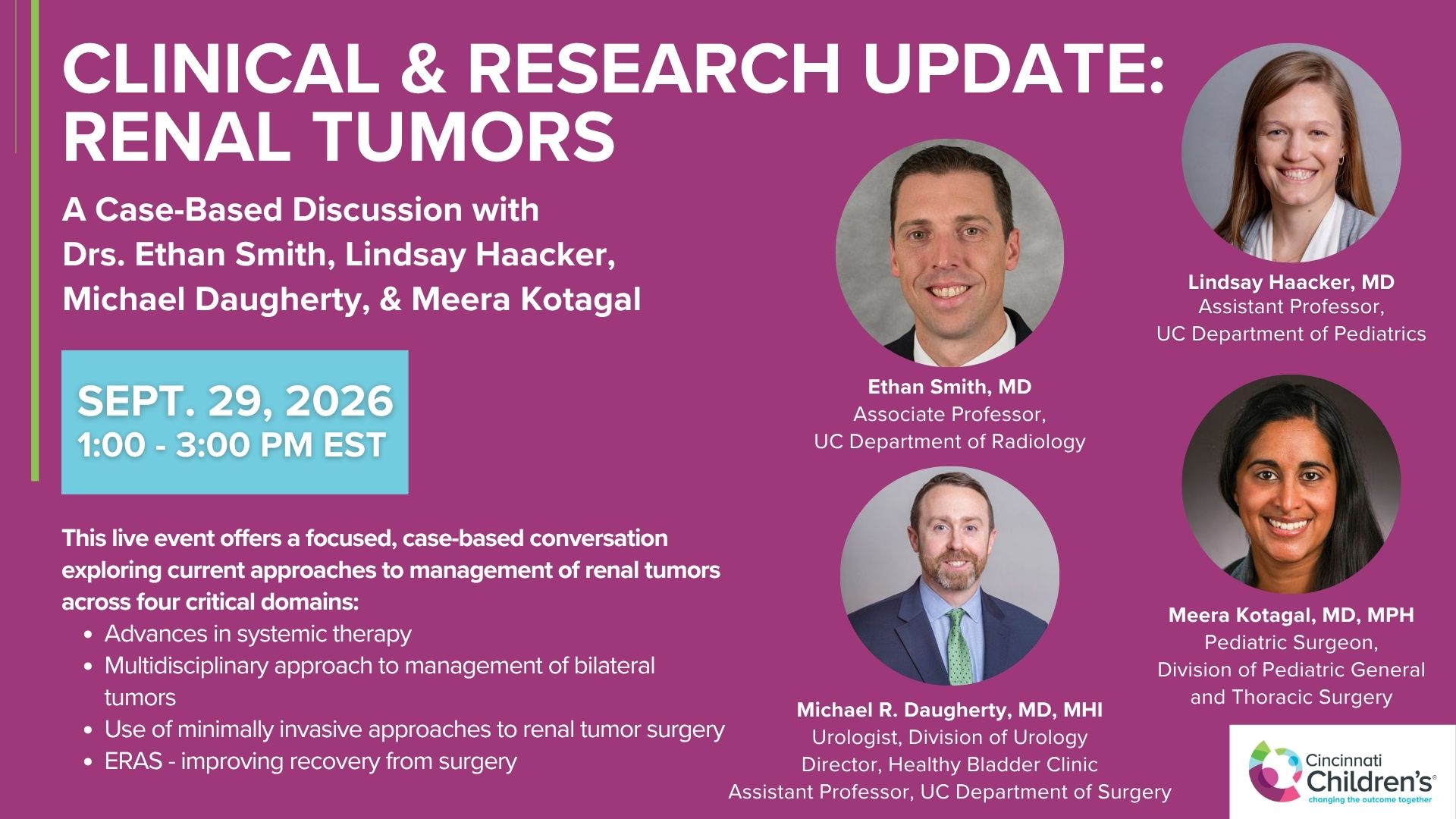
Clinical & Research Update: Renal Tumors with Drs. Ethan Smith, Lindsay Haacker, Michael Daugherty, and Meera Kotagal
71 min · Published Sep 2026
Video
Clinical & Research Update: Neuroblastoma with Drs. Katherine Somers, Cara Morin, Juan Gurria, and Meera Kotagal
67 min · Published Sep 2026
Video
Clinical & Research Update: Sarcoma w/ Drs. Roshni Dasgupta, Joseph Pressey, Arthur Meyer, Luke Pater
66 min · Published Sep 2026
Video
2026 Laparoscopic Pediatric Hernia Repair
123 min · Published Jun 2026
Video
Beyond the Spectrum: Diagnosis, Myths & Management - Caitlin Couch & Leslie Lopez - APP Conference 2026
50 min · Published May 2026
Video
Dysautonomia: Navigating the Journey - Martha Willis - APP Conference 2026
55 min · Published May 2026
What the experts said
Presence of hair in the gluteal crease is the most important predisposing risk factor for pilonidal disease
Study included 198 patients presenting from June 2019 to April 2022
102 patients were male and 96 patients were female
Majority of patients had dark colored and medium thickness hair
Majority of patients had Fitzpatrick skin types three and four
Mean age at time of first laser session was 18 years
Median follow-up time was 217 days
A linear relation was observed between number of laser sessions and amount of hair reduction regardless of patient hair and skin characteristics
On average, 2.6 laser sessions required to reach 20% hair reduction
On average, 4.3 sessions required to reach 50% hair reduction
On average, 6.6 sessions required to reach 75% hair reduction
On average, 7.8 sessions required to reach 90% hair reduction
Patients with Fitzpatrick skin types 1 and 2 required less average laser sessions to reach the same percentage of hair reduction compared to other skin type groups
Thicker hair was associated with higher average laser sessions required
Dark colored hair was associated with higher average laser sessions required
44 patients underwent incision and drainage at time of presentation
132 patients underwent trephination procedure
22 patients did not undergo any surgical intervention under study care
Overall recurrence rate was 6%
None of the patients with more than 75% hair reduction experienced recurrence
After controlling for other confounding factors, dark hair was associated with higher recurrence rate
After controlling for other confounding factors, Fitzpatrick skin types five and six were associated with higher recurrence rate
Mean number of laser sessions after which recurrence occurred was 3.2 sessions
Probability of recurrence decreases with increase in percentage of hair reduction
Probability of recurrence after 20% hair reduction decreased by 50%
Probability of recurrence after 50% hair reduction decreased by 78%
Probability of recurrence after 75% hair reduction decreased by 100%
75% hair reduction could be a treatment target for pilonidal disease patients since no recurrence occurred after achieving this threshold in the study cohort