


From
Live Event Content
BOB in Ped Surg 2023 - IPEG Winner - Fulvia Del Conte, MD
With Dr. Fulvia Delconte
Chapter 1 of 4 · Evidence & Research
Session intro
Introduction and Session Overview
Expert statements on this page
No expert statements were drawn from this page.
Host summaries · secondary, not cited in answers
Educational content from recorded physician discussions — not medical advice. Talk to your (or your child's) care team about your situation.
More about this diagnosis
Pulmonary sequestrationVideo
BOB Ped Surg 2023 - Fulvia Del Conte, IPEG - Presentation
Published Feb 2023
Video
Neuroblastoma
CCHMC Pediatric Surgery · Published May 2020
Video
BOB in Ped Surg 2023 - OVERALL WINNER - Dr. Rebeca Figueira - EUPSA
6 min · Published Feb 2023
Video
Update Course 2023 - Update Course 2022 and Best of the Best Recap
17 min · Published Aug 2023
Video
Congenital Cystic Lung Lesions: Update Course 2014
Dr. Steve Rothenberg · 24 min · Published Nov 2018
Video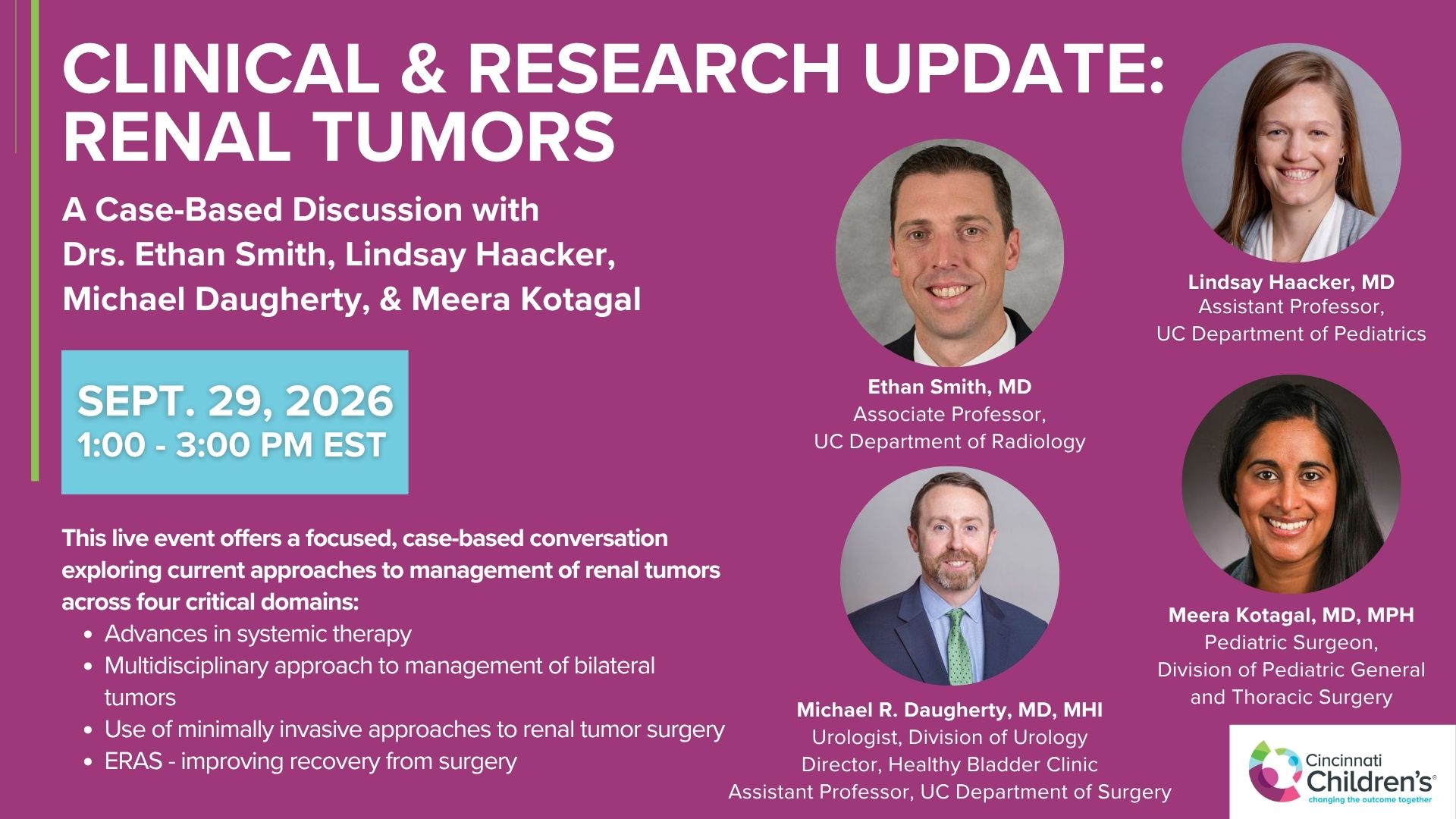
Clinical & Research Update: Renal Tumors with Drs. Ethan Smith, Lindsay Haacker, Michael Daugherty, and Meera Kotagal
71 min · Published Sep 2026
Video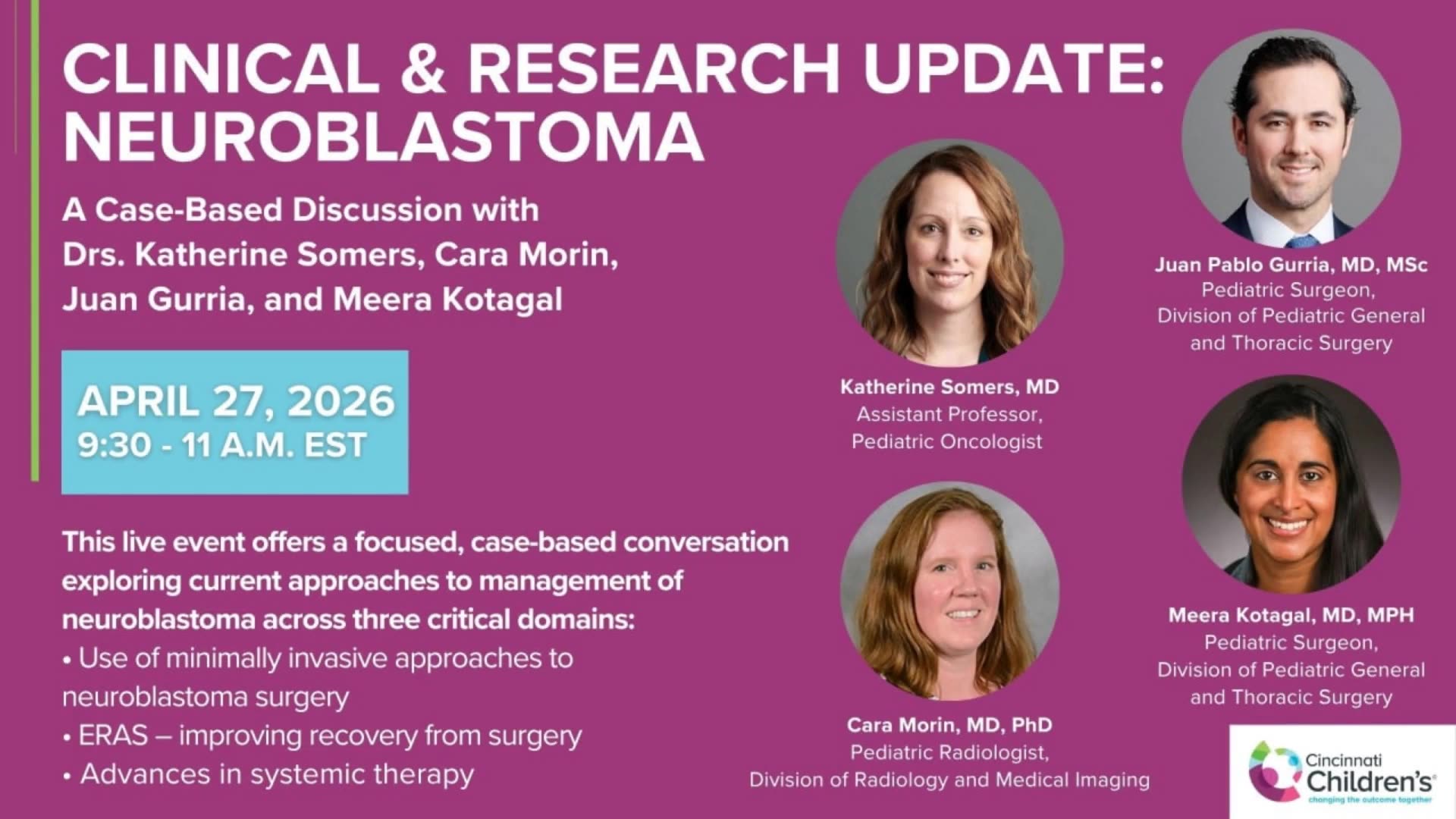
Clinical & Research Update: Neuroblastoma with Drs. Katherine Somers, Cara Morin, Juan Gurria, and Meera Kotagal
67 min · Published Sep 2026
Video
Clinical & Research Update: Sarcoma w/ Drs. Roshni Dasgupta, Joseph Pressey, Arthur Meyer, Luke Pater
66 min · Published Sep 2026
Video
2026 Laparoscopic Pediatric Hernia Repair
123 min · Published Jun 2026
Video
Beyond the Spectrum: Diagnosis, Myths & Management - Caitlin Couch & Leslie Lopez - APP Conference 2026
50 min · Published May 2026
Video
Dysautonomia: Navigating the Journey - Martha Willis - APP Conference 2026
55 min · Published May 2026
What the experts said
The study aimed to evaluate and compare the results of embolization and surgical treatments of pulmonary sequestration in pediatric patients.
Only Group 2 (embolization) patients performed MRI or CT scan to check the complete evolution of the lesion.
At one year follow-up, one Group 1 patient required surgical revision after two weeks due to an infected intralobar sequestration.
Three pediatric surgery units and four pediatric cardiological units were involved in the study.
In one Group 2 patient, it was impossible to complete the embolization procedure and the patient was referred to surgeons.
Patients younger than three years old who received embolization or surgical treatment for pulmonary sequestration between January 2010 and December 2020 were included.
All symptomatic patients became asymptomatic at the one year follow-up.
All procedures were performed under general anesthesia.
At long-term follow-up, only six embolization patients performed imaging, and two of them required reintervention due to recurrence, with only one being symptomatic.
Surgical approach was performed using three or four trocars with the first one placed on the anterior axillary line with an open technique.
Arterial embolization was performed by transfemoral approach in all cases, identifying the aberrant artery which was cannulated and closed by vascular plug devices.
Surgery and endovascular embolization are both effective and safe treatments for pulmonary sequestration.
The main difference is that surgical approach allows removal of the lesion, avoiding the need to monitor pathological tissue and its complete evolution over time.
85 patients were included and divided into two groups: Group 1 with 51 patients (surgical) and Group 2 with 34 patients (embolization).
No differences were found in sex distribution and intralobar versus extralobar distribution between groups.
Surgical approach should be the preferential choice, especially in cases of intralobar sequestration or suspected complicated lesions.
Prenatal diagnosis was significantly higher in Group 1 (surgical group) as well as symptomatic patients.
There were no differences in procedure time and intensive care unit stay after procedure between the two groups.
Embolization should be used in cases of severe symptoms or heart failure, with long-term follow-up supported by imaging recommended.
Hospitalization was significantly shorter in Group 1 (surgical) because 24 patients were treated as day case surgery.
Conversion to open surgery was necessary in five Group 1 cases.
Three hybrid lesions were found in Group 1 patients.
Two Group 1 patients were previously approached by embolization.
In Group 1, follow-up was based on clinical examination and chest X-ray.
In the study, only six embolization patients performed MRI at long-term follow-up, and within them two presented recurrence.
It is very important to perform imaging in all embolization patients to check complete evolution and ensure the lesion does not recur.
With surgery, long-term imaging follow-up is not needed, which is a big difference from embolization.
The follow-up after embolization is invasive and heavy for parents because they remain with doubt that the lesion has not completely disappeared.
Even if there is a small rate of malignancy in sequestrations, patients must be followed in all cases.
Embolization cannot resolve the problem of potential malignancy, so it should be reserved only for cases where surgery cannot be performed.
Pulmonary sequestrations have a very low malignancy rate.