


From
Colorectal Channel
DrBeen Medical Lectures: Dr. Marc Levitt, MD Discusses Hirschsprung Disease
With Dr. Marc Levitt · hosted by Dr. Mobeen Sayed
Chapter 1 of 8 · Fundamentals
Introduction
Introduction and Overview of Hirschsprung Disease
Expert statements on this page
No expert statements were drawn from this page.
Host summaries · secondary, not cited in answers
Educational content from recorded physician discussions — not medical advice. Talk to your (or your child's) care team about your situation.
Podcast
Hirschsprung Disease â PediaCast 287
Marc Levitt · 38 min · Published May 2014
Podcast
Colorectal Quiz Episode 3: Hirschsprung Disease
20 min · Published Feb 2021
Video
Colorectal Quiz: Episode 46 - Hirschsprung's Disease
Marc Levitt · 29 min · Published Apr 2025
Podcast
The Colorectal Quiz Episode 10: Total Colonic Hirschsprung Disease Part 1
12 min · Published Apr 2021
Podcast
Colorectal Quiz: Episode 46
Marc Levitt · 29 min · Published Apr 2025
Video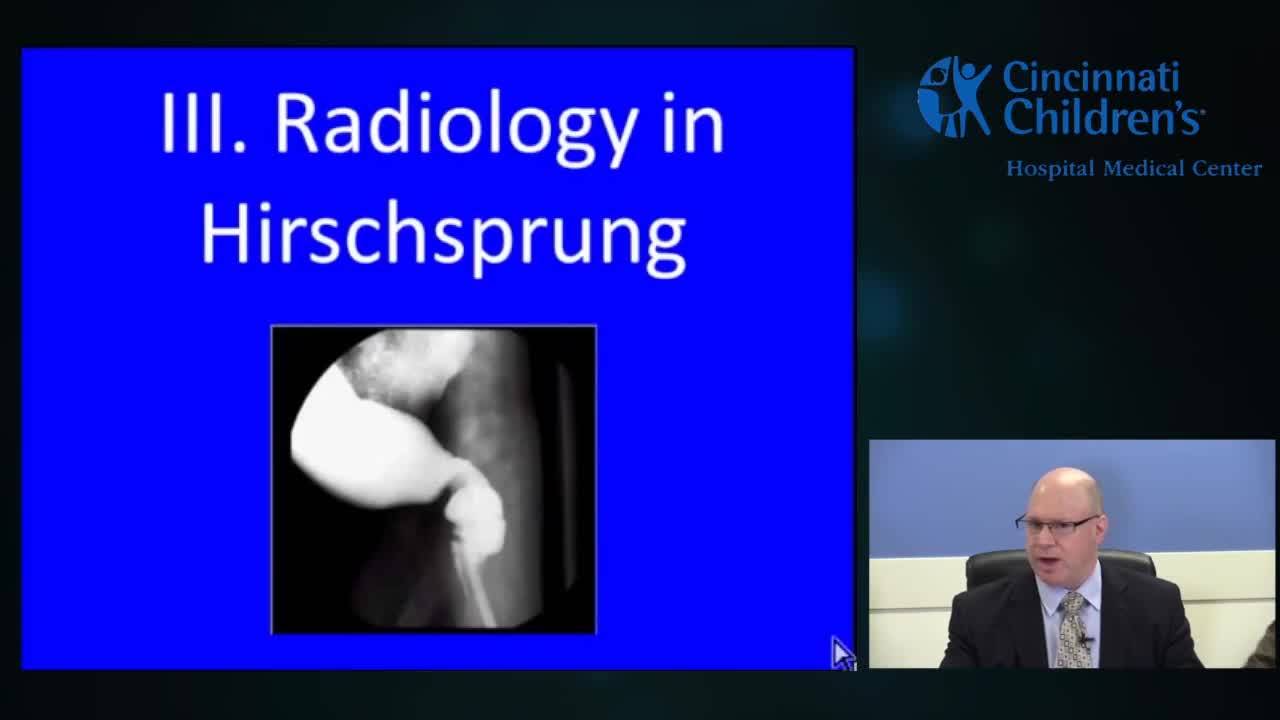
Radiology and Image Diagnosis of Hirschsprung Disease
44 min · Published Nov 2018
Video
Validation of an anorectal malformation trainer - Can a high-fidelity model simulate real life?
1 min · Published Jun 2026
Video
Complications and Long-Term Outcomes of Patients With Cloacal Malformation After Bowel Neovagina...
1 min · Published Jun 2026
Video
Safety and utility of long-acting steroid injection for management of post-operative stricture...
1 min · Published Jun 2026
Video
Association Between Social Determinants of Health and Choice of Urinary Reconstruction in Children
1 min · Published Jun 2026
Video
The Perineal Body Preserving PSARP (PPP)
11 min · Published Jun 2026
Video
Update Course Rewind 2025: Hirschsprung + ARM: Rare but Real
1 min · Published May 2026
Video
Colorectal Quiz Ep. 50 -16th Annual European Pediatric Colorectal & Pelvic Reconstruction Conference
Marc Levitt · Published Mar 2026
Podcast
Colorectal Quiz: Episode 50 - 16th Annual European Pediatric Colorectal and Pelvic Reconstruction Conference, Stockholm, Sweden, October 2025 - What did we learn?
24 min · Published Mar 2026
Video
Colorectal Quiz Episode 33: Cloaca Exstrophy
Marc Levitt · 22 min · Published Sep 2025
Video
The Colorectal Quiz Episode 21: The History of Hirschsprung Disease
Marc Levitt · 15 min · Published Sep 2025
Video
Colorectal Quiz: Episode 49 – Collaborating for Kids: Colorectal & Pelvic Care (with Help from AI)
Marc Levitt · 40 min · Published Jul 2025
Podcast
Colorectal Quiz: Episode 49 - Collaborating for Kids: Colorectal & Pelvic Solutions (with a Little Help from AI)
Marc Levitt · 40 min · Published Jul 2025
Podcast
Long-term obstetric and gynecologic care for patients with anorectal malformations
21 min · Published Sep 2026
Podcast
Post-pubertal gynecologic evaluation and management of patients with anorectal malformations
22 min · Published Sep 2026
Podcast
Pre-pubertal gynecologic evaluation and management of patients with anorectal malformations
23 min · Published Sep 2026
Podcast
Methods of gynecologic evaluation for patients with anorectal malformations
21 min · Published Sep 2026
Podcast
Gynecologic care in patients with anorectal malformations: A primer and call to action
18 min · Published Sep 2026
Podcast
Evaluation and Management of Postsurgical Patient With Hirschsprung Disease Neurogastroenterology & Motility Committee: Position Paper of North American Society of Pediatric Gastroenterology, Hepatology, and Nutrition (NASPGHAN)
17 min · Published Sep 2026
What the experts said
Hirschsprung disease occurs in about 1 in 5000 live births.
90% of Hirschsprung patients are diagnosed in the first couple of months of life, the vast majority in the first week or so of life.
In Hirschsprung disease, ganglion cells have not migrated to the distal colon, and without ganglion cells the colon cannot relax and therefore stays squeezed.
Because the lining of the bowel is not normal in Hirschsprung disease, bacteria that stay in the colon can migrate out and get into the bloodstream, creating a life-threatening condition called enterocolitis.
If Hirschsprung disease is recognized, it is pretty straightforward to intervene; you do not necessarily need surgery to prevent enterocolitis, you just need good nursing care and proper irrigation to get the stool to flow.
About 5% of Hirschsprung patients present after 1 year of life; the vast majority present as babies.
Down syndrome is associated with Hirschsprung disease.
10% of patients with meconium plug actually have Hirschsprung disease as the underlying cause; 90% just pass the plug and get better.
Milk protein allergy can mimic Hirschsprung disease; if you biopsy looking for Hirschsprung, you will find ganglion cells but lots of eosinophils.
To confirm Hirschsprung disease, you need both the absence of ganglion cells and confirmation that the nerves associated with those ganglion cells are thickened (hypertrophic).
Nerve trunks greater than 40 microns are abnormal in rectal biopsy specimens.
You cannot diagnose Hirschsprung with a frozen section, but you can rule it out if ganglion cells are present. To prove it is Hirschsprung disease, you need several days and need to evaluate 100 slices of the sample.
In about 15% of Hirschsprung cases, the aganglionic segment extends higher than the splenic flexure.
Contrast enema is accurate in identifying the transition zone about 90% of the time, so when doing surgery, you need to confirm under the microscope where the healthy bowel begins.
The dilated colon in Hirschsprung disease will shrink down to more normal size as soon as it is given the opportunity to successfully empty out the anus once the blockade has been removed.
You really only need about 10% of your colon to function completely normally and have one bowel movement per day.
Most Hirschsprung patients only lose about 15 to 20% of their colon because that is where the abnormal segment is, so they can have a completely normal stooling life with one bowel movement per day.
Patients who have to lose their entire colon and have small bowel brought to the anus tend to have more frequent stools, somewhere between 2 and 6 per day, but can all maintain bowel control provided the surgeon successfully preserves the anal canal and sphincters.
Sometimes the irrigation tube does not reach high enough and does not get into the normal bowel, and therefore you cannot successfully decompress the bowel; such patients would benefit from a diversion with a stoma.
If a family has a baby with Hirschsprung disease, the risk of another baby having Hirschsprung disease in their family is about 1 in 200, significantly higher than the general population risk of 1 in 5000.
Hirschsprung-associated enterocolitis is treated with irrigations, metronidazole antibiotic (for anaerobic bacteria), and intravenous hydration.
Even after successful Hirschsprung surgery, you are in danger of getting enterocolitis if you do not have good flow, and the sphincters can slow down the flow enough that you can develop enterocolitis even after surgery.
If you give Botox to temporarily knock out the sphincters (the Botox wears off over the next 3 months), the baby can learn to push on their abdomen and overcome the non-relaxing sphincters.
In Hirschsprung disease, the internal sphincter does not relax normally. When you have fullness in your rectum, your internal sphincter is supposed to relax, but in Hirschsprung disease it tightens at the wrong time and can hold stool in at an inappropriate time.
The vast majority of Hirschsprung patients recover very uneventfully, stool normally, and when they get to age 3 or 4 they successfully potty train.
Hirschsprung disease is a source of significant morbidity and mortality in the developing world if it is unrecognized.