


Chapter 1 of 5 · Complications
Hirschsprung's complications
Post-operative Hirschsprung's Disease: Enterocolitis and Obstructive Complications
Expert statements on this page
No expert statements were drawn from this page.
Host summaries · secondary, not cited in answers
Educational content from recorded physician discussions — not medical advice. Talk to your (or your child's) care team about your situation.
Podcast
Update Course Rewind: 2020 Colorectal Part 2
11 min · Published Mar 2021
Podcast
Update Course Rewind: 2020 Colorectal Part 1
12 min · Published Mar 2021
Podcast
Colorectal Quiz: Episode 46
Marc Levitt · 29 min · Published Apr 2025
Video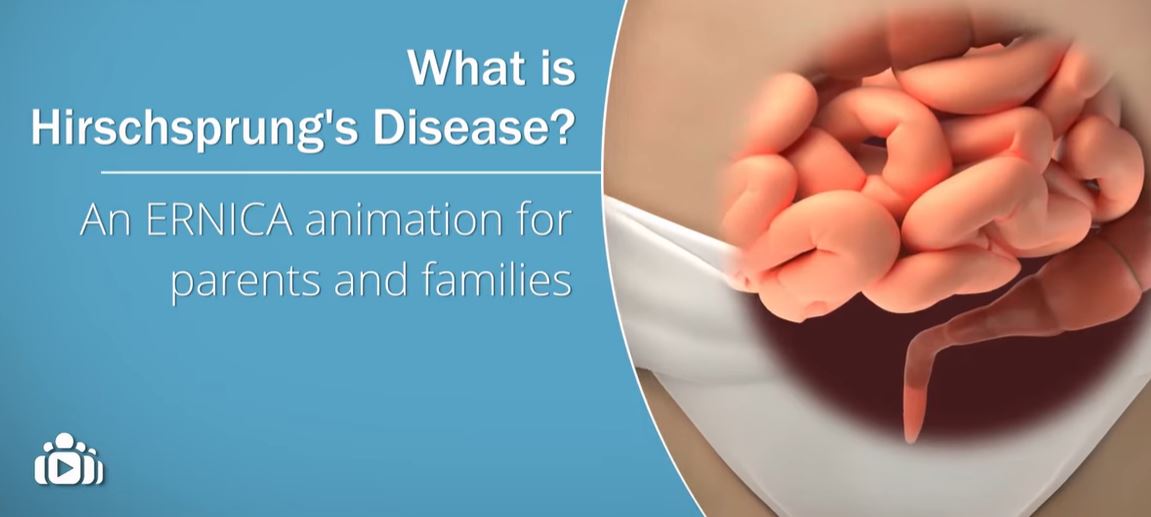
What is Hirschsprung's Disease? An ERNICA animation for parents and families
4 min · Published Dec 2023
Video
Bowel Management Updates & Innovations with Live Q&A: April 2018
CCHMC Pediatric Surgery · 61 min · Published Apr 2018
Video
Panel Discussion and Case Presentation Part II: Pediatric Bowel Management 2013
Dr. Todd Ponsky · 33 min · Published May 2013
Video
Validation of an anorectal malformation trainer - Can a high-fidelity model simulate real life?
1 min · Published Jun 2026
Video
Complications and Long-Term Outcomes of Patients With Cloacal Malformation After Bowel Neovagina...
1 min · Published Jun 2026
Video
Safety and utility of long-acting steroid injection for management of post-operative stricture...
1 min · Published Jun 2026
Video
Association Between Social Determinants of Health and Choice of Urinary Reconstruction in Children
1 min · Published Jun 2026
Video
The Perineal Body Preserving PSARP (PPP)
11 min · Published Jun 2026
Video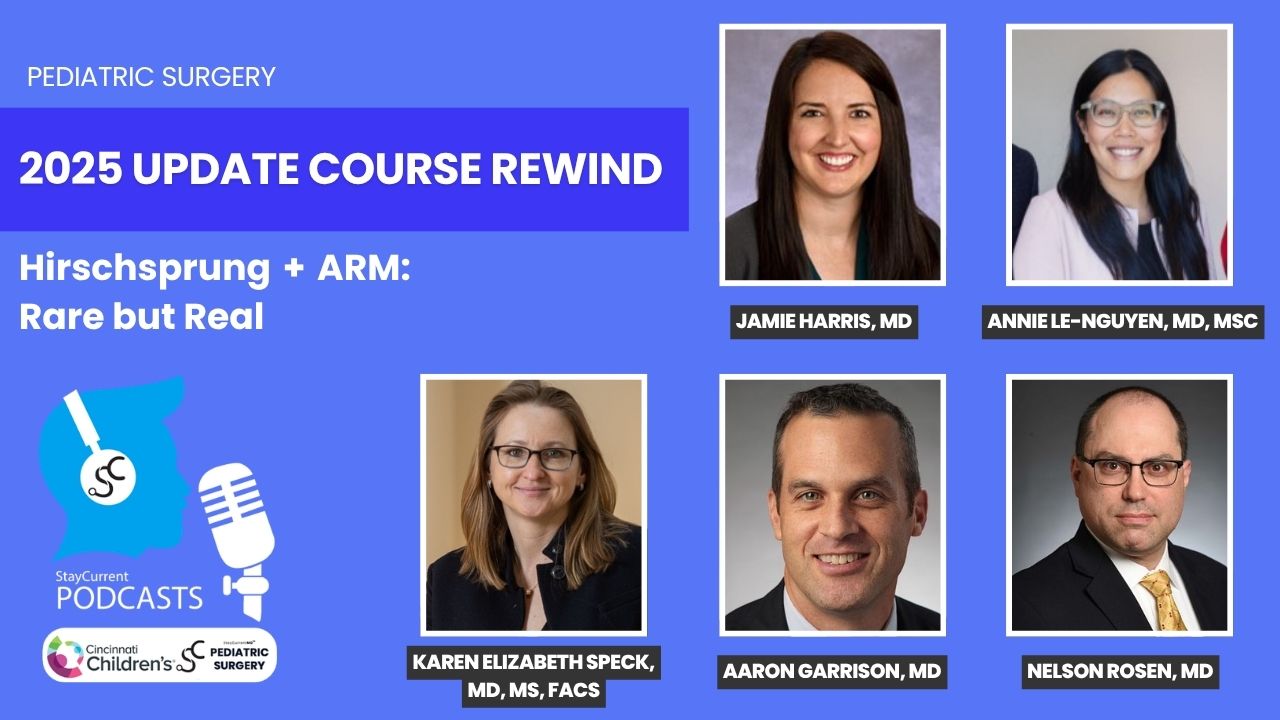
Update Course Rewind 2025: Hirschsprung + ARM: Rare but Real
1 min · Published May 2026
Video
Clinical & Research Update: Renal Tumors with Drs. Ethan Smith, Lindsay Haacker, Michael Daugherty, and Meera Kotagal
71 min · Published Sep 2026
Video
Clinical & Research Update: Neuroblastoma with Drs. Katherine Somers, Cara Morin, Juan Gurria, and Meera Kotagal
67 min · Published Sep 2026
Video
Clinical & Research Update: Sarcoma w/ Drs. Roshni Dasgupta, Joseph Pressey, Arthur Meyer, Luke Pater
66 min · Published Sep 2026
Video
2026 Laparoscopic Pediatric Hernia Repair
123 min · Published Jun 2026
Video
Beyond the Spectrum: Diagnosis, Myths & Management - Caitlin Couch & Leslie Lopez - APP Conference 2026
50 min · Published May 2026
Video
Dysautonomia: Navigating the Journey - Martha Willis - APP Conference 2026
55 min · Published May 2026
What the experts said
Post-pull-through Hirschsprung's patients may develop stricture or outlet obstruction as the anastomotic area heals and narrows, typically presenting weeks after initial good stooling.
There is no standardized post-operative regimen for Hirschsprung's patients; treatment is individualized based on patient response.
For Hirschsprung's enterocolitis, typical management includes NPO status, IV Flagyl, and rectal irrigations (10 cc/kg normal saline every 8 hours for first 24-48 hours).
Patients with more severe enterocolitis (signs of sepsis) receive broad-spectrum antibiotics including gram-negative coverage in addition to Flagyl.
Teaching parents to perform home rectal irrigations improves quality of life by allowing them to manage early constipation episodes without emergency room visits.
Hirschsprung's patients with hypermotility-related incontinence are more difficult to manage than anorectal malformation patients because they have an intact sphincter creating outlet obstruction even with antegrade continence enemas.
High-amplitude propagating contractions (HAPC) with pressures upwards of 400 mmHg can cause pseudoincontinence in post-Hirschsprung's patients, which no patient can voluntarily control.
Most pediatric rectal prolapse occurs during potty training age (around 3-4 years old) due to weak pelvic floor and low rectal position in children.
Cystic fibrosis should be considered in the differential diagnosis of pediatric rectal prolapse.
Conservative management of rectal prolapse includes treating constipation, proper toilet positioning (sitting upright with feet supported, not falling through the seat), and limiting time on the toilet.
95% alcohol is the most commonly used sclerosing agent for rectal prolapse because it has high success rates and is readily available in hospitals (used by interventional radiology).
Pelvic floor rehabilitation combined with psychiatric support and sclerotherapy provides more durable outcomes in rectal prolapse patients with psychiatric comorbidities by strengthening pelvic floor musculature and providing behavior modification.
The gastrographin protocol requires attending surgeon examination and X-ray review before initiation to ensure no signs of peritonitis or strangulation.
In the gastrographin protocol, if contrast reaches the cecum by 8-10 hours, the obstruction is resolved and NG tube can be removed; if not in cecum by 24 hours, patient should proceed to operating room.
The published guideline for obstructed post-Hirschsprung's patients recommends: exam to rule out mechanical obstruction, rectal biopsy if obstruction persists, Botox for outlet obstruction, then motility studies if symptoms continue.
A systematic review of 900 patients with rectal prolapse showed 300 underwent sclerotherapy (8 studies, 3 agents) and 600 underwent operative management (22 studies, 17 different procedures), indicating lack of consensus on best surgical approach.
Sclerotherapy for rectal prolapse has high initial success rate, and cumulative success rate exceeds 80% after up to three attempts; after three failed attempts, operative intervention is reasonable.
Sclerotherapy for rectal prolapse has minimal risk of long-term complications; complications are mostly acute and negligible.
Among operative options for rectal prolapse, laparoscopic rectopexy has the highest success rate with lowest risk of complications.
Approximately half of children over 3 years old with rectal prolapse have concurrent psychiatric diagnoses such as obsessive-compulsive disorder, anxiety, or depression.
Gastrographin challenge for adhesive small bowel obstruction is standard of care in adult surgery and limited pediatric data parallels adult data in safety and efficacy.