


From
StayCurrentMD
Todd Ponsky: What is new in Pediatric Surgery? Teaser
With Dr. Mike Rubin · hosted by Dr. Todd Ponsky & Dr. Alp Numanoglu
Chapter 1 of 12 · Evidence & Research
Pneumothorax protocol
Introduction and Spontaneous Pneumothorax Management
Expert statements on this page
No expert statements were drawn from this page.
Host summaries · secondary, not cited in answers
Educational content from recorded physician discussions — not medical advice. Talk to your (or your child's) care team about your situation.
Video
What's New in Pediatric Surgery 2020 - FULL SHOW
CCHMC Pediatric Surgery · 57 min · Published Oct 2020
Podcast
Spontaneous Pneumothorax
33 min · Published Aug 2019
Video
Spontaneous Pneumothorax: Update Course 2014
15 min · Published Sep 2014
Video
Aspiration Test Predicts Need for Operation in Pediatric Spontaneous...
Published Feb 2020
Video
BOB in Ped Surg 2023 - PAPS Winner - Jamie Schnuck, MD
Published Feb 2023
Podcast
Journal of Pediatric Surgery Article Review: July 2023, PAPS Issue
10 min · Published Jan 2024
Video
Intestinal Atresia Types Explained: Grossfeld Classification for Pediatric Surgery
1 min · Published Sep 2026
Video
Derivation and validation of the Pediatric Community-Acquired Pneumonia Severity (PedCAPS) score: A prospective cohort study
50 s · Published Sep 2026
Video
FETO for Late-Diagnosed Severe Congenital Diaphragmatic Hernia (CDH) at Cincinnati Children's with Dr. Beth Rymeski
4 min · Published Sep 2026
Video
Severe Congenital Diaphragmatic Hernia (CDH) Case: FETO Management & Unexpected Findings with Dr. Beth Rymeski
3 min · Published Sep 2026
Video
Fetoscopic Endoluminal Tracheal Occlusion (FETO) Procedure: Step-by-Step Guide with Dr. Beth Rymeski
4 min · Published Sep 2026
Video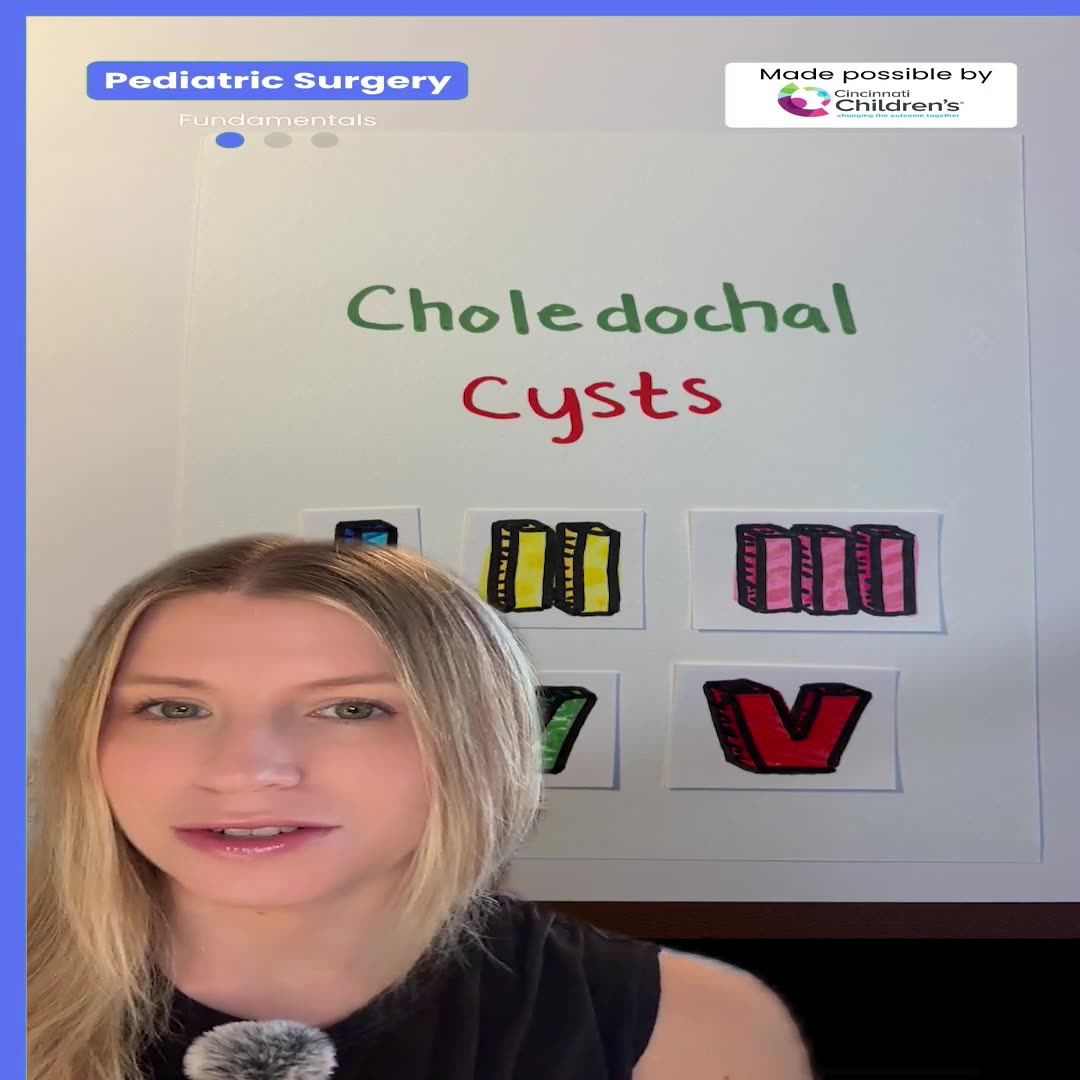
Choledochal Cyst Types Explained: Pediatric Surgery Fundamentals
1 min · Published Sep 2026
What the experts said
Putting a chest tube for spontaneous pneumothorax is probably an unnecessary step that will eventually be eliminated—either send patients home or go to the operating room.
A 1950s study showed larger umbilical hernias have lower spontaneous closure rates, which could justify earlier repair, but recommendation is to wait until after 4 years of age.
Traditional pilonidal disease excision with flaps has a recurrence rate of 30-40% published from Kansas City data.
The worst thing you could do with someone with reactive airway disease is instrument their airway—it's a high-risk case that makes them worse.
In Akron Children's series of 133 patients with suspected airway foreign body, when CT showed a foreign body, findings were confirmed on bronchoscopy 94% of the time.
Patients with negative CT for airway foreign body who were called years later had zero problems—none ever had a foreign body issue.
Bronchoscopy alone for suspected airway foreign body is negative 40% of the time (61% positive rate).
Traditional ATLS teaching was to give two 20cc/kg boluses of crystalloid before giving blood, but this is now changing to earlier blood administration.
ATOMAC is a 12-institution prospective trial that produced approximately 15 articles radically changing solid organ injury management, including eliminating grade-based classification in favor of algorithm-based management.
Neonatologists are nervous about glycopyrrolate because it slows secretions and could theoretically cause mucus plugs in the airway, though this hasn't been observed yet.
The disposable bouffant cap mandate in many US hospitals came out with no basis behind it, and when data was examined, it didn't make sense—people went back to wearing cloth caps.
Medical publications are growing at an exponential rate, doubling every 73 days due to proliferation of open-access journals, making it impossible to know what to pay attention to.
Machine learning algorithm for predicting important pediatric surgery papers has achieved 85% accuracy after one year of training; data scientists predict 95% accuracy after three years of content.
Ultrasound guidance for jugular line placement, combined with fluoroscopy, decreases complications including hematoma and reduces need for multiple sticks, based on Kansas City study.
Micro-pneumothoraces after central line placement or spontaneous pneumothorax are not as scary as previously thought—children with mild symptoms can be followed rather than routinely requiring intervention.
In the Midwest Pediatric Surgery Consortium prospective trial of spontaneous pneumothorax, 83% of patients who failed aspiration and received a chest tube eventually required VATS procedure.
After aspiration protocol for spontaneous pneumothorax with 6-hour observation, 44% of patients sent home had recurrence, with no episodes of tension pneumothorax.
Riley Hospital randomized controlled trial (2016) found relaxed ad-lib feeding after pyloromyotomy decreased time to goal feeds and overall length of stay without significant differences in post-operative vomiting or readmissions compared to incremental feeding protocol.
Patients with serum chloride less than 100 on admission after pyloromyotomy took significantly longer to reach feeding goal.
Multi-state retrospective cohort study (Journal of Pediatrics 2019) showed umbilical hernia repair before age 4 doubled the recurrence rate and doubled the readmission rate.
Prospective multi-center study (Journal of Crohn's and Colitis, February 2019) found appendix removal in refractory ulcerative colitis resulted in sustained symptomatic improvement in 30% of patients, pathologic improvement in 50%, and complete endoscopic remission in 17%.
The Gips procedure for pilonidal disease involves coring out pits with trephine, extracting granulation tissue and hair, curetting the cavity, and flushing with saline then peroxide, leaving holes unpacked and unsutured.
The Gips procedure for pilonidal disease has the same recurrence rate as traditional flaps but with less pain and fewer sick days away from school.
Volumetric chest CT for suspected airway foreign body has almost 100% sensitivity and incredibly high ability to detect foreign bodies whether radiolucent or not.
ATOMAC protocol recommends that patients who receive 20cc/kg crystalloid and don't respond should get 10-20cc/kg bolus of blood rather than a second crystalloid bolus.
The magic number in pediatric trauma is 40cc/kg of blood or 4 units—if a patient is transfused this amount, it indicates probable failure of non-operative management and need for operating room.
Kansas City study of 622 fluoroscopy-guided central lines: 504 patients had no chest X-ray and no symptoms with no adverse outcomes.
In the central line study, 25 patients were symptomatic and received chest X-ray; 4 had pneumothorax managed non-operatively and sent home next day, and 1 had pleural effusion requiring chest tube.
Out of 622 central line patients, only 1 required a chest tube, and that patient was symptomatic—conclusion is routine chest X-ray after every line placement is not needed.
Randomized controlled trial of glycopyrrolate for esophageal atresia anastomotic leak: treatment group had chest tube output of 124mL compared to 370mL in placebo group.
Glycopyrrolate treatment for EA leak achieved leak resolution in 76% versus 29% in placebo group, and oral feeding in 71% versus 14% in placebo group.
Riley Hospital Hats Off study found disposable bouffant caps had the highest microbial and particle shedding on the surgical field.
Cloth skull caps had the lowest permeability and lowest porous material with very low shedding compared to disposable bouffant caps.