


Malignant peripheral nerve sheath tumors: A report from Children's Oncology Group Study ARST0332 | Prospective Multicenter Clinical Trial | 2025 | 58 patients w/ newly diagnosed MPNST | 86% tumors > 5 cm | 95% deep tumors | 74% invasive | 10% metastatic at diagnosis | Risk-adapted therapy including: | Surgery ± radiation | Ifosfamide + doxorubicin chemotherapy | Neoadjuvant therapy in 31 patients | Significant factors affecting survival: | Metastatic disease | Risk group | Achieving surgical resection (R0/R1) | Sex | Not significant: | Germline NF-1 status | Conclusion: The treatment for low-risk MPNST had excellent outcomes; metastatic disease has extremely poor prognosis. Novel therapies are urgently needed for high-risk patients. | https://pubmed.ncbi.nlm.nih.gov/41386267/ | Crane JN et al. | Department of Pediatrics, Children's Hospital of Philadelphia, University of Pennsylvania, Philadelphia, PA, USA. | @LizzyPAC8 | @globalcastmd | @StayCurrentMD | Cincinnati Children's
From
StayCurrentMD
Malignant peripheral nerve sheath tumors: a report from children's oncology group study ARST0332
Part of
Pediatric Oncology 696 items
Infographic · Feb 2026 · 1 min read
In brief
In brief
Children's Oncology Group study of 58 pediatric MPNST patients treated with risk-adapted surgery, chemotherapy, and radiation achieved 87% 5-year survival in low-risk disease but 0% in metastatic cases. NF-1 status did not impact outcomes, while complete resection and absence of metastases were key prognostic factors.
- Complete surgical resection (R0/R1) is the most critical prognostic factor for MPNST survival regardless of timing.
- Low-risk MPNST patients achieved 87% 5-year EFS with risk-adapted therapy; high-risk metastatic disease had 0% 5-year EFS.
- Neoadjuvant ifosfamide/doxorubicin showed limited efficacy with only 23% objective response rate in evaluable patients.
- NF-1 germline status did not significantly impact event-free or overall survival in this cohort.
- Novel therapeutic approaches are urgently needed for metastatic MPNST given universally poor outcomes with current protocols.
Written by the GCMD Library team from the infographic.
The infographic uses a teal, gray, and yellow color scheme with illustrated icons including a hospital building, a neuron diagram, a patient in bed, and a physician. Information is organized in distinct sections with bullet points and colored text boxes highlighting key findings and conclusions.
Jacquelyn N Crane, Wei Xue, Amira Qumseya, Donald A Barkauskas, Khang Chau, Serena Y Tan, Susan Hiniker, Roshni Dasgupta, Rajkumar Venkatramani, Sheri L Spunt, Aaron R Weiss, Theodore W Laetsch
Background: The cornerstone of the treatment of malignant peripheral nerve sheath tumors (MPNST) is surgical resection. Radiation and chemotherapy are variably employed. The optimal treatment remains uncertain, particularly for unresectable or metastatic disease and patients with neurofibromatosis type-1 (NF-1).
Methods: We present data for fifty-eight patients with newly diagnosed MPNST enrolled on the Children's Oncology Group study ARST0332. Patients were treated with risk-adapted therapy including surgery with or without radiotherapy and ifosfamide and doxorubicin chemotherapy.
Results: Most patients had primary tumors that were greater than 5 cm (86%), deep (95%), and invasive (74%), and 10% had distant metastases. Thirty-two (55%) patients had germline NF-1 and 26 (45%) did not. Thirty-one patients received neoadjuvant therapy and 22 were evaluable for response with 5 (23%) attaining an objective response, 10 (45%) stable disease, and 7 (32%) progressive disease. Estimated 5-year event-free survival (EFS) was 87%, 52% and 0% for the low- (n = 8), intermediate- (n = 44) and high-risk (n = 6) patients, respectively. In univariate analysis, EFS and overall survival (OS) differed by sex, presence or absence of metastatic disease, risk group, and achievement of upfront or delayed R0/R1. There was no difference in EFS or OS based on germline NF-1 status.
Conclusion: The treatment strategy in ARST0332 achieved excellent outcomes for low-risk MPNST. Patients with high risk (metastatic) MPNST have poor outcomes and novel treatments are needed.
The text in the image
Educational content from recorded physician discussions — not medical advice. Talk to your (or your child's) care team about your situation.
Video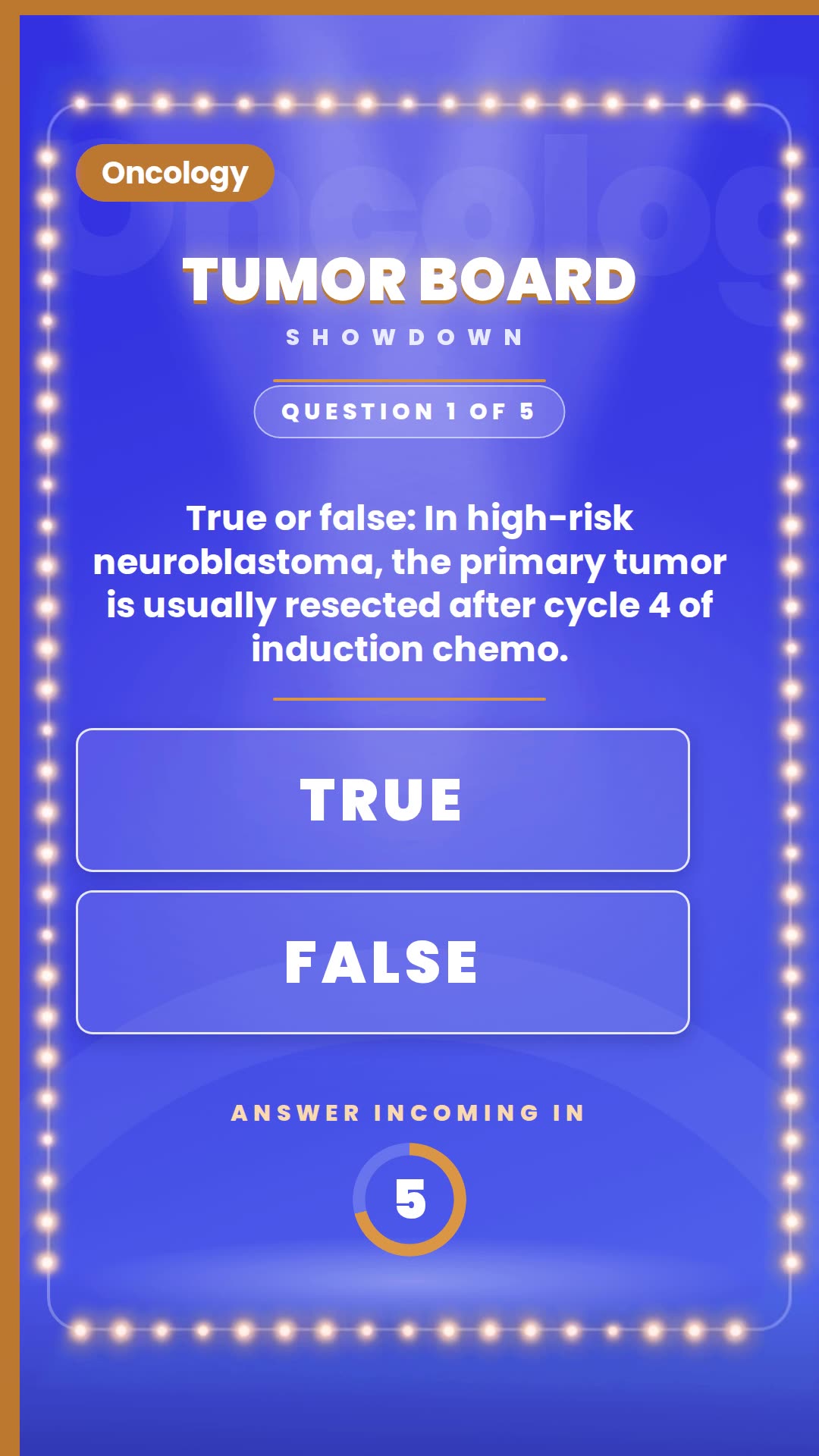
Oncology Tumor Board Showdown: Pediatric Oncology 5 Question Quiz
1 min · Published Oct 2026
Article
Minimally invasive surgery for abdominal and thoracic neuroblastic tumors: A systematic review by the APSA Cancer committee
Juan Pablo Gurria · Published Oct 2026
Video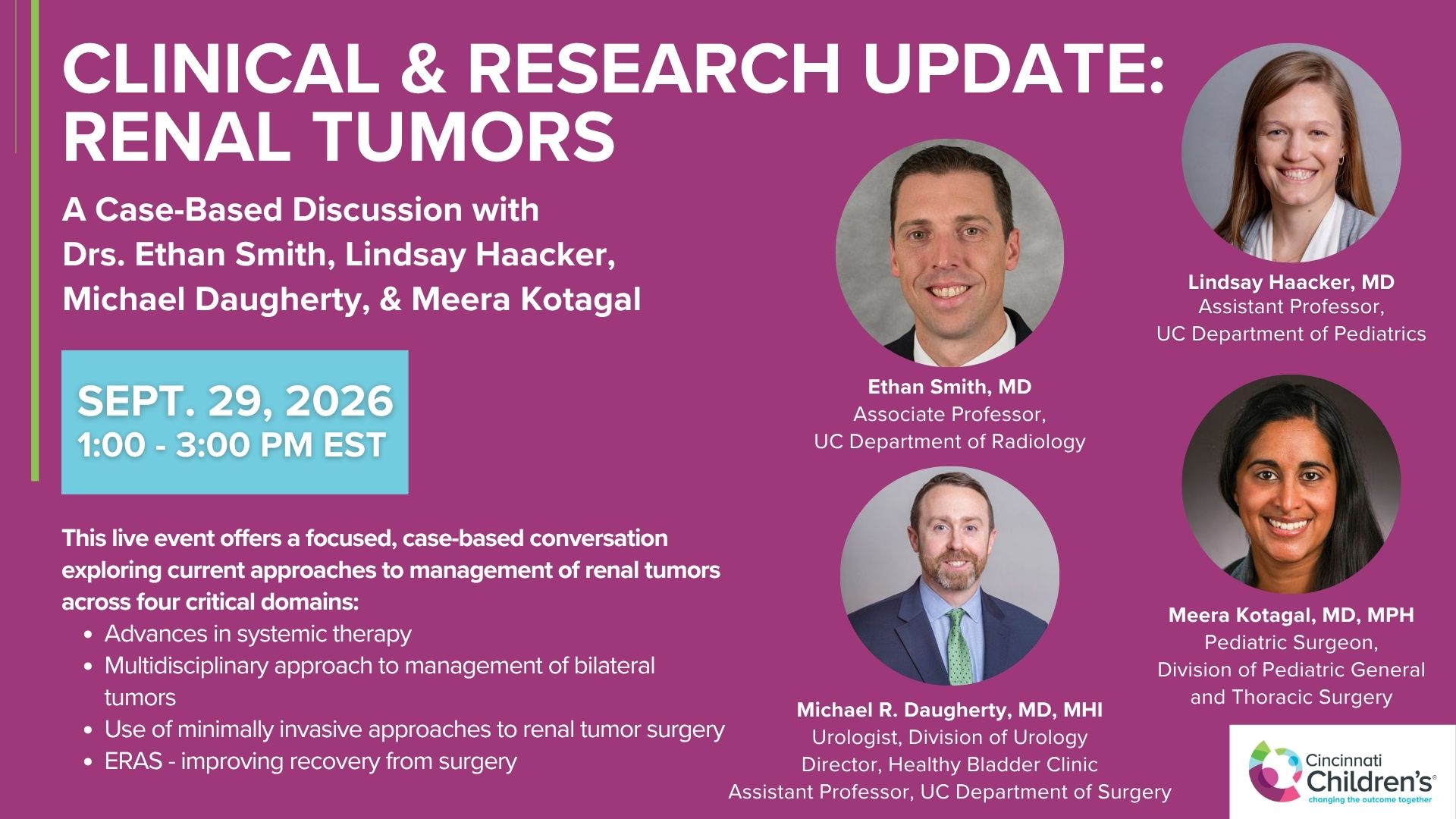
Clinical & Research Update: Renal Tumors with Drs. Ethan Smith, Lindsay Haacker, Michael Daugherty, and Meera Kotagal
71 min · Published Sep 2026
Video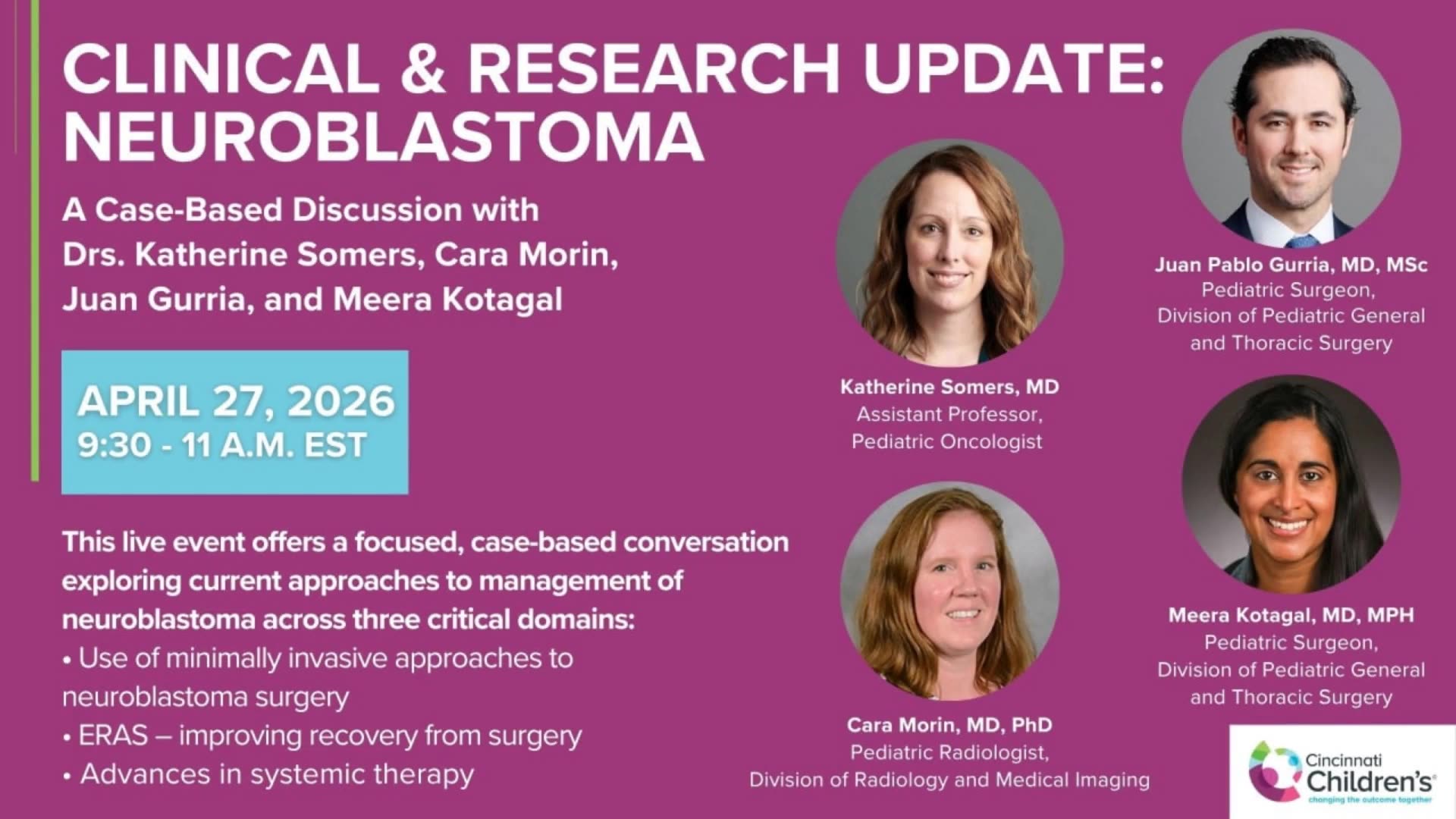
Clinical & Research Update: Neuroblastoma with Drs. Katherine Somers, Cara Morin, Juan Gurria, and Meera Kotagal
67 min · Published Sep 2026
Video
Clinical & Research Update: Sarcoma w/ Drs. Roshni Dasgupta, Joseph Pressey, Arthur Meyer, Luke Pater
66 min · Published Sep 2026
Video
Update Course Rewind 2025: Nerve Monitoring in Pediatric Thyroid Surgery
6 min · Published Jul 2026
Video
Intestinal Atresia Types Explained: Grossfeld Classification for Pediatric Surgery
1 min · Published Sep 2026
Video
Derivation and validation of the Pediatric Community-Acquired Pneumonia Severity (PedCAPS) score: A prospective cohort study
50 s · Published Sep 2026
Video
FETO for Late-Diagnosed Severe Congenital Diaphragmatic Hernia (CDH) at Cincinnati Children's with Dr. Beth Rymeski
4 min · Published Sep 2026
Video
Severe Congenital Diaphragmatic Hernia (CDH) Case: FETO Management & Unexpected Findings with Dr. Beth Rymeski
3 min · Published Sep 2026
Video
Fetoscopic Endoluminal Tracheal Occlusion (FETO) Procedure: Step-by-Step Guide with Dr. Beth Rymeski
4 min · Published Sep 2026
Video
Choledochal Cyst Types Explained: Pediatric Surgery Fundamentals
1 min · Published Sep 2026