


From
StayCurrentMD
TEF Presentations (Extended): Aerodigestive & Esophageal Surgery
With Dr. Bob Wood · hosted by Dr. Todd Ponsky
Chapter 1 of 12 · Diagnosis & Workup
Finding TEF
Diagnostic Techniques for Finding TEF
Expert statements on this page
No expert statements were drawn from this page.
Host summaries · secondary, not cited in answers
Educational content from recorded physician discussions — not medical advice. Talk to your (or your child's) care team about your situation.
Video
Aerodigestive Management of Pediatric Aspiration - FULL SHOW
CCHMC Pediatric Surgery · 157 min · Published Jul 2020
Video
QUAD #6 Slide Tracheoplasty for TEF, Otolaryngology Approach with Dr. Mike Rutter
CCHMC Pediatric Surgery · 7 min · Published Mar 2024
Podcast
Tracheoesophageal Fistula with Dr. Daniel von Allmen
45 min · Published Dec 2016
Video
Interesting Case Presentations Part II: EA/TEF
66 min · Published Dec 2012
Video
Update Course Rewind 2025: The Recurrent TEF Problem
2 min · Published Jul 2026
Video
Esophageal Atresia/Tracheoesophageal Fistula Bronchoscopy and Surgical Technique
Dr. Todd Ponsky · 16 min · Published Nov 2021
Video
Surgeon annual volume impacts recurrence rates of pediatric inguinal hernia repairs: A multi-institutional study
54 s · Published Feb 2026
Podcast
Journal of Pediatric Surgery Article Review: 2nd Quarter (Apr-Jun) 2025
16 min · Published Aug 2025
Video
Tracheobronchopexy to Avoid Tracheostomy in Esophageal Atresia Patients With Severe Life-Threatening Tracheobronchomalacia
50 s · Published Apr 2025
Video
QUAD #27 - Multidisciplinary - How Do Teams Enhance Outcomes by the CCHMC ADEC Team
CCHMC Pediatric Surgery · 10 min · Published Apr 2025
Video
QUAD #25: Medical Management of Minor Laryngeal Clefts with Dr. Greg Burg
CCHMC Pediatric Surgery · 7 min · Published Feb 2025
Video
QUAD #22: What is CHARGE syndrome? with Dr. Catherine Hart
CCHMC Pediatric Surgery · 59 s · Published Dec 2024
Video
Aerodigestive & Esophageal Surgery - The Unsalvageable Esophagus & Cases
CCHMC Pediatric Surgery · 101 min · Published Nov 2018
Video
Aerodigestive & Esophageal Surgery - Difficult Tracheal Esophageal Fistula
Dr. Todd Ponsky · 120 min · Published Nov 2018
Video
Aerodigestive & Esophageal Surgery: Dual Endoscopy Discussion
Dr. Todd Ponsky · 2 min · Published Dec 2014
Video
Aerodigestive & Esophageal Surgery: Aspiration in TEFs
5 min · Published Dec 2014
Video
Intestinal Atresia Types Explained: Grossfeld Classification for Pediatric Surgery
1 min · Published Sep 2026
Video
Derivation and validation of the Pediatric Community-Acquired Pneumonia Severity (PedCAPS) score: A prospective cohort study
50 s · Published Sep 2026
Video
FETO for Late-Diagnosed Severe Congenital Diaphragmatic Hernia (CDH) at Cincinnati Children's with Dr. Beth Rymeski
4 min · Published Sep 2026
Video
Severe Congenital Diaphragmatic Hernia (CDH) Case: FETO Management & Unexpected Findings with Dr. Beth Rymeski
3 min · Published Sep 2026
Video
Fetoscopic Endoluminal Tracheal Occlusion (FETO) Procedure: Step-by-Step Guide with Dr. Beth Rymeski
4 min · Published Sep 2026
Video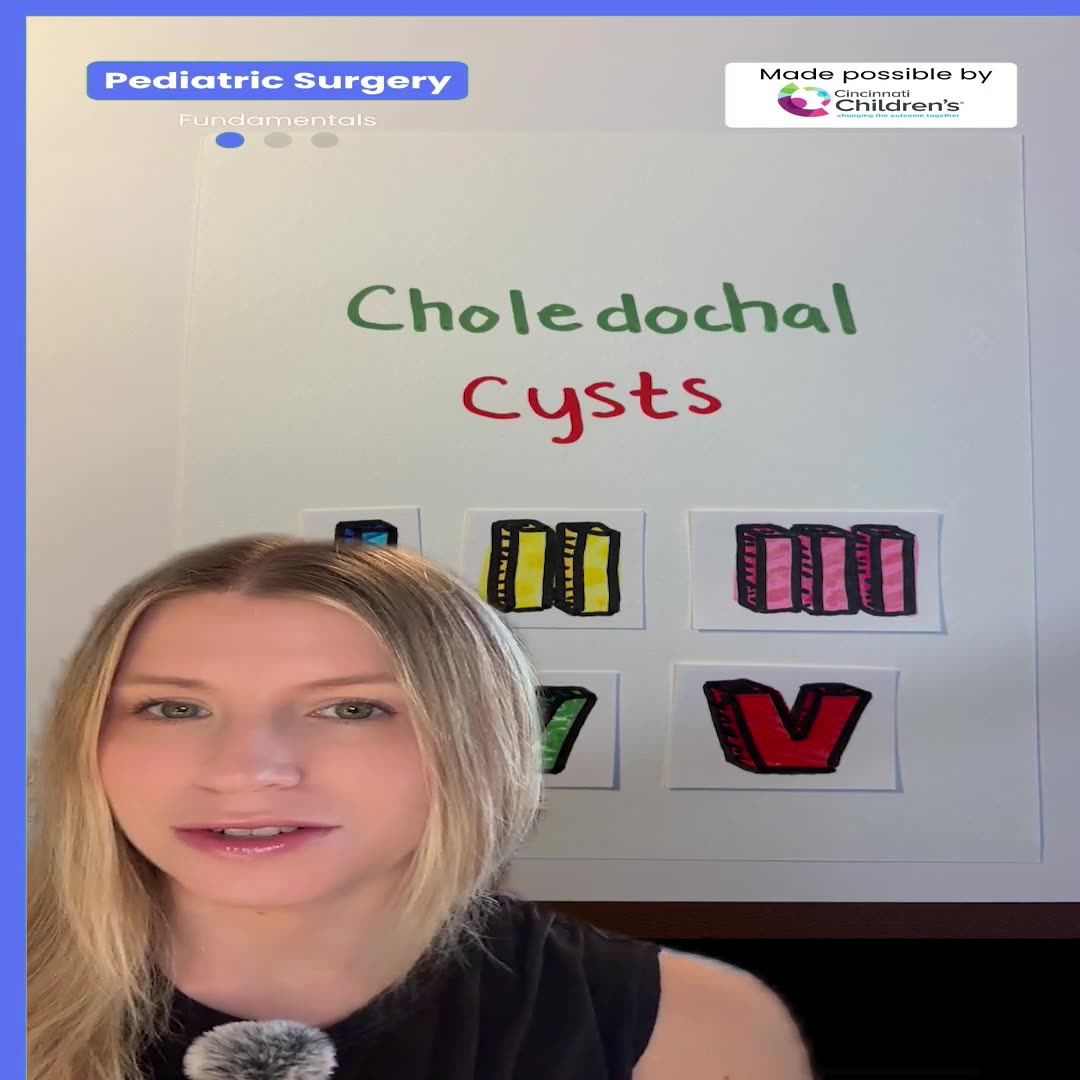
Choledochal Cyst Types Explained: Pediatric Surgery Fundamentals
1 min · Published Sep 2026
What the experts said
The bugbee cautery is useful and underutilized among general surgeons for treating recurrent tracheoesophageal fistulas.
A 70-degree endoscope is a difficult tool to use but useful for tracking down hard-to-find tracheoesophageal fistulas.
Routine bronchoscopy is now standard practice for all type C esophageal atresia cases, though this represents a change from earlier training when it was not necessarily performed.
General surgeons may underappreciate tracheomalacia or laryngomalacia, making collaboration with ENT colleagues valuable for comprehensive airway assessment.
Pediatric surgery fellows at this institution complete a one-month attachment with ENT to perform bronchoscopies as part of their training.
High tracheoesophageal fistulas are very difficult to find from the esophageal side because they are just below the esophageal inlet where a forward-viewing gastroscope does not deflect well enough to get an en face view.
Going retrograde up the esophagus provides easier maneuvering just below the esophageal inlet for finding high fistulas.
Bronchoesophageal fistulas can be very hard to find because there are so many subsegmental bronchi.
During dual scoping for bronchoesophageal fistula, you can shake hands across the fistula if you can track it down, and seeing the other operator's scope is usually a giveaway.
Dual scoping (simultaneous bronchoscopy and esophagoscopy) is enormously valuable for complicated TEF patients, providing different information and advantages in visualization.
During dual scoping, you can see the light from one scope through the epithelium, inject material that may come through subtle holes, or observe bubbles from air insufflation, making simultaneous visualization quite valuable.
During dual scoping, you can see the light from the other scope through the epithelium, inject material that may come through a hole, or see bubbles from insufflation, making simultaneous scoping quite valuable.
Operators can turn off their light during dual scoping so the other person can see their light and determine if they are in the right region.
For combined bronchoscopy and esophagoscopy in small children, a 2.8 mm flexible bronchoscope is typically used alongside an infant gastroscope (5.4 or 6 mm outer diameter).
A 2.8 mm flexible bronchoscope is typically used for combined procedures, and the GI scope for small children is an infant scope (5.4 or 6 mm outer diameter).
An infant gastroscope will fit retrograde through a 16 French gastrostomy tube.
An infant gastroscope will fit retrograde through a 16 French gastrostomy tube, which is why 16 French G-tubes are preferred over 14 French.
A bronchoscope can be used retrograde in the esophagus because it fits through smaller openings.
The concept of endoscopic TEF repair is to demucosalize the tract because mucosa is a non-stick surface; you want raw against raw with a tiny bit of fibrin glue to seal it while it scars off.
When using fibrin glue for TEF repair, use a very small amount (about 0.1 ml) via a Duplo double-lumen catheter to avoid forming a foreign body.
Trichloroacetic acid (TCA) can be used for TEF demucosalization, but it is difficult to control precisely and leaves white tissue everywhere, whereas the bugbee provides more precise control.
When using bugbee cautery for TEF repair, place something in the esophagus (such as an endotracheal tube) as a spacer to avoid burning the back of the esophageal wall.
A bugbee catheter will go down an EGD scope, allowing cauterization from the esophageal side if the tract angle is favorable.
A 3 French bugbee fits through a 2.8 mm flexible bronchoscope with a 1.2 mm suction channel, providing precise control of the tip.
When passing a bugbee through a rigid scope, bending the end at a slight angle before insertion allows steering by rotation.
One of the problems with endoscopic TEF cauterization is not being aggressive enough; you need to destroy the mucosa, not just give it a fright.
With a flexible bronchoscope, you can insufflate through the suction channel and distend the lumen to get a better view and sweep the inside of the lumen during cauterization.
Laryngeal clefts are incredibly easy to miss and must be actively looked for and probed, not just visually inspected.
Positive pressure testing for TEF involves placing an endotracheal tube with cuff in the esophagus and applying 30 cm H2O pressure of air, then observing for air blowing out of the fistula; the stomach must be suctioned afterward.
Endoscopic TEF repair often needs to be performed more than once; the average is approximately 2 procedures, with some requiring 1 and others 3-4 attempts.
For proximal fistulas, intubation with a cuffed tube past the hole is preferred so the cuff holds the hole occluded during repair; this is not possible for fistulas on the carina.
The success rate for endoscopic TEF closure is running about 80%, not 100%.
After 3 or 4 failed endoscopic TEF repair attempts, it is typically time to give up and discuss alternative approaches.
When cauterizing a TEF, you should particularly try to get the edges and sides because as they scar in, that will narrow the whole mouth, making re-intervention easier if needed.
To reduce airway fire risk during bugbee cautery, insufflated oxygen should be kept at 30% or less.
Patients can tolerate a minute or two of lower oxygen saturation during cautery procedures to maintain safe oxygen levels below 30%.
Radiance voice gel (used for vocal cord injection) can be injected into the wall beside a TEF to obliterate the potential space and hold raw surfaces together; it only lasts a few weeks.
Slide tracheoplasty is a useful technique for big complex TEF holes, using part of the trachea to repair the esophageal defect.
Sternal periosteum is an excellent interposition graft material—it is like Kevlar, bulletproof, abundant, and very strong, though almost impossible to suture.
In the series of approximately 12 slide tracheoplasties for TEF, there were two failures, both in button battery cases, and both patients were the only button battery cases in the series.
Button batteries are extremely dangerous and can cause ongoing tissue damage that extends beyond what is visible and beyond the expected time frame.
The institutional protocol for button battery ingestion is to remove them within 2 hours of identification, as it is considered a medical emergency.
The American Society of Pediatric Otolaryngology has a task force working to introduce legislation requiring skull-and-crossbones etching on all button batteries to distinguish them from coins on X-ray.
For button battery ingestions, if there was a witnessed ingestion, the patient is asymptomatic, removal occurs within a couple of hours, and the mucosa looks good, the likelihood of doing well is high.
Late deaths from aortoesophageal fistulas have occurred following unwitnessed button battery ingestions that were not terribly prolonged.
For button battery cases, CT angiography to look at the aorta may provide as much information about risk of sudden death as endoscopic evaluation, though sensitivity data is lacking.
The style of button battery matters for risk: large round flat 3-volt batteries are by far the most potentially damaging, while smaller fatter batteries pose less risk.
The protocol is to remove button batteries from the stomach because if they do not leave and sit in one spot, they create considerable injury, especially in the distal stomach/antrum where scarring or stenosis can occur.
For transtracheal TEF repair, a three-layer closure is performed: esophageal layer with knots in the esophageal lumen, interposition graft (typically sternal periosteum), and tracheal layer with knots in the tracheal lumen to reduce refistulization risk.
The primary complication of transtracheal TEF repair is refistulization, whereas slide tracheoplasty complications include dehiscence, which is a much bigger deal.
Transtracheal repair is a relatively two-dimensional operation where the surgeon matters less than in three-dimensional operations like slide tracheoplasty.
Slide tracheoplasty appears to be a learning-curve, surgeon-dependent operation, unlike many operations where the surgeon does not matter long-term.
H-type fistulas are relatively short tracks straight from trachea to esophagus and do not do nearly as well with endoscopic repair compared to longer tracts.
Long skinny TEF tracts from proximal to distal are the ideal candidates for endoscopic repair, while short, fat, wide tracts do not tend to do well with endoscopic techniques.
When repairing high H-type fistulas from a thoracic approach, there is a temptation to ligate the fistula on the esophageal side, which can leave a large tracheal pouch/diverticulum that causes problems if the patient needs a tracheostomy.
Endoscopic suturing in the trachea is remarkably humbling and painful, and the hardest part is tying the knot.
Nitinol clips could theoretically be used for endoscopic TEF repair, though they are permanent.
Metal clips can be used with endoscopic sutures for laryngeal cleft repairs from the esophageal side to hold sutures; the patient swallows the clip when the PDS dissolves.
For TEF repair, all that matters is achieving raw-on-raw tissue contact for healing.
Thoracoscopic diaphragmatic hernia repairs may have a higher recurrence rate than open repairs, possibly because they do not cause enough raw-on-raw tissue contact.