


From
StayCurrentMD
Fetal Surgical Intervention for Myelomeningocele: Fetal Surgery 2012
With Dr. Scott Adzik · hosted by Dr. Todd Ponsky
Chapter 1 of 9 · Fundamentals
Steroids for CCAM/SCT
General Fetal Surgery Discussion: Steroids for CCAM and SCT
Expert statements on this page
No expert statements were drawn from this page.
Host summaries · secondary, not cited in answers
Educational content from recorded physician discussions — not medical advice. Talk to your (or your child's) care team about your situation.
Video
Open Fetal Surgery & EXIT Procedure with Dr. Jose Peiro
CCHMC Pediatric Surgery · 10 min · Published Oct 2024
Video
Fetal Interventions Part I: Lung Lesions
14 min · Published Aug 2012
Podcast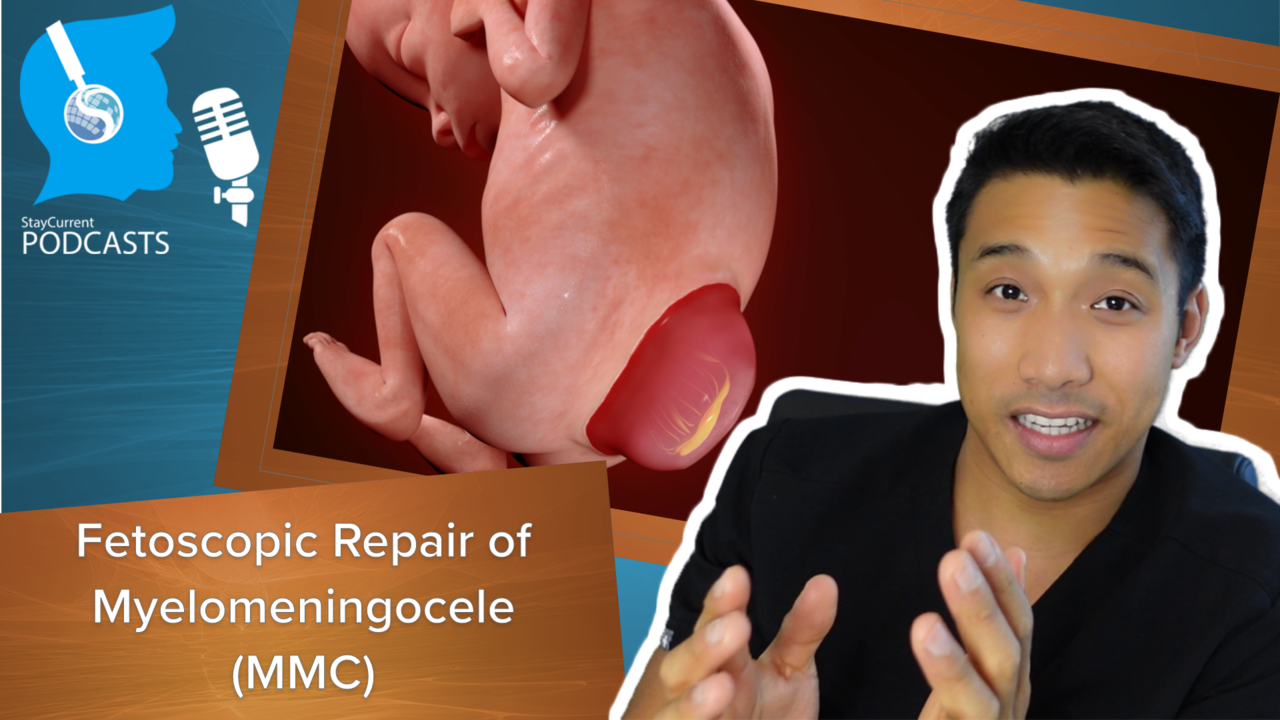
Fetoscopic Repair of Myelomeningocele (MMC)
5 min · Published Aug 2021
Podcast
Colorectal Quiz Episode 15: Bowel Management in Spinal Patients - Need for a UrologistPart 1
17 min · Published Jun 2021
Podcast
Cloacal Exstrophy with Dr. Alberto Peña
53 min · Published Apr 2017
Video
Fecal Incontinence Bowel Management: Pediatric Bowel Management 2013
Dr. Todd Ponsky · 85 min · Published May 2013
Video
Inside a FETO Procedure: Fetoscopic Balloon Tracheal Occlusion with Dr. Beth Rymeski
4 min · Published Jul 2026
Video
Utility of Fluorescence In Situ Hybridization as a Fetal Surgery Eligibility Criterion for....
52 s · Published Jun 2026
Video
The fetal frontier: A review of current and emerging fetal therapies for genetic diseases
44 s · Published May 2026
Video
Myelomeningoceles (open spina bifida) -Fetoscopic Intrauterine Myelomeningocele Closure
Lurie Children's Hospital · 3 min · Published Dec 2025
Video
Quick Literature Updates Ep 19
4 min · Published May 2025
Video
Tracheomalacia and tracheomegaly in infants and children with congenital diaphragmatic hernia managed with and without fetoscopic endoluminal tracheal occlusion (FETO): a multicentre, retrospective cohort study
59 s · Published Oct 2024
Video
Intestinal Atresia Types Explained: Grossfeld Classification for Pediatric Surgery
1 min · Published Sep 2026
Video
Derivation and validation of the Pediatric Community-Acquired Pneumonia Severity (PedCAPS) score: A prospective cohort study
50 s · Published Sep 2026
Video
FETO for Late-Diagnosed Severe Congenital Diaphragmatic Hernia (CDH) at Cincinnati Children's with Dr. Beth Rymeski
4 min · Published Sep 2026
Video
Severe Congenital Diaphragmatic Hernia (CDH) Case: FETO Management & Unexpected Findings with Dr. Beth Rymeski
3 min · Published Sep 2026
Video
Fetoscopic Endoluminal Tracheal Occlusion (FETO) Procedure: Step-by-Step Guide with Dr. Beth Rymeski
4 min · Published Sep 2026
Video
Choledochal Cyst Types Explained: Pediatric Surgery Fundamentals
1 min · Published Sep 2026
What the experts said
Spina bifida affects approximately 1500 babies born per year in the US, about 30 per week or 5-6 per day.
With standard postnatal care, approximately 14% of MMC patients die by age 5, mostly due to symptomatic brain stem compression from hindbrain herniation.
About 85% of MMC patients require ventricular shunts with standard postnatal care, with approximately half developing shunt complications within one year.
The two-hit hypothesis for MMC proposes that secondary damage occurs in utero from amniotic fluid, meconium, or hydrodynamic forces after the initial failure of neurulation.
In fetal sheep models, mid-gestational spinal cord exposure leads to progressive neurologic injury that mimics human MMC, with paralysis and loss of sensation below the lesion level.
Hindbrain herniation reverses after prenatal MMC repair because closing the defect prevents CSF leak, reestablishing the pressure column in the spinal canal.
In CHOP's pre-MOMS experience with 50 fetal MMC repairs, the shunt rate by one year was 40%, compared to 85% with postnatal repair.
Two-thirds of prenatally repaired MMC patients showed motor function two or more levels better than the anatomic lesion level.
The MOMS trial was stopped early on December 7, 2010 by the Data Safety Monitoring Board due to demonstrated efficacy of prenatal surgery.
In the MOMS trial, shunts were placed in 40% of the prenatal surgery group compared to 82% of the postnatal surgery group.
At 30 months, 42% of babies in the prenatal surgery group could walk independently versus only 21% in the postnatal surgery group.
At the time of delivery in the MOMS trial, the hysterotomy site was intact in about two-thirds of cases, very thin in one-quarter, with dehiscence in 9% and complete dehiscence in one case.
Mean gestational age at delivery was 34 weeks in the prenatal surgery group versus 37 weeks in the postnatal group, with 13% of prenatal cases delivered before 30 weeks.
Longer operating room times and postoperative oligohydramnios correlate with increased risk for preterm birth in fetal MMC repair.
Since the end of the MOMS trial, CHOP has had 359 referrals, with 202 evaluated on-site, but only 60 (30%) underwent fetal surgery.
Fetal MRI is mandatory for preoperative evaluation because ultrasound alone can incorrectly identify hindbrain herniation; in 9 cases with absent hindbrain herniation on MRI, ultrasound showed positive or equivocal findings.
Fetoscopic MMC repair using 3 or more ports leads to membrane fixation and tearing with uterine growth, resulting in premature birth 3-6 weeks after surgery and delivery before 30 weeks as a rule.
Compared to open fetal MMC repair, fetoscopic repair has higher rates of fetal death, premature rupture of membranes, chorioamnionitis, oligohydramnios, premature delivery, and persistent hindbrain herniation.
In the US experience with open fetal surgery for MMC, there have been no maternal deaths and no serious maternal complications in recent years.
In Europe, approximately one-third of mothers decline open fetal MMC surgery because it is an open procedure.
For proper neurosurgical repair of cystic MMC, it is essential to remove the cyst and excise tissues that don't belong, not simply cover the lesion—a step that may be missing in some fetoscopic approaches.
In the MOMS trial, 51% of prenatally repaired children met shunt criteria, but only 31 actually received shunts (approximately 65% of those meeting criteria), compared to 66 of 74 (89%) in the postnatal group.
In utero coverage of experimentally created MMC in fetal sheep rescues neurologic function at birth, with lambs able to stand, walk, and maintain continence.
A Washington University financial model using MOMS trial data showed that over $3 million would be saved for 100 babies treated prenatally versus postnatally.
There have been three maternal deaths associated with open fetal surgery for MMC in South America (one in Colombia, two in Argentina).
The discrepancy between meeting shunt criteria and receiving shunts occurred because an independent neurosurgical review committee determined criteria, but individual neurosurgeons made placement decisions, and most discrepancies involved criterion 3 (head size/ventricle changes) without accompanying symptoms.
Using revised shunt criteria based on modified criterion 3, there is a close match between shunt criteria and actual shunt placement in both prenatal (46%) and postnatal (86%) groups.