


From
StayCurrentMD
CDH-ECMO Routine Patient Preoperative Workup, Timing, Technique: Update...
hosted by Dr. Todd Ponsky
Chapter 1 of 4 · Case-Based Learning
Repair timing
Case presentation and timing of CDH repair
Expert statements on this page
No expert statements were drawn from this page.
Host summaries · secondary, not cited in answers
Educational content from recorded physician discussions — not medical advice. Talk to your (or your child's) care team about your situation.
Video
CDH - MIS vs. Open: Update Course 2015
5 min · Published Nov 2015
Video
Controversies in Congenital Diaphragmatic Hernia: Update Course 2018
41 min · Published Aug 2018
Video
Improving Outcomes for Congenital Diaphragmatic Hernia (CDH): Protocol Changes at Cincinnati Children's
5 min · Published Jun 2026
Video
Challenges in Diaphragmatic Hernia Repair: Update Course 2016
44 min · Published Oct 2018
Video
CDH-ECMO - VV vs. VA - Repair on ECMO: Update Course 2015
10 min · Published Nov 2015
Video
BOB Ped Surg 2023 - Christina Theodorou, CAPS - Presentation
Published Feb 2023
Video
Intestinal Atresia Types Explained: Grossfeld Classification for Pediatric Surgery
1 min · Published Sep 2026
Video
Derivation and validation of the Pediatric Community-Acquired Pneumonia Severity (PedCAPS) score: A prospective cohort study
50 s · Published Sep 2026
Video
FETO for Late-Diagnosed Severe Congenital Diaphragmatic Hernia (CDH) at Cincinnati Children's with Dr. Beth Rymeski
4 min · Published Sep 2026
Video
Severe Congenital Diaphragmatic Hernia (CDH) Case: FETO Management & Unexpected Findings with Dr. Beth Rymeski
3 min · Published Sep 2026
Video
Fetoscopic Endoluminal Tracheal Occlusion (FETO) Procedure: Step-by-Step Guide with Dr. Beth Rymeski
4 min · Published Sep 2026
Video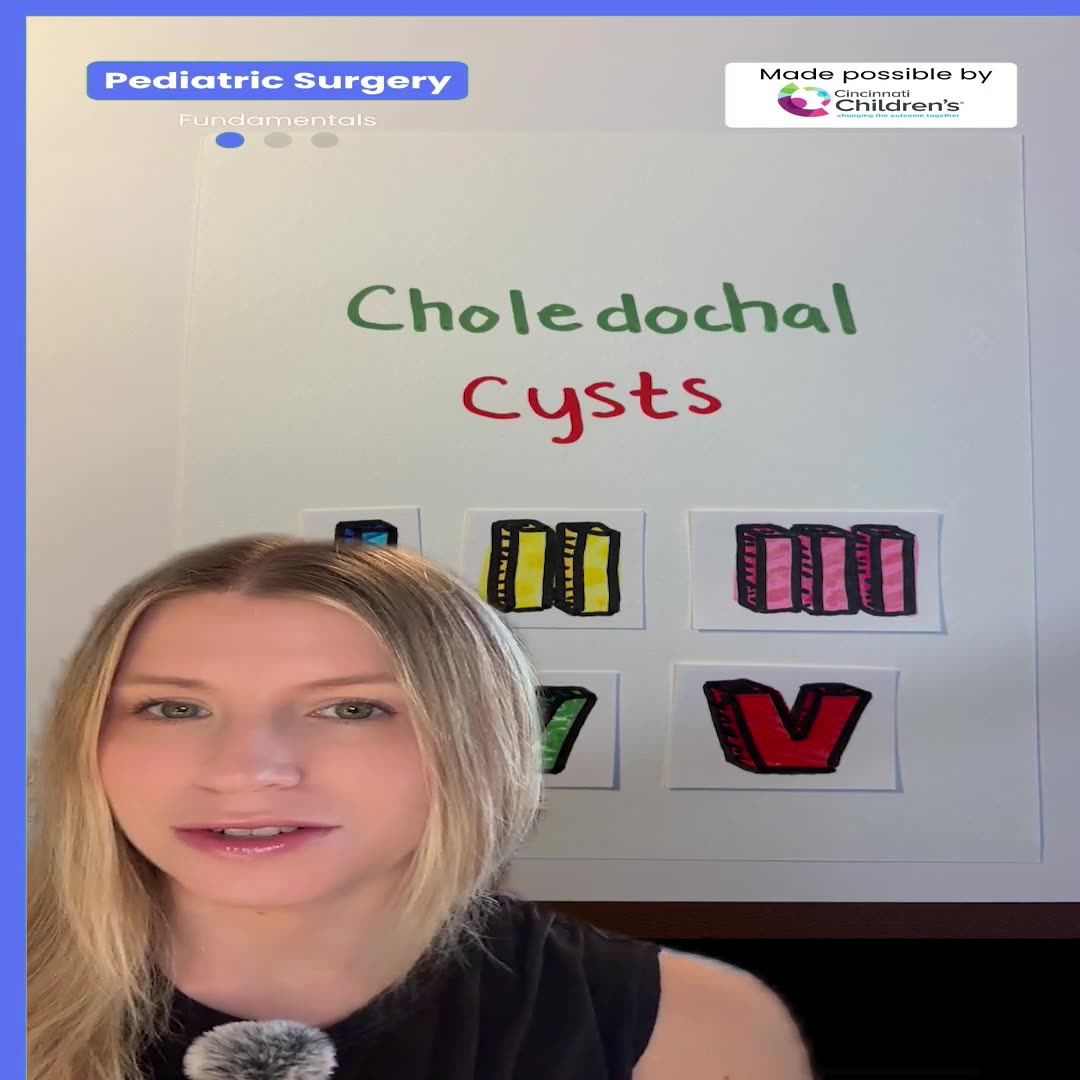
Choledochal Cyst Types Explained: Pediatric Surgery Fundamentals
1 min · Published Sep 2026
What the experts said
Echocardiography and TR jet measurement are essential to assess pulmonary hypertension in CDH patients, as pre- and post-ductal saturations alone are insufficient.
Jason waits until pulmonary pressures are subsystemic, at least 70% systemic and ideally 50% systemic, before proceeding to CDH repair.
Jason uses serial echocardiography aggressively to monitor pulmonary pressures before surgery, typically waiting around 2 days.
Jason performs thoracoscopic CDH repair in well-managed patients.
Jason tried laparoscopic CDH repair early on and found it quite nice, but considers thoracoscopy an easier operation.
Jason has started dissecting out the pleura to create a raw edge around the CDH defect.
Sewing pleura to pleura without creating a raw edge may have a high failure rate analogous to laparoscopic inguinal hernia repair (sewing peritoneum to peritoneum).
Scoring the pleura all the way around and unfurling it so that it comes together with more of a scar may reduce recurrence.
A lamb model for studying CDH repair techniques would cost $5000 per lamb, making formal study prohibitively expensive.
The speaker has a high degree of suspicion that pleural dissection will reduce CDH recurrence, but this has not been formally studied.