


From
StayCurrentMD
Hirschsprung Disease: Update Course 2015
With Dr. Jason Frischer · hosted by Dr. Todd Ponsky
Chapter 1 of 3 · Case-Based Learning
Case & approach poll
Case presentation: newborn with suspected Hirschsprung disease and operative approach polling
Expert statements on this page
No expert statements were drawn from this page.
Host summaries · secondary, not cited in answers
Educational content from recorded physician discussions — not medical advice. Talk to your (or your child's) care team about your situation.
Video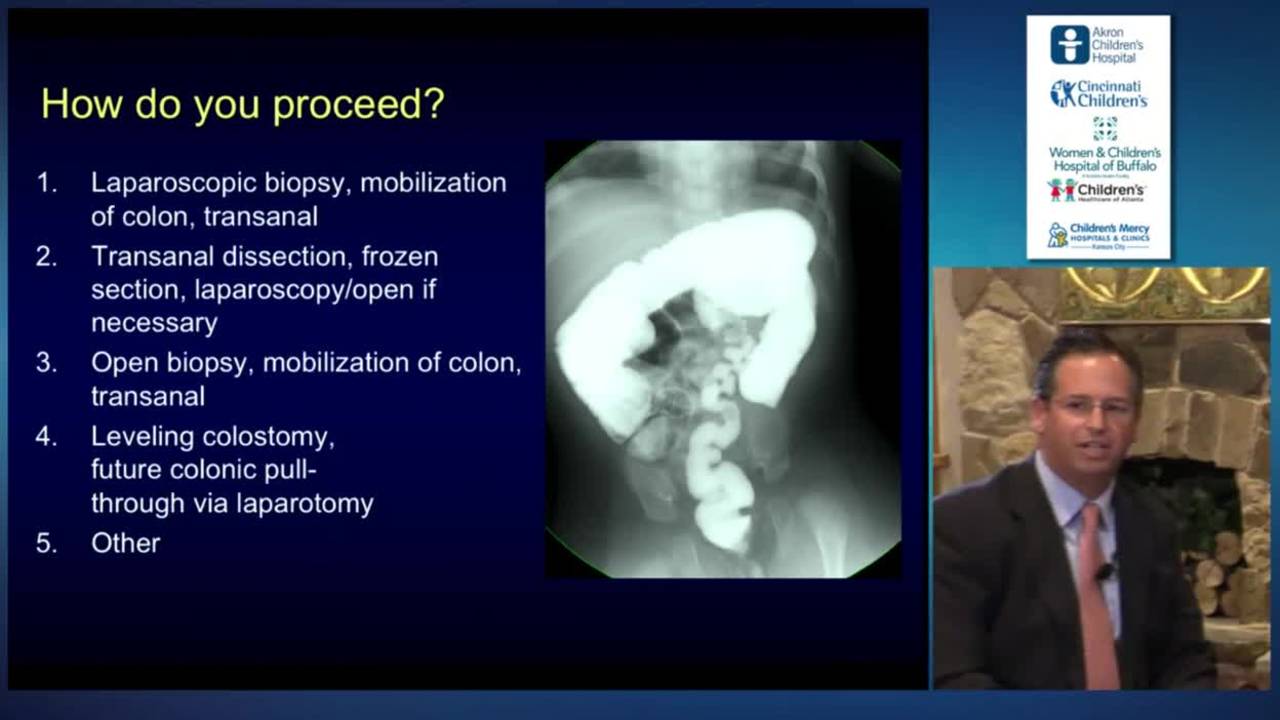
Hirschsprung Disease Rapid Fire: Update Course 2015
CCHMC Pediatric Surgery · 12 min · Published Nov 2015
Video
Hirschsprung Disease - Imperforate Anus - Rectal Prolapse: Update Course 2015
CCHMC Pediatric Surgery · 25 min · Published Nov 2018
Podcast
Update Course Rewind: 2020 Colorectal Part 1
12 min · Published Mar 2021
Video
Hirschsprung Disease: Update Course 2013
38 min · Published Sep 2013
Video
Panel Discussion and Case Presentation Part II: Pediatric Bowel Management 2013
Dr. Todd Ponsky · 33 min · Published May 2013
Podcast
Hirschsprung Disease Workup
10 min · Published Jul 2021
Video
Validation of an anorectal malformation trainer - Can a high-fidelity model simulate real life?
1 min · Published Jun 2026
Video
Complications and Long-Term Outcomes of Patients With Cloacal Malformation After Bowel Neovagina...
1 min · Published Jun 2026
Video
Safety and utility of long-acting steroid injection for management of post-operative stricture...
1 min · Published Jun 2026
Video
Association Between Social Determinants of Health and Choice of Urinary Reconstruction in Children
1 min · Published Jun 2026
Video
The Perineal Body Preserving PSARP (PPP)
11 min · Published Jun 2026
Video
Update Course Rewind 2025: Hirschsprung + ARM: Rare but Real
1 min · Published May 2026
Podcast
Colorectal Quiz: Episode 47
Marc Levitt · 22 min · Published May 2025
Video
Colorectal Quiz: Episode 46 - Hirschsprung's Disease
Marc Levitt · 29 min · Published Apr 2025
Podcast
Colorectal Quiz: Episode 46
Marc Levitt · 29 min · Published Apr 2025
Video
Colorectal Quiz: Episode 44 - HD Frozen Section
Marc Levitt · 18 min · Published Feb 2025
Podcast
Colorectal Quiz: Episode 43
Marc Levitt · 23 min · Published Jan 2025
Video
Colorectal Quiz Episode 38: Transitional Care in Colorectal Surgery
25 min · Published Mar 2024
Video
Intestinal Atresia Types Explained: Grossfeld Classification for Pediatric Surgery
1 min · Published Sep 2026
Video
Derivation and validation of the Pediatric Community-Acquired Pneumonia Severity (PedCAPS) score: A prospective cohort study
50 s · Published Sep 2026
Video
FETO for Late-Diagnosed Severe Congenital Diaphragmatic Hernia (CDH) at Cincinnati Children's with Dr. Beth Rymeski
4 min · Published Sep 2026
Video
Severe Congenital Diaphragmatic Hernia (CDH) Case: FETO Management & Unexpected Findings with Dr. Beth Rymeski
3 min · Published Sep 2026
Video
Fetoscopic Endoluminal Tracheal Occlusion (FETO) Procedure: Step-by-Step Guide with Dr. Beth Rymeski
4 min · Published Sep 2026
Video
Choledochal Cyst Types Explained: Pediatric Surgery Fundamentals
1 min · Published Sep 2026
What the experts said
For a newborn with Hirschsprung disease and a transition zone at the descending colon level, laparoscopic biopsy and mobilization is the preferred approach among polled experts.
For the average pediatric surgeon performing primary transanal pull-through without biopsy, there is approximately a 1 in 10 to 1 in 15 chance of encountering disease higher than expected or total colonic aganglionosis during their career.
Surgeons performing transanal pull-through without prior biopsy should have a predetermined exit strategy for managing unexpectedly proximal disease.
The safest approach to Hirschsprung surgery involves some form of biopsy (laparoscopic or full-thickness through umbilicus) prior to definitive pull-through.
Leveling colostomy may be the safest approach when institutional pathology expertise in reading Hirschsprung biopsies is limited or unavailable.
Leveling colostomy represents a three-stage procedure for Hirschsprung disease management.
Pure transanal pull-through may not be less invasive than laparoscopic approach, as prolonged torquing in the anal canal can be more traumatic than three small abdominal incisions.
Transanal dissection attempting to reach high past the pelvic reflection involves significant pulling and stretching of the sphincters.
Prolonged transanal dissection (approaching 4 hours) should prompt consideration of converting to laparoscopic approach to avoid excessive sphincter stretching.
Laparoscopic mobilization with 3-millimeter ports can be completed in approximately 45 minutes for appropriate cases.
Standard rectosigmoid Hirschsprung disease (6-10 centimeters proximal) can be completed transanally in approximately 2 hours when the level is known from a good contrast study.
Complications after Hirschsprung surgery are divided into two categories: obstructive symptoms (including enterocolitis, failure to thrive, abdominal distention) and soiling issues.
Soiling after Hirschsprung surgery is further classified into true incontinence and pseudo-incontinence.
Obstructive symptoms after Hirschsprung surgery require differentiation between anatomic problems and pathologic problems.
True fecal incontinence after Hirschsprung surgery can result from injury to the sphincter or injury to the dentate line.
Pseudo-incontinence after Hirschsprung surgery may be caused by underlying constipation.
Workup for post-Hirschsprung complications includes water-soluble contrast enema and exam under anesthesia evaluating dentate line position, stricture, stretched sphincter, and anatomic twists.
Jack Langer published an algorithm for working up patients with problems after Hirschsprung disease.