


From
StayCurrentMD
Journal of Pediatric Surgery Article Review: May 2023, CAPS Issue
With Dr. Sonia Butterworth & Dr. Jacob Langer & Dr. Greta Bercher & Dr. Katerina Dukleska · hosted by Dr. Cecilia Gigena & Dr. Tom Bash
Chapter 1 of 5 · Evidence & Research
Introduction
Introduction and Episode Overview
Expert statements on this page
No expert statements were drawn from this page.
Host summaries · secondary, not cited in answers
Educational content from recorded physician discussions — not medical advice. Talk to your (or your child's) care team about your situation.
Video
Quick Literature Updates Episode 15
4 min · Published Jan 2024
Video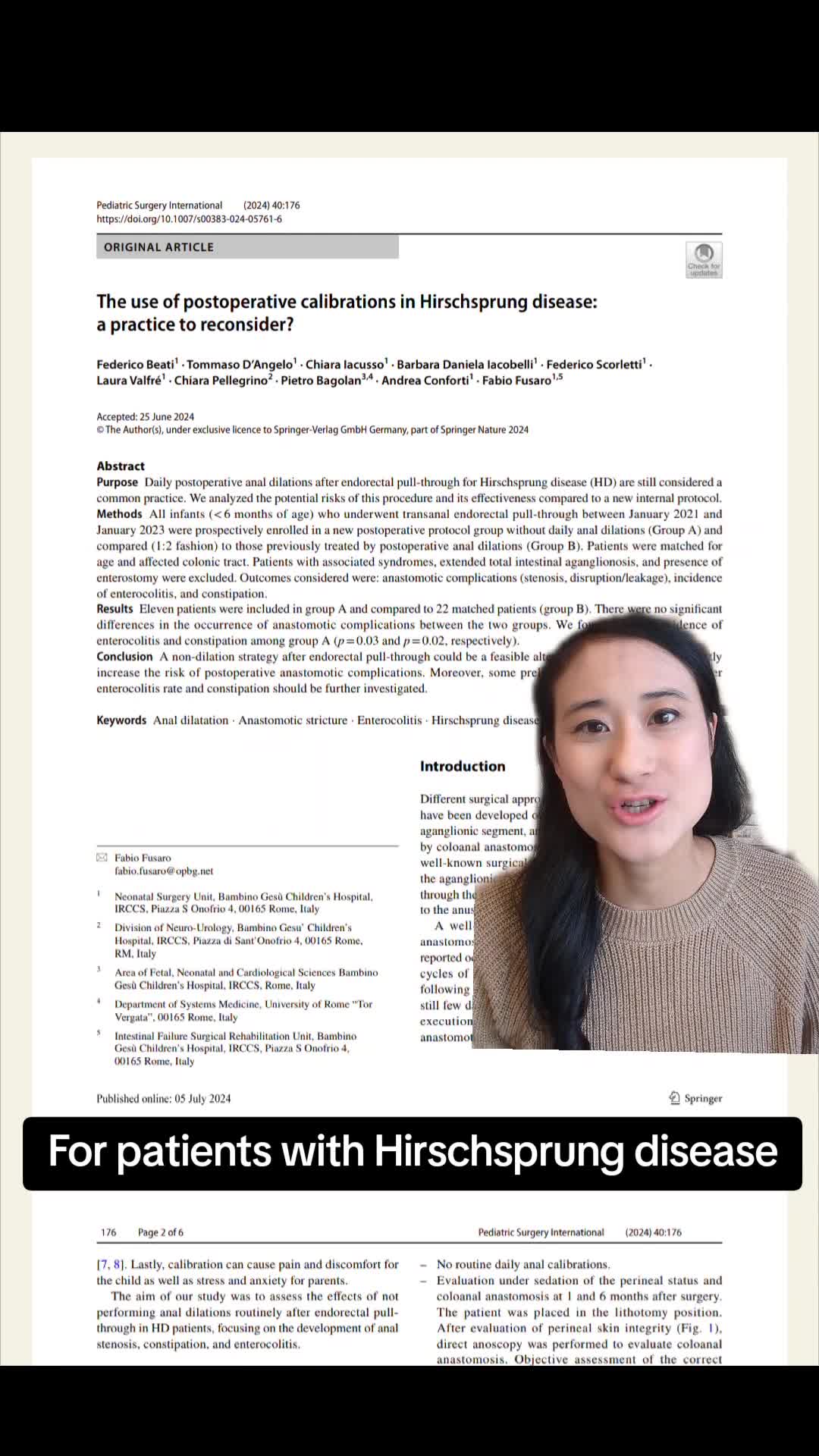
The use of postoperative calibrations in Hirschsprung disease
59 s · Published Nov 2024
Video
Update Course Rewind 2025: Hirschsprung + ARM: Rare but Real
1 min · Published May 2026
Video
How to Administer a Rectal Irrigation at Home
5 min · Published Jun 2023
Video
Hirschsprung Disease in Brief
Dr. Todd Ponsky · 10 min · Published Oct 2021
Video
Meconium Plug Syndrome (MPS)
Published Mar 2020
Video
Validation of an anorectal malformation trainer - Can a high-fidelity model simulate real life?
1 min · Published Jun 2026
Video
Complications and Long-Term Outcomes of Patients With Cloacal Malformation After Bowel Neovagina...
1 min · Published Jun 2026
Video
Safety and utility of long-acting steroid injection for management of post-operative stricture...
1 min · Published Jun 2026
Video
Association Between Social Determinants of Health and Choice of Urinary Reconstruction in Children
1 min · Published Jun 2026
Video
The Perineal Body Preserving PSARP (PPP)
11 min · Published Jun 2026
Video
Update Course Rewind 2025: Botox for Hirschsprung’s: Where, When, and Why
1 min · Published May 2026
Video
Intestinal Atresia Types Explained: Grossfeld Classification for Pediatric Surgery
1 min · Published Sep 2026
Video
Derivation and validation of the Pediatric Community-Acquired Pneumonia Severity (PedCAPS) score: A prospective cohort study
50 s · Published Sep 2026
Video
FETO for Late-Diagnosed Severe Congenital Diaphragmatic Hernia (CDH) at Cincinnati Children's with Dr. Beth Rymeski
4 min · Published Sep 2026
Video
Severe Congenital Diaphragmatic Hernia (CDH) Case: FETO Management & Unexpected Findings with Dr. Beth Rymeski
3 min · Published Sep 2026
Video
Fetoscopic Endoluminal Tracheal Occlusion (FETO) Procedure: Step-by-Step Guide with Dr. Beth Rymeski
4 min · Published Sep 2026
Video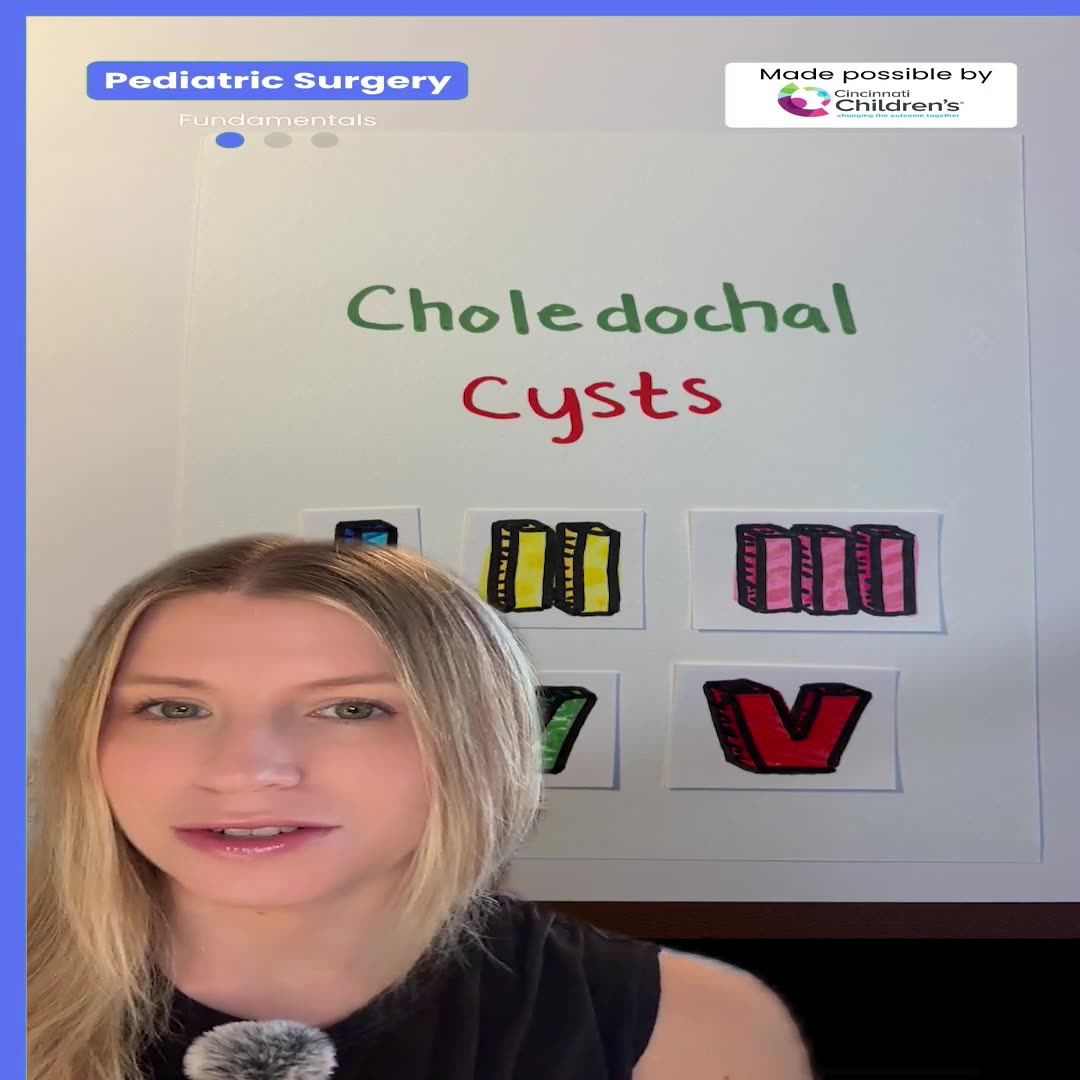
Choledochal Cyst Types Explained: Pediatric Surgery Fundamentals
1 min · Published Sep 2026
What the experts said
Three risk factors for Hirschsprung-associated IBD are trisomy 21, a history of enterocolitis following pull-through surgery, and long segment disease.
Biologic therapy is most likely to be effective for treating Hirschsprung-associated IBD.
Hirschsprung's associated IBD is very poorly defined, presents in a number of different ways, and the reason why it happens is unknown.
Hirschsprung's enterocolitis that persists past age 5, or that is unresponsive to typical treatment under age 5, should prompt consideration of Hirschsprung-associated IBD diagnosis.
Complicated appendicitis was defined as: all perforated appendicitis, clear purulent peritonitis, or small bowel obstruction from appendicitis.
Median symptom duration between onset and emergency presentation was 1 day pre-COVID and 2 days during pandemic, representing a clinically significant difference despite lack of statistical significance.
Patients during COVID-19 had an increased rate of perforation compared to pre-pandemic, stayed in hospital longer, and had increased risks of complications.
During COVID-19, the government of Ontario made it mandatory that all patients below 18 years of age had to be treated at a pediatric hospital.
The institution already had a CART (critical airway response team) that activated all stakeholders except gastroenterology, which was added for the button battery protocol.
Even the pre-protocol time of 73 minutes for button battery removal was a very impressive target.
Button battery ingestions are not common events.
With the reduced time to removal, a decrease in at least major complications for button battery patients is anticipated over time.
The Hirschsprung-associated IBD study was a retrospective study from 2000 to 2021 at 17 institutions with 55 patients.
50% of Hirschsprung-associated IBD patients had long segment disease.
Enterocolitis was reported in 68% of Hirschsprung patients after pull-through.
The most common presentation for Hirschsprung-associated IBD was colonic or small bowel inflammation resembling IBD.
The COVID-19 appendicitis study assessed patients from February 2018 to June 2019 (pre-pandemic control) and mid-February 2020 to June 2021 (COVID period).
The study included 1100 patients total: 44% in pre-pandemic control group and 56% in COVID-19 group.
A larger proportion of complicated appendicitis occurred during COVID-19 compared to pre-pandemic period.
Symptom duration at presentation and length of stay were not significantly different between pre-pandemic and COVID-19 groups.
The button battery study evaluated whether implementation of a clinical algorithm shortened time from diagnosis to removal of esophageal button battery.
The algorithm was based on the national database algorithm and implemented in October 2019.
After implementing the critical airway response team algorithm, time from chest X-ray to button battery removal was reduced from 73 minutes to 35 minutes.