

From
Colorectal Channel
Colorectal Quiz Episode 19: Hirschsprung Disease - The Obstructed Patient Part 1
With Dr. Marc Levitt & Dr. Rebecca Rentea & Dr. Jason Frischer & Dr. Hira Hammad · hosted by Dr. Amanda Jensen
Chapter 1 of 5 · Case-Based Learning
Case presentation
Case Introduction: 7-Year-Old with Post-Pull-Through Obstruction
Expert statements on this page
No expert statements were drawn from this page.
Host summaries · secondary, not cited in answers
Educational content from recorded physician discussions — not medical advice. Talk to your (or your child's) care team about your situation.
Podcast
Hirschsprung Disease Audience Q&A with Dr. Marc Levitt
12 min · Published Apr 2017
Podcast
Colorectal Quiz: Episode 46
Marc Levitt · 29 min · Published Apr 2025
Podcast
The Colorectal Quiz Episode 20: Hirschsprung Disease Obstruction Part 2
21 min · Published Sep 2021
Video
Colorectal Quiz: Episode 46 - Hirschsprung's Disease
Marc Levitt · 29 min · Published Apr 2025
Video
Total Colonic Hirschsprung Disease with Malrotation: Difficult Cases
13 min · Published Dec 2013
Video
Surgical treatment for Hirschsprung’s Disease: An ERNICA animation for parents and families
3 min · Published Dec 2023
Video
Validation of an anorectal malformation trainer - Can a high-fidelity model simulate real life?
1 min · Published Jun 2026
Video
Complications and Long-Term Outcomes of Patients With Cloacal Malformation After Bowel Neovagina...
1 min · Published Jun 2026
Video
Safety and utility of long-acting steroid injection for management of post-operative stricture...
1 min · Published Jun 2026
Video
Association Between Social Determinants of Health and Choice of Urinary Reconstruction in Children
1 min · Published Jun 2026
Video
The Perineal Body Preserving PSARP (PPP)
11 min · Published Jun 2026
Video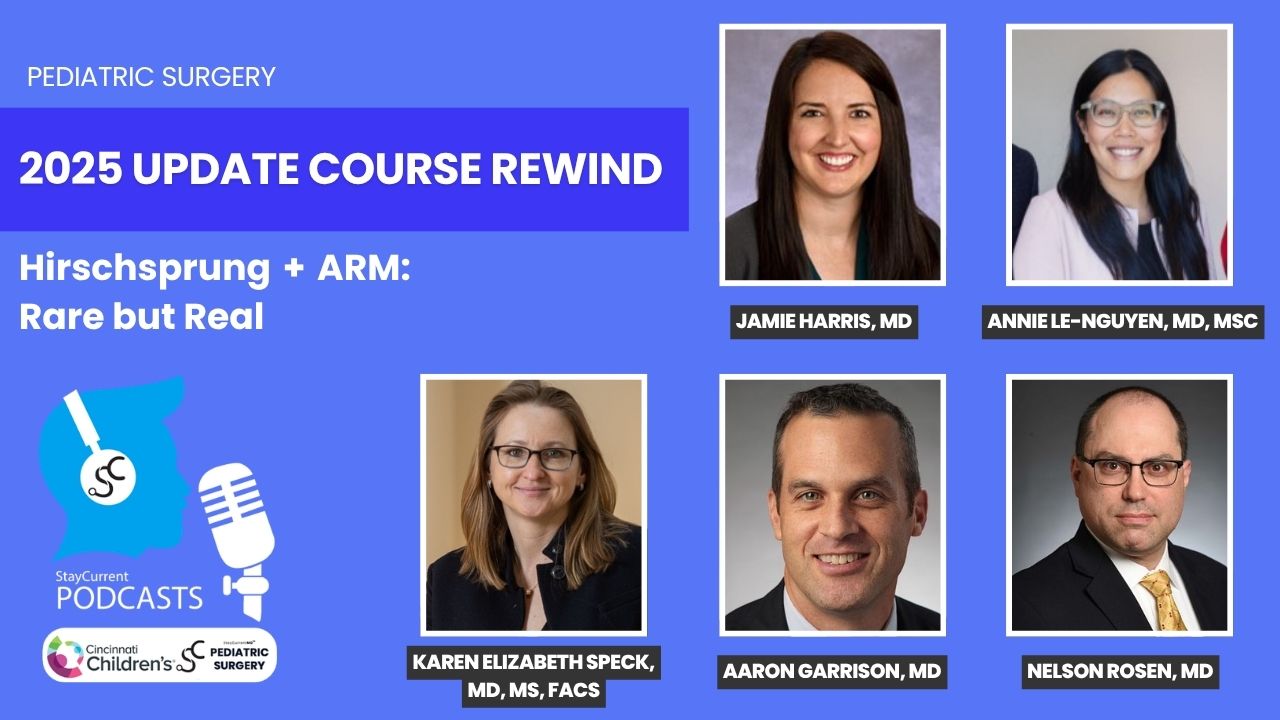
Update Course Rewind 2025: Hirschsprung + ARM: Rare but Real
1 min · Published May 2026
Video
Colorectal Quiz Ep. 50 -16th Annual European Pediatric Colorectal & Pelvic Reconstruction Conference
Marc Levitt · Published Mar 2026
Podcast
Colorectal Quiz: Episode 50 - 16th Annual European Pediatric Colorectal and Pelvic Reconstruction Conference, Stockholm, Sweden, October 2025 - What did we learn?
24 min · Published Mar 2026
Video
Colorectal Quiz Episode 33: Cloaca Exstrophy
Marc Levitt · 22 min · Published Sep 2025
Video
The Colorectal Quiz Episode 21: The History of Hirschsprung Disease
Marc Levitt · 15 min · Published Sep 2025
Video
Colorectal Quiz: Episode 49 – Collaborating for Kids: Colorectal & Pelvic Care (with Help from AI)
Marc Levitt · 40 min · Published Jul 2025
Podcast
Colorectal Quiz: Episode 49 - Collaborating for Kids: Colorectal & Pelvic Solutions (with a Little Help from AI)
Marc Levitt · 40 min · Published Jul 2025
Podcast
Long-term obstetric and gynecologic care for patients with anorectal malformations
21 min · Published Sep 2026
Podcast
Post-pubertal gynecologic evaluation and management of patients with anorectal malformations
22 min · Published Sep 2026
Podcast
Pre-pubertal gynecologic evaluation and management of patients with anorectal malformations
23 min · Published Sep 2026
Podcast
Methods of gynecologic evaluation for patients with anorectal malformations
21 min · Published Sep 2026
Podcast
Gynecologic care in patients with anorectal malformations: A primer and call to action
18 min · Published Sep 2026
Podcast
Evaluation and Management of Postsurgical Patient With Hirschsprung Disease Neurogastroenterology & Motility Committee: Position Paper of North American Society of Pediatric Gastroenterology, Hepatology, and Nutrition (NASPGHAN)
17 min · Published Sep 2026
What the experts said
The anatomy of the original pull-through can explain the patient's obstructive symptoms, and it is important to know what pull-through type was performed to determine if there is a fixable problem.
When performing initial rectal exam on a distended child with suspected enterocolitis, step to the side because there may be an explosive release of stool and gas.
Post-pull-through obstruction can be caused by stricture, twist (any pull-through type), Soave cuff (Soave procedure), Duhamel spur or non-functional distended segment (Duhamel procedure), or non-functional segment (Rehbein procedure).
If the original operative note is unavailable, a contrast study can help infer the original surgery type based on imaging findings; expertise in reading post-pull-through contrast studies is essential.
In a very ill child, a contrast study would not be the best initial option; resuscitation and stabilization should come first.
In obstructed Hirschsprung patients, the colon fills with liquid stool with severe bacterial overgrowth, causing fluid loss into the bowel lumen, hypovolemia, and bacterial translocation/bacteremia, all occurring without passage of stool.
In Hirschsprung patients with distention, irritability, and fever, enterocolitis should be assumed until proven otherwise.
Irrigation is the best way to break the cycle of enterocolitis because patients are not passing stool due to distal obstruction.
Enterocolitis can occur before surgery, after surgery, and even after successful surgery in babies who don't relax their sphincters and hold stool so efficiently they develop enterocolitis.
For a patient with prior Hirschsprung diagnosis presenting sick, assume Hirschsprung-associated enterocolitis; treatment with rectal irrigations, IV fluids, and antibiotics will not cause harm even if the diagnosis is different (e.g., Crohn's disease, E. coli enterocolitis).
When reading literature on Hirschsprung enterocolitis rates, be aware that definitions vary (admission, need for irrigations, need for antibiotics); the PCPLC consortium is working on validating the Langer score for uniform application.
Post-pull-through enterocolitis within the first 3 months occurs in about 20% of patients, based on a study from Cincinnati and Columbus.
After pull-through surgery, wait one to two weeks before performing the first irrigation, and the first irrigation should be performed by someone who is confident and knows where the anastomosis is.
Families should not undergo Hirschsprung pull-through surgery until they can demonstrate ability to perform rectal irrigations, and they should be discharged with supplies to perform irrigations at home.
In rare circumstances where a patient is too ill and sedation in the ER doesn't work, go to the OR under general anesthesia for irrigation until the patient improves; occasionally an ileostomy is needed to get the child out of trouble and work up the pull-through problem later.
In a logical workup, obtain the contrast study before going to the OR for rectal exam under anesthesia, as it may reveal findings that guide the surgical approach.
On contrast enema, it is important to look at the presacral space (space between the hollow of the sacrum and the pull-through); a widened presacral space is an abnormal finding.
A lateral view on contrast enema is important because it provides significant information about the presacral space and distal rectum anatomy.
On contrast enema, if the catheter is inserted too high or the balloon is under too much pressure, distal pathology cannot be easily ascertained.