


Chapter 1 of 4 · Fundamentals
Introduction
Introduction and Historical Context
Expert statements on this page
No expert statements were drawn from this page.
Host summaries · secondary, not cited in answers
Educational content from recorded physician discussions — not medical advice. Talk to your (or your child's) care team about your situation.
Video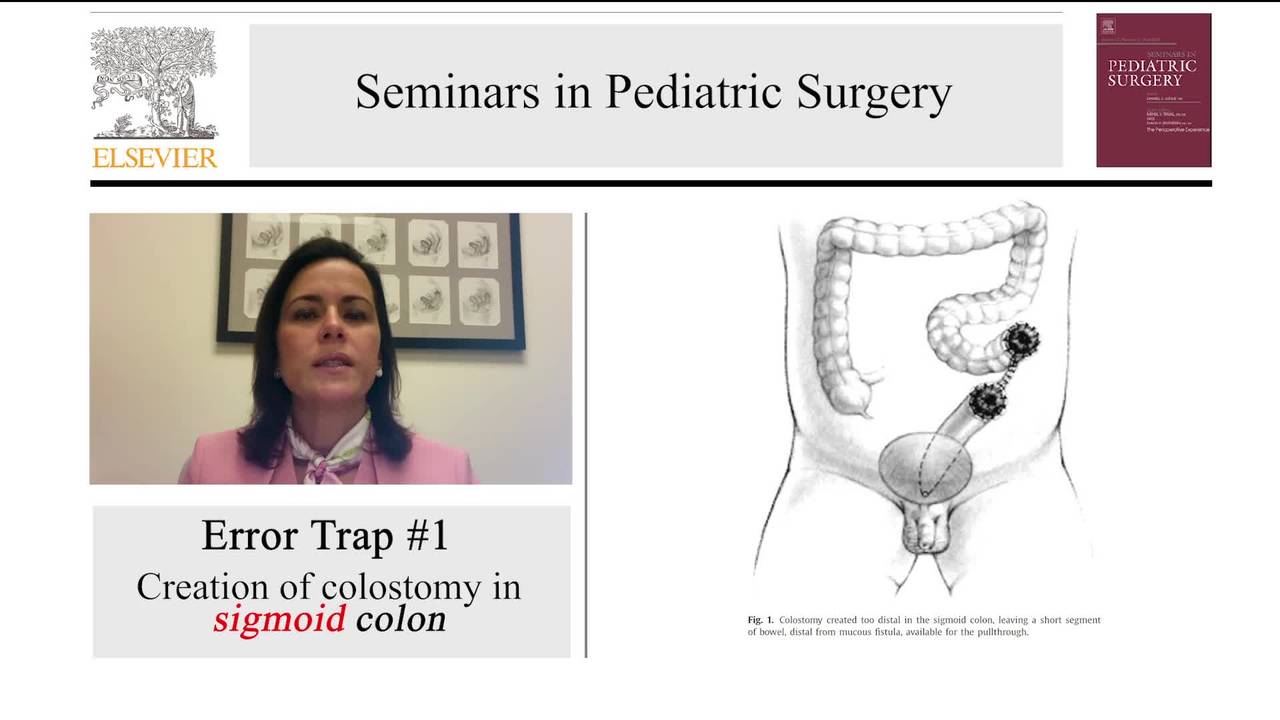
Error Traps and Culture of Safety in Anorectal Malformations
CCHMC Pediatric Surgery · 2 min · Published Sep 2019
Video
Recto-Bladderneck Fistula: Laparoscopic-Assisted Anorectoplasty
3 min · Published Oct 2022
Video
Laparoscopic Assisted Posterior Sagittal Anorectoplasty
5 min · Published Jan 2025
Video
Anorectal Malformation Management of Female Patients Part I: Pediatric...
26 min · Published Apr 2012
Podcast
Colorectal Quiz Episode 14: ARM Newborn Part 3
10 min · Published Jun 2021
Video
Posterior Sagittal Anorectoplasty
6 min · Published Mar 2025
Video
Validation of an anorectal malformation trainer - Can a high-fidelity model simulate real life?
1 min · Published Jun 2026
Video
Complications and Long-Term Outcomes of Patients With Cloacal Malformation After Bowel Neovagina...
1 min · Published Jun 2026
Video
Safety and utility of long-acting steroid injection for management of post-operative stricture...
1 min · Published Jun 2026
Video
Association Between Social Determinants of Health and Choice of Urinary Reconstruction in Children
1 min · Published Jun 2026
Video
The Perineal Body Preserving PSARP (PPP)
11 min · Published Jun 2026
Video
Update Course Rewind 2025: Hirschsprung + ARM: Rare but Real
1 min · Published May 2026
Podcast
Long-term obstetric and gynecologic care for patients with anorectal malformations
21 min · Published Sep 2026
Podcast
Post-pubertal gynecologic evaluation and management of patients with anorectal malformations
22 min · Published Sep 2026
Podcast
Pre-pubertal gynecologic evaluation and management of patients with anorectal malformations
23 min · Published Sep 2026
Podcast
Methods of gynecologic evaluation for patients with anorectal malformations
21 min · Published Sep 2026
Podcast
Gynecologic care in patients with anorectal malformations: A primer and call to action
18 min · Published Sep 2026
Podcast
Evaluation and Management of Postsurgical Patient With Hirschsprung Disease Neurogastroenterology & Motility Committee: Position Paper of North American Society of Pediatric Gastroenterology, Hepatology, and Nutrition (NASPGHAN)
17 min · Published Sep 2026
What the experts said
Anorectal malformations (imperforate anus) occur in 1 in 5,000 live births.
Anorectal malformations occur when the anus, rectum, and nerves do not develop properly during fetal growth.
More than 90% of anorectal malformation patients have anatomy that can be ascertained on physical exam alone.
Male rectal-urethral fistulas are categorized by location on the urethra: bulbar, prostatic, or bladder neck.
95% of boys with anorectal malformations have a fistula somewhere.
The vast majority of male anorectal malformation fistulas enter into the urinary tract.
Patients with rectal-urethral fistulas need colostomies, then distal colostograms, then definitive surgery.
A flat bottom (absence of normal midline groove) is usually associated with a very high located rectum and usually associated with a bad prognosis.
With a bucket-handle malformation, you can be very confident that you have a perineal fistula right under that little bucket handle.
You can gently dilate a perineal fistula to get meconium out and spare a baby a trip to the OR if they are too ill (e.g., have a coarctation).
In black-ribbon malformations, the fistula parallels the urethra for a long distance, creating potential for urethral injury during surgery.
For black-ribbon malformations, you don't have to go crazy finding the fistula; you just need to unroof the meconium, find healthy rectum, and make an anoplasty.
In male patients with perineal fistula, the fistula is always located anterior to the center of the sphincter.
No surgical repair should be done before the first 24 hours because a patient may pass meconium through a tiny orifice and the perineal fistula should be identified.
The no-fistula defect is quite rare, only about 5% of cases.
The no-fistula defect is not surprising if you had a trisomy 21 patient.
The no-fistula defect is almost uniformly at the same level as the bulbar urethra.