


From
Colorectal Channel
The Colorectal Quiz Episode 4: Classic Hirschsprung disease - Surgical Technique
With Dr. Jason Frischer & Dr. Marc Levitt & Dr. Aaron Garrison & Dr. Andrea Badillo · hosted by Dr. Rod Gerardo
Chapter 1 of 8 · Fundamentals
Case recap
Introduction and Case Recap
Expert statements on this page
No expert statements were drawn from this page.
Host summaries · secondary, not cited in answers
Educational content from recorded physician discussions — not medical advice. Talk to your (or your child's) care team about your situation.
Podcast
The Colorectal Quiz Episode 4
Marc Levitt · 19 min · Published Feb 2021
Podcast
The Colorectal Quiz Episode 3.5: Proximal Hirschsprung Disease
8 min · Published Feb 2021
Podcast
Hirschsprung Disease Part I with Marc Levitt
59 min · Published Apr 2017
Podcast
The Colorectal Quiz Episode 5: Proximal Hirschsprung Disease Surgical Technique
14 min · Published Mar 2021
Video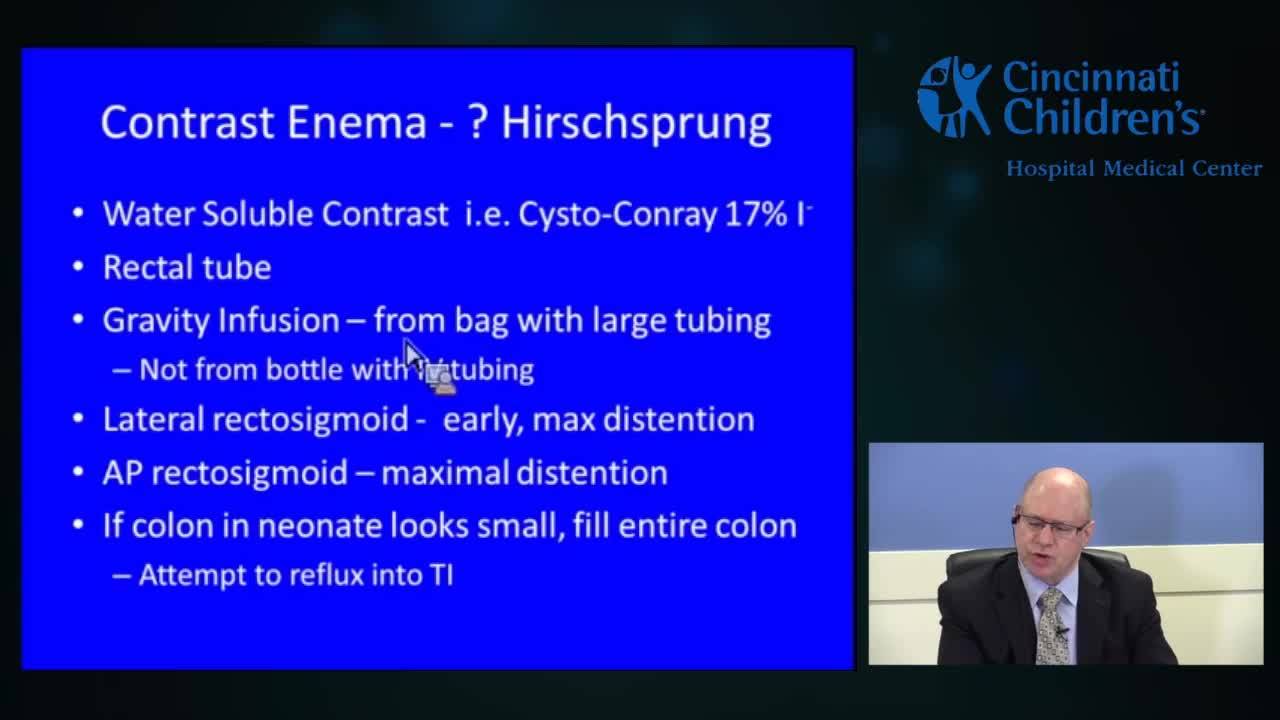
Contrast Enema for Hirschsprung Disease
11 min · Published Feb 2015
Video
Hirschsprung Disease: Radiology Aspect
CCHMC Pediatric Surgery · 43 min · Published Feb 2015
Video
Validation of an anorectal malformation trainer - Can a high-fidelity model simulate real life?
1 min · Published Jun 2026
Video
Complications and Long-Term Outcomes of Patients With Cloacal Malformation After Bowel Neovagina...
1 min · Published Jun 2026
Video
Safety and utility of long-acting steroid injection for management of post-operative stricture...
1 min · Published Jun 2026
Video
Association Between Social Determinants of Health and Choice of Urinary Reconstruction in Children
1 min · Published Jun 2026
Video
The Perineal Body Preserving PSARP (PPP)
11 min · Published Jun 2026
Video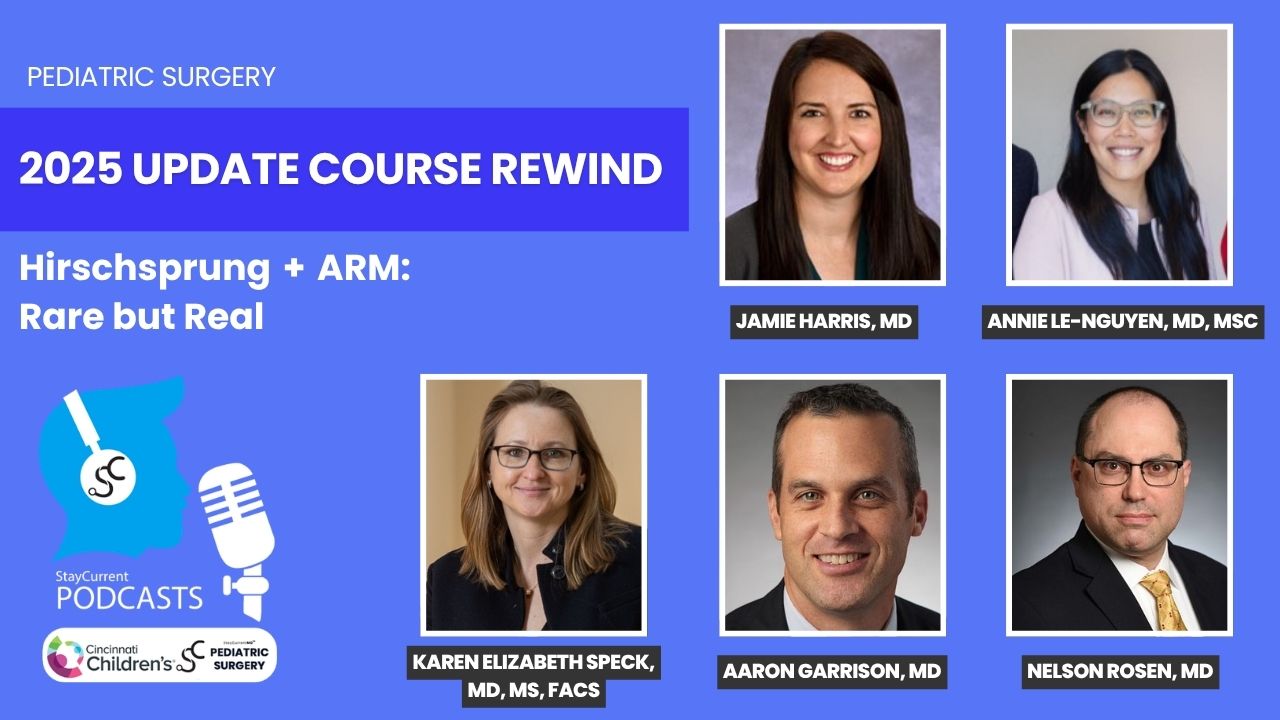
Update Course Rewind 2025: Hirschsprung + ARM: Rare but Real
1 min · Published May 2026
Podcast
Colorectal Quiz: Episode 47
Marc Levitt · 22 min · Published May 2025
Video
Colorectal Quiz: Episode 46 - Hirschsprung's Disease
Marc Levitt · 29 min · Published Apr 2025
Podcast
Colorectal Quiz: Episode 46
Marc Levitt · 29 min · Published Apr 2025
Video
Colorectal Quiz: Episode 44 - HD Frozen Section
Marc Levitt · 18 min · Published Feb 2025
Podcast
Colorectal Quiz: Episode 43
Marc Levitt · 23 min · Published Jan 2025
Video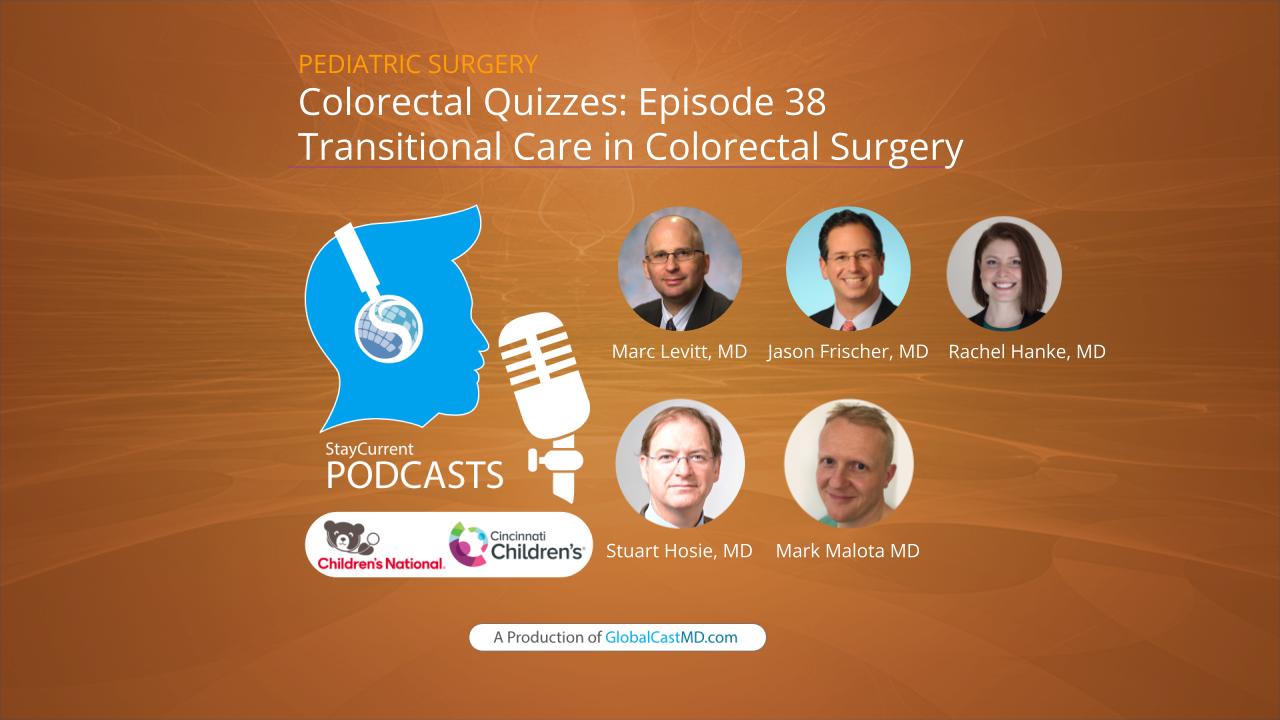
Colorectal Quiz Episode 38: Transitional Care in Colorectal Surgery
25 min · Published Mar 2024
Podcast
Long-term obstetric and gynecologic care for patients with anorectal malformations
21 min · Published Sep 2026
Podcast
Post-pubertal gynecologic evaluation and management of patients with anorectal malformations
22 min · Published Sep 2026
Podcast
Pre-pubertal gynecologic evaluation and management of patients with anorectal malformations
23 min · Published Sep 2026
Podcast
Methods of gynecologic evaluation for patients with anorectal malformations
21 min · Published Sep 2026
Podcast
Gynecologic care in patients with anorectal malformations: A primer and call to action
18 min · Published Sep 2026
Podcast
Evaluation and Management of Postsurgical Patient With Hirschsprung Disease Neurogastroenterology & Motility Committee: Position Paper of North American Society of Pediatric Gastroenterology, Hepatology, and Nutrition (NASPGHAN)
17 min · Published Sep 2026
What the experts said
The most important reason to use laparoscopy for Hirschsprung pull-through is to achieve deep pelvic dissection, minimizing transanal work and avoiding overstretching of the sphincters, which is a significant source of morbidity.
With proper laparoscopic dissection, the transanal portion of a primary Hirschsprung pull-through should take well under one hour.
For surgeons without laparoscopy available, an umbilical approach can accomplish significant dissection work.
Full-thickness biopsy should be cut as a cube with the seromuscular side equal to the mucosal side to ensure adequate tissue for pathology evaluation.
Surgeons should wait for frozen section confirmation before taking mesentery during Hirschsprung pull-through.
Pathology must confirm presence of ganglion cells and nerves less than 40 microns in diameter before proceeding with pull-through.
The biopsy must include submucosa because ganglion cells may be present in the seromuscular layer while hypertrophic nerves are present in the submucosal layer.
Mesenteric dissection should stay close to the bowel wall, not deep in the mesentery, as this plane tends to be less bloody.
Staying close to the bowel during distal rectal dissection is critical because the old Swenson technique with wide dissection resulted in incontinence and urinary retention, likely from injury to the nerve erigentis.
For distal Hirschsprung disease, only distal branches of the IMA need to be taken, but for left colon involvement, the IMA itself may need to be taken to achieve adequate reach.
The transanal dissection should begin 1 cm above the dentate line to protect the dentate line and sphincters from injury.
Lone Star retractor pins should be placed in three positions: first at the skin to identify the dentate line, then advanced to cover the dentate line, then moved to the mucosal opening site as dissection proceeds superiorly.
The Swenson full-thickness dissection in the areolar plane is essentially bloodless and is preferred over submucosal dissection.
If a Soave submucosal dissection with cuff is performed, the cuff should be very short (approximately 1 cm) and must be split.
For standard rectosigmoid Hirschsprung cases, the patient can remain supine with legs wrapped and fastened to the ether screen, avoiding the need to flip prone.
The resection margin should be approximately 5 cm above the biopsy site where the bowel appears healthy.
Tacking sutures on the serosa to the pelvic sidewall at 3 and 9 o'clock positions help anchor the anastomosis in place, though this does not constitute a true two-layer anastomosis.
The reinforcement layer of sutures is critical for lining up the two pieces of bowel to achieve mucosa-to-mucosa edge approximation.