


From
Dr. Marc Levitt
The Colorectal Quiz Episode 4
With Dr. Marc Levitt & Dr. Jason Frischer & Dr. Andrew Badillo & Dr. Aaron Garrison · hosted by Dr. Em Gootee & Dr. Todd Ponsky
Chapter 1 of 7 · Case-Based Learning
Case intro
Introduction and case presentation
Expert statements on this page
No expert statements were drawn from this page.
Host summaries · secondary, not cited in answers
Educational content from recorded physician discussions — not medical advice. Talk to your (or your child's) care team about your situation.
Podcast
The Colorectal Quiz Episode 4: Classic Hirschsprung disease - Surgical Technique
19 min · Published Feb 2021
Video
Technique: Laparoscopic Assisted Pull-through for Hirschsprung's Disease
Dr. Steve Rothenberg · 10 min · Published Nov 2018
Podcast
The Colorectal Quiz Episode 3.5: Proximal Hirschsprung Disease
8 min · Published Feb 2021
Video
Surgical treatment for Hirschsprung’s Disease: An ERNICA animation for parents and families
3 min · Published Dec 2023
Video
Hirschsprung Disease: Update Course 2015
CCHMC Pediatric Surgery · 7 min · Published Nov 2015
Video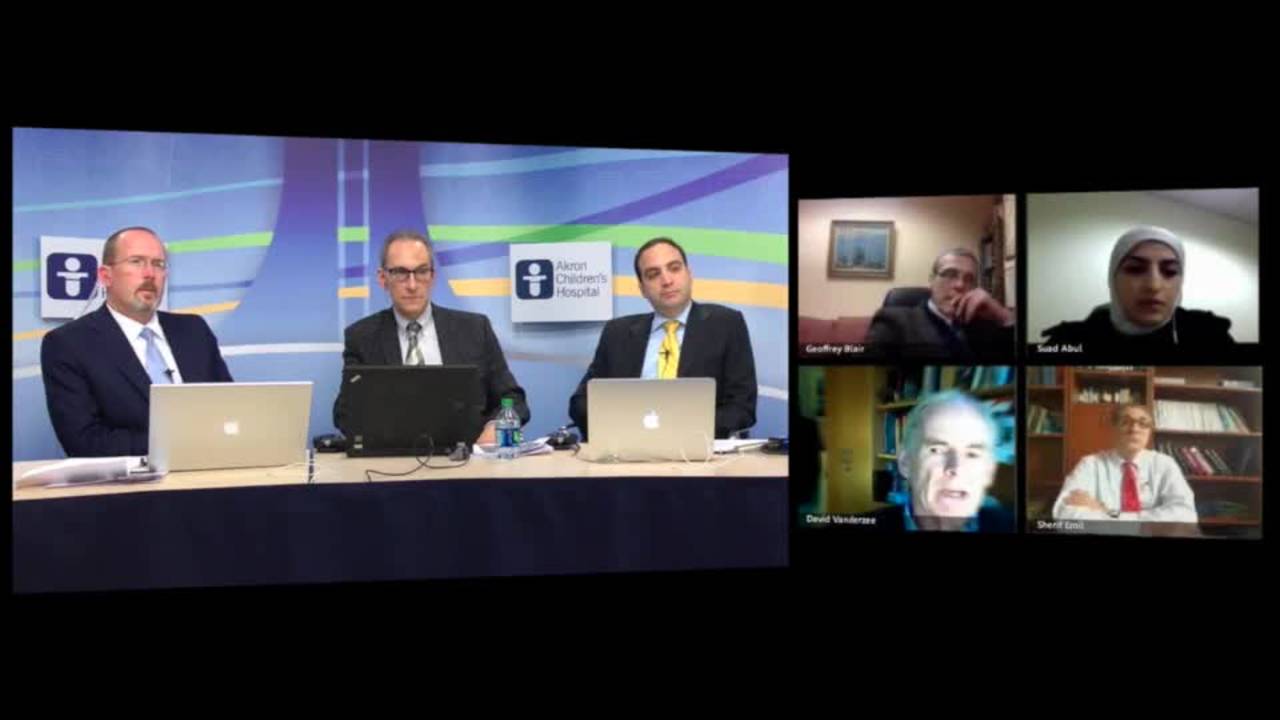
Laparoscopic Duhamel: Pediatric Surgery Difficult Cases 2013
10 min · Published Dec 2013
Video
Validation of an anorectal malformation trainer - Can a high-fidelity model simulate real life?
1 min · Published Jun 2026
Video
Complications and Long-Term Outcomes of Patients With Cloacal Malformation After Bowel Neovagina...
1 min · Published Jun 2026
Video
Safety and utility of long-acting steroid injection for management of post-operative stricture...
1 min · Published Jun 2026
Video
Association Between Social Determinants of Health and Choice of Urinary Reconstruction in Children
1 min · Published Jun 2026
Video
The Perineal Body Preserving PSARP (PPP)
11 min · Published Jun 2026
Video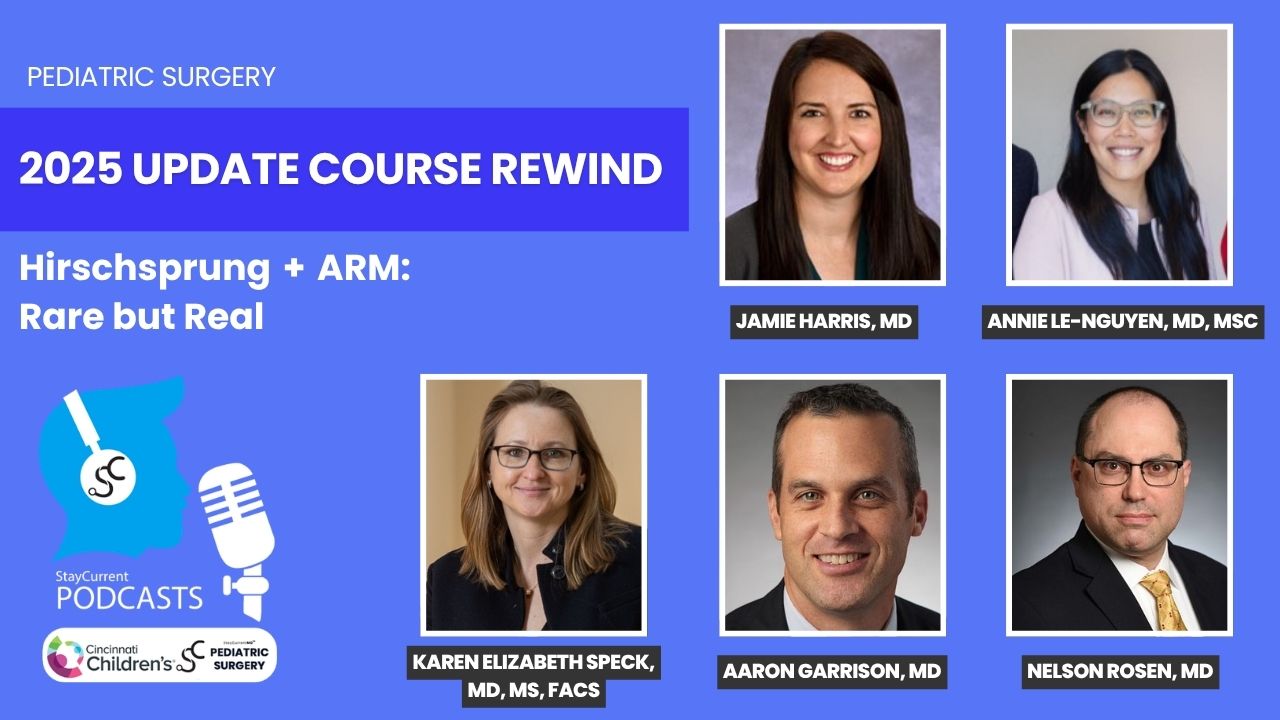
Update Course Rewind 2025: Hirschsprung + ARM: Rare but Real
1 min · Published May 2026
Video
Colorectal Quiz Ep. 50 -16th Annual European Pediatric Colorectal & Pelvic Reconstruction Conference
Marc Levitt · Published Mar 2026
Podcast
Colorectal Quiz: Episode 50 - 16th Annual European Pediatric Colorectal and Pelvic Reconstruction Conference, Stockholm, Sweden, October 2025 - What did we learn?
24 min · Published Mar 2026
Video
Colorectal Quiz Episode 33: Cloaca Exstrophy
Marc Levitt · 22 min · Published Sep 2025
Video
The Colorectal Quiz Episode 21: The History of Hirschsprung Disease
Marc Levitt · 15 min · Published Sep 2025
Video
Colorectal Quiz: Episode 49 – Collaborating for Kids: Colorectal & Pelvic Care (with Help from AI)
Marc Levitt · 40 min · Published Jul 2025
Podcast
Colorectal Quiz: Episode 49 - Collaborating for Kids: Colorectal & Pelvic Solutions (with a Little Help from AI)
Marc Levitt · 40 min · Published Jul 2025
What the experts said
Laparoscopic approach allows ability to biopsy elsewhere if transition zone is not rectosigmoid
Deep laparoscopic dissection into pelvis minimizes transanal work needed and avoids sphincter overstretching morbidity
Transanal dissection should take under one hour in primary pull-through
Full-thickness biopsy must include seromuscular side same size as mucosal side (cube-shaped)
Should wait for frozen section before taking mesentery
Adequate frozen section requires ganglion cells and nerves less than 40 microns
Frozen section biopsy must include submucosa to avoid missing hypertrophic nerves in submucosal layer while finding ganglion cells in seromuscular layer
Mesenteric dissection should stay close to bowel wall, not deep in mesentery, to reduce bleeding
In old Swenson procedures done through abdomen, too wide distal rectal dissection caused incontinence and urinary retention from nerve injury
Must preserve arcade along left colon and sigmoid to get enough length to reach pelvis
For distal disease, can take just distal IMA branches; for left colon disease may need to take IMA to get splenic flexure to reach
Transanal dissection should start about one centimeter above dentate line
Swenson full-thickness dissection follows areolar plane which is essentially bloodless
Soave submucosal dissection leaves a cuff; if performed, cuff should be very short (about one centimeter) and must be split
Resection margin should be approximately five centimeters above biopsy site where bowel looks good
Tacking sutures from serosa to pelvic sidewall at three and six o'clock positions anchor anastomosis in place
Reinforcement layer is critical to line up bowel pieces for mucosa-to-mucosa anastomosis