


From
StayCurrentMD
Update Course Rewind: 2022 Top Ten Key Takeaways
With Dr. Todd Ponsky · hosted by Dr. M. Tom Bash
Chapter 8 of 10 · Evidence & Research
Addressing bias
Implicit and Explicit Bias in Medicine
Cued at 16:30 · press play
Expert statements on this page
No expert statements were drawn from this page.
Host summaries · secondary, not cited in answers
Educational content from recorded physician discussions — not medical advice. Talk to your (or your child's) care team about your situation.
Video
Update Course 2023 - Update Course 2022 and Best of the Best Recap
17 min · Published Aug 2023
Podcast
Intestinal Rehabilitation, Episode 3: Enteral Autonomy, Part 1
16 min · Published Mar 2022
Video
Update Course 2021: DEI – CONCORDANCE AND POST OP COMPLICATION STUDIES
Published May 2022
Video
Intestinal Failure - Feeding Access and Nutrition
118 min · Published Nov 2018
Video
Quick Literature Updates Episode 16
4 min · Published Jan 2025
Podcast
Journal of Pediatric Surgery Article Review: 2nd Quarter (Apr-Jun) 2024
17 min · Published Sep 2024
Video
Impact of social determinants of health on outcomes in pediatric short bowel syndrome...
43 s · Published Aug 2026
Video
Advancements in Pediatric Intestinal Failure: Innovative Therapies and Improved Outcomes
17 min · Published Aug 2026
Podcast
Update Course Rewind: Omphalocele & Gastroschisis 2020
Miguel Guelfand · 15 min · Published Jul 2026
Video
Availability, utilization, and barriers to bowel ultrasound for necrotizing enterocolitis...
55 s · Published Jul 2026
Video
Malrotation and Volvulus with Trinity
Dr. Steve Rothenberg · 8 min · Published May 2026
Video
Malrotation Infant
Dr. Steve Rothenberg · 9 min · Published May 2026
Video
Acute Cholecystitis
Todd Ponsky · 32 min · Published Jul 2026
Video
Update Course Rewind 2025: Updates in NEC Management
11 min · Published Jul 2026
Video
Journal of Pediatric Surgery Article Review: September 2021
Todd Ponsky · 11 min · Published Jul 2026
Video
22. HerniaTalk LIVE Q&A: Pediatric Hernias
Todd Ponsky · 59 min · Published Jul 2026
Video
Journal of Pediatric Surgery Article Review: The Disruption Score
Todd Ponsky · 12 min · Published Jul 2026
Video
2022 Pediatric Surgery Update Course Introduction
Todd Ponsky · 2 min · Published Jul 2026
Video
Intestinal Atresia Types Explained: Grossfeld Classification for Pediatric Surgery
1 min · Published Sep 2026
Video
Derivation and validation of the Pediatric Community-Acquired Pneumonia Severity (PedCAPS) score: A prospective cohort study
50 s · Published Sep 2026
Video
FETO for Late-Diagnosed Severe Congenital Diaphragmatic Hernia (CDH) at Cincinnati Children's with Dr. Beth Rymeski
4 min · Published Sep 2026
Video
Severe Congenital Diaphragmatic Hernia (CDH) Case: FETO Management & Unexpected Findings with Dr. Beth Rymeski
3 min · Published Sep 2026
Video
Fetoscopic Endoluminal Tracheal Occlusion (FETO) Procedure: Step-by-Step Guide with Dr. Beth Rymeski
4 min · Published Sep 2026
Video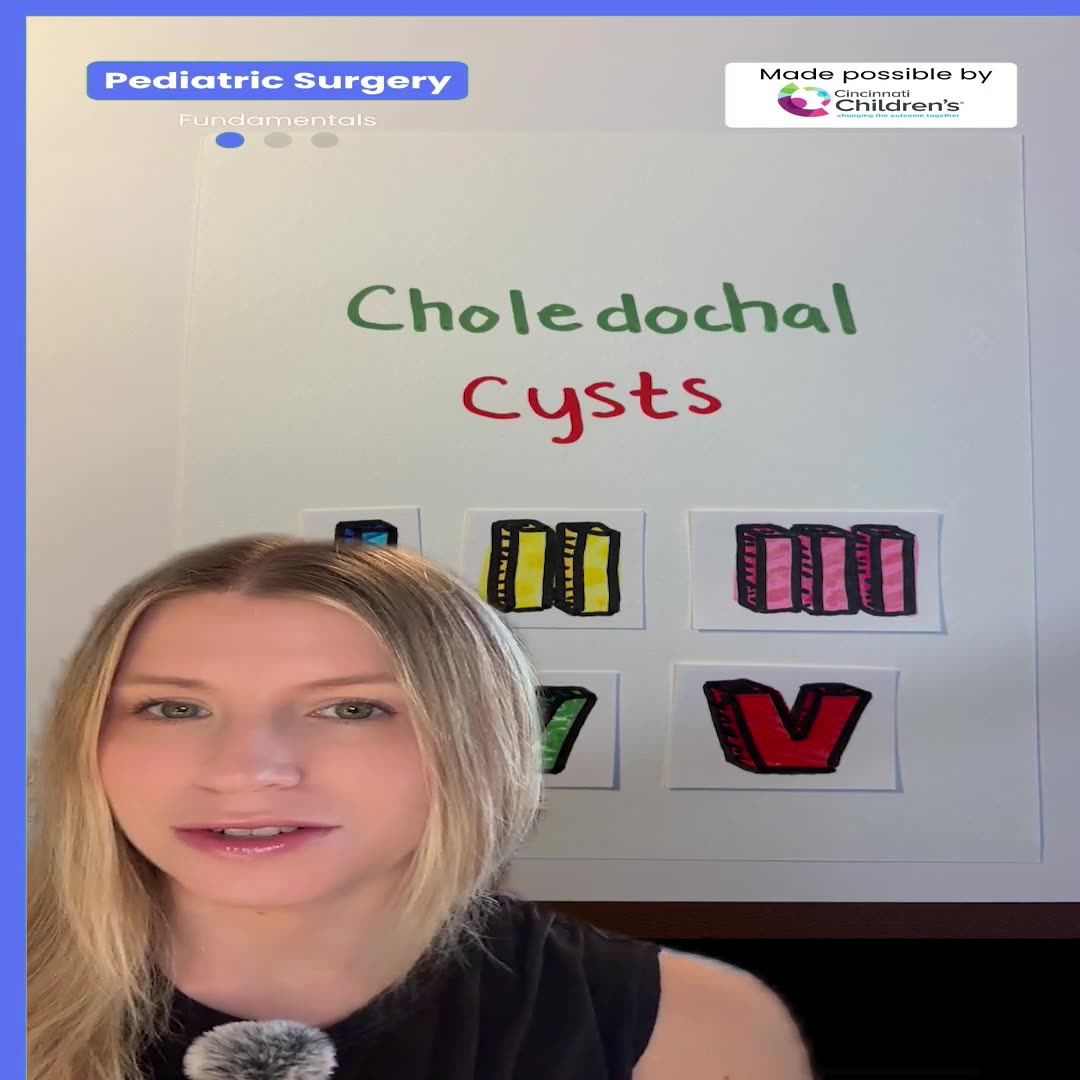
Choledochal Cyst Types Explained: Pediatric Surgery Fundamentals
1 min · Published Sep 2026
What the experts said
Infants with gastroschisis often require prolonged hospitalization for surgical repair and initiation and advancement of feeds.
Based on recently updated protocols from Cincinnati Children's Hospital and Children's Mercy Kansas City, feeds can be started immediately after sutureless abdominal closure for uncomplicated gastroschisis, beginning with 10-20 mL/kg/day and advancing by 20 mL/kg/day if tolerated.
Immediate feeding after gastroschisis closure has been shown to be associated with shorter length of stay and faster attainment of goal feeds.
For babies with uncomplicated gastroschisis tolerating feeds for a few days, it is okay to continue the feeding protocol even after one bout of emesis.
High resolution esophageal manometry, esophagography, and endoscopy can help determine the diagnosis of congenital esophageal stenosis.
Serial dilations may be used to manage congenital esophageal stenosis if there is no cartilage component suspected in the stenotic area.
Surgical resection for congenital esophageal stenosis can be reserved for patients where serial dilation is unsuccessful or there is concern for a cartilaginous component.
Initial conservative management should be considered for patients with congenital esophageal stenosis, especially if a cartilaginous component is not suspected.
Management of intussusception after enema reduction varies in practice, with historically recommended inpatient observation lacking evidence-based guidelines.
A systematic review and meta-analysis found that overall recurrence rates and recurrences within 24 and 48 hours were similar between inpatient and outpatient management groups after intussusception enema reduction.
There was no significant difference in the rate of return to the emergency department between inpatient and outpatient management after intussusception reduction, and both groups had similar rates of requiring operative intervention.
Outpatient management of intussusception after air enema reduction results in shorter hospital stay with no difference in rate of ED returns, recurrence, need for operation, or mortality.
There is no compelling evidence in pediatric or adult literature to support mechanical bowel preparation reducing surgical site infections in colorectal surgery.
Recent adult studies have shown no benefit from mechanical bowel preparation in reducing surgical site infections, with some studies showing an increase in wound infections.
Adult studies suggest a possible benefit of oral and IV antibiotics to reduce surgical site infections in colorectal surgery.
Recent retrospective studies have not shown the importance of oral antibiotics for pediatric colorectal operations.
Case-appropriate preoperative IV antibiotics may reduce surgical site infection incidence in colorectal surgery.
Firearms are now the leading cause of death in all children and adolescents in the United States, overtaking motor vehicle crashes in 2019.
There are controversies about whether pediatric surgeons should be involved in firearm violence prevention efforts and advocacy across the country.
As pediatric surgeons, we need to advocate for protecting children's health and well-being, no matter what the topic is.
Pediatric surgeons can play key roles for patients affected by firearms, including direct patient care and advocacy.
Unwitnessed foreign body aspiration can be challenging to manage, and many items are not radiopaque so cannot be seen on plain x-ray.
The gold standard for airway evaluation has been rigid or flexible bronchoscopy, but there are risks of negative bronchoscopy with subsequent airway compromise.
CT bronchoscopy has been proposed as an adjunct in cases of children without obvious respiratory distress.
Low-dose non-contrast CT of the chest has high sensitivity and specificity for identification of airway foreign bodies.
CT can avoid the cost and resources of taking a child to the operating room for a non-therapeutic bronchoscopy procedure.
The largest study looking at initial laparotomy versus peritoneal drainage for necrotizing enterocolitis was conducted at 20 US centers and examined combined death or neurodevelopmental impairment at corrected age 18-22 months.
Death or neurodevelopmental impairment occurred in 69% of patients with preoperative diagnosis of NEC who underwent initial laparotomy versus 85% of those who underwent initial peritoneal drainage.
The prospective randomized cohort study from the National Institute of Child Health and Human Development showed no difference in overall survival but did show improved long-term neurodevelopmental outcomes with initial laparotomy for NEC.
For infants with necrotizing enterocolitis, initial laparotomy may be associated with less neurodevelopmental impairment and improved outcomes for extremely low birth weight babies.
Racism and sexism that manifest as microaggressions are commonly experienced by members of minority groups.
Individuals from minoritized groups are often left weighing the potential benefits and risks of addressing microaggression comments.
Placing the burden to interrupt bias on marginalized colleagues is unjust, and microaggressions can harm trainees' performance and sense of belonging.
Bystanders can and should make an effort to become upstanders, which means bystanders who respond with action to interrupt microaggressions.
Blunt head trauma represents the majority of pediatric trauma admissions, but there is very little evidence on how to best manage isolated skull fractures.
A 10-year retrospective review of isolated traumatic skull fractures with normal neurologic exam findings showed that 77% of patients were admitted for observation, but none needed neurosurgical intervention or additional imaging during the index admission.
Pediatric isolated skull fractures are low risk conditions with a low likelihood of complications, and these patients can be discharged safely from the emergency department without inpatient observation.
The IMPACT trial was a multi-institutional prospective randomized trial comparing piperacillin-tazobactam monotherapy versus ceftriaxone-metronidazole combination therapy for perforated appendicitis in children, with 30-day post-operative intra-abdominal abscess rate as the primary outcome.
Patients taking piperacillin-tazobactam had lower incidence of intra-abdominal abscesses, lower usage of CT scans, and fewer ED revisits compared to combination therapy.
Piperacillin-tazobactam monotherapy did not have an increase in antibiotic usage or increase in antibiotic-related complications compared to combination therapy.
Monotherapy with piperacillin-tazobactam has been shown to be associated with decreased incidence of intra-abdominal abscesses after surgery for patients with perforated appendicitis.