


From
StayCurrentMD
Hirschsprung Disease Workup
With Dr. Nelson Rosen & Dr. Patty Curran · hosted by Dr. Rod Gerardo
Chapter 2 of 6 · Fundamentals
Pathophysiology
Pathophysiology and Anatomic Distribution of Hirschsprung Disease
Cued at 1:05 · press play
Expert statements on this page
No expert statements were drawn from this page.
Host summaries · secondary, not cited in answers
Educational content from recorded physician discussions — not medical advice. Talk to your (or your child's) care team about your situation.
Podcast
The Colorectal Quiz Episode 8: Motility Disorders Part 1
14 min · Published Mar 2021
Video
Hirschsprung Disease: Update Course 2015
CCHMC Pediatric Surgery · 7 min · Published Nov 2015
Video
Hirschsprung Disease in Brief
Dr. Todd Ponsky · 10 min · Published Oct 2021
Podcast
Update Course Rewind: 2020 Colorectal Part 1
12 min · Published Mar 2021
Video
Hirschsprung Disease Rapid Fire: Update Course 2015
CCHMC Pediatric Surgery · 12 min · Published Nov 2015
Video
The use of postoperative calibrations in Hirschsprung disease
59 s · Published Nov 2024
Video
Validation of an anorectal malformation trainer - Can a high-fidelity model simulate real life?
1 min · Published Jun 2026
Video
Complications and Long-Term Outcomes of Patients With Cloacal Malformation After Bowel Neovagina...
1 min · Published Jun 2026
Video
Safety and utility of long-acting steroid injection for management of post-operative stricture...
1 min · Published Jun 2026
Video
Association Between Social Determinants of Health and Choice of Urinary Reconstruction in Children
1 min · Published Jun 2026
Video
The Perineal Body Preserving PSARP (PPP)
11 min · Published Jun 2026
Video
Update Course Rewind 2025: Hirschsprung + ARM: Rare but Real
1 min · Published May 2026
Video
Update Course Rewind 2025: Timing of PSARP: Early vs. Delayed—Does It Really Matter?
3 min · Published Apr 2026
Video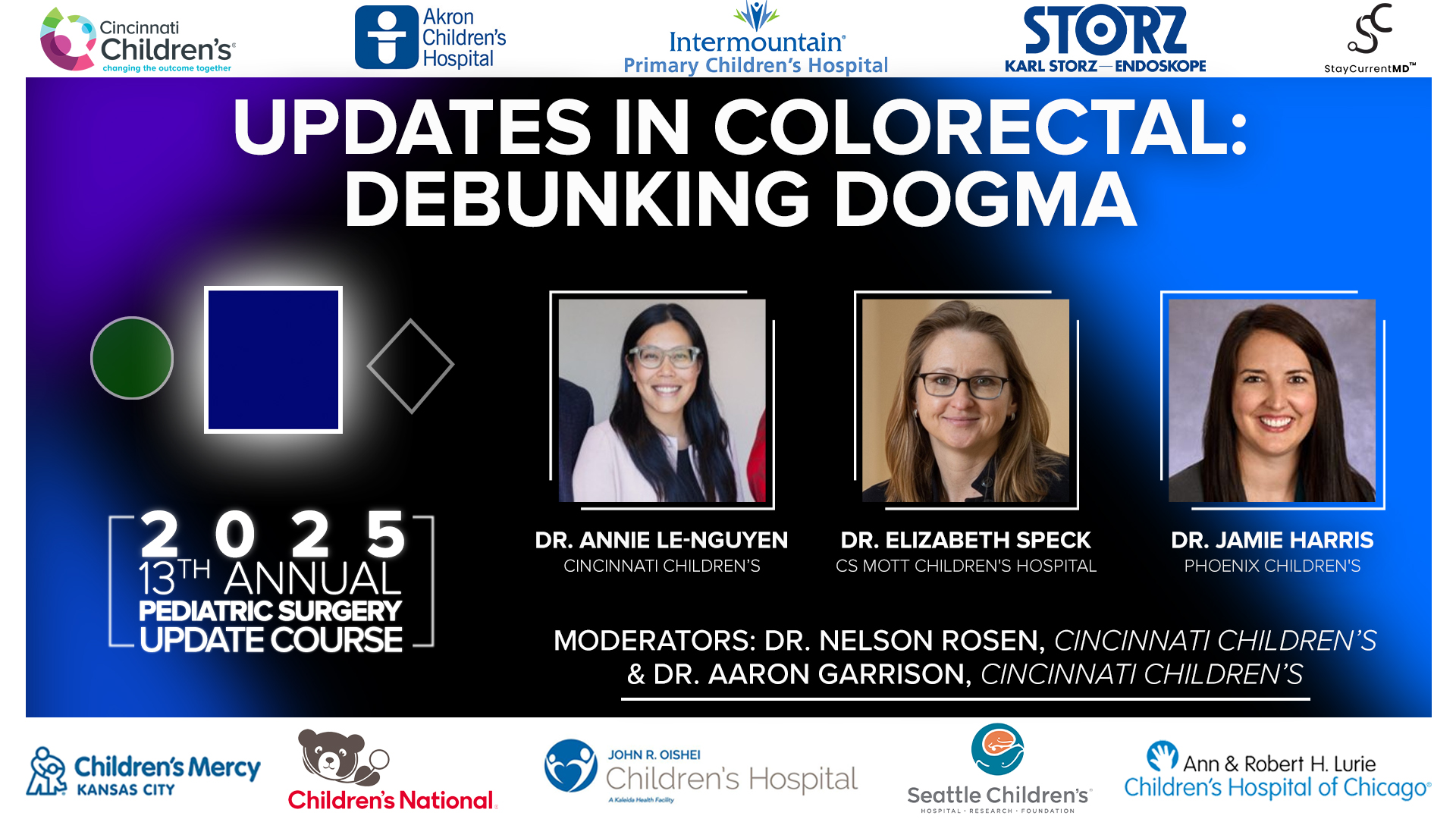
2025 Pediatric Surgery Update Course - Updates in Colorectal: Debunking Dogma
30 min · Published Aug 2025
Video
Update Course Rewind: Surgical Management of Pilonidal Disease 2024
Published Apr 2025
Video
Update Course Rewind: Patient Education and Non-Surgical Management of Pilonidal Disease 2024
Published Jan 2025
Video
Best of the Best Gen Surg - Development of postoperative local tumors and distant metastases in diet, genetics and microbiome-dependent in a mouse model of colorectal cancer recurrence - Dr. Morgan
12 min · Published Sep 2022
Video
Pediatric Surgery Updates for the PCP - Full Show
CCHMC Pediatric Surgery · 58 min · Published Nov 2020
Video
Intestinal Atresia Types Explained: Grossfeld Classification for Pediatric Surgery
1 min · Published Sep 2026
Video
Derivation and validation of the Pediatric Community-Acquired Pneumonia Severity (PedCAPS) score: A prospective cohort study
50 s · Published Sep 2026
Video
FETO for Late-Diagnosed Severe Congenital Diaphragmatic Hernia (CDH) at Cincinnati Children's with Dr. Beth Rymeski
4 min · Published Sep 2026
Video
Severe Congenital Diaphragmatic Hernia (CDH) Case: FETO Management & Unexpected Findings with Dr. Beth Rymeski
3 min · Published Sep 2026
Video
Fetoscopic Endoluminal Tracheal Occlusion (FETO) Procedure: Step-by-Step Guide with Dr. Beth Rymeski
4 min · Published Sep 2026
Video
Choledochal Cyst Types Explained: Pediatric Surgery Fundamentals
1 min · Published Sep 2026
What the experts said
Hirschsprung disease is a congenital condition affecting the lower most aspect of the intestine (rectum or sigmoid), characterized by missing ganglion cells in the submucosal and myenteric plexus that allow the intestine to relax.
In Hirschsprung disease, the rectum and lowest part of the colon are always affected, with the aganglionosis always ending right above the anus.
About 85% of Hirschsprung cases begin in the very end part of the sigmoid colon or the beginning of the rectum.
In about 10% of Hirschsprung cases, the entire colon is affected.
90 to 95% of Hirschsprung cases are recognized in the newborn period.
The first sign of Hirschsprung disease in newborns is usually failure to pass stool (meconium) within the first 24 to 48 hours.
After failure to pass meconium, newborns with Hirschsprung disease develop bloating, continued failure to pass stool, and vomiting.
In newborns with suspected Hirschsprung disease, the initial workup includes a water-soluble contrast enema looking for a narrower distal segment (rectum) with dilation above.
If contrast enema raises concern for Hirschsprung disease, a suction rectal biopsy is performed to examine tissue for the presence of ganglion cells.
In older children, Hirschsprung disease can be missed and typically presents with failure to thrive (small for age) and significant constipation.
Children with Hirschsprung disease very rarely thrive and develop normally.
In older children with suspected Hirschsprung disease, the diagnostic pathway includes plain films to assess degree of constipation, followed by contrast rectal enema, and then biopsy depending on findings.
In older children with low-risk presentations (normal early years, then worsening constipation), biopsy should usually be done only after routine constipation management measures are tried and fail.
Anorectal manometry uses a balloon catheter to measure pressures in the anus and rectum, specifically looking for the rectoanal inhibitory reflex.
The normal rectoanal inhibitory reflex causes the anal sphincter to relax when a balloon is inflated in the rectum, but this reflex is absent in Hirschsprung disease.
Anorectal manometry is not sufficiently sensitive to rule out Hirschsprung disease; a normal manometry does not completely exclude the diagnosis.
Suction rectal biopsy can be performed at the bedside in newborns and is reliable up to one year of age.
After one year of age, biopsy should be performed in the operating room under anesthesia to obtain tissue from higher in the rectum.
Even with suggestive manometry findings, a biopsy is still required before surgical intervention; no surgeon would operate on manometry alone.
Normal individuals without Hirschsprung disease have no ganglion cells in the very first (distal-most) part of the rectum.
In children over one year old, the suction biopsy tool cannot obtain adequate tissue depth because the tissue is thicker, necessitating surgical biopsy in the OR.
Surgical rectal biopsy in older children is a simple 20-minute procedure with same-day discharge.