


INTESTINAL REFEEDING IN NEWBORNS: WHY NOT? | TORONTO, CANADA | META-ANALYSIS | 23 | 1996 - 2022 | NEWBORNS WITH STOMA + MUCOUS FISTULA | INTESTINAL ATRESIA, NEC, MECONIUM ILEUS...ETC | 16 RETROSPECTIVE STUDIES | 10 COMPARATIVE | n= 623 | MUCOUS FISTULA REFEEDING | VS NO REFEEDING | TPN | PARENTERAL NUTRITION ↓-37 DAYS | CHOLESTASIS ↓ RR 0.46 | SEPSIS (=) | Solís-García G et. al., Mar 2023.DOI: 10.1136/archdischild-2022-324995 | Archives of Disease in Childhood | SCHCP CIRUGÍA PEDIÁTRICA | Authors: José Manuel Campos Varak @jmcampos_design
From
StayCurrentMD
Mucous fistula refeeding in neonates: a systematic review and meta-analysis
Infographic · Jul 2023 · 1 min read
In brief
In brief
Systematic review of 16 studies (n=623) shows mucous fistula refeeding reduces parenteral nutrition duration by 37 days in neonates with ostomies, while also decreasing cholestasis rates and hospital stay. This technique maintains intestinal physiology by reintroducing proximal effluent into the distal limb after abdominal surgery.
- Mucous fistula refeeding reduces parenteral nutrition duration by ~37 days in neonates with ostomies after abdominal surgery.
- MFR maintains intestinal physiology by reintroducing proximal ostomy effluent into the distal mucous fistula.
- Neonates receiving MFR show lower cholestasis rates, faster time to full enteral feeds, and shorter hospital stays.
- Current evidence is low certainty (observational studies only); randomized trials needed to confirm benefits.
- MFR is a practical strategy to optimize bowel function and reduce TPN dependence in neonates with temporary ostomies.
Written by the GCMD Library team from the infographic.
Three-panel infographic with red header and white background. Left panel shows newborn icon with anatomical markers and study metadata. Center panel displays anatomical illustration of intestinal mucous fistula with blue arrow indicating refeeding direction. Right panel presents clinical outcomes using icons for TPN bag, baby figure with cholestasis indicator, and sepsis symbol with relative risk values.
New infographic by Dr. Jose Campos and the Chilean society of pediatric surgery
"Mucous fistula refeeding in neonates: a systematic review and meta-analysis"
Authors: Gonzalo Solís-García, Bonny Jasani
Full article: https://pubmed.ncbi.nlm.nih.gov/36858828/
Background and objective: Mucous fistula refeeding (MFR) aims to maximise bowel function when an ostomy is active after abdominal surgery, by introducing the proximal ostomy effluent into the distal mucous fistula to maintain intestinal physiology. The aim of the study was to assess the effectiveness and complications of MFR in neonates following abdominal surgery.
Design, setting and interventions: Systematic review and meta-analysis of randomised controlled trials and observational studies. PubMed, Embase, Cochrane and CINAHL were searched until June 2022 for studies including neonates with ostomy receiving MFR compared with neonates with ostomy without MFR.
Outcomes: The primary outcome was duration of parenteral nutrition. Secondary outcomes were time to full enteral feeds, rates of cholestasis, peak total serum bilirubin, sepsis, time to reanastomosis and length of hospital stay.
Results: A total of 16 observational studies were included (n=623). Compared with comparator group, neonates who received MFR had fewer days of parenteral nutrition (mean difference 37.17 days, 95% CI -63.91 to -10.4, n=244, 5 studies, GRADE: low). In addition, neonates who received MFR had lower rates of cholestasis, shorter time to reach full feeds and shorter hospital stay.
Conclusion: Low certainty of evidence suggests that MFR is associated with shorter duration of parenteral nutrition in neonates following abdominal surgery and stoma creation. Results of ongoing and future randomised trials may help to corroborate these findings.
The text in the image
Educational content from recorded physician discussions — not medical advice. Talk to your (or your child's) care team about your situation.
Article
Type of pledget and suture technique relative to esophageal tensile strength in long-gap esophageal atresia
Published May 2026
Video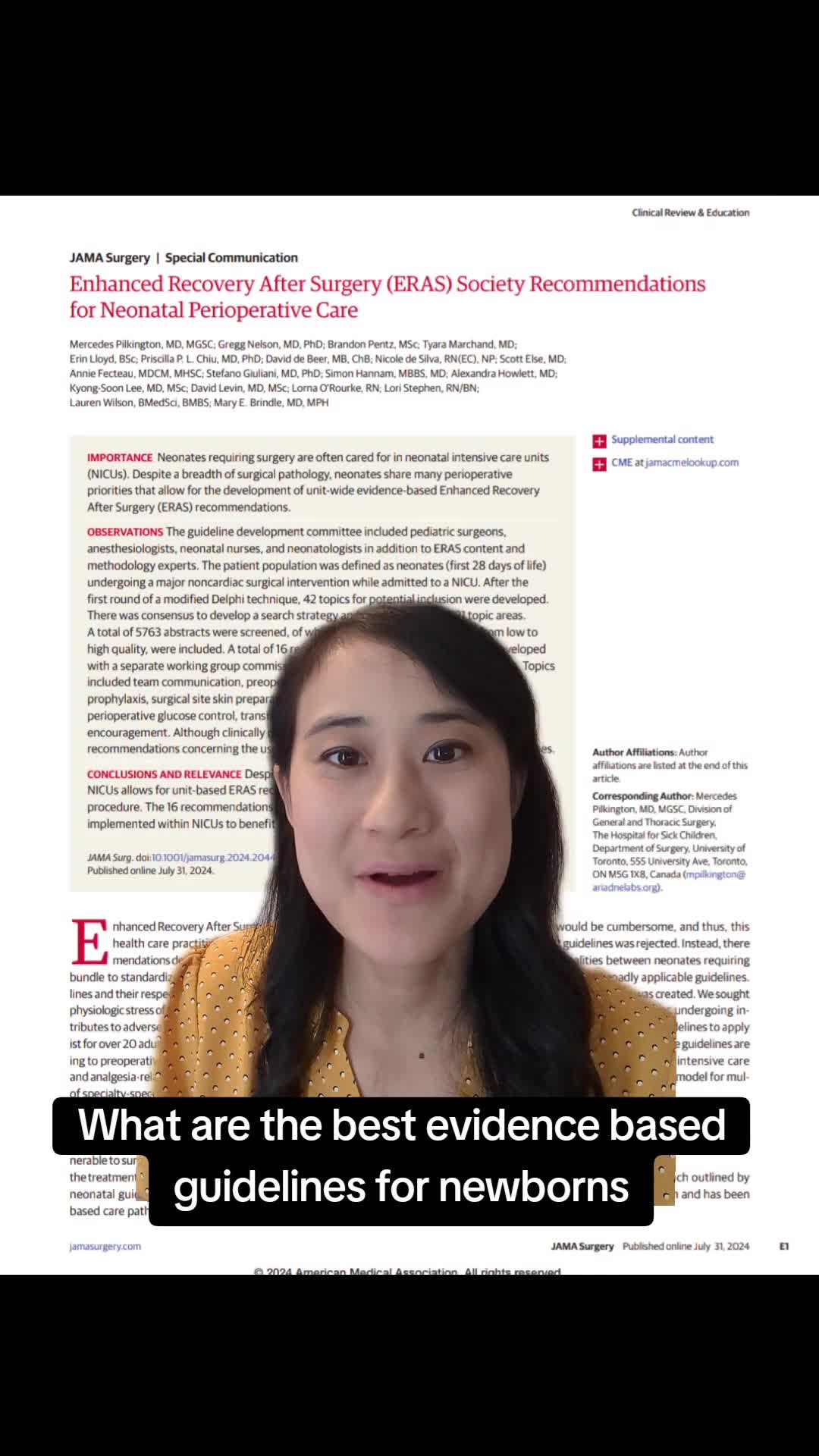
Enhanced Recovery After Surgery (ERAS) Society Recommendations for Neonatal Perioperative Care
59 s · Published Oct 2024
Video
Reducing Unplanned Intubations in the Neonatal Intensive Care Unit After Children's Surgery
53 s · Published Jun 2024
Video
Neonatal Gastric Necrosis: Pediatric Surgery Difficult Cases-Innovative...
15 min · Published Jul 2017
Podcast
Congenital Diaphragmatic Hernia with Dr. Charlie Stolar
82 min · Published Jan 2017
Video
Intestinal Atresia Types Explained: Grossfeld Classification for Pediatric Surgery
1 min · Published Sep 2026
Video
Derivation and validation of the Pediatric Community-Acquired Pneumonia Severity (PedCAPS) score: A prospective cohort study
50 s · Published Sep 2026
Video
FETO for Late-Diagnosed Severe Congenital Diaphragmatic Hernia (CDH) at Cincinnati Children's with Dr. Beth Rymeski
4 min · Published Sep 2026
Video
Severe Congenital Diaphragmatic Hernia (CDH) Case: FETO Management & Unexpected Findings with Dr. Beth Rymeski
3 min · Published Sep 2026
Video
Fetoscopic Endoluminal Tracheal Occlusion (FETO) Procedure: Step-by-Step Guide with Dr. Beth Rymeski
4 min · Published Sep 2026
Video
Choledochal Cyst Types Explained: Pediatric Surgery Fundamentals
1 min · Published Sep 2026